Israeli air raids damage alleged Syrian chemical weapons site

Arms control monitors have singled out the Masyaf site for suspected chemical weapons research

An Israeli air force jet drops decoy flares. AFP

Israeli air strikes heavily damaged Syria’s main weapons research establishment, according to a human rights monitor and analysts who verify incident reports using satellite imagery.

The US government has sanctioned employees of the site at Masyaf for working on the Syrian government’s chemical weapons programme. Syria is believed to have disposed of most of its chemical weapons arsenal following international pressure in 2014, but analysts say some capability may have been retained covertly.

In March, international watchdog the Organisation for the Prohibition of Chemical Weapons said Syria had used prohibited chemicals in newly investigated attacks — which happened in 2016 — after telling inspectors that it had disposed of its arsenal in 2014.

Further attacks, such as the Khan Sheikhoun attack in 2017, which triggered Nato intervention to bomb suspected chemical sites, had already been investigated by the watchdog.

The site at Masyaf, also known as the Syrian Scientific Studies and Research Centre, has been heavily bombed in the past, with Israeli air raids frequently hitting buildings and bunkers there since 2017, according to the US Institute for Science and International Security, a think tank.

The Israeli government has previously accused Syria of developing chemical weapons at the sprawling complex.

The OPCW has also singled out Masyaf for monitoring during the international effort to rid Syria of chemical weapons, between 2013 and 2014.

The US government sanctioned more than 200 employees of the SSRC in 2017 for their alleged “support of Syria’s chemical weapons programme.”

Syrian state media reported after the Thursday night attack between the cities of Tartus and Hama that two people were wounded and fires were sparked in nearby forests. It said that the missiles were fired from over the Mediterranean and most of them were shot down.

Images taken by Planet Labs PBC and provided by Aurora Intel on Sunday, a network that provides news and updates based on open-source reporting, showed that some buildings and areas sustained heavy damage from the reported air strikes.

It added that areas around the centre sustained “heavy fire damage due to the secondary explosions”, which was consistent with local reporting.

The imagery showed that part of the green areas surrounding the facility had been burnt.

Rami Abdulrahman, who leads the Britain-based opposition war monitor the Syrian Observatory for Human Rights, said the Israelis struck several positions but the main target was a large arms depot housing about 1,000 precision-guided middle-range missiles. He said the explosions at the site lasted for more than five hours after the stri


As Lapid and Netanyahu trade barbs over Iran approach, Haaretz cites draft proposal that would see a uranium enrichment freeze, sanctions relief and a prisoner release deal

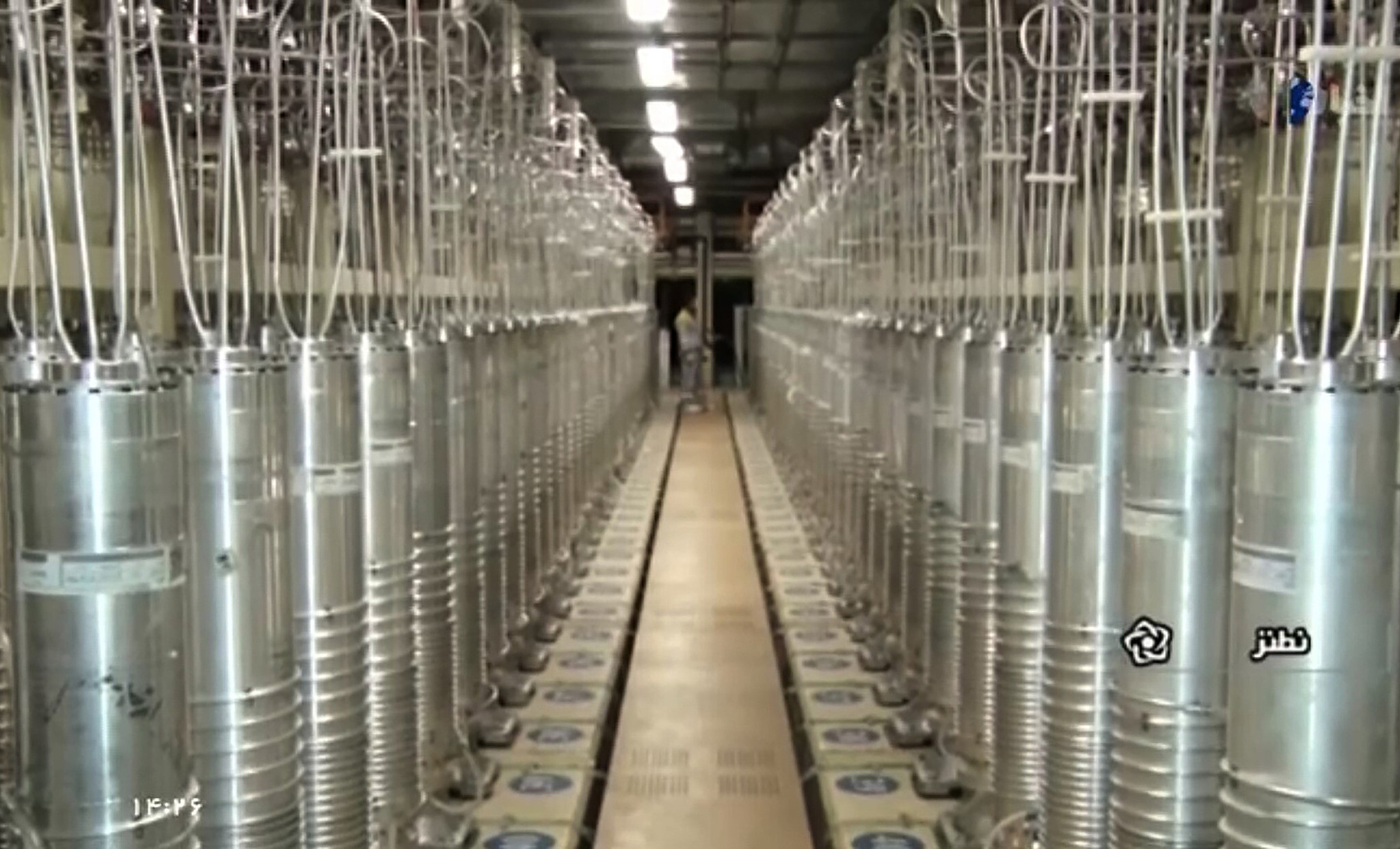
Various centrifuge machines line a hall at the Natanz Uranium Enrichment Facility, on April 17, 2021. (Screenshot/Islamic Republic Iran Broadcasting-IRIB, via AP)

Various centrifuge machines line a hall at the Natanz Uranium Enrichment Facility, on April 17, 2021. (Screenshot/Islamic Republic Iran Broadcasting-IRIB, via AP)

A draft proposal from the final stages of negotiations to revive the 2015 Iran nuclear deal envisions the Iranians halting all uranium enrichment, but holding on to the material they already have, and a final US return to the pact less than six months after it is signed, Haaretz reported on Sunday.

The newspaper published what it said was a draft of the proposal submitted by the European Union to the Iranians last month as a final offer. Iran responded with its own comments and the US later provided its own input after reviewing the Iranian response. The EU has coordinated talks in Vienna on reviving the nuclear deal, known formally as the Joint Comprehensive Plan of Action, which has unraveled since the US pulled out in 2018.

According to the unsourced report, the EU draft proposed last month included four incremental steps in the halting of Iran’s nuclear activity and in the lifting of Western sanctions on the Islamic Republic, with the fourth and final step taking effect 165 days after the deal is signed.

The purpose of the gradual steps is to consolidate trust between the parties, according to the report.

Before any deal is signed, the sides will reportedly finalize a deal that will see Western prisoners freed by Tehran in exchange for Iranian assets being unfrozen by Western nations and initial sanctions relief.

The first step, taking effect on the day of the signing, would see Iran freeze its uranium enrichment, although it will be allowed to hold on to the enriched uranium it will have stockpiled before that date.

The sun sets behind the Palais Coburg where closed-door nuclear talks take place in Vienna, Austria, August 5, 2022. (AP Photo/Florian Schroetter)

The report said the second step would take 30 days and will see the administration of US President Joe Biden bring the deal to Congress for approval. The third step, 60 days after congressional approval, would see Washington notify the UN Security Council and the International Atomic Energy Agency (IAEA) about its decision to rejoin the pact.

The fourth and final step — after an additional 60 days — would see the US formally return to the deal, with the sides removing more sanctions and halting their violations of the JCPOA, according to the report.

An official with knowledge of the negotiations told Reuters last week that under the emerging deal, Iran would not be allowed to possess uranium at 20% and 60% enrichment levels and it would be forced to switch off its advanced centrifuges, preventing it from amassing the material required to build a bomb.

A day before it gave its remarks to the EU, Washington said that Iran had agreed to ease key demands that had held up an agreement.

According to an anonymous US official, Iran’s draft does not include Tehran’s long-held demand that the US lift the terrorism designation of Iran’s Islamic Revolutionary Guard Corps and that the International Atomic Energy Agency close its investigation into unexplained traces of uranium at three undeclared sites.

Israel has piled pressure on Western countries to halt talks on reviving the agreement, warning against the consequences of returning to the accord. Mossad chief David Barnea will travel to Washington next week as part of the efforts to shape the deal.

A senior Israeli official told reporters Sunday that Israel wants “a minimum amount” of funds to be released to Iran through lifted sanctions, but did not specify if there’s a figure Israel could accept. Lapid last week claimed that the deal would enable $100 billion a year to flow into Iran’s coffers, money that he said could be directed to its terror financing.

The push toward finally signing a deal in Vienna also ignited a harsh exchange on Sunday between Prime Minister Yair Lapid and opposition leader Benjamin Netanyahu.

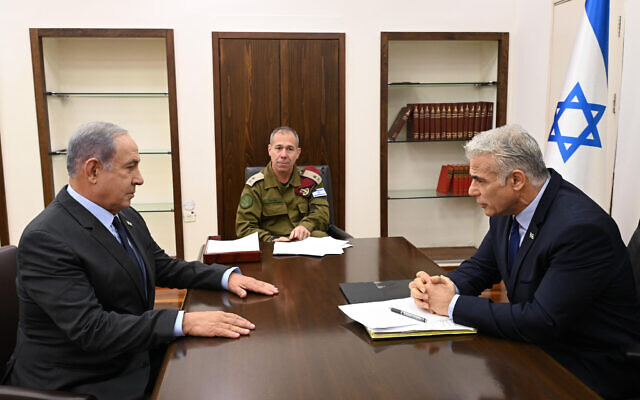
Opposition leader Benjamin Netanyahu (left) has a briefing on the Israel-Gaza conflict with Prime Minister Yair Lapid, August 7, 2022. (Haim Zach/GPO)

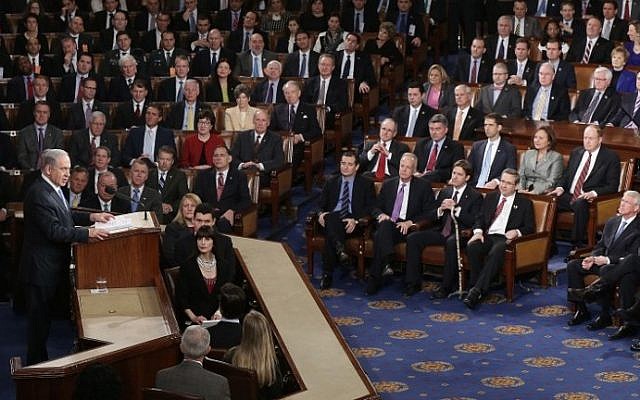
Under Netanyahu, Israel fought the original 2015 agreement in the court of public opinion and in a particularly contentious direct address by Netanyahu to the US Congress, coordinated without White House involvement.

Lapid told reporters on Sunday that “we must not get to the situation we were in 2015. To this day, we are paying for the damage caused by Netanyahu’s speech in Congress, following which the US administration ended its dialogue with us and did not allow Israel to make amendments to the agreement.”

Netanyahu hit back in a statement proclaiming that “in the past year, Lapid and [Defense Minister Benny] Gantz completely abandoned the public struggle against the Iran nuclear deal.”

“For 12 years, we fought this deal with determination and even caused the US to withdraw from it. But in their only year in power, Lapid and Gantz let their guard down and enabled the US and Iran to reach a nuclear deal that endangers our future,” Netanyahu said.

He accused Lapid of failing to publicly challenge these efforts in Congress, in the UN or in foreign media, and of only “waking up” too late, after major progress was made in the talks.

In response, Lapid stated that “the damage [Netanyahu] caused during his tenure to the two issues most important to Israel — the struggle against Iran’s nuclear program and the relations with the United States — is severe and deep and we are still fixing it.”

Lapid said he has summoned Netanyahu for a security briefing on Monday, “so that he will at least have some idea what he’s talking about.” The pair are slated to meet in the afternoon at the Prime Minister’s Office.

For most of his tenure as opposition chief, Netanyahu has refused to personally take part in the periodical briefings.

Then-prime minister Benjamin Netanyahu speaks about Iran during a joint meeting of the United States Congress in the House chamber at the US Capitol on March 3, 2015 in Washington, DC. (Win McNamee/Getty Images/AFP)

The National Unity party, an alliance of parties opposed to Netanyahu led by Gantz, also weighed in, tweeting that “history will judge Netanyahu who pushed for a [US] exit from the deal without creating an alternative.”

The party noted that Gantz met last week for the sixth time in the past year with the US national security adviser in order to deal with “Netanyahu’s legacy.”

Lapid and former prime minister Naftali Bennett — who is currently abroad on vacation – moved the debate into private channels, attempting to avoid the relationship fallout that occurred between Israel and the Obama administration.

The 2015 agreement between Iran and six world powers — Britain, China, France, Germany, Russia, and the US — gave the Islamic Republic sanctions relief in exchange for curbs on its nuclear program.

The JCPOA was designed to prevent Iran from developing a nuclear weapon — something the country has denied it is pursuing.

After the US withdrew and imposed sanctions on Iran the latter dropped many of its own commitments, ramping up its program and enriching uranium to levels and stockpiles that exceed the JCPOA limits and raising concerns that it is approaching the threshold of producing a nuclear weapon.


Senior official says Washington meeting with Jake Sullivan ‘positive’ despite defense minister raising Israeli objections to emerging nuclear deal


Defense Minister Benny Gantz meets with US national security adviser Jake Sullivan in Washington DC, August 26, 2022. (Yossi Mai/Defense Ministry)

Defense Minister Benny Gantz meets with US national security adviser Jake Sullivan in Washington DC, August 26, 2022. (Yossi Mai/Defense Ministry)

Defense Minister Benny Gantz told US President Joe Biden’s national security adviser Friday that Israel “needs” the US to have a credible military option against Iran, a senior Israeli official said to reporters Friday, amid reports of an emerging renewed nuclear deal between the Islamic Republic and world powers.

According to the defense official, Israel received “good hints” with regard to the US having a working offensive plan against Iran. He did not elaborate, but said it that would potentially ensure Tehran is more flexible during negotiations for the renewed accord. If not, the US would be ready to act against Iran alongside Israel, which has also been preparing a military option.

The official said the meeting between Gantz and Jake Sullivan in Washington was “intimate” and “positive.” He said Gantz emphasized Israel’s objection to the potential deal, which has been branded by Israel as “very bad.”

The official warned that Iran’s nuclear program has expanded significantly since 2018 when then-US president Donald Trump pulled out of the so-called Joint Comprehensive Plan of Action. The official said he personally viewed Trump’s move as a mistake.

The official said the situation had reached a point where there are only two scenarios: No agreement, allowing Iran to gradually expand its nuclear program further, or a bad deal that does not serve Israel’s interests.

The official added that Israel has attempted to influence the deal in certain aspects as much as possible, but “as of now, it is far from serving Israel’s interests as it sees it.” Israel seeks to make the deal “longer and stronger,” the official said.

Still, the official said Gantz’s objections were positively received by Sullivan. “I think that we are being listened to even if the Americans, in the end, don’t accept everything we want,” the official said.

The official said that Israel would still have its freedom to act against Iran, adding that whether an agreement is signed or not, Jerusalem would still continue its efforts against what it sees as hostile Iranian actions.

A readout issued by the US National Security Council spokesperson said “Sullivan emphasized President Biden’s unwavering commitment to Israel’s security, and the two exchanged views on ways to deepen the US-Israel security partnership, including via regional cooperation and coordination.”

“They discussed US commitment to ensure Iran never obtains a nuclear weapon, and the need to counter threats from Iran and Iran-based proxies. They also discussed the need to ensure equal measures of security, freedom, and prosperity for Palestinians and Israelis alike, and the importance of ongoing follow-through on initiatives announced during President Biden’s trip to Israel,” the statement said.

Defense Minister Benny Gantz, left, meets with US CENTCOM commander Gen. Michael Kurilla at the US Central Command Headquarters on August 25, 2022. (Courtesy CENTCOM)

On Thursday, Gantz met with US Central Command chief General Michael Kurilla, at CENTCOM’s headquarters in Florida. Gantz was briefed on the US’s plans for the days after a nuclear deal is agreed upon, or not. He was also given a tour of a fleet of refueling planes, used for long-range missions.

Gantz and Kurilla’s discussion focused on ways to increase cooperation between Israel and the US military, methods for countering the Iranian threat in the Middle East, and a “Plan B” to the nuclear deal.

Gantz warned Kurilla that if there is no deal, Iran would feel more “liberated” to act, and therefore Israel and the US would need to strengthen cooperation with regional allies in order to combat potential actions by Iran or its proxies.

Gantz also pressed Kurilla on the US’s capabilities to act in Iran, if Tehran pushes forward with developing a nuclear weapon. Last month, Biden told Israel’s Channel 12 news that he would use force against Iran as a “last resort” to prevent it from obtaining nuclear weapons.

CENTCOM officially assumed responsibility for the US military’s relationship with Israel in September last year. Until then, Israel had been kept in the area of responsibility of the European Command (EUCOM) in order to prevent possible tensions between CENTCOM and the Arab and Muslim nations under its purview, many of which did not maintain formal ties with Israel and would therefore not want to be considered as mutual allies.

In recent years, however, CENTCOM’s Arab allies have increasingly developed relations with Israel, some informally, so the issue has largely faded.

“Israeli influence in the region is growing stronger,” the senior defense official told reporters on Friday.

“The region’s players are no less disturbed than we are by the emerging agreement. We have communication channels, and in many ways, they put their trust in us that we will convince and influence,” he said.

The official said such dialogue was taking place “under the umbrella of CENTCOM.”

Defense Minister Benny Gantz talks to US Air Force personnel at the air refueling wing at MacDill Air Force Base in Tampa, Florida, August 25, 2022. (Defense Ministry)

Provided a new deal is signed, Israeli officials say they expect Iran to significantly ramp up funding for its proxies in the Middle East, including the Lebanese Hezbollah terror group on Israel’s northern frontier.

Gantz was visiting the US the same week as a trip there by Israeli national security adviser Eyal Hulata, both carrying a message of displeasure from Jerusalem at the acceleration in talks toward reviving the 2015 nuclear deal with Iran

Iran said Wednesday that it had received the US’s response to its proposal for a return to the 2015 accord.

White House National Security Council spokesman John Kirby declined to characterize the administration’s response to the latest proposal, but noted that “we are closer now than we were even just a couple of weeks ago because Iran made a decision to make some concessions.”

Prime Minister Yair Lapid told reporters on Thursday that Israel’s efforts to influence the outcome of negotiations had borne fruit, but that the accord was still “a bad deal” for Israel.

Mossad chief David Barnea called the emerging deal “a strategic disaster” for Israel, in recent meetings about the agreement. He said it would be “very bad for Israel” and the US “is rushing into an accord that is ultimately based on lies,” citing Iran’s ongoing claim that its nuclear activities are peaceful in nature.

Israel has long opposed the deal, arguing that Iran is seeking to build a nuclear bomb, and has published intelligence it says reveals the Iranian weapons program. Iran has denied any nefarious intentions and claims its program is designed for peaceful purposes, though it has recently been enriching uranium to levels that international leaders say have no civil use.