
Barnea warns pact allows Tehran to amass nuclear material for a bomb within a few years, says his agency ‘is preparing and knows how to remove that threat’

Prime Minsiter Yair Lapid meets with the head of the Mossad David Barnea at the Defense Ministry, Tel Aviv, August 25, 2022. (Prime Minister's Office)

Prime Minsiter Yair Lapid meets with the head of the Mossad David Barnea at the Defense Ministry, Tel Aviv, August 25, 2022. (Prime Minister’s Office)

Mossad chief David Barnea has called an emerging Iran nuclear deal between the Islamic Republic and world powers “a strategic disaster” for Israel in recent meetings about the agreement.

In comments carried by Hebrew-language media Thursday evening, the spy master said the deal is “very bad for Israel” and the US “is rushing into an accord that is ultimately based on lies,” citing Iran’s ongoing claim that its nuclear activities are peaceful in nature.

Barnea added that an accord appeared to be inevitable “in light of the needs of the US and Iran.” Washington is seeking to prevent Tehran from acquiring the capability to build a nuclear bomb, while the Islamic Republic is seeking relief from crippling financial and economic sanctions.

According to Barnea, the deal, due to its sunset clauses, “gives Iran license to amass the required nuclear material for a bomb” in a few years, and will also provide Tehran billions of dollars in currently frozen money, increasing the danger Iran poses throughout the region via its proxies.

He stressed that a deal will not obligate Israel, and that the Jewish state will act however it sees fit to neutralize the threat against it. Israel has already begun preparations for a military strike against Iran if such action is deemed necessary.

“The Mossad is preparing and knows how to remove that threat,” Barnea said.

Prime Minister Yair Lapid sat down for a discussion about the looming deal with Barnea earlier on Thursday.

Prime Minister Yair Lapid speaks during a faction meeting in Tel Aviv on August 25, 2022. (Avshalom Sassoni/Flash90)

On Wednesday, Iran announced that it had received the US’s response to its proposal for a return to the so-called Joint Comprehensive Plan of Action, which was ditched by then-US president Donald Trump in 2018.

White House National Security Council spokesman John Kirby declined to characterize the administration’s response to the latest proposal, but noted that “we are closer now than we were even just a couple of weeks ago because Iran made a decision to make some concessions.”

Lapid told reporters on Thursday that Israel’s efforts to influence the outcome of negotiations had borne fruit, but that the accord was still “a bad deal” for Israel.

The prime minister pointed both to the trip to Washington this week by national security adviser Eyal Hulata for “very intensive discussions” on the issue and to Defense Minister Benny Gantz’s visit to the US, which began on Thursday.

Gantz met with US Central Command chief General Michael Kurilla in Tampa, Florida, to discuss ways to increase cooperation between Israel and the US military, as well as methods for countering the Iranian threat in the Middle East.

Defense Minister Benny Gantz (L) arrives in Florida on his way to CENTCOM headquarters on August 25, 2022. (Courtesy: Israeli Defense Ministry)

Before departing for Washington, Gantz tweeted that the goal of his trip was “to send a clear message in regard to the negotiations between Iran and powers on the nuclear deal: A deal that does not knock Iran’s abilities back by years and does not restrain it for years ahead, is a deal that will harm global and regional security.”

While Gantz was in Washington, Iran conducted a second day of military exercises with combat drones. The drones successfully destroyed many of their intended targets during the drills, according to the semi-official Fars News Agency.

The Walla news site claimed that Israeli officials are slightly less worried about the possibility of the US granting major concessions to Tehran in the wake of Hulata’s visit to DC on Wednesday.

Citing a senior Israeli official, the report said that the US had “hardened their position” and refused to make concessions to Iran in response to pressure from Israel.

Channel 12 news reported Thursday that the emerging accord would not require the US to remove Iran’s Revolutionary Guard Corps from its list of foreign terror organizations, nor would it roll back Iran’s requirement to explain sites with suspected nuclear activity to the International Atomic Energy Agency.

Rafael Grossi, Director General of the International Atomic Energy Agency (IAEA), speaks at the start of the tenth annual review of the Nuclear Non-Proliferation Treaty at UN headquarters on August 1, 2022 in New York City. (Spencer Platt/Getty Images/AFP)

IAEA chief Rafael Grossi told the PBS network that the US “has not put pressure” on the nuclear watchdog to compromise on its demands of Iran regarding those sites and said that he believed investigators will eventually be allowed to conduct a probe.

“We will get there, I’m sure,” Grossi said.

Iran, on the other hand, repeated its call to the IAEA on Thursday to end its investigation into the unexplained traces of uranium at three undeclared sites.

“We are very serious about safeguard issues, and do not want to allow some of the IAEA’s baseless accusations to remain,” Iranian Foreign Minister Hossein Amir-Abdollahian said, according to state news agency IRNA.

The issue has poisoned relations between the IAEA and the Islamic Republic, which considers the matter “political in nature, and which should not be used as a pretext to punish Iran,” an Iranian diplomat said, according to IRNA.

Negotiations for a return to the nuclear deal have intensified in recent weeks, after months of stalling following Iranian demands that were rejected by Washington.

The European Union-coordinated talks began in April 2021, came to a standstill in March, and picked up again in August. The Biden administration has repeatedly said it believes diplomacy is the best way to resolve the crisis.

In a briefing to foreign reporters on Wednesday, Lapid urged the US and the European Union to back away from the emerging deal, claiming it did not meet US President Joe Biden’s own red lines as it would not prevent Iran from becoming a nuclear-armed state.

Iran’s chief nuclear negotiator Ali Bagheri Kani (L) leaves after talks at the Coburg Palais, the venue of the Joint Comprehensive Plan of Action (JCPOA) in Vienna on August 4, 2022. (Alex Halada/AFP)

“In our eyes, it does not meet the standards set by President Biden himself: preventing Iran from becoming a nuclear state,” Lapid said, while also attempting to downplay any rift between Jerusalem and Washington or Europe.

Lapid panned the EU’s negotiating position, claiming that it had reneged on its declaration of “take it or leave it” when it presented a supposed final draft of the deal, allowing the Iranians to submit counterdemands and changes.

Opposition Leader Benjamin Netanyahu, who led a fierce campaign against the 2015 accord, also voiced staunch opposition to the deal on Wednesday, saying that the emerging new agreement is even worse than before.

“The terrible deal with Iran… casts a heavy shadow on our security and our future,” Netanyahu told reporters in Tel Aviv.

Israel has long opposed the deal, arguing that Iran is seeking to build a nuclear bomb, and has published intelligence it says reveals the Iranian weapons program. Iran has denied any nefarious intentions and claims its program is designed for peaceful purposes, though it has recently been enriching uranium to levels that international leaders say have no civil use.


Terror group claims truce included Egyptian promise to work toward release of its West Bank chief and hunger-striking prisoner

Palestinian Islamic Jihad leader Ziad Nakhaleh speaks in a televised address, August 25, 2022. (Screengrab/Twitter)

Palestinian Islamic Jihad leader Ziad Nakhaleh speaks in a televised address, August 25, 2022. (Screengrab/Twitter)

The leader of the Palestinian Islamic Jihad terror group in Gaza accused Israel on Thursday of reneging on its commitments under a truce that ended a flare-up earlier this month.

The televised remarks of Ziad Nakhaleh came as PIJ held simultaneous rallies in the Gaza Strip, Damascus, and Beirut, weeks after three days of violence that ended in the Egyptian-brokered truce.

“The enemy is still evading the commitments it made to our brothers in Egypt,” Nakhaleh said.

“The enemy government must bear full responsibility for that,” he said, referring to the Jewish state.

His comments came after military prosecutors earlier Thursday filed an indictment against Bassem Saadi, Islamic Jihad’s West Bank leader, whose arrest on August 1 sparked the round of fighting.

A military court further extended Saadi’s remand on Thursday, ordering him held until Sunday, when a hearing will be held to have him remain under arrest until the end of legal proceedings. There was no immediate date scheduled for his trial.

Bassem Saadi, head of the Palestinian Islamic Jihad terror group in the West Bank, appears for a hearing at Ofer prison, outside of Jerusalem, on August 25, 2022. (Yonatan Sindel/Flash90)

In response to Saadi’s initial arrest, the PIJ announced it was declaring a state of alert. The Israel Defense Forces, saying it had concrete indications of an imminent attack on the Gaza border, put the area on lockdown for four days amid concerns that PIJ would try to fire anti-tank missiles at Israeli targets along the border.

Eventually, the IDF launched a series of airstrikes in Gaza against a senior PIJ commander and several anti-tank guided missile squads in an operation called Breaking Dawn, which prompted rocket fire from the Strip.

After nearly three days of fighting, a ceasefire agreement was signed, which reportedly included “Egypt’s commitment to work toward the release of” Saadi and another Palestinian detainee, Khalil Awawdeh, a terror group spokesperson said.

Israel has no intention of releasing the prisoners early, officials said after the ceasefire. Awawdeh’s administrative detention has been temporarily suspended, but Israel’s top court has denied him a full release.


US-Iran tensions in Syria amid Iran deal talks – analysis

The US carried out two airstrikes this week after US bases were targeted by pro-Iranian groups in Iraq and Syria for the past ten months.

A pair of US Air Force F-15E Strike Eagles fly over northern Iraq after conducting airstrikes in Syria (photo credit: REUTERS)
A pair of US Air Force F-15E Strike Eagles fly over northern Iraq after conducting airstrikes in Syria
(photo credit: REUTERS)

The US carried out airstrikes twice this week against Iranian-affiliated elements in Syria after US bases and forces were targeted by pro-Iranian groups in Iraq and Syria over the past ten months.

The US attacks struck affiliates of the Islamic Revolution Guard Corps (IRGC).

This is important because it illustrates that the US is willing to name Iran and its affiliates as a threat, and because it comes amid rumors that the US and Iran could revive the Iran nuclear deal of 2015.

It is not known how devastating the US attacks were, but reports have said that some militants were killed. “The United States will not hesitate to defend itself against Iranian and Iran-backed aggression when it occurs,” Undersecretary of Defense Colin Kahl said.

“At President Biden’s direction, US military forces conducted precision airstrikes in Deir ez-Zor Syria today. These precision strikes are intended to defend and protect US forces from attacks like the ones on August 15 against US personnel by Iran-backed groups,” the statement said.

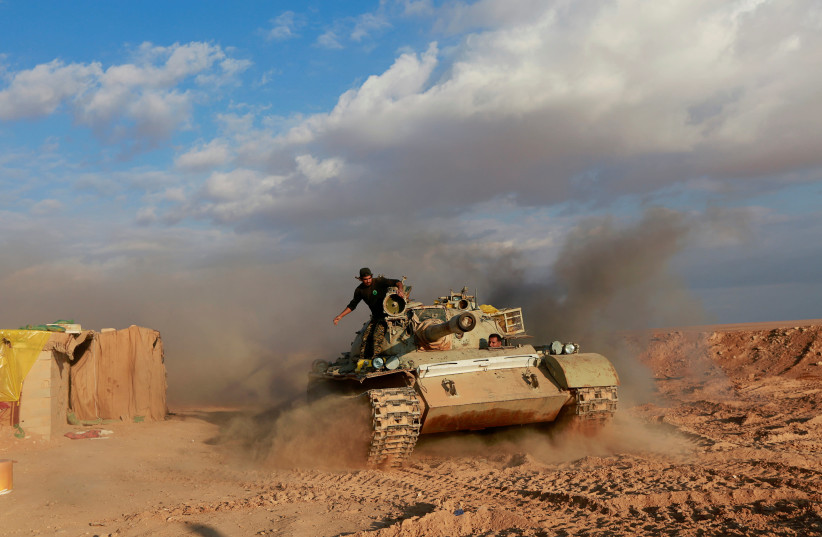
Iranian-backed militias stand on a tank close to the Syria-Iraq border (credit: ALAA AL-MARJANI/REUTERS)Iranian-backed militias stand on a tank close to the Syria-Iraq border (credit: ALAA AL-MARJANI/REUTERS)

“The United States will not hesitate to defend itself against Iranian and Iran-backed aggression when it occurs,”

Undersecretary of Defense Colin Kahl

The US has carried out retaliatory airstrikes against pro-Iranian groups in the past, usually for attacks in Iraq. The reason the US has chosen to respond in Syria in the past was because there is more freedom of action in Syria.

The US is a guest of the Iraqi government and US forces are in Iraq to fight ISIS, not Iran. Pro-Iran militias in Iraq are often affiliated with Iraqi Shi’ite political parties and even receive government salaries as paramilitaries.

In Syria, the Iranian groups are linked to Iran or the Syrian regime, but the US doesn’t need to ask the Syrian regime for permission. This means the US can carry out retaliatory strikes on Iran in Syria with impunity. Similarly, Iran operates in Syria with impunity, from where it threatens US forces and Israel.

What does Iran think?

IRAN TRANSFERS weapons to Syria and through Syria to Lebanon. In the past year pro-Iranian militias in Syria, concentrated near the Euphrates river valley, have increased attacks on US forces.

The fact that the US carried out two rounds of strikes is also unique. However, whether the Iranian units and their affiliates suffered any casualties or whether the attacks resulted in much damage, is unclear.

The nature of “precision” strikes is usually that they are so specific and small that they don’t really result in material setbacks or decisive victories or even deterrence.

Blowing up a truck used to transport munitions, or striking a rocket launcher isn’t a game changer. Does Iran now think it should be more careful in Syria as a result of the strikes? Iran views its militias as cannon fodder. But Iran doesn’t view its IRGC members and officers as cannon fodder, which is why Iran only sends a few IRGC members from Iran to Syria in comparison with the militias it seeks to use on the ground.

Overall Iranian forces in Syria may include a thousand Iranian IRGC members and many tens of thousands of militiamen. As such, a strike on a warehouse, a truck, or launcher or a car may not be a big deal from Iran’s perspective.

That the nuclear talks continue and it appears the US is pushing for a return to a deal is important. The US knows that regardless of a deal Iran will continue its threatening and destabilizing behavior in Syria, Iraq, Lebanon and Yemen.

Iranian media isn’t shouting about the US attacks in Syria because Iran appears to want to downplay the attacks, for now. But Iran will continue to use its proxies in Iraq and Syria to threaten the US.

In addition Iran will continue to use Hezbollah and Palestinian Islamic Jihad to stir up tension with Israel. This is the larger context and a few airstrikes won’t likely change the overall Iranian gameplan for the region.
