
The strikes came as the US aimed to respond to a draft agreement proposed by the EU that would bring back the 2015 nuclear deal with Iran.
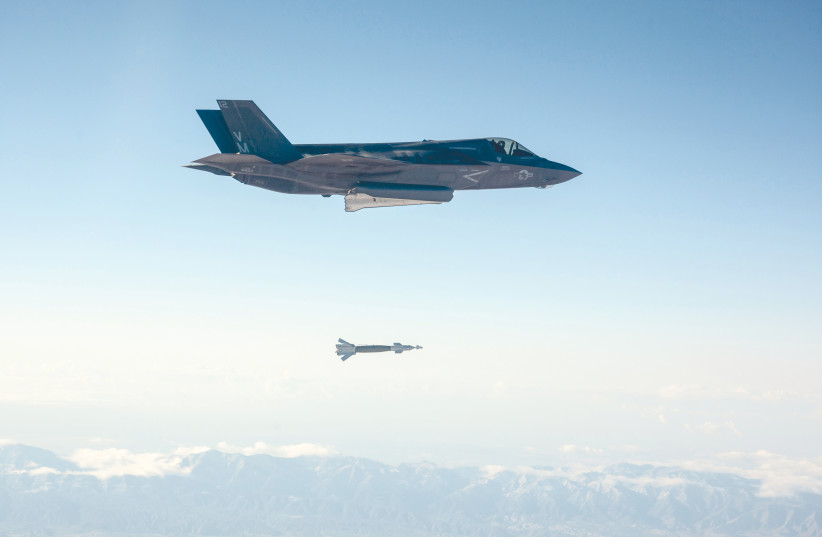
A US Marine Corps F-35B fighter jet drops a laser-guided bomb at Edwards Air Force Base, California. (photo credit: US NAVY VIA REUTERS)
A US Marine Corps F-35B fighter jet drops a laser-guided bomb at Edwards Air Force Base, California.
(photo credit: US NAVY VIA REUTERS)

A second round of airstrikes by the US-led international coalition operating in Iraq and Syria targeted Iran-linked sites in the Deir al-Zor region of eastern Syria on Wednesday evening, according to local reports.

The airstrikes targeted Iran-backed militias in the city of Al-Mayadin and Saker Island, according to the reports.

Alongside the reported airstrikes, reports by both Syrian and foreign media indicated that a number of rockets had been fired towards the Green Village and Conoco gas fields, both sites where US forces are hosted.


The renewed clashes came after the US military said it carried out air strikes on Tuesday in the Deir al-Zor region against facilities used by groups affiliated with Iran’s elite Islamic Revolutionary Guards Corps (IRGC).

The strikes came even as the United States aimed to respond to a draft agreement proposed by the European Union that would bring back the 2015 nuclear deal with Iran that former president Donald Trump abandoned and current President Joe Biden has sought to revive.

“The president gave the direction for these strikes.”

Army Colonel Joe Buccino

  Syrian Democratic Forces flag flutters on a damaged building in the village of Baghouz, Deir Al Zor province, Syria, on March 23, 2019 (credit: REUTERS/STRINGER)Syrian Democratic Forces flag flutters on a damaged building in the village of Baghouz, Deir Al Zor province, Syria, on March 23, 2019 (credit: REUTERS/STRINGER)

The military’s Central Command said in a statement that such strikes were aimed at protecting US forces from attack by Iran-backed groups.

It cited one such incident on August 15, which Reuters has reported involved drone attack on a compound run by coalition and US-backed Syrian opposition fighters, with no casualties.

“The president gave the direction for these strikes,” said spokesman Army Col. Joe Buccino.

Central Command called the strikes a “proportionate, deliberate action intended to limit the risk of escalation and minimize the risk of casualties.”

The statement about Tuesday’s US strike did not mention whether there were any casualties and did not say whether they were carried out by manned or unmanned aircraft.

History of US operations in Iraq and Syria 

This is not the first time US warplanes have struck Iran-backed forces in Iraq and Syria. America hit operational and weapons storage facilities at two locations in Syria and one in Iraq in June last year.

US forces first deployed into Syria during the Obama  administration’s campaign against Islamic State, partnering with a Kurdish-led group called the Syrian Democratic Forces. There are about 900 US troops in Syria, most of them in the east.

But Iran-backed militias established a foothold in Syria while fighting in support of President Bashar Assad during Syria’s civil war.

Iranian-backed militias are heavily concentrated west of the Euphrates in Deir al-Zor province, where they get supplies from Iraq through the al-Bukamal border crossing.

Iran denies any link to targets hit by US in Syria

Iran denied having any link to sites targeted by the United States in Syria, Iranian foreign ministry spokesperson Nasser Kanaani said on Wednesday, according to the ministry’s telegram channel.

“The US attack on Syrian infrastructure and people is a violation of Syria’s sovereignty and territorial integrity. The sites targeted had no links to the Islamic Republic,” Kanaani said.

Attack in Deir Ezzor province carried out in response to drone attack on al-Tanf base by IRGC,, Pentagon says

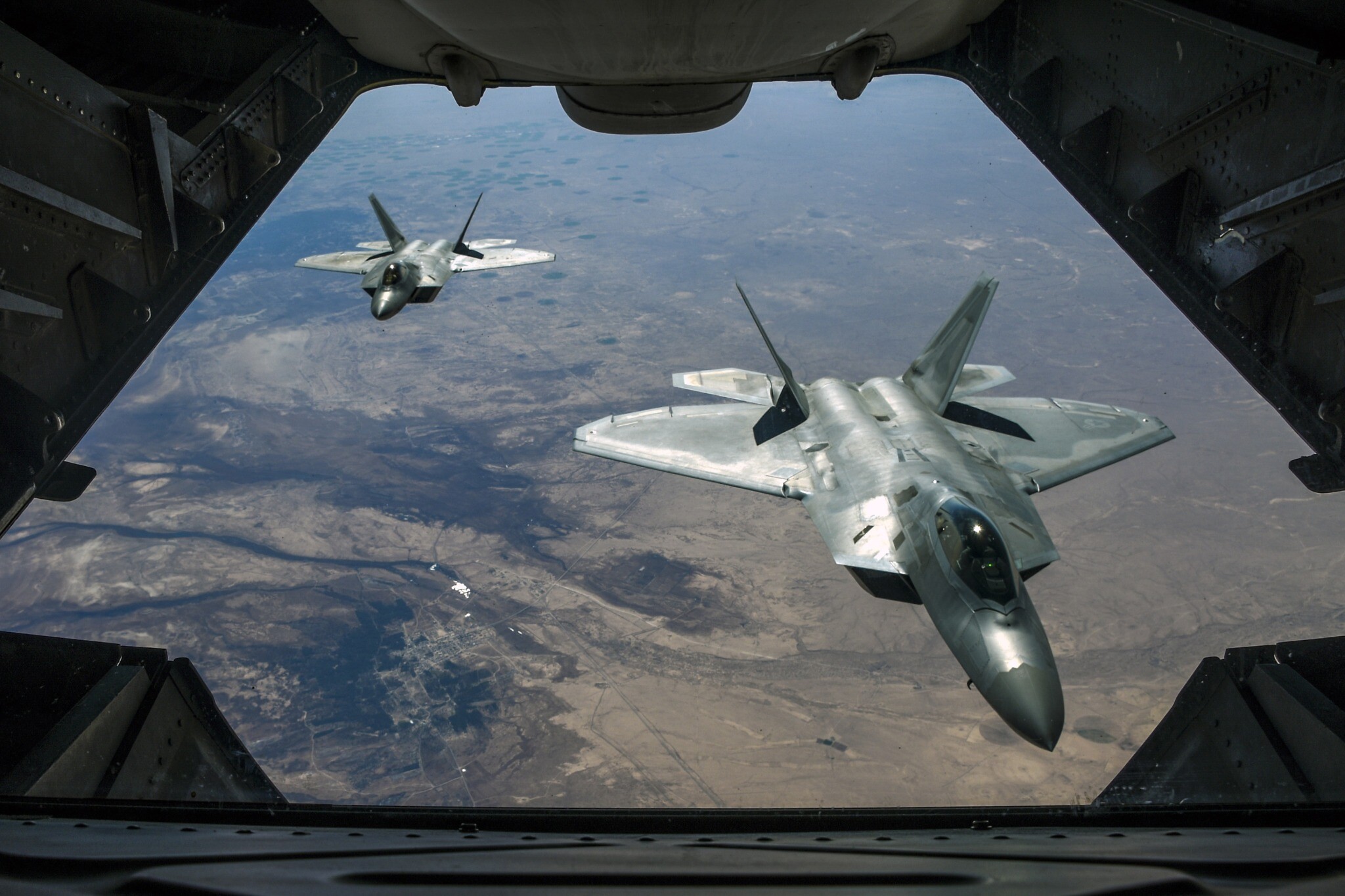
Two U.S. Air Force F-22 Raptors fly above Syria on Feb. 2, 2018. (Staff Sgt. Colton Elliott/US Air National Guard)

Two U.S. Air Force F-22 Raptors fly above Syria on Feb. 2, 2018. (Staff Sgt. Colton Elliott/US Air National Guard)

BEIRUT, Lebanon (AP) — The US military said early Wednesday it carried out airstrikes in eastern Syria that targeted areas used by militias backed by Iran’s paramilitary Revolutionary Guard.

There was no immediate acknowledgment by Syria’s state-run media of the strikes hitting Deir Ezzor. Iran as well did not acknowledge the attack.

The US military’s Central Command said the strikes “took proportionate, deliberate action intended to limit the risk of escalation and minimize the risk of casualties.”

It did not identify the targets, nor offer any casualty figures from the strikes, which the military said came at the orders of President Joe Biden.

“Today’s strikes were necessary to protect and defend US personnel,” Central Command spokesman Col. Joe Buccino said in a statement.

The colonel added the attack was in response to an August 15 attack targeting US forces. That attack saw drones allegedly launched by Iranian-backed militias target the al-Tanf Garrison used by American forces. US Central Command described the assault as causing “zero casualties and no damage” at the time.

A US Marine fires a shoulder-fired anti-tank missile during a live fire demonstration near At-Tanf Garrison, Syria, September 7, 2018. (Cpl. Carlos Lopez/US Marine Corps)

The strike came days after the US revealed that Iran had dropped its demand for the US to delist the IRGC in exchange for Tehran agreeing to return to compliance with the Iran nuclear deal.

Deir Ezzor is a strategic province that borders Iraq and contains oil fields. Iran-backed militia groups and Syrian forces control the area and have often been the target of Israeli war planes in previous strikes.

On Tuesday, Iranian state media confirmed that an IRGC general was killed in Syria.

“General Abolfazl Alijani, a member of the IRGC’s ground forces who was on a mission in Syria as a military adviser, was martyred on Sunday,” the state broadcaster said on its website.

It described Alijani as a “defender of the sanctuary”, a term used for those who work on behalf of Iran in Syria or Iraq, without providing more details of the attack in which he was killed.

Israel was blamed for several airstrikes in western and central Syria this month that left three soldiers dead.

A Syrian opposition war monitor, the Britain-based Syrian Observatory for Human Rights, said the alleged Israeli airstrikes hit Syrian army positions where Iran-backed fighters are based.

US forces entered Syria in 2015, backing allied forces in their fight against the Islamic State group.


A senior US official said that “thousands” of advanced centrifuges Iran is using to enrich today would be stopped and removed, including all of the centrifuges enriching at the fortified underground facility at Fordow.

An engineer inside Iran's Natanz uranium enrichment plant, shown during a ceremony headed by the country's president on Iran's National Nuclear Technology Day. (File Photo: Screengrab)

Iran would be prohibited from enriching uranium above 3.67 percent and stockpiling more than 300 kilograms until 2031 under a new nuclear deal, a senior US official said Tuesday.

Meanwhile, Israel appealed to the Biden administration to refrain from signing an agreement with Tehran.

The deal would deny Tehran the material needed for a bomb, the US official said in a statement to Al Arabiya English. “Iran would need to get rid of or render unusable the 20 and 60 percent-enriched uranium that it is stockpiling today,” the official said.

For all the latest headlines, follow our Google News channel online or via the app.

After more than a year of indirect talks and stalling mechanisms by Iran, the EU proposed a final text to Iran and the US at the start of this month, asking for a response within a few weeks.

Despite the EU saying there was no more room for negotiations, Tehran made several remarks and sent back its response to the EU, which in turn passed along the comments to the US.

Washington has yet to respond.

“Gaps still remain, but should we reach an agreement to return to the deal, Iran would have to take many significant steps to dismantle its nuclear program,” the administration official said on Tuesday.

The official said that “thousands” of advanced centrifuges Iran is using to enrich today would be stopped and removed, including all of the centrifuges enriching at the fortified underground facility at Fordow. “Strict limits on Iranian enrichment would mean that even if Iran left the deal to pursue a nuclear weapon, it would take at least six months to do so,” the official claimed.

Further defending a potential deal, which has been criticized by both Democrats and Republicans at home, the official said any Iranian pathway to a “plutonium-based nuclear weapon” would also be blocked. The official pointed to what would be the prohibition on reprocessing and redesigning a reactor that could be used to produce weapons-grade plutonium.

The Biden administration has repeatedly stated its belief that reviving the 2015 nuclear deal would be the best way to prevent Iran from acquiring a nuclear weapon, something which US officials have said was “weeks away” for several months now. But critics of the administration’s approach to

Iran have now said the deal will be different than the original 2015 pact.

On Tuesday, the senior US official suggested that under the new deal Iran would be bound by nuclear constraints as well as allow the UN nuclear watchdog to be able to implement “the most comprehensive inspections regime ever negotiated.”

‘Iran made concessions,’ not us

The US official pushed back on the narrative pushed by Tehran that Washington had made several concessions to reach a new deal.

Last week, London-based Iran International published a list of reported concessions the Biden administration had agreed to in a bid to get Iran to come back into full compliance with the deal. The outlet said these included the removal of sanctions on 17 banks, the immediate release of $7 billion worth of Iranian assets frozen in South Korea and the annulment of multiple Executive Orders signed by former US President Donald Trump.

“To be clear: reports that we have accepted or are considering new concessions to Iran as part of reentering the 2015 nuclear deal are categorically false,” the official said on Tuesday. “It is Iran that has made concessions on critical issues. Most notably, the President has been firm and consistent that he will not lift the terrorism designation of Iran’s Revolutionary Guards Corps. Iran’s demand that we do so has been removed from the latest versions of the text.”

But Former Prime Minister Naftali Bennett quickly called on the Biden administration not to sign a deal with Iran, “even now at this last minute.

Bennett took to Twitter to voice Israel’s opposition to the deal, claiming the deal would send “approximately a quarter of a trillion dollars to the Iranian terror administration’s pocket and to its regional proxies.”

The former Israeli premier said his country was able to convince the White House not to give in to Iranian demands over the last year. “Israel is not committed to any of the restrictions stemming from the agreement and will utilize all available tools to prevent the Iranian nuclear program from advancing,” he tweeted.

Jason Brodsky, policy director at United Against Nuclear Iran (UANI), said the Biden administration felt like they were behind the message curve amid the deluge of Iranian leaks on concessions Tehran reportedly won.

“The US is focusing on what it did not cave on, what Iranians reportedly retracted on, but not acknowledging that they are reentering an agreement that has already started to expire,” Brodsky told Al Arabiya English. He also pointed to the lack of bipartisan support, the opposition of Washington’s closest ally in the region, and the absence of a clear pathway forward on deterring Iran as “ingredients for unstable agreements.”

Brodsky said the US officials that were speaking out about potential benefits in the deal were “circulating recycled talking points from 2015” as part of their case to revive the JCPOA. “No mention of the sunset clock already ticking for years — while, according to press reports, Iran is receiving more sanctions relief in exchange for a shorter and weaker nuclear deal.”

Since beginning indirect talks with Iran over 500 days ago, US officials said they were seeking a “longer, stronger” deal.

Read more: Citing Russian officials being trained in Iran on drones, US warns of sanctions
