Russia starts mass production of Zircon naval hypersonic missile

Russian President Vladimir Putin said that the hypersonic missile would be deployed in coming months.
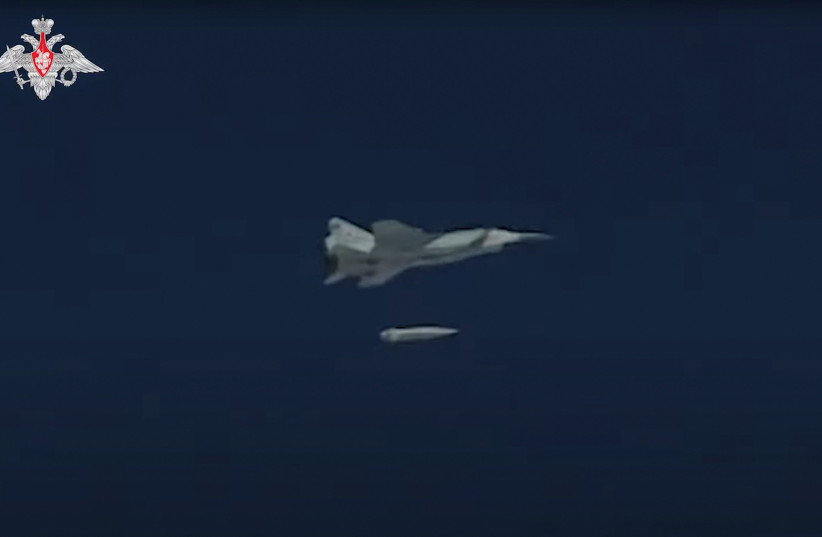
 A Russian Air Force MiG-31 fighter jet releases Kinzhal hypersonic missile during a drill in an unknown location in Russia, in this still image taken from video released February 19, 2022. (photo credit: RUSSIAN DEFENSE MINISTRY/HANDOUT VIA REUTERS)
A Russian Air Force MiG-31 fighter jet releases Kinzhal hypersonic missile during a drill in an unknown location in Russia, in this still image taken from video released February 19, 2022.
(photo credit: RUSSIAN DEFENSE MINISTRY/HANDOUT VIA REUTERS)

The Russian Zircon hypersonic has started being mass produced, Russian Defense Minister Sergei Shoigu told Russian media on Saturday night.

“We are starting mass production of Zircon missiles. We have actually put it into service. This year it will be documented,” Shoigu said in an interview with Russia-1 TV channel, according to Russian state media.

On July 31,  Russian President Vladimir Putin said that the hypersonic missile would be deployed in coming months. Three days prior, TASS specified that the Zircon would be deployed on surface ships as early as September, the  Admiral Gorshkov frigate being the first to be equipped.

Shoigu also said that the production of the Kinzhal hypersonic missile would continue. The Kh-47M2 Kinzhal or “Dagger” missile is an air-launched weapon, whereas the new Zircon is a naval weapon. An air-to-ground version is also in development, but the naval version was prioritized because of a production backlog and because that role is already filled by the Kinzhal. Both hypersonic missiles are nuclear warhead capable.

Increased missile production

The Russian defense minister also announced at the Army-2022 forum contracts worth half a trillion rubles for items including the supply S-500 anti-aircraft missiles and RS-28 Sarmat intercontinental ballistic missiles, RIA reported.

Russian President Vladimir Putin and Defence Minister Sergei Shoigu attend a ceremony opening the international military-technical forum Army-2022 at Patriot Congress and Exhibition Centre in the Moscow region, Russia August 15, 2022. (credit: REUTERS/MAXIM SHEMETOV)Russian President Vladimir Putin and Defence Minister Sergei Shoigu attend a ceremony opening the international military-technical forum Army-2022 at Patriot Congress and Exhibition Centre in the Moscow region, Russia August 15, 2022. (credit: REUTERS/MAXIM SHEMETOV)

Shoigu said that the contracts were proof that Russia’s military-industrial complex was “far from isolated,” according to TASS. Previous reports have highlighted how Russian munitions have been hobbled by the relliance on foreign technology and electronics to produce them. The rising cost of raw materials due to Ukraine war sanctions has reportedly further hindered Russia’s military-industrial complex.

Russian hypersonic missiles in Ukraine

The Zircon is alleged to be able to reach speeds of Mach 10 (12,300 km/h; 7,610 mph; 3.4 km/s), and would be used as an anti-ship weapon and against ground targets. According to the Russian Defense Ministry, a test in the Barents Sea in May saw the weapon strike a target in the White Sea from almost 1,000 kilometers away.

The Kinzhal was used in combat for the first time on March 20, to strike a military fuel depot near the southern Ukrainian city of Mykolaiv. On Thursday, Russia stationed three MiG-31 aircraft equipped with Kinzhal hypersonic missiles in the Kaliningrad exclave, to the backdrop of rising tensions with Lithuania.

Hypersonic missiles are incredibly fast guided projectiles that have a short window from launch to strike. Their maneuverability allows them to evade current missile defense systems.
‘If we are closer to a deal, that’s why,’ senior Biden official tells CNN, adding that Tehran also no longer demanding that US delist several firms tied to Revolutionary Guard

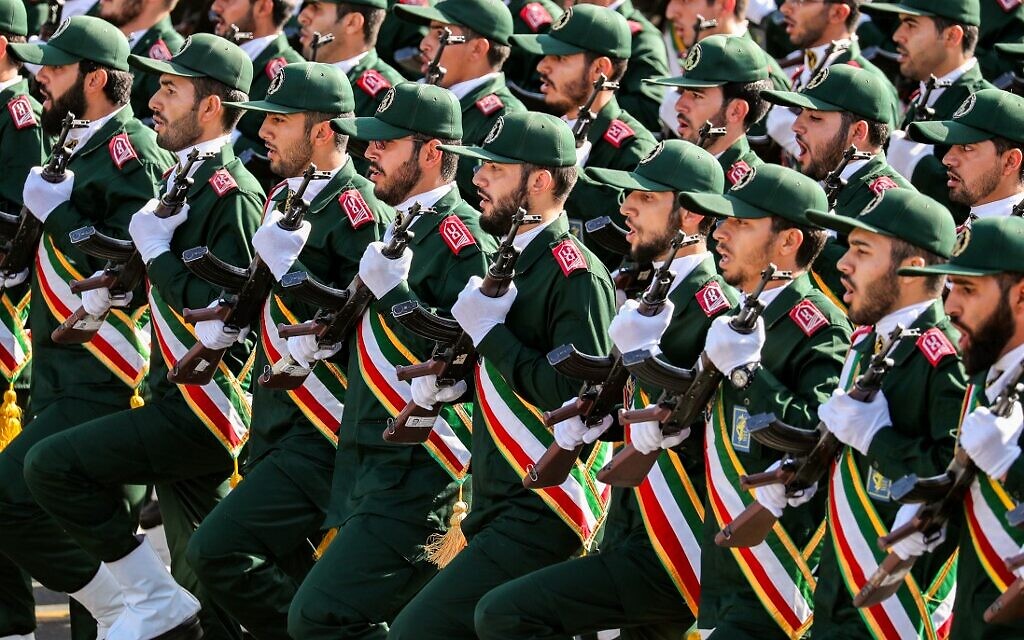
Members of Iran's Islamic Revolutionary Guard Corps (IRGC) march during the annual military parade marking the anniversary of the outbreak of the devastating 1980-1988 war with Saddam Hussein's Iraq, in the capital Tehran, on September 22, 2018. (Stringer/AFP)

Members of Iran’s Islamic Revolutionary Guard Corps (IRGC) march during the annual military parade marking the anniversary of the outbreak of the devastating 1980-1988 war with Saddam Hussein’s Iraq, in the capital Tehran, on September 22, 2018. (Stringer/AFP)

Iran has dropped its demand that the US remove the Islamic Revolutionary Guard Corps from the State Department’s list of Foreign Terrorist Organizations in exchange for Tehran returning to compliance with the nuclear agreement it signed with world powers in 2015.

After months of unconfirmed reports on the matter, the Biden administration revealed in May that it would not be heeding the Iranian demand in what was assumed to amount to a significant blow to the negotiations aimed at restoring the agreement known as the Joint Comprehensive Plan of Action.

But a senior administration official told CNN on Friday that Iran has dropped the “red line” demand amid reports that the sides are nearing an agreement on a joint US-Iranian return to compliance with the JCPOA. A senior US official confirmed the report to The Times of Israel.

In 2018, former president Donald Trump withdrew from the deal that traded sanctions relief for curbs on Iran’s nuclear program. He then instituted a “maximum pressure” sanctions regime targeting various Iranian sectors, leading Tehran to respond by expanding its nuclear program in violation of the JCPOA. US President Joe Biden entered office vowing to try and revive the deal and his administration has spent the past year-and-a-half in on-and-off indirect negotiations with Iran to achieve that goal.

While the sides had been pessimistic about prospects of a deal for months, progress has been reported over the past week.

The senior administration official speaking to CNN said that in its response to the draft nuclear deal agreement proposed by the European Union Iran did not include the IRGC delisting demand.

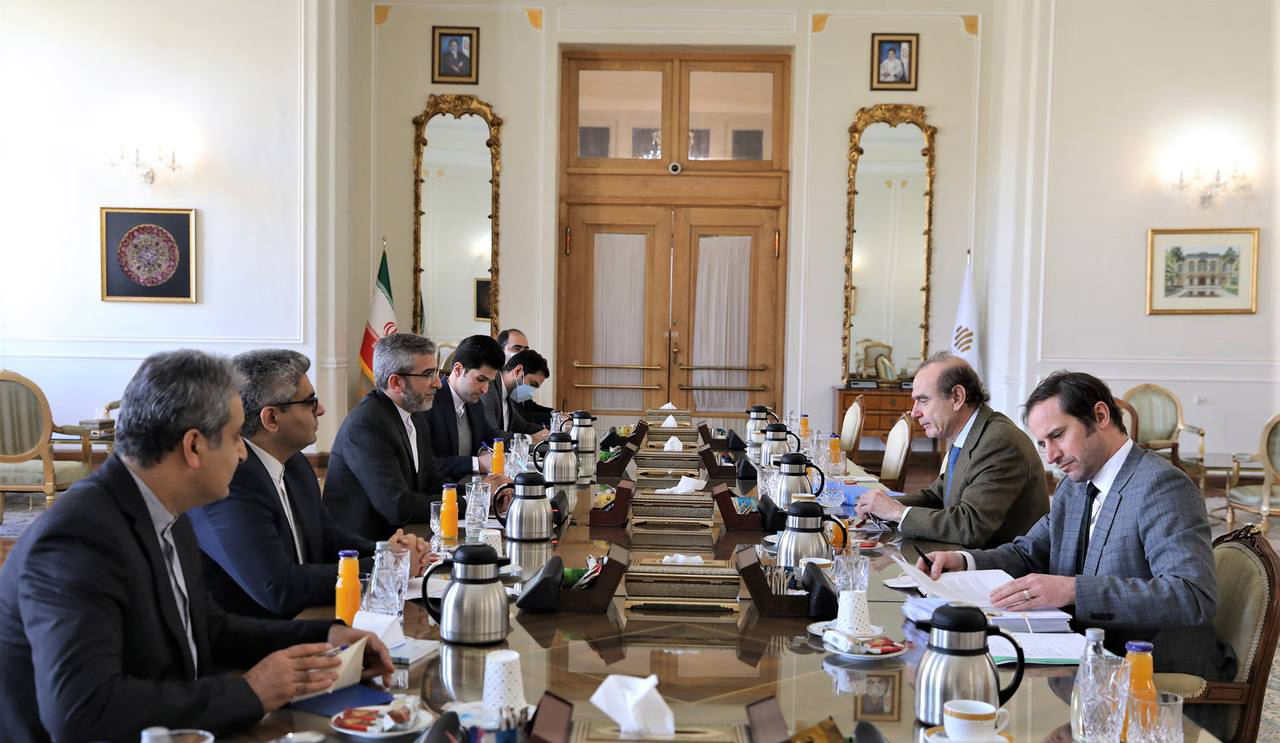
Enrique Mora, a leading European Union diplomat, second right, attends a meeting with Iran’s top nuclear negotiator Ali Bagheri Kani, third left, in Tehran, Iran, March 27, 2022. (Iranian Foreign Ministry via AP)

“The current version of the text, and what they are demanding, drops it,” the official said. “So if we are closer to a deal, that’s why.”

“The President has been firm and consistent that he will not lift the terrorism designation of Iran’s Revolutionary Guards Corps.”

The official also revealed that Iran had dropped other demands for the US delist to delist several companies with ties to the IRGC.

While the deal is now “closer than it was two weeks ago, the outcome remains uncertain as some gaps remain. President Biden will only approve a deal that meets our national security interests,” the official said.

Another administration official speaking to CNN was similarly cautious, explaining that progress may be slow moving forward but that there was indeed more momentum now than there was over the past year.

On July 26, European Union foreign policy chief Josep Borrell submitted a proposal to Iran on returning to the nuclear deal, with a deadline for it to respond by this past Monday at midnight.

Josep Borrell, the High Representative of the European Union for Foreign Affairs and Security Policy speaks during a meeting with Iran’s Foreign Minister at the Foreign Ministry headquarters in Iran’s capital Tehran on June 25, 2022. (Atta Kenare/AFP)

According to a Politico report citing a senior Western official, the Iranian response was received Monday evening Brussels time and focused on remaining questions related to sanctions and “guarantees around economic engagement.”

Iran’s state-run IRNA news agency offered no details on the substance of its response, but suggested that Tehran still wouldn’t take the European Union-mediated proposal, despite warnings there would be no more negotiations.

Top Israeli officials have warned their counterparts in the US and Europe against the deal and called for the negotiators to give up on the talks.

National Security Adviser Eyal Hulata will head to Washington, DC, next week to conduct a series of meetings with US officials on the Iran nuclear program.

Israel believes Iran wishes to build a nuclear bomb, has revealed intelligence it says reveals the Iranian weapons program and has reportedly carried out sabotage operations within the Islamic Republic to delay the development of such a weapon.

Iran has denied any nefarious intentions and claims its program is designed for peaceful purposes, though it has recently been enriching uranium to levels that international leaders say have no civil use.


Hassan Nasrallah denies his Iran-backed terror group’s actions in border dispute will be impacted by outcome of Iranian nuclear negotiations

Supporters of Hezbollah attend a televised speech by the Lebanese terror group's leader Hassan Nasrallah during a ceremony to lay the foundation for a site for "jihadist tourism," at a camp formerly run by Iran's Islamic Revolutionary Guard Corps in Lebanon to train Hezbollah fighters, in the Janta region in the east of the country on August 19, 2022. (AFP)

Supporters of Hezbollah attend a televised speech by the Lebanese terror group’s leader Hassan Nasrallah during a ceremony to lay the foundation for a site for “jihadist tourism,” at a camp formerly run by Iran’s Islamic Revolutionary Guard Corps in Lebanon to train Hezbollah fighters, in the Janta region in the east of the country on August 19, 2022. (AFP)

Hezbollah terror chief Hassan Nasrallah warned of an “escalation” with Israel if Lebanese demands are not met in maritime border talks.

In a televised speech Friday for a Hezbollah event, Nasrallah denied any link between the Iran-backed terror organization’s actions in the maritime dispute — which the United States has been mediating — and the ongoing negotiations to restore the 2015 Iranian nuclear deal, which appeared to be climaxing.

“If the Lebanese state is not given what it wants, we will be heading to an escalation, even if the nuclear agreement gets signed,” the Hezbollah leader said, according to Lebanese news site Naharnet. “Should the US mediator come and give the Lebanese state what it wants, we will be heading to calm, regardless whether or not there will be a nuclear agreement.”

“The eyes of the Lebanese should not be on Vienna… The eyes should be on Karish, the sea border and northern Israel,” he added, referring respectively to the location of the border talks and an Israeli offshore gas field claimed by Lebanon.

Nasrallah also hit out at Amos Hochstein, the US State Department mediating the maritime dispute between Israel and Lebanon, who he said was “still wasting time.” He said Hochstein’s “time is running out” to broker a deal.

Hezbollah is poised to gain financially from a renewed nuclear accord, which would see its chief patron Iran receive substantial relief from US sanctions in exchange for reimposing curbs on its nuclear program, while a maritime border deal with Israel would position Lebanon to reap the windfall of profits from offshore gas exploration.

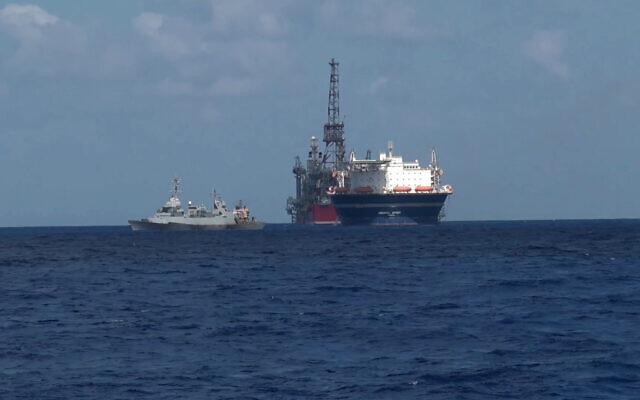
An Israeli Sa’ar Class 5 Corvette guards the Energean floating production, storage and offloading vessel at the Karish gas field, in footage published by the military on July 2, 2022. (Israel Defense Forces)

The Hezbollah chief has recently issued a number of threats toward Israel, amid intensified US efforts to resolve the more than a decade-old maritime border dispute between Jerusalem and Beirut, which have officially been at war since the Jewish state’s creation in 1948.

Both countries claim some 860 square kilometers (330 square miles) of the Mediterranean Sea. Lebanon also claims that the Karish gas field is in disputed territory under ongoing maritime border negotiations, while Israel says it lies within its internationally recognized economic waters.

Israel and Hezbollah are bitter enemies that fought a monthlong war in the summer of 2006. Israel considers the Iran-backed Shiite group its most serious immediate threat, estimating that Hezbollah has some 150,000 rockets and missiles aimed at Israel.

Lebanon badly needs an agreement over the maritime border in the Mediterranean as it hopes to exploit offshore gas reserves to try and alleviate what has become the worst economic crisis in its modern history.

Last month, the Israeli military shot down four unarmed Hezbollah drones flying toward the Karish field. Lebanon’s Prime Minister Najib Mikati at the time criticized Hezbollah, saying the move could pose risks to the country. Hezbollah also aired footage showing the gas platforms in the area.

Earlier this month, Israeli security officials warned the country’s political echelon that a failure to reach an agreement in the maritime border dispute with Lebanon will potentially mean being dragged into a military conflict with Hezbollah.