The police in Germany opened an investigation against PA chairman Mahmoud Abbas on suspicion of Holocaust denial, following his remarks this week about “50 Holocausts” perpetrated by Israel on Palestinians.

The police in Germany opened an investigation against PA chairman Mahmoud Abbas on suspicion of Holocaust denial, following his remarks this week about “50 Holocausts” perpetrated by Israel on Palestinians.
Senior Israeli official says continuing to negotiate shows weakness after Tehran gave noncommittal response to ‘take it or leave it’ offer
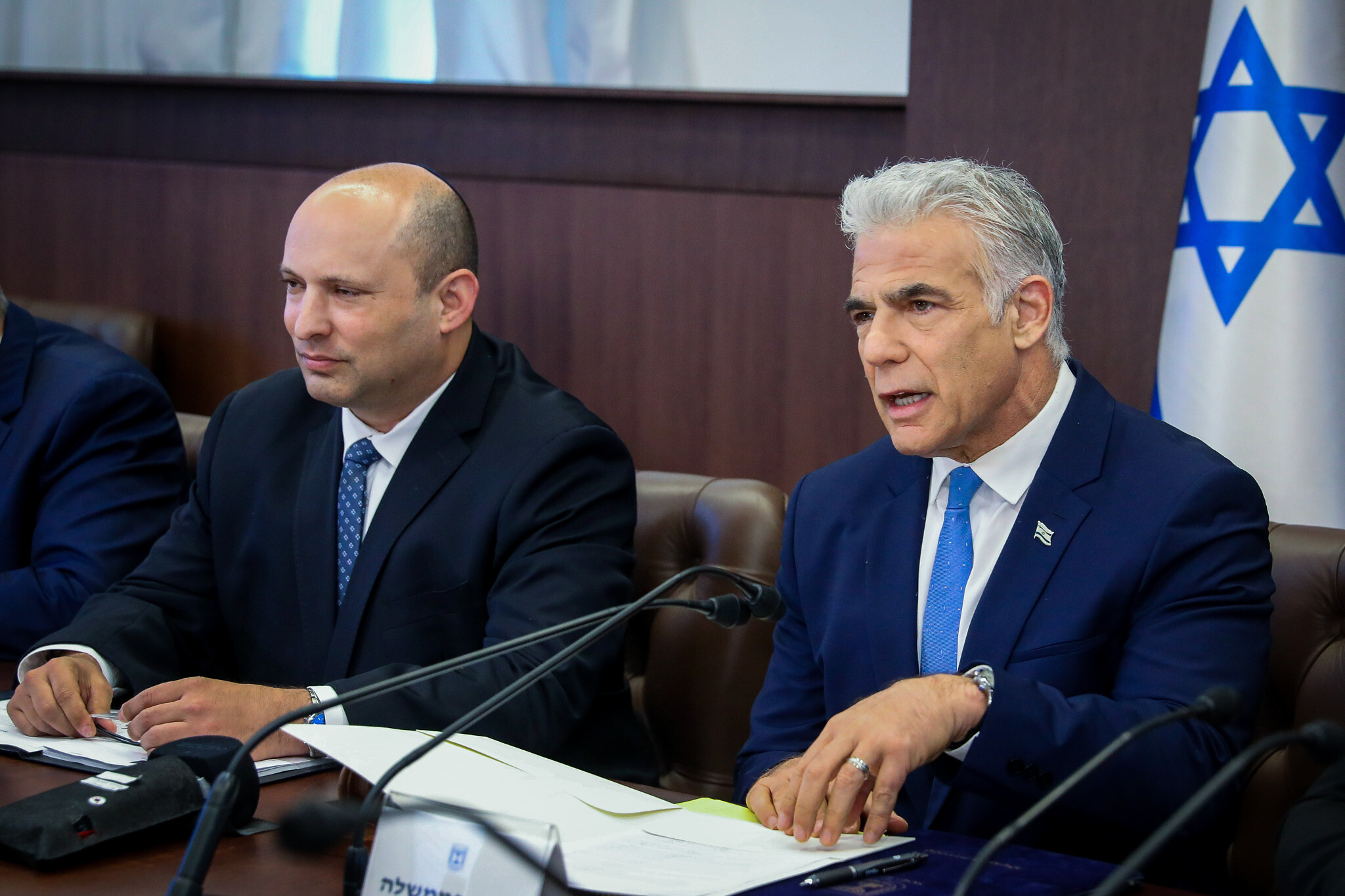
The time has come for Western powers to walk away from talks with Iran on returning to the nuclear deal, top Israeli officials are telling their counterparts in Washington and in European capitals.
“The Europeans sent Iran a final offer, which doesn’t even meet the demands that the Americans committed to, and established that this offer was ‘take it or leave it,’” said a senior Israeli official at the highest level of decision-making on Thursday.
“Iran turned down the offer, and the time has come to get up and walk away,” the official continued. “Anything else sends a strong message of weakness.”
The senior official, in a briefing to Israeli journalists, said that the world must now discuss what must be done in order to prevent Iran from attaining a nuclear weapon.
Prime Minister Yair Lapid expressed this message in his phone call with German Chancellor Olaf Scholz earlier on Thursday. He also made the case on Thursday to US Ambassador Tom Nides, and Florida congressman Ted Deutch, chairman of the House Subcommittee on the Middle East, North Africa and Global Counterterrorism.

National Security Adviser Eyal Hulata will head to Washington, DC, next week to conduct a series of meetings with US officials on the Iran nuclear program.
The briefing came a day after an anonymous Israeli official delivered to local media a seemingly contradictory message — that Jerusalem believes Iran is close to inking an agreement with world powers, and has started preparing for the announcement of a deal.
On July 26, EU foreign policy chief Josep Borrell submitted a proposal to Iran on returning to the nuclear deal, with a deadline for it to respond by midnight Monday night.
According to a Politico report citing a senior Western official, the Iranian response was received Monday evening Brussels time and focused on remaining questions related to sanctions and “guarantees around economic engagement.”
Iran’s state-run IRNA news agency offered no details on the substance of its response, but suggested that Tehran still wouldn’t take the European Union-mediated proposal, despite warnings there would be no more negotiations.
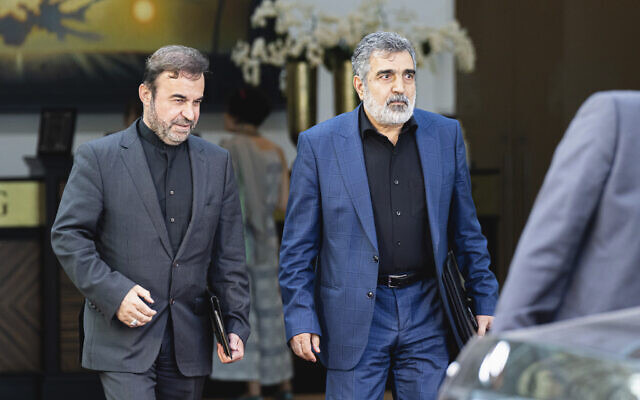
“The differences are on three issues, in which the United States has expressed its verbal flexibility in two cases, but it should be included in the text,” the IRNA report said. “The third issue is related to guaranteeing the continuation of [the deal], which depends on the realism of the United States.”
During Thursday’s briefing, the senior Israeli official highlighted a May 30 report by the International Atomic Energy Agency to the effect that Iran was not providing credible responses to the nuclear watchdog’s questions, saying that report should “set off a bright red warning light for the international community.”
The official also noted that Israel is not bound by any agreements with Iran, and said it “will do whatever is necessary in order to prevent Iran from attaining a nuclear weapon and to prevent Iran from using its terror proxies in the region.”
“The US knows and recognizes this,” the official said.
Iran signed its nuclear deal in 2015 with the US, France, Germany, Britain, Russia, and China. The deal saw Iran agree to limit its enrichment of uranium under the watch of UN inspectors in exchange for the lifting of economic sanctions.
In 2018, then-US president Donald Trump unilaterally pulled the US out of the accord and said he would negotiate a stronger deal, but that didn’t happen. Iran began breaking the deal’s terms a year later.
EU-coordinated negotiations on reviving the deal, known as the JCPOA, began in April 2021 before coming to a standstill in March and picking up again in August.
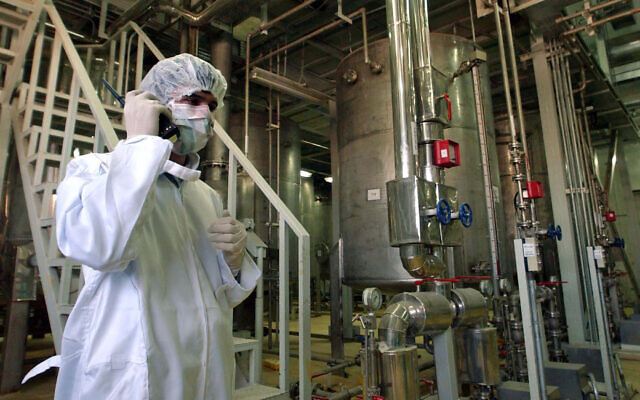
Israel believes Iran wishes to build a nuclear bomb, and has reportedly carried out sabotage operations within the Islamic Republic to delay the development of such a weapon.
Iran has denied any nefarious intentions and claims its program is designed for peaceful purposes, though it has recently been enriching uranium to levels that international leaders say have no civil use.
Two major roadblocks remain in the negotiations if Tehran does want to return to the deal: Iran is demanding an end to International Atomic Energy Agency investigations into its nuclear program, and wants guarantees to cover the possibility of the US ditching the agreement again in the future.
Ukrainian president demands Russian troop withdrawal as condition for peace, calls for UN to ensure safety of Zaporizhzhia facility over fear of nuclear disaster

LVIV, Ukraine (AFP) — Turkish leader Recep Tayyip Erdogan warned Thursday of a nuclear disaster in Ukraine during his first face-to-face talks with Ukrainian President Volodymyr Zelensky since Russia’s invasion began, echoing pleas from the UN’s chief.
A flare-up in fighting around Europe’s largest nuclear facility in Russian-controlled southern Ukraine has sparked urgent warnings from world leaders and UN chief Antonio Guterres cautioned during talks with Erdogan that any damage to the plant would be akin to “suicide.”
“We are worried. We don’t want another Chernobyl,” Erdogan said during a press conference in the eastern city of Lviv, during which he also assured the Ukrainian leader that Ankara was a firm ally.
“While continuing our efforts to find a solution, we remain on the side of our Ukraine friends,” Erdogan said.
Guterres said he was “gravely concerned” about the situation at the plant and said it had to be demilitarized, adding: “We must tell it like it is — any potential damage to Zaporizhzhia is suicide.”

The Turkish leader along with Guterres were key brokers of a deal inked in Istanbul last month allowing the resumption of grain exports from Ukraine after Russia’s invasion blocked essential global supplies.
Ahead of the press conference with Zelensky, Ukraine’s port authority announced that the 25th cargo ship under the deal had departed for Egypt carrying 33,000 tons of grain.
Ukraine and Russia are two of the world’s biggest grain exporters and the halt in exports saw grain prices soar and fears rise of global food shortages, particularly in poor countries already experiencing shortfalls.
Guterres said during the meeting with reporters that the sides hoped to intensify efforts to bolster operations at three southern ports designated for exports under the deal.
“We will do our best to scale up our operations to face… the coming winter,” the UN chief said, hailing the deal that saw a safe corridor established for cargo ships to exit Black Sea ports.
The success of the grain deal contrasts with failed peace talks early in the war and Zelensky on Thursday ruled out peace with Russia unless it withdraws its troops from Ukraine.
He told reporters he was “very surprised” to hear from Erdogan that Russia was “ready for some kind of peace,” adding: “First they should leave our territory, and then we’ll see.”

Fighting raged along the front on Thursday.
In the war-scarred eastern region of Kharkiv, Russian strikes left several dead and dozens injured.
The early morning bombardments across the city of Kharkiv and nearby Krasnograd left at least six dead and 25 injured, just one day after Russian bombardments killed 13 in the country’s second-largest urban center.
The regional governor Oleg Synegubov posted images from the scene of one Kharkiv strike showing the smoldering remains of several burnt-out buildings and twisted wreckage of destroyed vehicles nearby.
“Kharkiv. 175 days of horror. Daily terror, missile strikes on residential areas and civilians,” a senior presidential aide, Mykhaylo Podolyak, wrote on social media.
But fighting in recent weeks has focused around the southern region of Zaporizhzhia and the nuclear facility there, and Zelensky has called on the UN to ensure security at the plant after direct talks with Guterres in Lviv.

“The UN must ensure the security of this strategic object, its demilitarization and complete liberation from Russian troops,” he said, blaming Russia for “deliberate” attacks on the facility.
Russian forces took the Zaporizhzhia plant in southern Ukraine in March and uncertainty surrounding it has fuelled fears of a nuclear incident, recalling the Chernobyl disaster in 1986.
Moscow meanwhile dismissed Ukrainian allegations Thursday saying its forces had not deployed heavy weapons at Zaporizhzhia and accused Kyiv of preparing a “provocation” there.
“Russian troops have no heavy weapons either on the territory of the station or in areas around it. There are only guard units,” the ministry said in a statement.
NATO Secretary General Jens Stoltenberg said Russia’s seizure of the plant “poses a serious threat” and also called for a Russian withdrawal and inspections by the IAEA.
The UN chief is due to travel on Friday to Odessa, one of three ports involved in the grain exports deal.
He will then head to Turkey to visit the Joint Coordination Centre, the body tasked with overseeing the accord.
Scofield Biblical Institute and Theological Seminary Copyright 2010 – 2020
