
Operation Breaking Dawn has shown that even the smallest of Iran’s proxies is a threat. Any deal must take Israel’s interests into account.
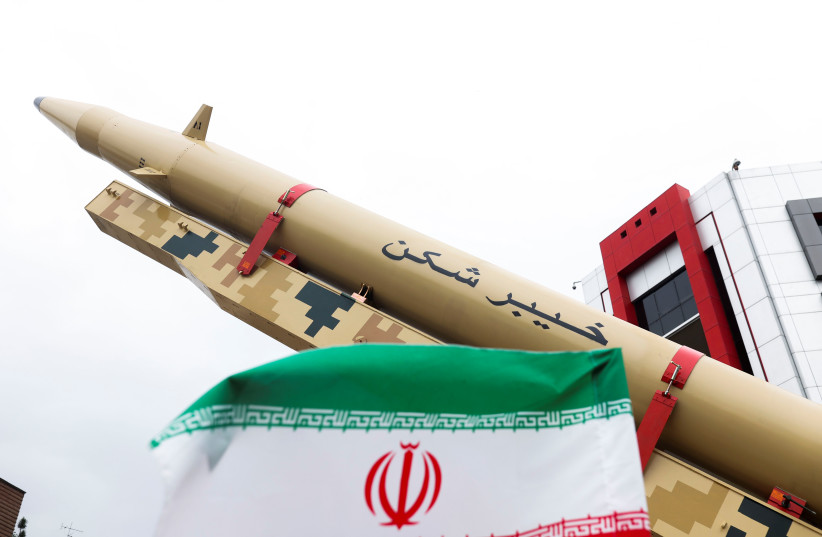
 An Iranian missile is displayed during a rally marking the annual Quds Day, or Jerusalem Day, on the last Friday of the holy month of Ramadan in Tehran, Iran April 29, 2022. (photo credit: MAJID ASGARIPOUR/WANA (WEST ASIA NEWS AGENCY) VIA REUTERS)
An Iranian missile is displayed during a rally marking the annual Quds Day, or Jerusalem Day, on the last Friday of the holy month of Ramadan in Tehran, Iran April 29, 2022.
(photo credit: MAJID ASGARIPOUR/WANA (WEST ASIA NEWS AGENCY) VIA REUTERS)

A return to the Iran deal that was negotiated in 2015 seemed impossible just a few weeks ago.

After a year of claims that the Iranians had to come to some sort of an agreement or the window of opportunity would close, it appeared that the ayatollahs in Tehran were too far away from the West in negotiating the return to what is known as the Joint Comprehensive Plan of Action.

However, new reports this past week claim that a final text of a deal has been hammered out.

We remain skeptical about this effort to finalize a deal but we hope that whatever is involved in the final talks and any agreement that might be made, will include measures that ensure Israel’s and the region’s stability and security. Israel relies on a close alliance with the United States and good relations with the Biden administration.

We support the administration’s attempts to provide security for the region, while expecting that Iran will never be able to develop nuclear weapons.

The European Union’s High Representative of the Union for Foreign Affairs Josep Borrell explained this week that “what can be negotiated has been negotiated, and it’s now in a final text…However, behind every technical issue and every paragraph lies a political decision that needs to be taken in the capitals.”
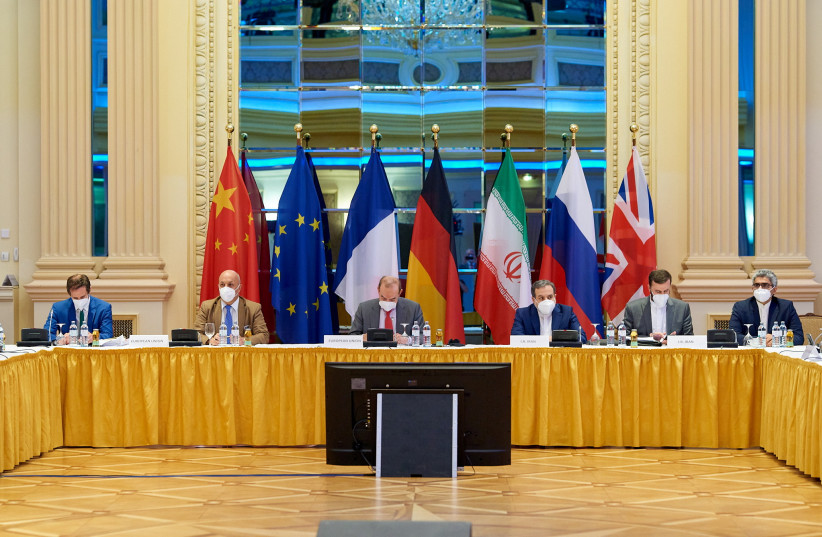
 European External Action Service (EEAS) Deputy Secretary General Enrique Mora and Iranian Deputy at Ministry of Foreign Affairs Abbas Araghchi wait for the start of talks on reviving the 2015 Iran nuclear deal in Vienna, Austria June 20, 2021 (credit: REUTERS)European External Action Service (EEAS) Deputy Secretary General Enrique Mora and Iranian Deputy at Ministry of Foreign Affairs Abbas Araghchi wait for the start of talks on reviving the 2015 Iran nuclear deal in Vienna, Austria June 20, 2021 (credit: REUTERS)

The US is also on board and it seems that right now the Iranian regime is holding things up as it continues to try and wring more concessions from the West.

These kinds of concessions are concerning, as is the overall nature of the deal. Iran wants its Islamic Revolutionary Guard Corps, which funds and arms terror groups around the region, to be removed, for example, from US sanctions lists. It also wants free rein for its missile and drone programs.

Most concerning has always been the fact that Iran has advanced centrifuges and has enriched large quantities of uranium to high levels. It has been enriching the uranium far beyond the agreements in the 2015 deal.

Iran argues that because the US violated the terms of the deal it too had the right to do so.

The major problem is that every day Iran enriches it grows closer to being able one day to build a nuclear bomb.

In fact, Iranian officials have recently hinted that they already have all the components and material needed to build a bomb, but they have so far decided not to.

This is problematic, because it means even if a new deal or a return to the old deal is agreed upon, Iran can always blackmail the West by using the enriched uranium card.

On another note, the overall deal has always been a concern because after a certain number of years, many of the safeguards designed to stop Iran from developing a nuclear weapon have fallen to the side.

The deal in 2015 appeared to merely postpone the inevitable. It is now 2022 and any deal that might be signed now would seem to just kick the can down the road in terms of eventually having to confront a nuclear Iran.

The Russian invasion of Ukraine and tensions between the US and China have complicated an already difficult situation.

The US prefers not to have to confront Iran at the same time, or deal with a new Iran-Israel crisis. The recent battles in Gaza against Palestinian Islamic Jihad seem to have been aimed at preempting the Iranian proxy’s ability to threaten Israel.

Nevertheless, that brief conflict shows that even the smallest of Iran’s proxies is a threat. What about the bigger threat of Hezbollah and groups like the Houthis in Yemen or Iranian-backed militias in Iraq and Iran’s entrenchment in Syria?

Iran has openly bragged about how it is pushing the US out of the region and how it can threaten Israel from a number of angles and fronts. The nuclear front is just one of those problems. The deal being discussed today must take into account Iran’s threats to the region and Israel.


Russia Attacks Lapid, Compares Gaza Operation to Bucha Massacre

The Russian embassy in Cairo on Tuesday tweeted: “Compare Yair Lapid’s lies about Ukraine in April and attempts to place blame and responsibility on Russia for the deaths of people in Bucha who were brutally murdered by the Nazi Ukrainians with his calls in August for bombing and strikes on Palestinian land in the Gaza Strip. Isn’t that double standards and complete disregard and contempt for the lives of Palestinians?”


Wow. They must really be angry at Yair Lapid to compare the surgical killing of two terrorist leaders and 15 rank & file Islamic Jihad fighters to the mass murder in Bucha, Ukraine, where the invading Russian forces killed at least 1,300 innocent civilians, including at least 30 children.

In April, Lapid tweeted: “It is impossible to remain indifferent in the face of the horrifying images that were discovered in the city of Bucha near Kiev, after the Russian army left the place. Intentional harm to a civilian population is a war crime.”

Many of the bodies were found mutilated and burnt, and girls as young as fourteen reported being raped by Russian soldiers. Ukraine asked the International Criminal Court to investigate what happened in Bucha as part of its ongoing investigation of the invasion, to determine whether a series of Russian war crimes or crimes against humanity were committed.

Russia denied responsibility for Bucha and claimed Ukraine had faked footage of the event or staged the killings itself as a false flag operation, calling the footage and photographs of dead bodies “fake news.” These claims have been debunked by independent groups and media organizations around the world. There’s no escaping it, as eyewitness accounts from residents of Bucha said that the Russian Armed Forces carried out the killings.

Comparing Israel’s attack on terrorist killers who ended up killing at least 15 of their own civilians with botched rocket launches to the Bucha horrors puts Russia firmly on the evil side of history, alongside Iran and North Korea. What the heck is wrong with these people?


Though touted for agriculture and water planning, Khayyam said able to monitor sites in Israel and Mideast; still not near capabilities of US spy and high-end commercial satellites

In this handout photo taken from video released by Roscosmos on Aug. 9, 2022, a Russian Soyuz rocket lifts off to carry Iranian Khayyam satellite into orbit at the Russian leased Baikonur cosmodrome near Baikonur, Kazakhstan. (Roscosmos via AP)

In this handout photo taken from video released by Roscosmos on Aug. 9, 2022, a Russian Soyuz rocket lifts off to carry Iranian Khayyam satellite into orbit at the Russian leased Baikonur cosmodrome near Baikonur, Kazakhstan. (Roscosmos via AP)

A new Iranian satellite has surveillance capabilities that present a serious problem for Israel due to its ability to monitor sensitive sites in the country, snapping high-resolution images of objects on the ground, experts have warned.

The Khayyam satellite, built and launched by Russia on behalf of Iran, lofted into orbit on Tuesday from the Russia-controlled Baikonur cosmodrome in Kazakhstan.

Hours later Iranian media reported that the first telemetry had been received from the spacecraft.

The Iranian Space Agency has said the satellite will be used for agriculture and water resources planning, and the Russian embassy in Tehran said the spacecraft was devised for non-military purposes, the New York Times reported Tuesday.

But Western experts have no doubts that the satellite is intended for spying.

“As far as Iran is concerned, this is a real breakthrough — for the first time an Iranian owns and operates a satellite with a high imaging resolution, much better than what they had until now,” Tal Inbar, a senior research fellow at the non-partisan US-based Missile Defense Advocacy Alliance, told The New York Times.

Inbar said the satellite’s imaging capabilities will present a significant challenge to Israel, which has itself used such technology for a long time.

“From now on, Iran will be able to collect much more accurate intelligence information for military operations of their forces as well as for the organizations they support,” Inbar said and noted that includes real-time operations by Iran or any of the militia groups it backs.

“This is a significant narrowing of the technological gap between Iran, and Israel and the United States,” Inbar said.

Despite Iran’s space agency claims that Khayyam is for internal, peaceful purposes, the Times reported that analysts tied to Iran’s Islamic Revolutionary Guard Corps have boasted on social media that it will be able to monitor US military bases and Israel.

Though Iran has in the past managed to launch small satellites of less than 50 kilograms, Khayyam weighs nearly half a ton.

Continuous monitoring

Last week, two Western security officials told the Washington Post that the satellite has a resolution of 1.2 meters, meaning it can photograph objects of at least that size.

It is a significant improvement over Iran’s existing abilities but still not near the capabilities of US spy or high-end commercial satellite imagery providers, they said.

But, perhaps the biggest boost for Iran will be the ability to use the satellite to continuously monitor locations, including military sites in Israel, or other key infrastructure in Gulf states, the officials said on condition of anonymity as they were not authorized to speak about the subject.

Experts say that Iran could also share the information it gathers with the terror groups it backs, such as Hezbollah in Lebanon.

Richard Goldberg, a former Iran analyst in the Trump administration’s National Security Council and who is now a senior adviser for the Washington-based think tank the Foundation for Defense of Democracies, told the Washington Post that the satellite is a “clear and present” danger to the US and its allies.

“As Iran perfects its missile arsenal — from short, medium to longer-range missiles, alongside its growing UAV capability throughout the Middle East — being able to sync those capabilities with satellite capabilities and surveillance will only increase the lethality of the Iranian threat,” Goldberg said.

However, Khayyam’s first job may not be to spy on Israel, but Ukraine.

Russian soldiers walk along a street in Mariupol on April 12, 2022. (Alexander Nemenov/AFP)

The Western security officials told the Post that Russia intends to use Iran’s Khayyam satellite to assist its ongoing invasion of its neighbor, which it began in February and which has encountered fierce Ukrainian resistance.

Moscow will use the satellite for several months to watch military targets, the two officials said.

Russia’s embassy in Washington declined to comment on their claims, the Post said. US administration officials would also not comment on Russia’s possible use of the satellite against Ukraine.

First signals received

Iran’s Fars new agency reported Tuesday that the first data was received from the satellite.

According to Fars, the satellite is in an orbit 500 kilometers (310 miles) above Earth and will send images four times a day.

Iranian Minister of Communications and Information Technology Issa Zarepour, who was in Kazakhstan to watch the launch, said the launch of the satellite on a Russian rocket “is the beginning of Iran-Russia’s strategic cooperation in the space field.”

Zarepour added that his country will also continue working to develop its own launch capabilities.

In June, the Iranian Space Agency said that seven more satellites are planned, Fars reported.

Though the launch is seen as an example of greater cooperation between Iran and Russia as Moscow faces international isolation over its invasion of Ukraine, the deal for the satellite project was negotiated four years ago.

As Moscow’s international isolation grows under the weight of Western sanctions over Ukraine, the Kremlin is seeking to pivot Russia toward the Middle East, Asia and Africa and find new clients for the country’s embattled space program.

Russian President Vladimir Putin met Iranian counterpart Ebrahim Raisi and Supreme Leader Ayatollah Ali Khamenei in Tehran last month — one of his few trips abroad since the invasion began.

In this picture released by the official website of the office of the Iranian supreme leader, Supreme Leader Ayatollah Ali Khamenei, right, and Russian President Vladimir Putin greet each other during their meeting in Tehran, Iran, July 19, 2022. (Office of the Iranian Supreme Leader via AP)

The US has said that Iran has offered to sell Russia drones for use in Ukraine.

An unnamed US official told CNN on Tuesday that Washington believes Russian forces have begun training in Iran to use combat drones made by the Islamic Republic.

Khayyam, apparently named after the 11th-century Persian polymath Omar Khayyam, was not be the first Iranian satellite that Russia has put into space. In 2005, Iran’s Sina-1 satellite was deployed from Russia’s Plesetsk cosmodrome.

The first successful satellite launch by Iran was in 2009 but in the following decades about 67 percent of orbit launches failed. Other space agencies around the world have a 5% failure rate, the New York Times said.

Western governments worry that satellite launch systems incorporate technologies interchangeable with those used in ballistic missiles capable of delivering a nuclear warhead, something Iran has always denied wanting to build.

Iran successfully put its first military satellite into orbit in April 2020, drawing a sharp rebuke from the United States.

AFP contributed to this report.
