Russian embassy in Egypt cites April tweet in which now-PM called massacre of civilians in Bucha ‘a war crime,’ says he now shows ‘disregard and contempt for Palestinian lives’

Prime Minister Yair Lapid leads a cabinet meeting at the Prime Minister's Office in Jerusalem on July 31, 2022. (Marc Israel Sellem/Pool/Flash90)

Prime Minister Yair Lapid leads a cabinet meeting at the Prime Minister’s Office in Jerusalem on July 31, 2022. (Marc Israel Sellem/Pool/Flash90)

Russia’s embassy in Egypt on Tuesday lashed out at Prime Minister Yair Lapid, slamming him for past criticism of an alleged Russian massacre in Ukraine in light of the past weekend’s fighting in Gaza between Israel and Palestinian terrorists.

In a statement posted on its social media accounts, the Russian mission posted a screenshot of a tweet that Lapid issued in April on the killing of civilians in the Ukrainian town of Bucha, where Moscow’s forces have been accused of slaughtering hundreds of noncombatants.

“Intentionally harming a civilian population is a war crime and I strongly condemn it,” the tweet from April said. Lapid, who was Israel’s top diplomat but not prime minister at the time, explicitly accused Russia of war crimes days later.

The tweet apparently rankled Russia, which has denied responsibility for the Bucha killings and claimed they were staged. Russian troops have also been accused of other atrocities since invading Ukraine on February 24.

In Tuesday’s statement, the Russian embassy in Cairo sought to contrast Lapid’s tweet from April with what it said were his calls to bomb the Gaza Strip, where Israel engaged in a three-day conflict with the Palestinian Islamic Jihad terror group that ended Sunday night with an Egyptian-brokered ceasefire.

“Is that not a double standard and disregard and contempt for Palestinian lives?” the embassy said.

The statement was not shared on the Russian embassy in Israel’s social media accounts.

During the weekend fighting, Russia’s foreign ministry had called for “maximum restraint” in Gaza. The ministry’s spokeswoman said Israel sparked the flare-up with strikes that took out a top PIJ commander, adding that the Palestinians responded with “massive and indiscriminate bombardments” toward Israeli territory.

Authorities in Hamas-run Gaza said 45 people were killed in the fighting, including 16 children, but it did not say how many of the total killed were affiliated with terror groups; Israel has blamed errant missile fire by Palestinian fighters for many of the deaths. At least 15 deaths were claimed as members by the PIJ, Hamas and another, smaller, terror group.

The statement from Russia’s embassy in Egypt came amid increasingly strained ties between Jerusalem and Moscow, including Russian authorities’ efforts to shutter the activities of the Jewish Agency in the country. Many see the tensions as a result of Israel’s increased support for Ukraine in its conflict with Russia.

Bodies lie on a street in Bucha, northwest of Kyiv, on April 2, 2022. (Ronaldo Schemidt/AFP)

President Isaac Herzog called Russian leader Vladimir Putin on Tuesday as part of Israel’s ongoing efforts to prevent Moscow from closing down the operations of the agency.

Jerusalem has avoided providing direct military aid to Kyiv — including offensive arms or advanced defensive technology — since Russian troops invaded Ukraine, in an attempt to avoid sparking a crisis with Moscow.

But Israel has found itself at odds with Russia as it has increasingly supported Ukraine while seeking to maintain freedom of movement in Syria’s skies, which are largely controlled by Moscow.


As fighting ends, PM says Abraham Accords can be an alternative model for Gaza: ‘There is another way’; Gantz says Israel will keep using preemptive strikes to maintain security

Prime Minister Yair Lapid delivers a message a day after the close of Operation Breaking Dawn, from the Israel Defense Forces' Tel Aviv headquarters, August 8, 2022. (Amos Ben Gershom / GPO)

Prime Minister Yair Lapid delivers a message a day after the close of Operation Breaking Dawn, from the Israel Defense Forces’ Tel Aviv headquarters, August 8, 2022. (Amos Ben Gershom / GPO)

In his first public statement since the close of the three-day military operation against the Palestinian Islamic Jihad terror group in the Gaza Strip, Prime Minister Yair Lapid addressed Gazans and said, “There is another way,” pointing to the Abraham Accords as a potential paradigm of peace, rather than war.

“I want to turn from here to the residents of Gaza and tell them: There is also another way. We know how to protect ourselves from anyone who threatens us, but we also know how to provide work, livelihood, and a life of dignity to anyone who wants to live in peace by our side,” Lapid said in televised remarks made from the Israel Defense Forces’ Tel Aviv headquarters.

“There is another way to live. The path of the Abraham Accords, of the Negev Summit, of innovation and economy, of regional development and joint projects. The choice is yours. Your future depends on you,” the prime minister said, in a rare appeal directly to Gazan residents, rather than to their leaders, the Hamas terror group.

His message comes at the close of Operation Breaking Dawn, which Israel initiated to address an immediate terror threat posed by Islamic Jihad against residents of Israel’s south.

The Gaza Strip is controlled by Hamas, which sat out the most recent bout of fighting. Islamic Jihad is a fellow terror group backed by Iran, smaller than Hamas but still well-armed with rockets – over 1,000 of which the group launched at Israel between Friday and Sunday night, when a ceasefire was agreed.

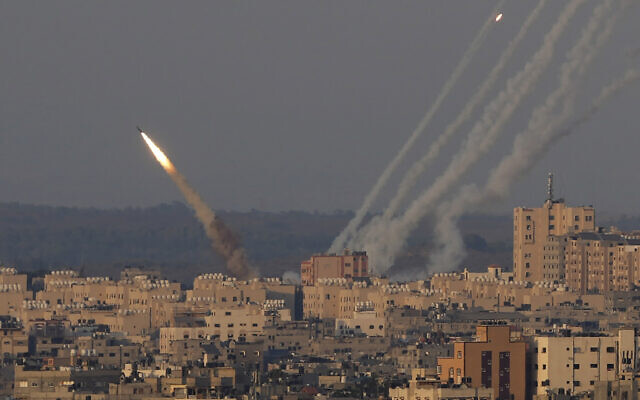
Rockets are launched towards Israel from Gaza City in the Gaza Strip, August 7, 2022. (Hatem Moussa/AP)

While dealing a blow to Islamic Jihad, Lapid said that Israel would “not apologize” for protecting itself, stressing that special attention was paid to minimize Gazan civilian casualties.

“During the entire operation, a special effort was made to prevent harm to non-involved civilians. The State of Israel will not apologize for protecting its residents with the use of force, but the deaths of innocent people, especially children, are heartbreaking,” Lapid said.

The IDF officially estimates that of the 51 people killed in Gaza during the operation, 24 were Islamic Jihad terrorists, 16 Gazans were killed by misfired Islamic Jihad rockets, and 11 non-combatants were killed in Israeli strikes.

The Gaza  Health Ministry, run by Hamas, said that at least 45 Palestinians had been killed, including 15 children, and 360 people had been wounded since Friday. Israel says as many as 12 of the children were killed by misfired PIJ rockets.

Several Israelis were lightly injured by shrapnel during the fighting, or while running for shelter when the rocket sirens sounded.

Continuing the extension of olive branches, Lapid thanked opposition leader Benjamin Netanyahu for putting politics aside and “backing the government” during the recent Gaza conflict.

In addition to thanking the security establishment and Egyptian mediators, Lapid said: “I would also like to thank the opposition and opposition leader Netanyahu, who showed responsibility and backed the government throughout the operation.”
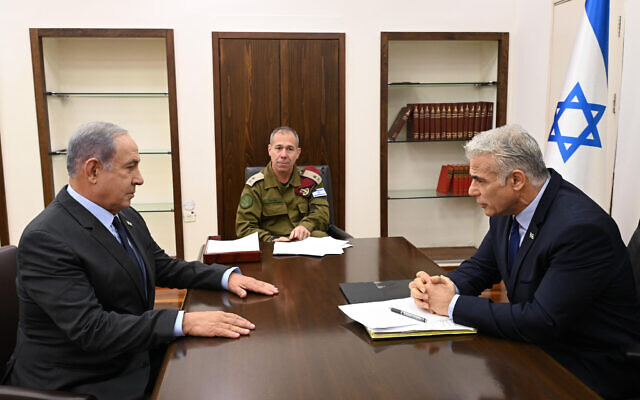
Opposition leader Benjamin Netanyahu (left) has a briefing on the Israel-Gaza conflict with Prime Minister Yair Lapid, August 7, 2022. (Haim Zach/GPO)

Despite the mutual mudslinging characteristic of current election campaigning, political rivals from across the blocs unified in support for the state and its military, as is characteristic of most Jewish Israeli politicians during a security event.

On Sunday, Netanyahu broke his year-long embargo on receiving security briefings from the outgoing government’s prime ministers, as befits his role as opposition leader. He also immediately came out in support of the military when the operation launched.

In a last whiff of unity, Netanyahu released a video address Monday night – at the same time as Lapid’s press conference – including a rare congratulatory message to the government he has repeatedly lambasted for being weak against terror, saying that “we are all united” when fighting terrorism.

“I congratulate the government, the Shin Bet and our beloved IDF soldiers on another successful operation against terror in Gaza. In the fight against terror, we are all united. There’s no opposition, there’s no coalition,” the opposition leader said.

Carrying the conciliatory note forward, Lapid echoed previous campaign calls for unity across Israeli society, cautioning politically polarized Israelis to “remember that our enemies are outside, not within us.”

“The right way to face our challenges is together,” the prime minister added.
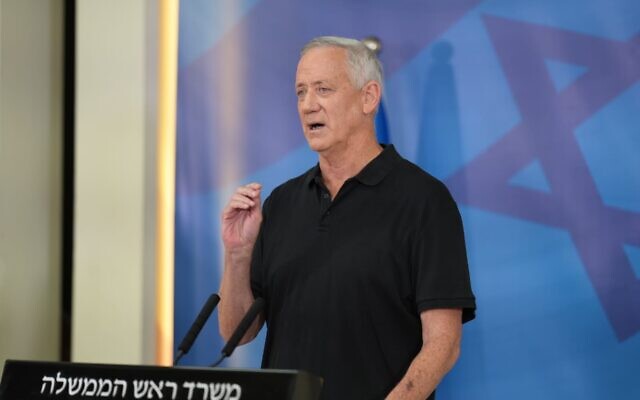
Defense Minister Benny Gantz speaks at the Kirya military headquarters on August 5, 2022. (Elad Malka)

Speaking after Lapid in a joint press conference, Defense Minister Benny Gantz articulated the three clear objectives Israel achieved in the operation: removing the “immediate threat” to residents of the Gaza border region; “maintaining operational freedom of action”; and preserving deterrence against enemies who threaten Israel’s citizens and sovereignty.

“In the future, if necessary, we will conduct preemptive strikes in order to protect the citizens of Israel, its sovereignty and infrastructure. This is true on each of the fronts, from Tehran [Iran] to Khan Yunis [Gaza],” the defense minister added.

Although Hamas prevented further escalation by bowing out of the conflict — serving the interests both of the terror group and Israel – Gantz emphasized that Israel will hold Hamas ultimately responsible for Gaza.

“Hamas bears responsibility for the territory in the Gaza Strip. Where the responsibility is not fulfilled, we will act forcefully, and we will use all the means at our disposal – military and civilian,” Gantz said.

Before the outbreak of fighting, Israel closed its border crossings with Gaza, which prevented 15,000 Gazans with permits from working in Israel over the past week. Additionally, Israel slowed the supply of fuel, which quickly crippled Gaza’s undersupplied power plants and led to widespread, uncomfortable electricity shortages.

Transitioning back into campaign mode, Netanyahu said in his address that, had the coalition that includes the Islamist party Ra’am not fallen in June, the government would not have been able to “fight terror” in the Gaza Strip.

“Only after this government with Ra’am fell, and only after Knesset dispersed, was it possible to go out to this operation,” Netanyahu said in his video message.

“Only a stable government that’s not reliant upon Ra’am and the [majority Arab] Joint List can fight terror,” he continued.

Netanyahu is campaigning against Lapid and Gantz in the upcoming November elections. Much of his Likud party’s messaging says that neither will be able to assemble the necessary 61 minimum of the Knesset’s 120 seats to form a coalition without including an Arab party.


State Department suggests deal’s restoration is in Tehran’s hands after EU submits ‘final text’ of drafted proposal; Iran expresses skepticism

The sun sets behind the Palais Coburg where closed-door nuclear talks take place in Vienna, Austria, August 5, 2022. (AP Photo/Florian Schroetter, File)

The sun sets behind the Palais Coburg where closed-door nuclear talks take place in Vienna, Austria, August 5, 2022. (AP Photo/Florian Schroetter, File)

The United States indicated on Monday it was prepared to “quickly” conclude a deal with Iran over its nuclear program, on the basis of a drafted agreement submitted earlier in the day by the European Union representatives in the negotiations.

“For our part, our position is clear: we stand ready to quickly conclude a deal on the basis of the EU’s proposals,” the State Department said, indicating the deal’s restoration was up to Iran.

“They (Iran) repeatedly say they are prepared for a return to mutual implementation,” the spokesperson added. “Let’s see if their actions match their words.”

Major power talks involving Britain, China, France, Germany, Iran and Russia, as well as the United States indirectly, and aimed at reviving an agreement over Tehran’s nuclear program resumed, on Thursday in Vienna, months after they had stalled.

The US, which abandoned the original nuclear deal four years ago under former president Donald Trump, described the tabled draft as “the best and only basis on which to reach a deal.”

The draft in question has been described by EU officials as a “final text,” with one official speaking on condition of anonymity saying “The negotiation is finished, it’s the final text… and it will not be renegotiated.”

“Now the ball is in the court of the capitals and we will see what happens,” the European official added. “No one is staying in Vienna.”

European Union’s foreign affairs chief Josep Borrell added on Twitter: “What can be negotiated has been negotiated,” adding, however, that “behind every technical issue and every paragraph lies a political decision that needs to be taken in the capitals.”

Illustrative: Secretary of State Antony Blinken, second left, meets with European Union foreign policy chief Josep Borrell, right, at the Sokha Hotel in Phnom Penh, Cambodia, August 4, 2022. (AP Photo/Andrew Harnik, Pool)

Key challenges to closing the deal remain. European officials over the weekend urged Iran to drop its “unrealistic demands” outside the scope of the original agreement, including over an International Atomic Energy Agency probe into undeclared nuclear material found in the country.

Iran said it was examining the text, but has raised skepticism about the chances for a breakthrough after a months-long stalemate.

“Naturally, the cases require comprehensive study,” Iran’s state-run IRNA news agency quoted an anonymous senior Iranian Foreign Ministry official as saying. “We will transfer our views and supplementary points.”

But Western diplomats have warned that time is running short, as Iran’s nuclear program rapidly advances under diminishing international oversight. They also worry looming midterm elections in the US could empower Republicans who oppose the accord.

Iran’s chief negotiator, Ali Bagheri, will shortly fly back to Tehran for political consultations, IRNA said. At the top of Iran’s theocracy is Supreme Leader Ayatollah Ali Khamenei, who would have the final say on any deal.

It was unclear how long the political consultations over the draft text would last.

But, Borrell said, “if these answers are positive, then we can sign this deal.”