For the third day in a row, residents of southern Israel have been held hostage by a terrorist group threatening to retaliate for the arrest by Israel of one of its operatives in the West Bank.
The summer is starting to get hot, and it’s not only the intense heat wave hovering over almost the entire globe.
Palestinian Islamic Jihad, whose West Bank leader Bassem Saadi was arrested by security forces for the eighth time on Monday, has broken the deterrence that the IDF claimed to have won following Operation Guardian of the Walls last year.
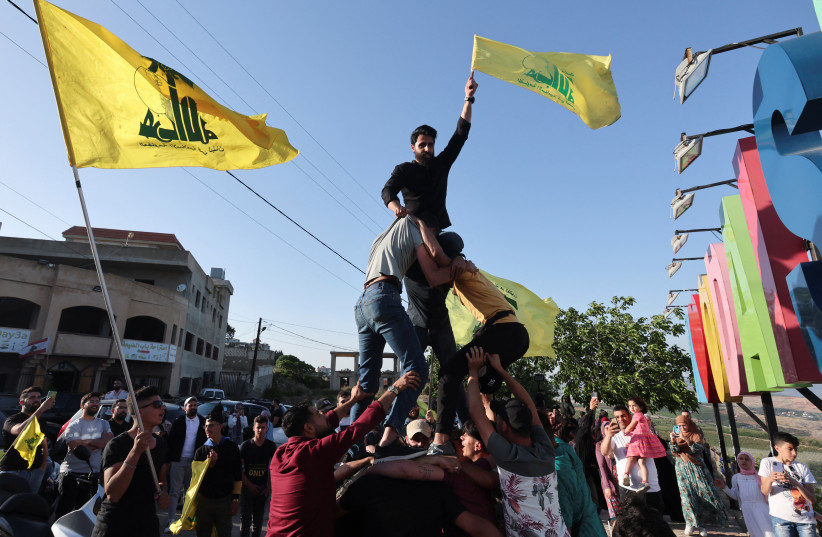
Supporters of Lebanon’s Hezbollah leader Sayyed Hassan Nasrallah, gather as they carry flags, marking the commemoration of Israel’s withdrawal from southern Lebanon in 2000, in Adaisseh village near the border with Israel, southern Lebanon, May 25, 2022. (credit: REUTERS/AZIZ TAHER)
The PIJ
Without even firing a shot, the terrorist group has been able to destroy the summer vacation of thousands of Israelis already suffering from years of almost non-stop violence and multiple rounds of attacks.
The closing of roads and heightened alert are not for naught. The military is bracing for anti-tank missiles, snipers and mortar fire. PIJ has previously targeted both civilian and military vehicles traveling close to the Strip. To them, it doesn’t matter if a bus full of children enters their sights or a military jeep. If they can hit it and kill Israelis, they will.
Unlike PIJ, Hamas is responsible for the millions of Gazans. Over the past year, 14,000 laborers and businesspeople have received permits to work in Israel because of the relative quiet and stability. But because of PIJ, those workers – who bring in millions of shekel to the Strip – are, like the Israelis of the South, stuck at home, unable to go to work.
With intensive mediation efforts by Egypt and Qatar and pressure by Hamas on the rogue group, Israel hopes that PIJ will be able to climb down from its tree of threats without any casualties. Perhaps its response will be symbolic: the firing of a rocket toward central Israel but aimed to fall in the sea, or a mortar launched toward open fields in the South.
As the days go on, there is cautious optimism that diplomacy is working. Israel has made it clear that it does not want another conflict inside the enclave, and neither does Hamas, which is trying to rebuild the Strip and increase its legitimacy with residents.
Is it possible that tempers will cool, roads will again be opened, and residents of the South will be able to leave their homes?
Hezbollah and their threats
At the same time, another terrorist group on Israel’s northern border is threatening war over gas in the Mediterranean.
Lebanon’s Hezbollah has issued threats against Israel over the Karish gas rig.
Hezbollah Secretary-General Hassan Nasrallah has become more and more aggressive in recent weeks, threatening that the terrorist army is ready and willing to go to war over Lebanon’s oil and gas fields.
But the country is in trouble.
Lebanon continues to spiral deeper and deeper into an economic black hole, two years after the explosion at the Port of Beirut. Last summer the country’s power system collapsed, plunging the entire country into darkness. Similar to Gaza, Lebanon receives less than 12 hours of electricity a day. In some areas of Lebanon, power cuts can even last up to 22 hours a day.
Hezbollah, which views itself as a protector of Lebanon, believes that the gas field is one of the only means of reviving Lebanon’s devastated economy.
Israel has said the rig is not in any disputed waters, but rather clearly in Israel’s exclusive economic zone. Seen as a strategic asset for Israel, the IDF will protect the rig, which is set to start drilling in less than a month.
The military views the northern border as the most dangerous front, with the potential for an escalation to break out any day. While some thought that Lebanon could have made peace with Israel a decade ago, Hezbollah has built up its arsenal with the help of Iran. It now has hundreds of thousands of rockets, anti-tank missiles and advanced weapons capabilities that have already put a dent in Israel’s freedom of operation in Lebanese skies.
The differences between Hezbollah v. Hamas
Hezbollah in 2022 is not the same Hezbollah of 2006. Should a war break out over a strategic economic asset, both sides would see intensive bombardment, destruction and high casualties, including civilians.
But unlike PIJ, Hezbollah is a terrorist group responsible for its citizens. It thinks twice before firing rockets or anti-tank guided missiles. The presence of cautious optimism that a deal might be reached in the coming weeks might allow everyone in the region to breathe a sigh of relief.
It’s a long shot, but perhaps Israel is able to get through one year without another round of violence, or war, breaking out.