
Move aimed at ‘lifting cruel sanctions against our country,’ Tehran says; ‘Our expectations are in check,’ US envoy says; talks have been stalled for 5 months

Iran's top nuclear negotiator Ali Bagheri Kani listens to Russian Foreign Minister Sergey Lavrov during a meeting in Tehran, Iran,  June 23, 2022. (AP Photo/Vahid Salemi, File)

Iran’s top nuclear negotiator Ali Bagheri Kani listens to Russian Foreign Minister Sergey Lavrov during a meeting in Tehran, Iran, June 23, 2022. (AP Photo/Vahid Salemi, File)

Iran said Wednesday it was sending a delegation to Vienna to resume talks to revive the frayed 2015 agreement on its nuclear program that have been halted since March.

“As part of the policy of lifting cruel sanctions against our country, Iran’s negotiating team led by Ali Bagheri, the Islamic Republic’s chief negotiator, will leave for Vienna in a few hours,” foreign ministry spokesman Nasser Kanani said in a statement.

“Heading to Vienna to advance the negotiations,” Bagheri tweeted.

“The Onus is on those who breached the deal and have failed to distance from ominous legacy. The US must seize the opportunity offered by the JCPOA partners’ generosity; ball is in their court to show maturity and act responsibly,” Bagheri wrote.

The United States and the European Union’s Iran nuclear envoys soon followed suit, announcing they were traveling to Vienna for talks with Tehran’s delegation as they seek to salvage the agreement on its atomic ambitions.

“Our expectations are in check, but the United States welcomes EU efforts and is prepared for a good faith attempt to reach a deal,” Malley said.

“It will shortly be clear if Iran is prepared for the same,” he added.
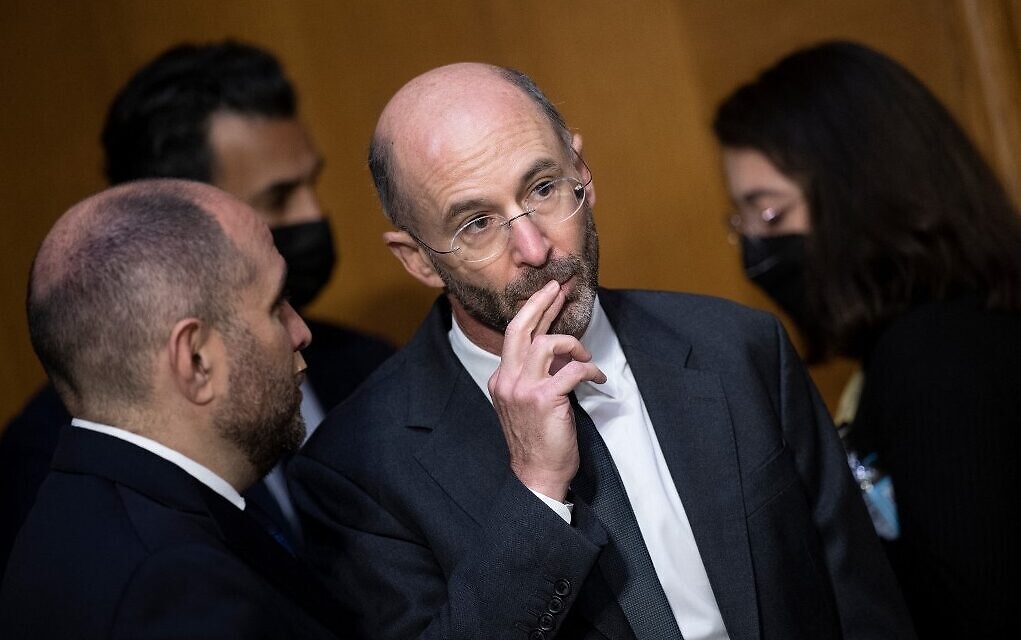
In this file photo from May 25, 2022, Robert Malley, Biden’s administration special envoy for Iran, waits to testify about the Iran nuclear deal during a hearing of the Senate Foreign Relations on Capitol Hill in Washington. (Brendan Smialowski/AFP)

EU nuclear coordinator Enrique Mora was also due in Vienna “to discuss (getting) JCPOA back to full implementation”, he tweeted, referring to the 2015 deal intended to prevent Tehran from developing a nuclear bomb.

Iran said it was “optimistic” about the talks.

Negotiations in Vienna began in April 2021 to restore the deal, but have stalled for the past five months amid differences between Tehran and Washington on several issues.

The two sides have negotiated indirectly through the European Union coordinator in a bid to bring the US back into the deal and to lift sanctions on Iran, on the basis that Tehran would return to its nuclear commitments.

Qatar hosted indirect talks at the end of June between the United States and Iran in a bid to get the Vienna process back on track, but those discussions broke up after two days without any breakthrough.

Last week, the EU foreign policy chief and coordinator of the nuclear talks between Iran and world powers, Josep Borrell, submitted a new draft text and urged all sides to accept it or “risk a dangerous nuclear crisis.”

Illustrative: European Union foreign policy chief Josep Borrell, right, speaks with Spain’s Foreign Minister Jose Manuel Albares Bueno during a meeting of EU foreign ministers in Brussels, July 18, 2022. (AP Photo/Virginia Mayo)

Iran expressed “optimism” that the talks would resume after Borrell’s draft compromise was reviewed.

“In this round of talks, which will take place as before with the coordination of the EU, discussions will be held regarding the ideas presented by the parties including those presented this week by Iran to the other party,” Kanani added.

The statement added that Iran hoped “the opposing parties will resolve the situation by taking the necessary decisions and seriously focusing on resolving the remaining issues.”

The Times of Israel staff contributed to this report. 


Senior Islamic Jihad official: We will bomb the center of Israel

The official denied that Hamas is trying to prevent the Palestinian Islamic Jihad from attacking Israel.

Iron Dome missile interceptors (left) launch at Hamas rockets (right) on their way from the Gaza Strip into Israel last week. (photo credit: ANAS BABA/AFP VIA GETTY IMAGES)
Iron Dome missile interceptors (left) launch at Hamas rockets (right) on their way from the Gaza Strip into Israel last week.
(photo credit: ANAS BABA/AFP VIA GETTY IMAGES)

Israel’s military is bracing for an attack near the border with Gaza, but other areas might be at risk as well.

For more stories from The Media Line go to themedialine.org

Khaled al-Batsh, head of the politburo of the Palestinian Islamic Jihad in the Gaza Strip, told The Media Line that central Israel is under threat by his organization.

“We have every right to bomb Israel with our most advanced weapons, and make the occupier pay a heavy price. We will not settle for attacking around Gaza, but we will bomb the center of the so-called State of Israel,” Batsh said.

In an interview with The Media Line on Wednesday, Batsh made it clear that Islamic Jihad intends to retaliate for the arrest of its West Bank commander, Bassam al-Saadi, late on Monday night. “The Palestinian Islamic Jihad can’t sit silent and watch the Israeli crimes, and the spilling of Palestinian blood in the West Bank and in the Gaza Strip,” he said.

Batsh also denied that Hamas is trying to prevent the Palestinian Islamic Jihad (PIJ) from attacking Israel, stating that contact between the organizations is ongoing. “No one attempts to stop us from using our right to stop the Israeli crimes,” he said.

 Palestinian Islamic Jihad militants take part in a rally to celebrate the shooting attacks in Israel, in Khan Younis, in the southern Gaza Strip April 8, 2022. (credit: REUTERS/IBRAHEEM ABU MUSTAFA)Palestinian Islamic Jihad militants take part in a rally to celebrate the shooting attacks in Israel, in Khan Younis, in the southern Gaza Strip April 8, 2022. (credit: REUTERS/IBRAHEEM ABU MUSTAFA)

“Our goal is to make the occupation pay for its crimes, and to prove that the Islamic Jihad will keep to its commitment to protect the Palestinian people and the resistance anywhere,” he added.

Cabinet meets to discuss tensions

Israeli security cabinet met Wednesday for a briefing by the heads of security Shin Bet, chief of staff and head of the intelligence corps, about the high tension in the area surrounding the Gaza Strip. The ministers were briefed about status and steps taken to protect residents of the area. Roads are closed and bus stations are heavily secured in the areas surrounding the Gaza Strip, as Israeli security forces estimate a coming attack from the Palestinian Islamic Jihad.

Security officials in Israel claim that both armed forces and civilians are at risk, as the PIJ might attempt to take revenge for the arrest of Bassam A-Saadi, a senior commander in the organization, which took place in the west bank city of Jenin Monday night. Videos of the arrest showing A-Saadi dragged on the ground and bit by a dog went viral on social networks immediately after the arrest, causing rage among the terror group supporters. In an unusual step, Israeli security forces published a photo of al-Saada after the arrest, attempting to prove he’s alive and calm down the flames.

‘If they wanted to shoot rockets – they would have already done that’

Eyal Hajbi, the security chief of Sha’ar HaNegev regional council talked to The Media Line about the difficulties in being on alert: “Not one bullet was fired, yet we’re already acting like there is a war going on. People take roads that take 40 minutes instead of 5 minutes, because of the roadblocks. Don’t get me wrong- it’s frustrating, but I understand where it’s coming from,” he says. “We want to prevent them [the Palestinian Islamic Jihad-A.K.] from getting a victory image, by bombing a vehicle or a sniper shooting a solider.”

Hajbi also has an estimation of what could be the form of the attack: an anti-tank missile, or a sniper attack. “If they wanted to retaliate by shooting rockets- they would have already done that. It’s these actions that require more preparation,” he explains. “And it’s dangerous because it can easily trigger an escalation. Don’t forget that Guardian of the Walls [May 2021 escalation between Israel and Hamas-A.K] started of an anti-tank shooting from the Gaza Strip.”

While the military is blocking more and more roads around Gaza, the PIJ keeps a fog around its plans, creating an atmosphere of uncertainty for the communities around the Gaza strip. “People here don’t really have a choice. We know where we live and accept the costs. But it’s inconvenient, and tense times like this make everyone more anxious in the long run,” says Hajbi.

The Israeli military didn’t respond to The Media Line’s enquiries by time the article was published.


As Tom Nides lobbies for legislation needed for Israel to join US Visa Waiver Program, Likud adamant it will not back the bills, claims it’s a lost cause this year anyway

US Ambassador to Israel Tom Nides (L) and opposiiton chairman Benjamin Netanyahu meet in the Knesset on December 9, 2021. (US Embassy in Israel)

US Ambassador to Israel Tom Nides (L) and opposiiton chairman Benjamin Netanyahu meet in the Knesset on December 9, 2021. (US Embassy in Israel)

US Ambassador to Israel Tom Nides warned Tuesday that time was running out to advance the three pieces of legislation necessary in order for Israel to be able to join the US Visa Waiver Program (VWP) by the end of next year.

“Continuing to work hard to get #VisaWaiverProgram done to benefit both Israelis and Americans. Can’t slow down now,” Nides tweeted.

The VWP allows citizens of participating countries to visit the US without applying for and being granted a visa, a process that takes time and money and is by no means assured to be successful.

The three required bills granting US authorities limited access to the information of US-bound travelers — as required of all VWP members — have been held up in the Knesset due to push-back from the Likud-led opposition. Nides sought to lobby lawmakers across the spectrum to get on board with the bills, seen as overwhelmingly popular among all Israelis, before parliament dissolved itself in June.

But the effort failed and now it will take the scheduling of emergency sessions in the coming months while the Knesset is in recess to pass the legislation. Otherwise, Israel will likely have to wait until at least 2024 to be added to the VWP, assuming it meets the criteria then.

But an official familiar with the matter told The Times of Israel that this year may be the only year that Israel will be able to qualify for the VWP, thanks to a combination of low travel numbers due to the pandemic, along with the US embassy’s effort to assist Israelis with their visa applications, which have historically been ridden with disqualifying mistakes. To date, Israel has never been able to keep its visa rejection rate below the three percent mark necessary to qualify for inclusion in the VWP.

Hours after Nides’ tweet, Channel 12 published an unsourced report claiming that the ambassador had recently met Netanyahu and sought to pressure the Likud leader to back the legislation amid fears that the effort will be delayed by an entire year if the laws aren’t advanced before the November 1 Israeli election.

Likud then issued a statement responding to the report, insisting that US law doesn’t allow for Israel’s entry into the VWP for another year anyway, suggesting that there is no real reason for urgency.

Toward the end of the year, US authorities will receive the visa rejection rate from the previous fiscal year, which ends in late September. If it is below three percent, as the embassy hopes, Israel will be able to join the VWP, as long as it meets the other criteria.

While there is no clear deadline for when the three pieces of legislation must be passed, the bills must be implemented for a period of time before Israel joins the VWP, computer systems must be put in place and the US ambassador must submit a formal request for the country to be added to the program. If Israel waits until after the November election, there may not be enough time to complete all of these steps, particularly given the real possibility that parties will subsequently fail to form a government, further extending the ongoing political deadlock.

Likud in its statement took issue with the legislation being advanced, claiming it violates the privacy rights of Israelis. The bill is believed to largely be a template of the legislation passed in the 40 other countries that have joined the US VWP.

“After we form a stable government, the Likud will submit the necessary, but responsible, legislation [to the Knesset] and complete the move by March 2023, so that inclusion in the VWP will not be delayed even one day,” Likud asserted.

Critics say Likud’s intransigence is an effort to avoid giving the outgoing government a political win.

International passengers arrive at Miami International Airport before they are screened by US Customs and Border Protection (CBP) using facial biometrics to automate manual document checks required for admission into the US on November 20, 2020, in Miami, Florida. (AP Photo/ Lynne Sladky)

Israeli efforts to become the 41st party to join the program have been underway for years. They received a boost last year when US President Joe Biden told then-prime minister Naftali Bennett that it was something he wanted to see through, and that he had instructed his staff to play its part in doing so.

In the absence of waiver program membership, US law requires Israelis to apply for a visa in advance of their travels to the US — a process that often takes months, as it requires scheduling an appointment at the US embassy for a background interview, during which consular staff seeks to ensure that incoming travelers are not looking to remain in the US indefinitely.

If a candidate passes the interview process, they must submit their passport to the embassy, and it usually takes several weeks before it is returned with a visa inside. The timeline has been further drawn out as a result of the pandemic, with some Israelis reporting that the only appointments available at the embassy are for a year forward.

Passing the relevant legislation and meeting the required rejection rate are not the only hurdles Israel must overcome.

In order to be included in the waiver program, countries must provide reciprocal privileges to all US passport holders at all points of entry. This will mean allowing all US citizens in Gaza and the West Bank visa-less entry into Israel — something Israel does not currently grant over what it says are security concerns.

It places similar visa limitations on Palestinian-Americans coming into Israel from abroad, which would also have to cease if Jerusalem wants to join the program.

A source close to Likud MK Yoav Kisch told The Times of Israel in June that the party also has issues with the US stipulation that authorities reduce pressure on Palestinian Americans who wish to transit through Israel.