
Israel has undertaken a major military effort against what it sees as an increased Iranian threat in Syrian territory.
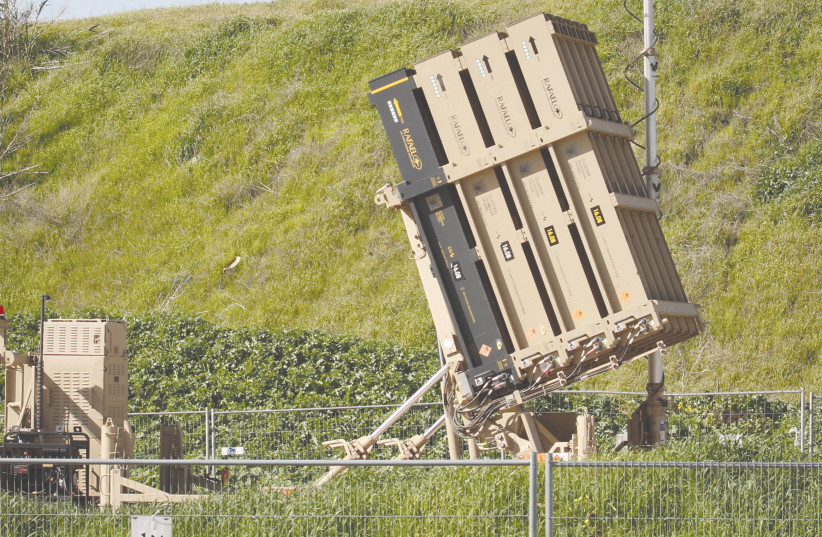
 AN IRON DOME anti-missile launcher is deployed in the center of the country in January 2019 amid tension in Syria and in the South. (photo credit: KOKO/FLASH90)
AN IRON DOME anti-missile launcher is deployed in the center of the country in January 2019 amid tension in Syria and in the South.
(photo credit: KOKO/FLASH90)

The quiet on Israel’s border with Syria is deceiving. Under the surface, and often away from the headlines, Israel has undertaken a major military effort against what it sees as an increased Iranian threat in Syrian territory.

For more stories from The Media Line go to themedialine.org

An enemy since the establishment of the Jewish state, Syria has evolved to become the host of a major threat to Israel. Israel once saw the Syrian army as a formidable enemy that possessed non-conventional weapons. While this is no longer the case; the threat has been replaced and the response has been altered accordingly.

The civil war in Syria, which erupted as part of the Arab Spring in 2011, severely weakened the regime and the army of President Bashar Assad. At first, Israel debated its position. The dilemma was whether to help Assad’s opposition topple a regime hostile to Israel or to be an uninvolved bystander. The latter option was chosen, while simultaneously providing humanitarian aid on the border, mostly behind the scenes.

Minor incidents

Over the years, there were occasional incidents of stray fire penetrating Israeli territory. Israel’s policy has been to respond to every fire toward the northern part of the country, whether intentional or not, asserting a breach of sovereignty.
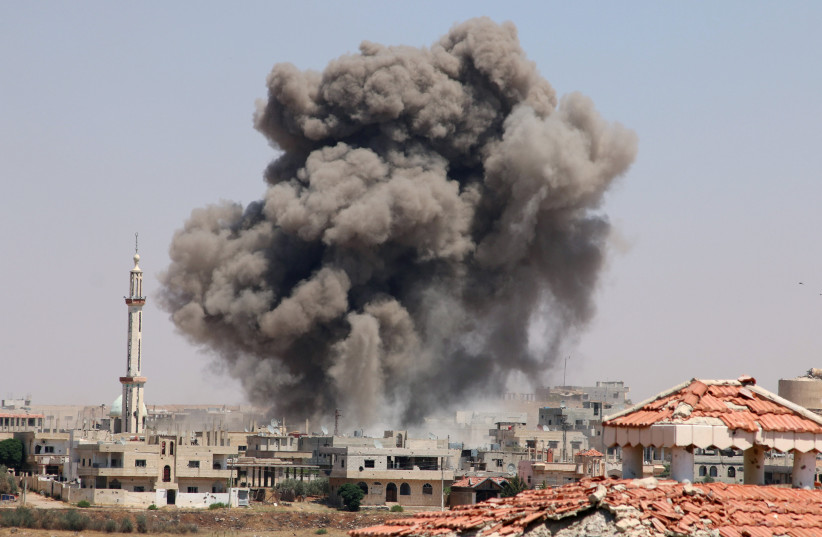
 Smoke rises after airstrikes on a rebel-held part of the southern city of Deraa, Syria, June 15, 2017 (illustrative). (credit: REUTERS/ALAA AL-FAQIR)Smoke rises after airstrikes on a rebel-held part of the southern city of Deraa, Syria, June 15, 2017 (illustrative). (credit: REUTERS/ALAA AL-FAQIR)

Assad in turn would condemn Israel, but given his unstable position, it was a well-rehearsed show by all participants that never escalated further.

Iran has been a major provider of support to Assad, seeing the stability of his regime as a major interest that needs to be defended. For Israel, this was a growing cause of concern.

Russia gets involved

Things became complicated in 2015 when Russia became directly involved in the civil war by inserting its forces into Syria, after several years of passive assistance. Thanks to Russian reinforcements, the turning point was quick to come. In 2016, when Assad managed to reestablish his hold on Syria’s second-largest city, Aleppo, the balance was tipped. Syria transformed into an arena where major geopolitical interests clash and coexist at the same time.

Israel needed to change its strategy. The decision was to undertake a “campaign between wars” aimed at curtailing the Iranian presence in Syria. The assessment in Israel is that Assad himself will not retaliate against Israel due to a range of domestic and regional interests. Limiting himself to weak condemnations, he has not contradicted Israel’s forecast.

As part of this campaign, Israel is believed to have carried out hundreds of strikes in Syria against militant groups, mainly against the Lebanese-based, Iranian-backed Hezbollah. Hezbollah uses Syrian soil to transport weapons to be used in future attacks on Israel. Israel has taken responsibility for only a handful of strikes against Iranian military installations in Syria and weapons convoys.

Last month, Israel is believed to have carried out an airstrike against Syria’s international airport in Damascus, causing extensive damage and shutting it down for weeks. Russia was quick to condemn the attack.

Experts consider Hezbollah to be Israel’s most immediate and dangerous threat, in possession of thousands of precise missiles.

“Israel’s strategic decision is to prevent Hezbollah from obtaining tie-breaking weapons or abilities,” said Dr. Yehuda (Udi) Blanga from Bar-Ilan University’s Department of Middle Eastern Studies.

“In recent years, another goal has been added by Israel,” said Dr. Carmit Valensi, the head of Syria research program at the Institute for National Security Studies, Tel Aviv University. “In light of all the challenges Assad is facing within Syria, there is an opportunity to drive a wedge between Damascus and Tehran.

“Israel believes that Iran has become a liability rather than an asset to the Assad regime and its stability,” Valensi added. “Israel is looking to accentuate the gaps between Iran and Syria.” This effort has so far found limited success. Assad has tried to curb Iranian movement in Syria, but the Iranians are not being cooperative.

Syria’s alignment with Shi’ite Iran puts it at odds with many Arab countries, including Gulf states. Assad, who needs assistance from these countries to rehabilitate his war-torn country, needs to make a decision.

“The Iranian plan to establish a strong presence in Syria has definitely been obstructed,” said Valensi. She attributes this not only to the ongoing Israeli campaign but also to the US’s assassination in Baghdad of Iranian General Qasem Soleimani, who was a leading figure in Iran’s involvement in Syria.

Soleimani’s demise served as a major dent in Iranian plans to establish its closest point of friction with Israel. Yet Hezbollah is still a threat that continues to increase its arsenal and improve the quality of its missiles.

“Israel has established a status quo that it has succeeded in maintaining,” said Blanga. “It has managed to prevent Hezbollah from operating from Syria, but it has not always succeeded in preventing Hezbollah’s armament.”

Syrian Civil War

The Syrian Civil War is part of a major change that the Middle East has been going through. Syria has become an arena in which this process can be visibly identified and where the changes in alignment are vividly demonstrated.

Later this week, Russian President Vladimir Putin is headed to Tehran where he will discuss developments in Syria. Turkish President Recep Tayyip Erdoğan will also be present, adding to the complexities.

Putin is not at peace with the Iranian presence in Syria.

“Israel needs to invest more in dialogue with Russia,” said Blanga. “The fact that Russia and Iran do not see eye-to-eye on Syria’s future is an advantage Israel should use. Israel needs to strengthen the dialogue with Russia in order to guarantee its freedom to act in Syria … but also maybe the Russians can convince Assad to curtail the Iranian presence in the country.”

“Russia wants to see Syria stabilized and rehabilitated,” said Valensi. “Iran has a destabilizing effect in Syria and they both are competing for influence and control over the country. Israeli strikes against Iranian targets serve Russian interests as well.”

In recent years, as Israel and several Arab states have normalized ties, Iran has emerged as a common enemy and Israel as its main active opponent.

“Israel is perceived as the only actor who is operating against Iranian presence in the region,” said Valensi.

“The US is hardly responding. This has positioned Israel as an actor with precise abilities and much-needed courage.”

Dr. Carmit Valensi

Israel is still far from reaching its goal and the existence of the Iranian presence in Syria is not threatened.

This guarantees not only the continuation of Israeli operations in Syria but also the continuation of tensions in the region that could spiral into a greater conflict at any time.


Iran wants Turkey, Russia backing for its Syria policy

In a conversation on the eve of the meeting of Iran’s President Ebrahim Raisi, Putin and Erdogan, Iran’s Fars News says that the meeting will seek to reduce any tensions in Syria.

 RUSSIAN PRESIDENT Vladimir Putin and Iranian President Ebrahim Raisi speak at the Caspian Summit in Ashgabat, Turkmenistan, on Wednesday.  (photo credit: SPUTNIK/GRIGORY SYSOYEV/REUTERS)
RUSSIAN PRESIDENT Vladimir Putin and Iranian President Ebrahim Raisi speak at the Caspian Summit in Ashgabat, Turkmenistan, on Wednesday.
(photo credit: SPUTNIK/GRIGORY SYSOYEV/REUTERS)

Iran hopes that by hosting Russia’s President Vladimir Putin and Turkish leader Recep Tayyip Erdogan that it will receive backing from Russia and Turkey and that Iran can also be a key broker to what is happening in Syria. The Iranian media reports on Monday night indicated the basic agenda of the meetings, as Turkey’s leader arrived in Iran.

Iran’s foreign minister has indicated that this important meeting will examine issues relating to Syria. Syria is therefore the first priority for Iran at the moment. Iran uses Syria as a place to entrench its forces and threaten Israel and US forces. In a conversation on the eve of the meeting of Iran’s President Ebrahim Raisi, Putin and Erdogan, Iran’s Fars News says that the meeting will seek to reduce any tensions in Syria.

“The Turkish side is talking about the possibility of a military operation up to 30 kilometers from the Syrian border, and we tried to resolve this crisis and Turkey’s security concerns from the political path.”

Iran’s Foreign Ministry

The issue of tensions is important because Russia is distracted by the Ukraine war. Turkey is demanding a new invasion of part of Syria. Meanwhile Russia could draw down forces, which could destabilize the Syrian regime by enabling Iran to grow its influence. Reports say Syria’s foreign minister may also visit Iran in coming days. Iran’s foreign ministry says that it wants to prevent a new Turkish military operation and a new security crisis in Syria. “The Turkish side is talking about the possibility of a military operation up to 30 kilometers from the Syrian border, and we tried to resolve this crisis and Turkey’s security concerns from the political path,” Iran’s foreign ministry said, according to the report.

A man cleans an area of a residential building damaged by a Russian military strike, as Russia's invasion of Ukraine continues, in Kharkiv, Ukraine July 11, 2022. (credit: REUTERS/NACHO DOCE)A man cleans an area of a residential building damaged by a Russian military strike, as Russia’s invasion of Ukraine continues, in Kharkiv, Ukraine July 11, 2022. (credit: REUTERS/NACHO DOCE)

“Of course, in this sensitive situation, one of the issues on the agenda is that instead of resorting to war and further displacement of a new wave of Syrian people, we can help solve this issue through political means,” the report said as well. “The foreign minister stated that the return of Syrian refugees to their homes and cities, helping peace, stability and security in Syria are among the issues that are on the agenda of this tripartite meeting.”

This is the seventh meeting of the three presidents. Iran has a new president, but Putin and Erdogan have guided their countries during the 11 years of the Syrian civil war. Russia, Iran and Turkey oppose the US role in Syria. “In this regard, Turkish President Recep Tayyip Erdogan is coming to Tehran this evening to participate in this meeting and make a bilateral trip, and Vladimir Putin is going to visit Tehran tomorrow,” the report says. That means that the Turkish leader’s trip is of utmost importance, at least in terms of the time spent in Iran. Putin’s trip is also historic because of the Ukrainian war and reports that Russia is seeking drone sales. If Syria’s foreign minister also comes, this will make for a series of key meetings regarding the future of Syria.

Meanwhile Turkish media says that Turkey could still try to freeze the ascension of Finland and Sweden to NATO. This illustrates that Turkey’s real interests are working with Russia and Iran and that opposing two democracies joining NATO is one of the goals of Ankara. Russia’s TASS media also reported that “Tehran is preparing the necessary documents to join the Shanghai Cooperation Organization (SCO), Iranian Ambassador to Russia Kazem Jalali said.” This forms part of the backdrop of the meetings in Iran. “The process of obtaining full membership in the Shanghai Cooperation Organization consists of numerous stages that a candidate country needs to implement within the established time frame,” Jalali pointed out. “According to the schedule, Iran is preparing documents, passing through these stages and notifying the Shanghai Cooperation Organization on a regular basis,” the envoy added.


   DailyWire.com
ZU_09 via Getty Images

Archaeologists from the University of North Carolina-Chapel Hill working in Israel unearthed depictions of Deborah, Jael, and other heroes from the biblical book of Judges.

A team led by professor Jodi Magness uncovered the three-panel mosaic — which is at least 1,600 years old — on the floor of an ancient Jewish synagogue in Huqoq, a village north of Tiberias, according to a press release. The mosaic is divided into three horizontal strips that depict scenes from the book of Judges — a historical account of the Israelites between the conquest of the promised land and the anointing of the first king.

One panel depicts prophetess Deborah looking at military commander Barak, who would lead the Israelite troops to victory over Canaanite general Sisera. Another panel shows Sisera seated, while a third shows a deceased Sisera bleeding from the head. According to the biblical account, Sisera fled after the battle and took refuge in the tent of Jael, who deluded the official into a false sense of security and drove a tent peg through his temple while he slept.


“This is the first depiction of this episode and the first time we’ve seen a depiction of the biblical heroines Deborah and Jael in ancient Jewish art,” Magness said. “We can see how the story might have had special resonance for the Jewish community at Huqoq, as it is described as taking place in the same geographical region — the territory of the tribes of Naphtali and Zebulon.”

According to the University of North Carolina, researchers first discovered mosaics at the site in 2012. Other mosaics show Samson using captured foxes to burn down the Philistines’ crops, Samson carrying the gate of Gaza upon his shoulders, as well as depictions of Moses, Noah’s ark, and the construction of the tower of Babel.

The period of the judges marked a chaotic time in the history of Israel, during which the people of God oscillated between faithful worship and idolatry. As the last verse in the book of Judges summarizes: “In those days there was no king in Israel. Everyone did what was right in his own eyes.” The book has been applied in the present day to comment on the dangers of postmodernism and the crisis of masculinity.

Last year, archaeologists discovered a fragment of a clay pot that dates back to the era of the judges. The fragment, which is 3,100 years old, included an inscription with the word “Jerubbaal” — a name for Gideon, the judge who led an army of 300 men to defeat the Midianite army.

Also last year, archaeologists discovered roughly 80 new Dead Sea Scroll fragments containing portions of biblical manuscripts — the first to be found in the desert south of Jerusalem in six decades. Experts were able to decipher 16 lines from the book of Zechariah: “These are the things that you shall do: Speak the truth to one another; render in your gates judgments that are true and make for peace; do not devise evil in your hearts against one another, and love no false oath, for all these things I hate, declares the LORD.”

The archaeologists also found coins from approximately 2,000 years ago, a skeleton of a mummified child dated at 6,000 years old, and what could be the oldest surviving basket in the world.
