
Russia and Iran Are Threatening the World With a New Cold War

JULY 17, 2022 4:28 PM

by Fiamma Nirenstein / JNS.org

OPINION

Service members of pro-Russian troops stand guard on a road before the expected evacuation of wounded Ukrainian soldiers from the besieged Azovstal steel mill in the course of Ukraine-Russia conflict in Mariupol, Ukraine May 16, 2022. REUTERS/Alexander Ermochenko

JNS.org — It may not be the Cold War, but it is beginning to look very like one. The United States is trying to build a network of alliances in the Middle East between Israel and moderate Arab countries. In response, Russian President Vladimir Putin has gone on the offensive, and is seeking to cement an alternative axis based in Tehran.

Putin’s move comes on the heels of US President Joe Biden’s trip to Israel and Saudi Arabia. As the world media covers Biden’s visits to Jerusalem, Jeddah and Riyadh, Putin is set to visit Tehran on July 19. He will be joined in Iran’s capital by Turkish President Recep Tayyip Erdogan to meet with Iran’s President Ebrahim Raisi, nicknamed “the butcher of Tehran” for having sentenced tens of thousands of people to death over the years.

The three leaders will take part in a summit that will ostensibly seek to broker an end to the 11-year Syrian civil war — the so-called “Astana peace process.” But it is difficult to believe that Putin would head to Iran for only his second foreign visit since he invaded Ukraine if the US had not just made the attempt to strengthen the American presence in the Middle East.

And it was a genuine attempt. Biden was not only looking for the Saudis to increase oil production and thus bring down skyrocketing fuel prices. He was also seeking support for normalization with Israel and the formation of an “Arab NATO” that would include the Jewish state. This bold move is a direct and potentially effective challenge to Iranian imperialism, and Tehran knows it. So does Putin.

So, Putin is on the move. He wants to intimidate the potential members of an Israel-Arab alliance, because such an alliance threatens his ambition to establish Russian hegemony in Eurasia — an issue that is all the more pressing as the Russia-Ukraine war drags on.

It’s not surprising that Putin is nervous. Biden’s optimistic remarks about his trip sent a very strong message: The US is deeply committed to the future of the Middle East. We have not disengaged. We are not weak. We are as strong as we have ever been and know we must be.

Besides his push for an Iranian axis, Putin turned to the weapon he employs most frequently — propaganda. Maria Zakharova, a Russian Foreign Ministry spokeswoman, attacked Biden’s request for increased oil production, saying it betrayed promises Biden made to US voters on renewable energy and climate change. But she went much further than this. She made the direst threat imaginable: that the US and its allies are pushing the world toward nuclear war.

Putin’s allies in Iran also chimed in to blast a potential Israel-Arab security alliance. The deputy head of Iran’s terrorist Revolutionary Guards, Yadollah Yavani, threatened a “decisive response” to America, the “Zionist regime” and Saudi Arabia.

Moreover, just as Biden was set to take off for Jerusalem, we learned that Iran will supply Russia with hundreds of drones and train Russian forces in how to use them. Previously, such drones had only been in the hands of Hezbollah and Hamas. Now, they are undoubtedly headed for Ukraine. Apparently, Iranian drones are always used against democracies and their innocent citizens.

Russia is lining up behind Iran diplomatically as well. Iranian Foreign Minister Amir Abdollahian recently visited Russia, and his Russian counterpart Sergei Lavrov said he is committed to seeing the removal of all sanctions on Tehran and the restoration of the 2015 nuclear deal.

Sides are forming up. The potential flash points are multiplying. And let’s not forget that, behind the scenes, China is expanding its presence in the Middle East and Africa. There is an abyss of possible new developments, and none of them are peaceful.

Fiamma Nirenstein was a member of the Italian Parliament (2008-13), where she served as vice president of the Committee on Foreign Affairs in the Chamber of Deputies. She served in the Council of Europe in Strasbourg, and established and chaired the Committee for the Inquiry into Anti-Semitism. A founding member of the international Friends of Israel Initiative, she has written 13 books, including Israel Is Us (2009). Currently, she is a fellow at the Jerusalem Center for Public Affairs.


Israeli military forces attacked two Hamas rocket manufacturing sites on Saturday in response to rockets fired at southern Israel from Gaza earlier in the day. The attack blew up 16 tons of underground explosives. Laser guided bunker buster bombs were used for the attack on Hamas, according to a Mako report.


Combat pilots targeted a Hamas underground facility in central Gaza used to produce rocket materials and a ground-level rocket manufacturing site.

The IAF air strikes, carried out “in response to rocket launches and machine gun fire from the Gaza Strip into Israeli territory,” were aimed at degrading the terrorists’ ability to manufacture rockets, the IDF said.


Just a few hours after President Joe Biden departed for Saudi Arabia from Ben Gurion International Airport, Gaza terrorists fired four rockets at Israel in two separate attacks.

There were no reports of physical injuries or damage in either attack. Two Ashkelon residents were treated for severe anxiety.


Two of the rockets, launched at around 1 am Saturday, were aimed at the southern coastal city of Ashkelon, and two others were aimed at the Lachish Regional Council district.

One of the rockets aimed at Ashkelon was intercepted by the Iron Dome aerial defense system, indicating it was headed to a populated area. The other landed in an open area.


At around 5 am, as Israeli forces were responding to that initial attack, Gaza terrorists launched the second round of rockets, triggering Red Alert incoming rocket sirens in Moshav Ahuzam, near Kiryat Gat. Both missiles landed in open areas.


“In response to the rockets fired from Gaza at Israel … we targeted one of Hamas’ most significant rocket production sites in Gaza,” the IDF said in a statement.

“This strike will significantly impede Hamas’ force-building capabilities. We will continue to defend Israeli civilians from Hamas’ terrorism,” the IDF added.


Iranian media showed several ships capable of launching drones, including a submarine.

 A drone flies above the Indian ocean, Iran, in this handout image obtained on July 15, 2022. (photo credit: IRANIAN ARMY/WANA (WEST ASIA NEWS AGENCY)/HANDOUT VIA REUTERS)
A drone flies above the Indian ocean, Iran, in this handout image obtained on July 15, 2022.
(photo credit: IRANIAN ARMY/WANA (WEST ASIA NEWS AGENCY)/HANDOUT VIA REUTERS)

Iran says it has launched a “flotilla” that is capable of carrying drones, but much remains unclear about this new “flotilla.”

Iranian media showed several ships capable of launching drones, including a submarine. For Iran, this is an accomplishment, but it also raises questions about the danger these UAVs pose. The reason this matters is because Iran’s drones increasingly are being used to target US forces in Iraq and Syria as well as targeting Israel and Gulf countries. Iran may also export drones to Russia.

Iran has used drones at sea for the last several years. It has unveiled these drone threats at exercises and also put drones on IRGC fast boats. In the past, the drone threat included short-range drones, as well as kamikaze drones. Last July Iran used drones to target a commercial tanker.

The new maritime “flotilla” shows that Iran wants to leverage its relatively small surface fleet by giving the fleet drones. Drones would expand the fleet’s capabilities and area of operation. The video of the drones being used included surveillance drones and drones likely capable of carrying munitions. Iran says the drones include those capable of “detection” and “destruction.” Iran International noted that the drones that will be deployed at sea include the Ababil-4 and others.

The fact that Iran unveiled this new drone capability at the same time that reports say Iran could supply Russia with drones illustrates that Iran wants to showcase its abilities. It also wanted to unveil this capability at the end of the Biden visit.

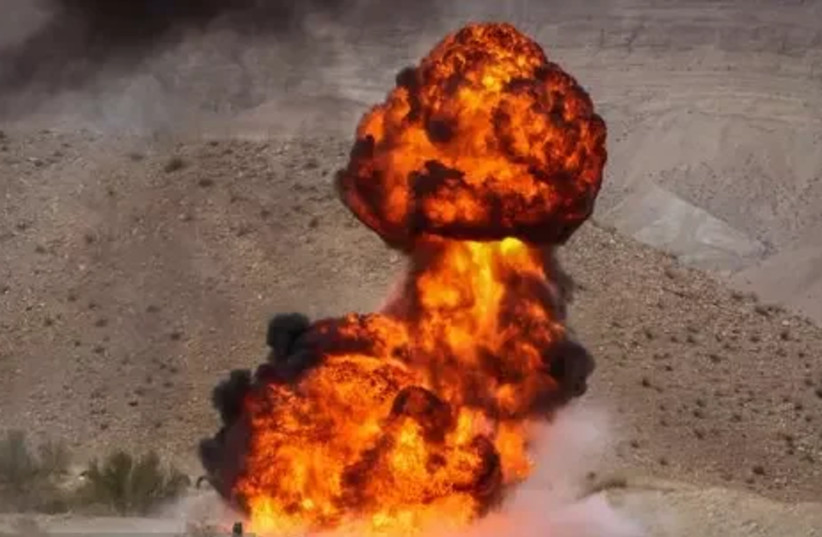
 An explosion is seen at an Iranian missile and drone test at the 17th Great Prophet drill in Iran. (credit: Ali Yeghane Lari/Mehr News Agency)An explosion is seen at an Iranian missile and drone test at the 17th Great Prophet drill in Iran. (credit: Ali Yeghane Lari/Mehr News Agency)

Biden’s visit

Iran’s media has been careful not to express too much concern about the Biden trip. That is reflected in news articles noting that Iran should try to work more closely with Saudi Arabia. Iran’s pro-government media wouldn’t be highlighting the chance for work with Riyadh if they intended to also raise tensions immediately. At the same time, the unveiling of the maritime drone “flotilla” is designed to show that Iran is an increasing presence in the Indian ocean and that its drones can and will operate far from home.
