International Fellowship of Christians and Jews, Israeli ministries bring 150 Ethiopian Jews to Israel


Ethiopian Jews arrive in Israel

Ethiopian Jews arrive in IsraelAvishag Shaar-Yashuv, IFCJ

The arrival of an Ethiopian Airways jetliner at Israel’s Ben Gurion airport earlier this week set the scene for an emotional reunion between family members, some of whom who hadn’t seen their relatives for as long as twenty years. The Aliyah flight consisting of 150 people was made possible through a joint initiative of the International Fellowship of Christians and Jews (IFCJ), Israel’s Ministry of Immigrant Absorption, Ministry of Interior, and the Jewish Agency as part of “Operation Zur Israel”.


The operation, which has been spearheaded by Pnina Tamano-Shata, Israel’s Minister of Immigrant Absorption, is designed to help the remaining community of Jews living in refugee camps in Gondar and Addis Ababa to make their way back to Israel. So far over 5,000 people who have first degree relatives already living in Israel have moved or are scheduled to move in the near future.


Escorting the group back to Israel, Yael Eckstein, President of the IFCJ, said helping to bring the final remnants of Ethiopian Jewry home to Israel is a central part of their mandate. “It’s a source of great pride to be able to assist hundreds more olim to come home. The most powerful part of this flight is knowing that many of these passengers have been waiting for decades for this moment and we see it as a central Zionist ideal to be able to make these types of reunions possible. We look forward to working with our partners in the Immigration Absorption Ministry to completing this operation as quickly as possible.”


Among the arrivals was 50 year old Astabal who said that he hadn’t seen his parents in 18 years since they moved to Tel Aviv. Another of the immigrants, Azanu Geremay Melesa similarly hasn’t seen her mother in nearly twenty years. She suffered the death of her eldest son recently after he fell fighting in the nation’s civil war, which helped spur the family’s decision to finally make the journey to Israel.


“When this awful thing happened to me, I was very lonely,” she says. “My mother, who I was very close with was not with me and when I couldn’t share my pain with her, it made the pain even worse. Coming to Israel was always our dream, and we believe only good things are going to happen to us there. I believe we are making a great choice and opens up a great opportunity for our children”.


Excited for to meet her grandchildren for the first time, Azanu’s mother and others in the community receive financial and medical support from the IFCJ. “It’s like an international circle of brotherhood and help,” she continued. “The Fellowship helps my mother in Israel and now the same Fellowship helps me to get to Israel to meet my mother. I am a really lucky person.”


Minister Tamano-Shata commented that “To be able to unite families who have been separated by thousands of miles allows us to finally address a failure that has affected the Ethiopian community for many years. These families have been waiting for this moment for decades. Through the partnership between our ministries, the Jewish Agency and the IFCJ we are able to witness another historic moment in Israel’s history where we have reaffirmed our commitment to do everything we can to bring our brothers and sisters home.”


Ranging in age from 6 to 50, the new immigrants will first live in five different absorption centers located around the country where they will be provided with Hebrew-language courses as well as training to help them acclimate into Israeli society and join the workforce.


“The Jewish Agency will continue to lead the aliya efforts from everywhere around the world and for every Jew who wants to move to Israel,” said Chair of the World Zionist Organization and Acting Chair of the Jewish Agency Yaakov Hagoel. “We deeply appreciate the work of all the partners who have made this possible and know that with every new oleh who comes home our country becomes that much stronger.”


Saudi Arabia welcomes back its Jewish community

Jewish organizations are showing their appreciation for the Saudi Prince, who has made it a priority to rebuild the local community.


You may like

Taboola


What is the agenda for the Eastern Mediterranean? – opinion

A more coherent common foreign policy agenda is needed to enhance the strategic significance of the Athens-Jerusalem-Nicosia partnership.

 PRIME MINISTER Yair Lapid, as foreign minister, meets with Greek Foreign Minister Nikos Dendias (center) and Cypriot Foreign Minister Ioannis Kasoulidis in Athens, in April.  (photo credit: Louiza Vradi/Reuters)
PRIME MINISTER Yair Lapid, as foreign minister, meets with Greek Foreign Minister Nikos Dendias (center) and Cypriot Foreign Minister Ioannis Kasoulidis in Athens, in April.
(photo credit: Louiza Vradi/Reuters)

In recent years, Cyprus, Greece, and Israel have significantly intensified their political, energy and military relations. The political leadership of the countries meets regularly. They coordinate their energy policies, particularly on the gas fields in the Eastern Mediterranean. In addition, they founded the East Mediterranean Gas Forum (EMGF), including Egypt, Italy, Jordan and the Palestinian Authority (PA). This became a regional cooperation platform for developing the natural gas fields in the Mediterranean.

Moreover, the three states conduct various military exercises honing their capabilities. Additional interactions in other areas cement this alignment, which is of political and strategic consequence. For example, it contributed to Turkey’s policy change toward the Abraham Accords and Israel.

A more coherent common foreign policy agenda is needed to enhance the strategic significance of the Athens-Jerusalem-Nicosia partnership. The first item on the agenda is better coordination in Washington to sensitize the United States to regional realities, as it does not seem to have a coherent policy toward this region.

Washington is obsessed with human rights in its approach to Egypt, the most important Arab state. In Libya, it tilts toward Islamist elements. The apex of strategic shortsightedness was the cancelation of its support for the EastMed pipeline (for supposed environmental reasons) that was planned to bring energy to Europe a few weeks before the Ukraine war, precipitating an energy crisis.

This administration needs better focus when approaching the region. As the US pivots its attention to China for understandable reasons, the Eastern Mediterranean region will get even less American attention. However, the rising energy prices might slow the American departure from the larger Middle East.

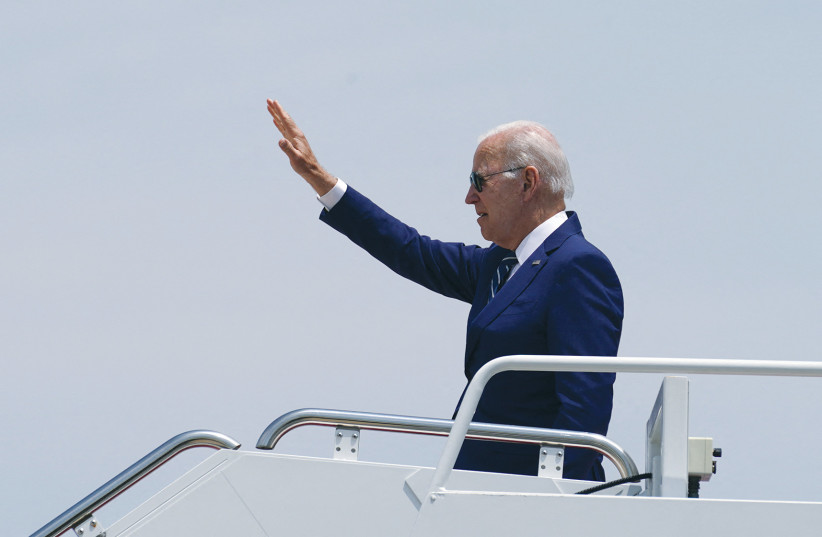
 US PRESIDENT Joe Biden waves as he boards Air Force One for a flight to Los Angeles this week. If Biden is coming to the Mideast to criticize and slow Israeli building in Judea and Samaria and greater Jerusalem, pull back, says the writer. (credit: KEVIN LAMARQUE/REUTERS)US PRESIDENT Joe Biden waves as he boards Air Force One for a flight to Los Angeles this week. If Biden is coming to the Mideast to criticize and slow Israeli building in Judea and Samaria and greater Jerusalem, pull back, says the writer. (credit: KEVIN LAMARQUE/REUTERS)

This period should be capitalized on to secure a better American understanding of the value of the trilateral alignment. President Joe Biden’s upcoming visit to Israel is an opportunity to enhance the American understanding of the utility of the Eastern Mediterranean alignment.

Alignment with Egypt, not Turkey

The second item on the common agenda regards Egypt, a member of the EMGF and a historical rival of Turkey. In addition, Greece and Cyprus have promoted military relations with Egypt, in the face of security threats and to help defend their interests in the Eastern Mediterranean.

Yet, Egypt is reluctant to join the Hellenic alignment with Israel, despite the significant improvement in Cairo-Jerusalem relations. Efforts toward integrating Egypt into the configuration are needed. Egyptian participation in the grouping could be highly beneficial to the four states.

The third common issue is Turkey, a revisionist power animated by Neo-Ottoman and Islamist impulses. It moderated its behavior for various reasons, but as long as President Recep Tayyip Erdogan is its leader, the potential for mischief is great.

Yet, the US exit from the region and a weakened Russia confer greater freedom of action to Turkey and other regional powers. The Ukraine war underscores the strategic importance of Turkey’s location. Moreover, the US will continue to hesitate in pressuring Ankara, in order to avoid pushing Turkey into Russian hands. These developments could encourage Turkish adventurism. Containing Turkey will continue to be a significant challenge.

A fourth common issue relates to the new West Asia Quad grouping of the United States, India, Israel and the United Arab Emirates (UAE). New Delhi is attempting to build an alternative to the Chinese Belt and Road enterprise by linking India to the Mediterranean via the UAE and Israel.

Such an endeavor will endear its participants to Washington. Israel, the UAE and the Hellenic nations should promote this alternative. Furthermore, establishing this Quad will strengthen the Abraham Accords, which are young and fragile. People in the Gulf have not, yet, internalized the inherent advantages of recognizing Israel, the Jewish state. Moreover, the Abraham Accords are contingent upon Israel making good on the expectation that it will end the Iranian threat.

Ukraine reminded us that war is still a policy option even in Europe. The Eastern Mediterranean and the Middle East are conflict-ridden and more bellicose regions than Europe.

Alas, international law and guarantees have proved ineffective in preventing predatory states from aggression. This is no surprise for those that realize the perennial chaotic nature of the international system where there is no international policeman to maintain law and order.

This means that states belonging to the Athens-Jerusalem-Nicosia alignment must prepare for war without illusions. While intra-alignment relations should be strengthened, it is worth remembering that this is not an alliance. Israel should be the model and its self-reliance doctrine must be emulated. Each state must invest in defense and enhance military capabilities and deterrence. Weakness always invites aggression.

Implementing this agenda is a national security imperative for the alignment and the US should actively promote it. Moreover, it could provide a modicum of stability in a bad neighborhood. Athens and Jerusalem, the founding blocks of Western civilization, should show the way for the rest of the world.

The writer is president of the Jerusalem Institute for Strategy and Security (JISS).