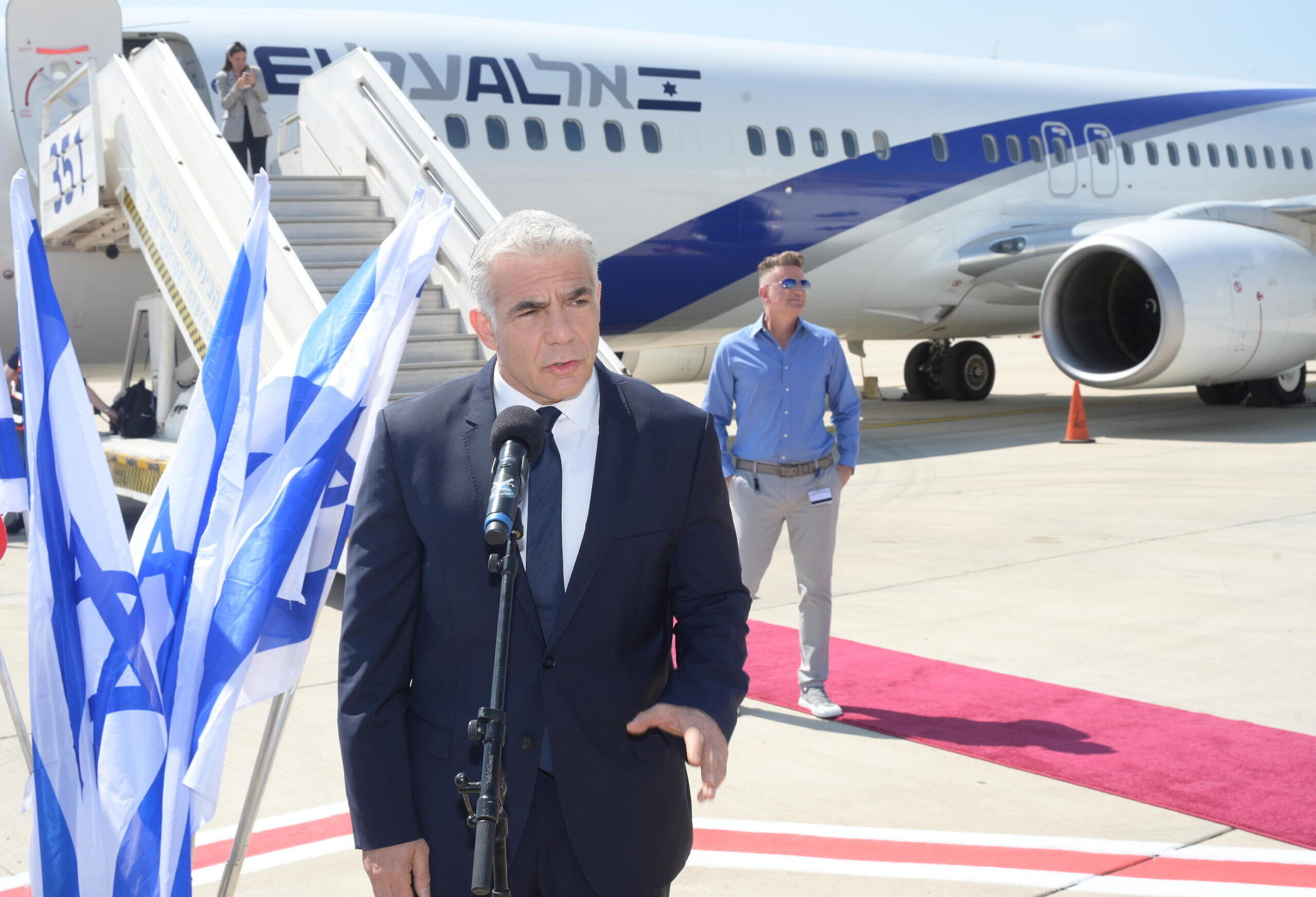
Prime Minister Yair Lapid threated Tuesday morning to “rein in” Hezbollah if Lebanon doesn’t force the Iran-backed terror group to stop attacking Israel’s natural gas assets in the Mediterranean Sea.
Lapid made the remarks to reporters as he prepared to board a plane for Paris, where he is set to hold talks with French President Emmanuel Macron.
The prime minister said that he would discuss with Macron “the repeated attacks on Israeli gas rigs.”
“Israel will not tolerate these attacks,” he said. “Anyone who does this is taking an unnecessary risk.”
Lapid called on the Lebanese government to “rein in Hezbollah from these attacks, or else we will need to do it.”
The Israel Defense Forces said Saturday that it had successfully
intercepted three drones flown by Hezbollah that were heading for the Karish natural gas field off Israel’s Mediterranean coast.
Tensions have risen over the site in recent weeks after an Israeli-contracted gas production vessel arrived at Karish to launch extraction operations in the offshore field, drawing condemnation from Lebanon, which had laid claim to parts of it. Hezbollah issued threats against the move, vowing to defend Lebanon’s resources. Israel says Karish is inside its UN-recognized exclusive economic zone.
France, which was granted the mandate to administer Lebanon in 1923 by the League of Nations, has been a major player in Lebanese politics and economy ever since.

A drone which the Israeli military says was launched by the Lebanese Hezbollah terror group, is seen shortly before being intercpted by an Israeli fighter jet over the Mediterranean Sea, July 2, 2022. (Israel Defense Forces)
In his remarks, Lapid highlighted that a key element of his trip is the fact that France is one of the E3 group of European countries that are dealing with the Iran nuclear deal.
“It is important that our opinion against this dangerous agreement be heard at this time, against Iran’s nuclearization,” he said. “It is also important that the international community knows that on the Iranian issue, Israeli society stands together, as one body, with one position.”
Lapid will meet with Macron, a close friend, in the mid-afternoon Tuesday at the Elysee Palace followed by a broader session with the two leaders’ aides. The visit was set up before Lapid became prime minister last week, at a time when he was still foreign minister — a post he still holds. He will head back to Israel Tuesday evening.
Message to Lebanon, pressure on Iran
A senior Israeli official said Lapid would look to send a stern message to Lebanon and Hezbollah during his meeting with Macron.
“We want the French president to use his connections to make clear to the Lebanese government we intend to complete the negotiations,” the official said Monday, referring to indirect talks between Israel and Lebanon over the disputed maritime boundary between the countries. “We want to do it, but we won’t be able to do it under Hezbollah threats.”
“Hezbollah should not play with fire,” added the official, warning that a strike on a gas platform “could be a very dangerous act.”
“The prime minister will present new materials that will explain how Hezbollah endangers Lebanon’s security and stability,” the official said.

An Israeli Sa’ar Class 4.5 missile boat guards the Energean floating production, storage and offloading vessel at the Karish gas field, in footage published by the military on July 2, 2022. (Israel Defense Forces)
In addition to the warning to Hezbollah, Israel hopes Macron will send a more conciliatory message to Lebanon’s government. “The message we want to be sent to them is that it would extremely beneficial for them to take advantage of the present opportunity,” said the official, stressing US energy envoy Amos Hochstein’s active involvement in the maritime border issue.
“We can get to an agreement,” said the official, “if they don’t let Hezbollah get in the way.”
If the Iran-backed terror group continues threatening Israel’s gas fields, warned the official, “it could cause a deterioration that we are not interested in.”
Regarding the Iran nuclear deal, the official said the prime minister will work to synchronize Israeli and Western pressure on Iran, and will emphasize Israel’s desire for a long-lasting, effective nuclear deal.
Israeli officials will stress that the US and the E3 — Germany, the UK, and France — can’t let Iran play for time by drawing out negotiations, which recently resumed in Qatar after a months-long hiatus.
“We expect that there will be some end to these never-ending talks,” said the official. “There is nothing fundamentally different in these talks [in Doha] than in the previous ones.”

US special envoy for Iran Robert Malley and United States’ top negotiator for Iran nuclear talks, center, speaks at the Doha Forum in Qatar, March 27, 2022. (AP Photo/Lujain Jo)
The nuclear deal, formally known as the Joint Comprehensive Plan of Action, gave Iran relief from sanctions in return for curbs on its nuclear program to prevent it obtaining a nuclear bomb. It was signed by Iran along with the US, UK, France, Germany, Russia and China. The Trump administration pulled out of the JCPOA in 2018 saying it was not comprehensive enough and reimposed sanctions on Iran. The Iranians responded by dropping most of their own obligations and ramping up the nuclear program, in particular enrichment of unranium which could be used to produce a weapon.
Israel also expects the investigation into the killing of Palestinian journalist Shireen Abu Akleh to come up in Tuesday’s meeting, according to the official.
Personal friendship
The friendship between Lapid and Macron goes back to before either of them was in their current position. Lapid took the unusual step of endorsing Macron in the 2017 presidential election, and Macron seemed to return the favor by hosting him at the Elysee Palace in Paris only four days before the April 2019 elections in Israel.
In late November, Lapid visited Paris and met with Macron at the end of a three-day trip to Europe, seen largely as focused on the Iran nuclear talks in Vienna.

French President Emmanuel Macron (C) meets with then-opposition Blue and White MKs Benny Gantz (R) and Yair Lapid in Jerusalem on January 22, 2019. (Elad Malka)
After Macron’s electoral victory in April, Lapid referred to the centrist Macron as “my good friend” and shared a photograph of the two men embracing.
There have been a number of signs that, with the election behind him, Macron intends to improve ties with Israel.
French Ambassador to Israel Eric Danon told visiting French parliamentarians last July that Macron intends to reset relations with Israel if he is reelected in 2022, according to a diplomatic source with knowledge of the meeting.
Macron’s appointment of Danon was itself an important indication of where he wants to take the relationship. Danon, a close confidant of the French leader, is not a typical diplomat, said Emmanuel Navon of the Jerusalem Institute for Strategy and Security, and is “very well disposed toward Israel.”
That disposition was on full display last July, when Danon gave a surprisingly muscular speech at Bastille Day celebrations, stressing France’s position that “the mullahs’ regime [in Iran] should never possess the nuclear bomb.”