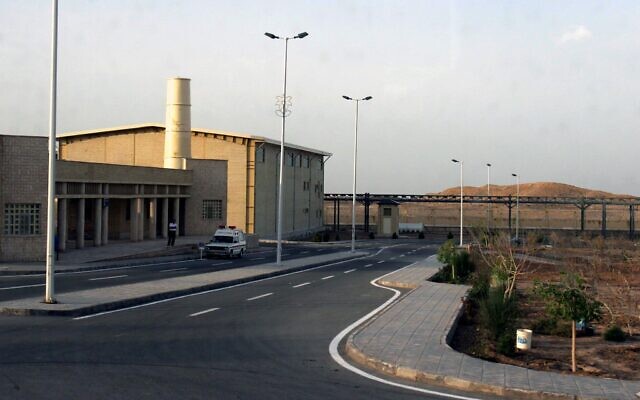
The Hezbollah leader stressed that Israel only understands “force and superiority.”
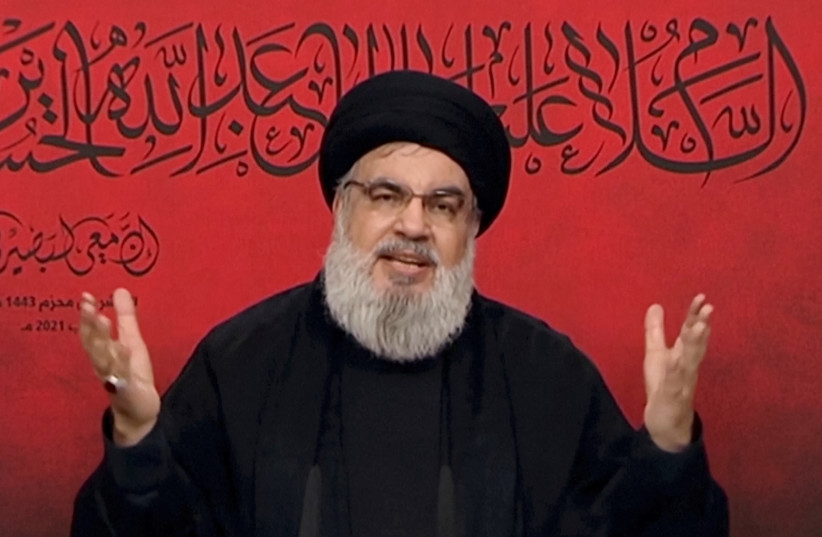
 Lebanon's Hezbollah leader Sayyed Hassan Nasrallah speaks through a screen during a religious ceremony marking Ashura (photo credit: AL-MANAR/HANDOUT VIA REUTERS)
Lebanon’s Hezbollah leader Sayyed Hassan Nasrallah speaks through a screen during a religious ceremony marking Ashura
(photo credit: AL-MANAR/HANDOUT VIA REUTERS)

Hezbollah leader Hassan Nasrallah warned on Thursday that the Iranian-backed group will stop Israel from extracting natural gas from the Karish field off the coast of northern Israel, adding that the issue could spread outside Lebanon.

Nasrallah pointed to the recent arrival of the Energean Power floating gas rig off the coast of Haifa, warning that the ship had arrived to extract natural gas, but admitting that the rig was not located in disputed waters, but instead nearby.

“What happened in the past few days is an attack on Lebanon and put Lebanon in a difficult situation, even if we are talking about a disputed area from the point of view of officials.”

Hezbollah Secretary-General Hassan Nasrallah

The Hezbollah leader stressed that the issue of the Karish field needed to become a “major Lebanese issue.”

“We have before us a huge wealth estimated at hundreds of millions and it belongs to the Lebanese people, and this wealth is the only hope to stop the collapse and address the problems we suffer,” said Nasrallah, claiming that the US and Israel were trying to strip large areas away from Lebanon and prevent extraction companies from working with Lebanon.

 Floating gas production rig, Energean Power (credit: ENERGEAN)Floating gas production rig, Energean Power (credit: ENERGEAN)

Nasrallah warned that “time is not in Lebanon’s favor,” as a delay until after the start of extraction would mean the loss of the benefits of the field from Lebanon.

The Hezbollah leader pointed out that while the ship is outside the disputed area, it will still be drawing gas from within the disputed area. “Lebanon in this confrontation possesses the right, the motive and the utmost need, and it possesses the strength under the title of the army and the resistance.”

Nasrallah added that Hezbollah “possesses the military, financial, security, informational, logistical and many capabilities to prevent the enemy from extracting oil and gas from the Karish field.”

“Intimidation and threats of the enemy we are used to, but if they commit any mistake, its repercussions will not be strategic but existential, and it is not known if the problem will remain only with Lebanon.”

Hezbollah Secretary-General Hassan Nasrallah

The Hezbollah leader added that if the Lebanese government chooses the route of negotiations, the movement will stand by the negotiating party and “strengthen its position.”

Nasrallah warned that while some Lebanese people were interested in signing a decree to fix the demarcation line, “We are in front of an enemy that does not recognize international resolutions, and the only logic that it follows is the logic of force and superiority. By experience, it does not respond to any international resolution and responds only with pressure and resistance.”

“The able resistance cannot stand idly by in front of the looting of Lebanon’s wealth, and it will not stand idly by,” stressed Nasrallah, warning that “all options are open” and that Hezbollah “does not fear” war.

The Hezbollah leader demanded that Israel stop any work on extracting gas from the Karish field until negotiations with Lebanon are completed. Nasrallah also threatened the Energean company, saying it is a “partner in the attack on Lebanon,” and waring that this has “consequences.”

“America and the enemy entity tell us that they will extract from the disputed area, and you cannot say anything, and even in the Lebanese region we do not allow, however they are starving the Lebanese people, and this will lead to a loss of social security in addition to collapse,”

Nasrallah claimed that the US and Israel were saying that they would extract gas from the disputed area and that Lebanon could not do anything about this, warning that this would “starve the Lebanese people” and lead to a loss of social security and collapse.

“We can prevent collapse and loss of security, but there is a risk,” said Nasrallah. “But if the enemy understands that this is a comprehensive national issue, we may not have to go to adventure, and much depends on this.”

“Nasrallah should keep hiding in his bunker”

Finance Minister Avigdor Liberman rejected Nasrallah’s threats on Thursday, tweeting “No one will dictate to us whether or not to extract gas from the economic waters of the State of Israel. Israel is a sovereign state and will continue to make decisions solely in accordance with its interests without regard to the threats of such or other terrorists.”

“I suggest Nasrallah continue to hide in the bunker, his videos from there do not impress anyone.”

Finance Minister Avigdor Liberman

Defense Minister Benny Gantz, Foreign Minister Yair Lapid and Energy Minister Karin Elharrar warned on Wednesday that Israel is prepared to defend the Karish gas reservoir and rig, which is entirely in Israeli territory.

“With its anchoring, the rig is located in Israeli territory, several kilometers south of the area over which negotiations are being conducted between the State of Israel and the Republic of Lebanon, mediated by the United States,” they added. “The rig will not pump gas from the disputed territory.”

Lebanese President Michel Aoun claimed that the vessel entered “the disputed maritime area with Israel… [and] any action or activity in the disputed area represents a provocation and an aggressive action.”

Lahav Harkov contributed to this report.

Iranians inform IAEA they will install two new cascades of advanced IR-6 centrifuges at underground Natanz nuclear facility; move comes as agency votes to censure Tehran


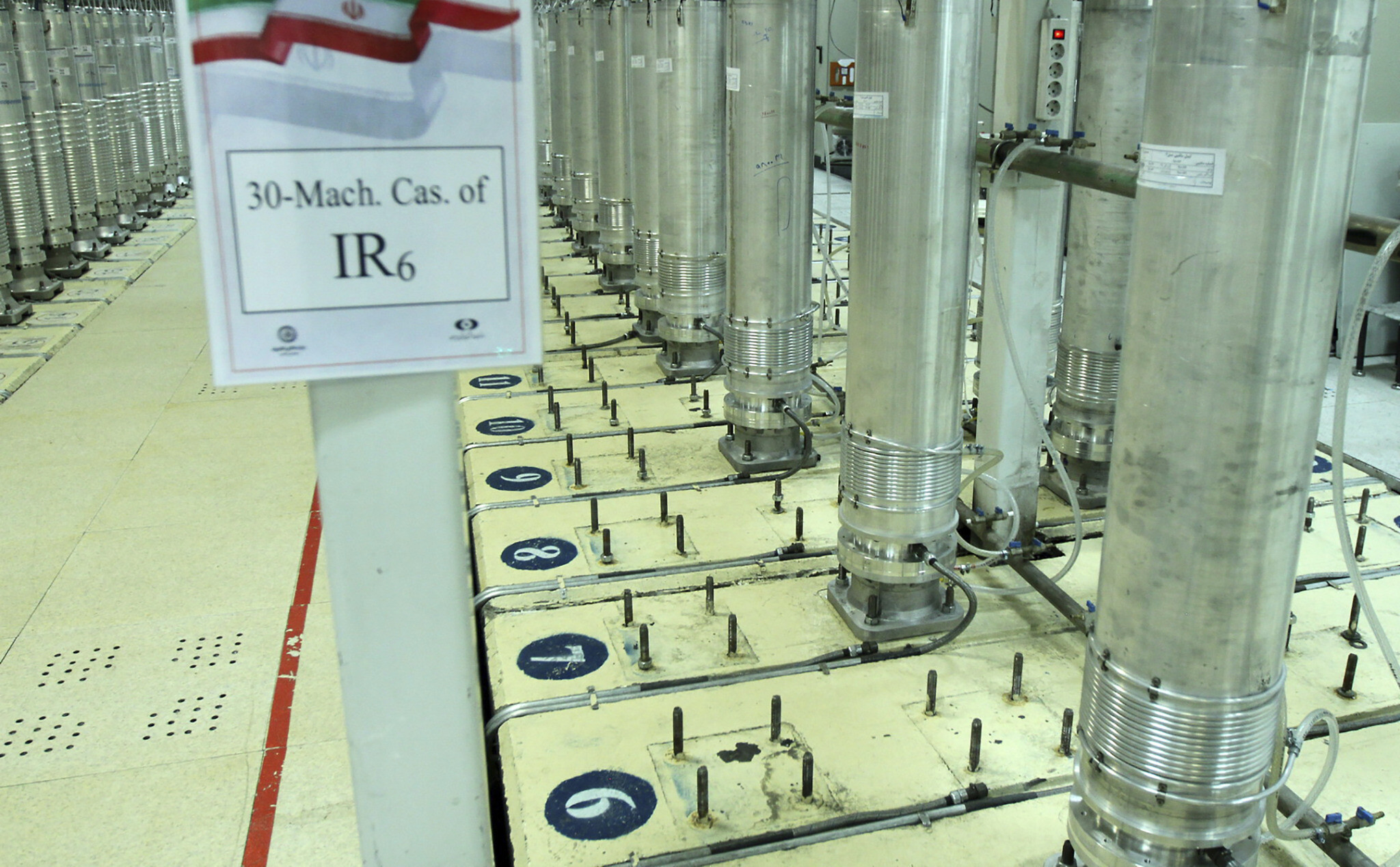
Centrifuge machines in the Natanz uranium enrichment facility in central Iran, in an image released on November 5, 2019. (Atomic Energy Organization of Iran via AP, File)

Centrifuge machines in the Natanz uranium enrichment facility in central Iran, in an image released on November 5, 2019. (Atomic Energy Organization of Iran via AP, File)

DUBAI, United Arab Emirates (AP) — Iran plans to install two new cascades of advanced centrifuges that will allow Tehran to rapidly enrich more uranium, the UN’s nuclear watchdog said Thursday, the latest escalation in the standoff over the country’s atomic program.

The decision to add the two IR-6 centrifuges cascades at its underground Natanz nuclear facility comes as countries at an International Atomic Energy Agency meeting in Vienna voted Wednesday night to censure Iran. The rebuke deals with what the watchdog refers to as Iran’s failure to provide “credible information” over man-made nuclear material found at three undeclared sites in the country.

But even before the vote, Iran shut off two devices the IAEA uses to monitor enrichment at Natanz. Iranian officials also threatened to take more steps amid a years-long crisis.

The IAEA said Thursday that its Director-General Rafael Mariano Grossi told members that Iran informed the agency that it planned to install two new cascades of the IR-6 at Natanz. A cascade is a series of centrifuges hooked together to rapidly spin uranium gas to enrich it.

An IR-6 centrifuge spins uranium 10 times as fast as the first-generation centrifuges that Iran was once limited to under its 2015 nuclear deal with world powers. As of February, Iran already had been spinning a cascade of IR-6s at its underground facility at Fordo, according to the IAEA.

At Natanz, located some 200 kilometers (125 miles) south of the capital, Tehran, Iran earlier said it planned to install one cascade of IR-6s. The IAEA said it “verified” the ongoing installation of that cascade Monday, while the newly promised two new cascades had yet to begin.

File: Iran’s nuclear enrichment facility in Natanz, Iran (AP Photo/Hasan Sarbakhshian)

Iran and world powers agreed in 2015 to the nuclear deal, which saw Tehran drastically limit its enrichment of uranium in exchange for the lifting of economic sanctions. In 2018, then-US president Donald Trump unilaterally withdrew America from the accord, raising tensions across the wider Middle East and sparking a series of attacks and incidents.

Talks in Vienna over Iran’s tattered nuclear deal have been stalled since April. Since the deal’s collapse, Iran runs advanced centrifuges and has a rapidly growing stockpile of enriched uranium.

Nonproliferation experts warn Iran has enriched enough up to 60% purity — a short technical step from weapons-grade levels of 90% — to make one nuclear weapon should it decide to do so.

Iran insists its program is for peaceful purposes, though UN experts and Western intelligence agencies say Iran had an organized military nuclear program through 2003.

Building a nuclear bomb would still take Iran more time if it pursued a weapon, analysts say, though they warn Tehran’s advances make the program more dangerous. Israel has threatened in the past that it would carry out a preemptive strike to stop Iran — and already is suspected in a series of recent killings targeting Iranian officials.

Iran already has been holding footage from IAEA surveillance cameras since February 2021 as a pressure tactic to restore the atomic accord.

Rafael Grossi, director general of the International Atomic Energy Agency, attends the quarterly IAEA Board of Governors meeting at the agency headquarters in Vienna, Austria, June 6, 2022. (JOE KLAMAR / AFP)

The censure resolution at the IAEA meeting in Vienna, sponsored by Germany, France, the UK and US, passed with the support of 30 of 35 governors. Russia and China voted against, Russian ambassador Mikhail Ulyanov wrote on Twitter. India, Libya and Pakistan abstained.

After the vote, a joint statement from France, Germany, and the UK and the US said the censure “sends an unambiguous message to Iran that it must meet its safeguards obligations and provide technically credible clarifications on outstanding safeguards issues.”

Iran’s Foreign Ministry meanwhile criticized the censure as a “political, incorrect and unconstructive action.”

An Iranian official earlier warned IAEA officials that Tehran was now considering taking “other measures” as well.

“We hope that they come to their senses and respond to Iran’s cooperation with cooperation,” said Behrouz Kamalvandi, a spokesman for the Atomic Energy Organization of Iran. “It is not acceptable that they show inappropriate behavior while Iran continues to cooperate.”

Wednesday night, a drone exploded in the northern Iraqi city of Irbil in its Kurdish region, slightly wounding three people and damaging cars and a nearby restaurant, officials said. While no one immediately claimed the attack, Iran has targeted Irbil in the past amid the regional tensions.


Iranian supreme leader says combating Jewish ‘conspiracies’ is an ‘essential duty’ during pilgrimage to Saudi Arabia, decries normalization deals with Israel


Iranian Supreme Leader Ayatollah Ali Khamenei speaks on the anniversary of the death of the late founder of the Islamic Republic, Ayatollah Ruhollah Khomeini, shown in the poster at top center, at his mausoleum in Tehran, Iran, June 4, 2022. (Office of the Iranian Supreme Leader via AP)

Iranian Supreme Leader Ayatollah Ali Khamenei speaks on the anniversary of the death of the late founder of the Islamic Republic, Ayatollah Ruhollah Khomeini, shown in the poster at top center, at his mausoleum in Tehran, Iran, June 4, 2022. (Office of the Iranian Supreme Leader via AP)

Iran’s Supreme Leader Ayatollah Ali Khamenei said on Wednesday that combating “Zionists’ plots” was a necessary part of the Muslim hajj pilgrimage to the Saudi city of Mecca.

“Exposing the Zionists’ plots and conspiracies is one of the essential duties in hajj,” Khamenei told Iranian officials who organize the event, according to the Iranian Fars news agency. The report did not elaborate further.

Khamenei also decried the Abraham Accords, which in recent years normalized relations between Israel and several Arab states.

“The Arab and non-Arab governments that moved toward normalizing their relations with the Zionist regime, against the will of their nations and for the will of the United States, must know that these interactions will bring them nothing but exploitation at the hands of the Zionist regime,” he said, referring to Israel.

The accords normalized ties between Israel and the United Arab Emirates and Bahrain. Their powerful neighbor Saudi Arabia, Iran’s regional adversary, was seen as giving approval for the process. All three Sunni-led states view the Shia Iran as a threat. Morocco and Sudan followed in normalizing ties with Israel, as Middle East attitudes toward the Jewish state underwent a shift.

Israel and Saudi Arabia do not have official diplomatic relations, but covert ties have warmed in recent years, as the Saudi crown prince, Mohammed bin Salman, has increasingly seen Israel as a strategic partner in the fight against Iranian influence in the region.

Recent reports have said Jerusalem and Riyadh are holding talks on economic ties and “security arrangements,” and US President Joe Biden is seeking to visit Israel and Saudi Arabia next month.

Saudi Arabia reopened its doors to hajj pilgrims earlier this month after the annual ritual was sharply restricted since the start of the pandemic. Hajj is usually one of the world’s largest religious gatherings; about 2.5 million people participated in 2019.

Muslim pilgrims circumambulate the Kaaba, the cubic building at the Grand Mosque, as they wear masks and keep social distancing, a day before the annual hajj pilgrimage, on July 17, 2021. (AP Photo/Amr Nabil)

Khamenei extolled the resumed hajj on Wednesday on Twitter, before launched his tirade against Jews, Israel and Arab states that have relations with Jerusalem.

“Zionism is an obvious plague for the world of Islam. The Zionists have always been a plague, even before establishing the fraudulent Zionist regime,” Khamenei wrote. “Even then, Zionist capitalists were a plague for the whole world. Now they’re a plague especially for the world of Islam.”

“Muslim nations oppose the normalization of relations with the Zionists, clench their fists and shout slogans against states seeking normalization,” he said. “The Zionist regime exploits these states. They don’t realize it, but we hope they realize it before it’s too late.”

Deborah Lipstadt, the US special envoy for antisemitism, called Khamenei’s comments “unacceptable.”

“Let us make no mistake, the use of ‘Zionist’ here is nothing but a foil for ‘Jewish,’” she said. “This vile, antisemitic rhetoric is not only disturbing, but deeply problematic. No government should tolerate, let alone espouse, these hateful and dangerous views.”

The Iranian regime has been increasingly at odds with the West in recent weeks, as the 2015 nuclear deal continues to crumble. Negotiations in Vienna have stalled for months, largely over Iran’s demand that the US delist its Islamic Revolutionary Guard Corps as a terror group, and the chances for a breakthrough are slim, diplomats have said.

On Wednesday, the UN nuclear watchdog formally censured Iran for not cooperating with its inspectors, hours after the regime said it disconnected some of the International Atomic Energy Agency’s cameras monitoring its nuclear sites.

The move by Iran’s atomic agency came in anticipation of ratification of the censure, drafted after the Vienna-based IAEA raised concerns about traces of enriched uranium previously found at three sites Tehran had not declared as having hosted nuclear activities.

The UN nuclear watchdog formally adopted the censure, the first to criticize Iran since June 2020, after it was submitted by Britain, France, Germany and the United States. The motion is largely symbolic and does not threaten any specific actions from world powers against Iran.