
The move marked a mild escalation, but still fell short of potential Iranian threats to completely kick out the IAEA.
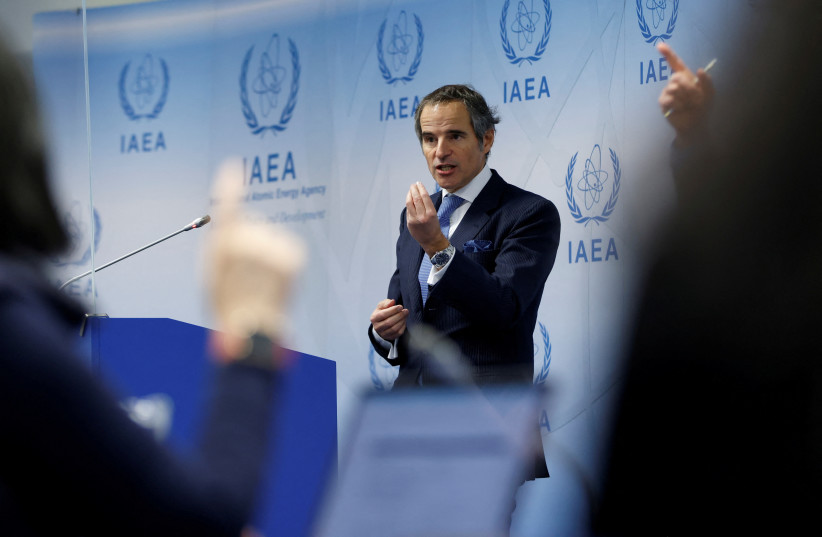
The IAEA Board of Governors approved a resolution censuring Iran for nuclear violations on Wednesday night.
Notably, the censure does not call yet for a referral to the UN Security Council. Only Russia and China opposed the resolution.
The draft resolution text that was submitted said the board “expresses profound concern that the safeguards issues related to these three undeclared locations remain outstanding due to insufficient substantive cooperation by Iran, despite numerous interactions with the agency.”
The text, seen by Reuters, also said the board “calls upon Iran to act on an urgent basis to fulfill its legal obligations and, without delay, take up the (IAEA) director general’s offer of further engagement to clarify and resolve all outstanding safeguards issues.” Indirect talks between Iran and the United States on reviving the 2015 deal have not been held since March.
Israeli Prime Minister Naftali Bennett welcomed the decision of the Board of Governors on Wednesday night, calling it “a significant decision that reveals the true face of Iran.”
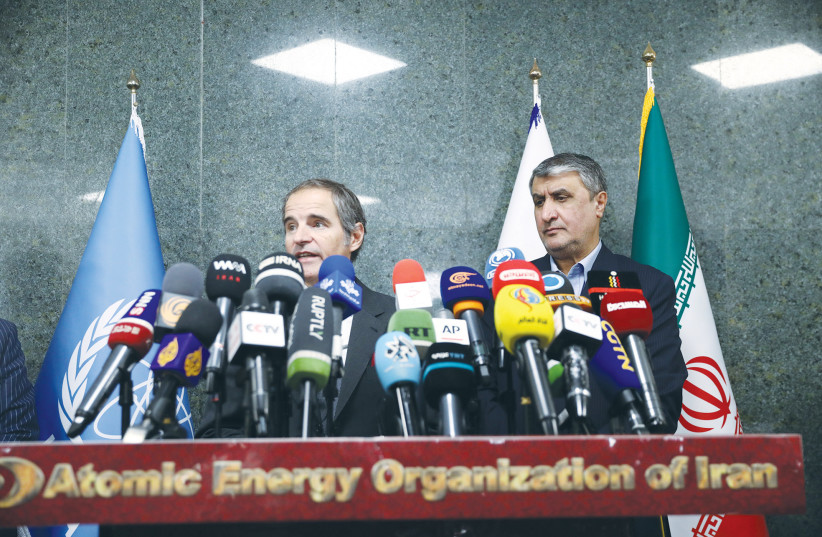
 IRAN’S ATOMIC Energy Organization chief Mohammad Eslami (right) and IAEA Director-General Rafael Mariano Grossi attend a news conference in Tehran last month. Today’s Zionists must stand up to Iranian nuclear aspirations. (credit: WEST ASIA NEWS AGENCY/REUTERS)
“The decision of the Board of Governors states that Iran does not cooperate with the IAEA and does not obey its instructions and thus does not allow the Agency to fulfill its important role and take action against activities in the military nuclear field,” said Bennett.
“Today’s vote in the IAEA is a clear warning sign for Iran: If Iran continues its operations, the leading countries must bring the Iranian issue back to the Security Council,” stressed the prime minister.
Mohammad Reza Ghaibi, Iran’s representative to the IAEA, called the resolution “disappointing,” warning that Iran will take “appropriate action” in response “the consequences of which will be borne by the proponents and supporters of this resolution.”
Iran shuts down IAEA cameras, announces new centrifuges in retaliation
Seeing the writing on the wall, the Islamic Republic retaliated preemptively on Wednesday, shutting down two IAEA cameras for surveillance of its nuclear program and installing advanced IR-6 centrifuges at Natanz.
Despite the swift pushback by Tehran, Iranian officials emphasized that they only switched off “voluntary” cameras added by the 2015 JCPOA nuclear deal, but allowed 80% of the nuclear watchdog’s cameras, under a Safeguards Agreement, to continue functioning.
Iran has begun installing advanced IR-6 centrifuges in one cluster at an underground enrichment plant at Natanz in line with a plan announced long ago but it now also intends to add two more such clusters, or cascades, the IAEA said on Wednesday.
“On 6 June 2022, the Agency verified … that Iran had started to install IR-6 centrifuges in the aforementioned single cascade previously declared by Iran to the Agency,” the International Atomic Energy Agency said in a report to member states seen by Reuters and confirmed by the agency. It added that installation of the two extra had yet to begin.
Moreover, the ayatollahs’ response fell far short of more extreme retaliation options, such as kicking out all nuclear inspectors, withdrawing from the Nuclear Non-Proliferation Treaty or enriching its uranium stock up the 90% weaponized level.
“So far, the IAEA has not only been ungrateful for Iran’s extensive cooperation but has also considered it as a duty. From today, relevant authorities have ordered that surveillance cameras of the Online Enrichment Monitor (OLEM) be shut down,” state TV said.
“Iran cannot be cooperative while the IAEA displays unreasonable behavior. We hope the agency will come to its senses and respond with cooperation with Iran.”
Irans Atomic Energy Organisation spokesperson Behrouz Kamalvandi
“If accurate, reports that Iran plans to reduce transparency in response to this resolution are extremely regrettable and counterproductive to the diplomatic outcome we seek,” a US statement to a meeting of the 35-nation Board of Governors said ahead of a vote on the US-backed draft resolution. “We do not seek escalation (with Iran).”
The US, Britain, Germany and France angered Iran by submitting to the IAEA’s governing board a draft resolution criticizing Iran for not fully answering the watchdog’s questions on uranium traces at undeclared sites.
The resolution text, seen by Reuters and little changed from a draft circulated last week, will be debated and voted on at this week’s quarterly meeting of the IAEA’s 35-nation Board of Governors, possibly as soon as Wednesday night.
Several diplomats said the resolution was likely to pass easily despite Iranian warnings of retaliation and consequences that could further undermine already stalled talks on rescuing Tehran’s 2015 nuclear deal with world powers. Iran’s ally Russia, one of the powers, opposes such a resolution.
If the Islamic Republic continues to ignore the violations identified by the IAEA, the Board could refer the situation to the UN Security Council at its next meeting in three months, which could culminate in a full global sanctions snapback.
The Vienna-based IAEA declined to comment.
IAEA and Iran: A history of distrust
On Tuesday, the US blamed Iran for both sides’ failure so far to reach an agreement on reviving the 2015 Iran nuclear deal, saying Iran’s demands on sanctions-lifting were preventing progress.
“What we need is a willing partner in Iran. In particular, Iran would need to drop demands for sanctions lifting that clearly go beyond the JCPOA and that are now preventing us from concluding a deal,” a US statement to a meeting of the UN nuclear watchdog’s Board of Governors said, referring to the 2015 deal by its name, the Joint Comprehensive Plan of Action.
This is not the first time that the Islamic Republic has significantly blindsided the IAEA.
From February 2021 until December 2021, Tehran shut off the IAEA’s access on a number of levels.
Some of that access was restored in recent months, but after Iran reneged on a deal this past March to clear up problematic questions the IAEA unearthed about its nuclear program, the sides have been increasingly at loggerheads.
It was also unclear how the US and Israel might act to the ayatollahs’ latest provocation.
In contrast, when the IAEA censured Iran in June 2020, Tehran rushed to improve relations and made some concessions within weeks.
However, this time the Islamic Republic and the West are also in the midst of a broader conflict over whether the sides will return to the 2015 JCPOA Iran nuclear deal.
Meanwhile, on Wednesday Russian President Vladimir Putin and his Iranian counterpart Ebrahim Raisi spoke by phone, the Kremlin said, and discussed the need to continue diplomatic efforts and reach an agreement on reviving the 2015 Iran nuclear deal.
The Kremlin said the two sides expressed a desire to further strengthen Russian-Iranian relations.
Reuters contributed to this report.


