
Head of the political wing of the Palestinian Hamas movement in the Gaza Strip Yahya Sinwar speaks during a meeting in Gaza City, on April 30, 2022. (Mahmud Hamas/AFP)

Head of the political wing of the Palestinian Hamas movement in the Gaza Strip Yahya Sinwar speaks during a meeting in Gaza City, on April 30, 2022. (Mahmud Hamas/AFP)

Hamas’s Gaza leader Yahya Sinwar threatens Israel against “violating” the Al-Aqsa Mosque in his first speech in nearly a year.

“Violating Al-Aqsa and Jerusalems means a regional, religious war,” Sinwar says. “We will not hesitate to take any steps if Al-Aqsa is violated.”

Tensions at the holy site, which is revered by both Muslims and Jews, helped touch off a war between Israel and Hamas last year.

Palestinians clashed repeatedly with Israeli forces at the site over the past month, leading to fears that the violence again spark a broader escalation.

“Our people must prepare for a great battle if the occupation does not cease its aggression against the Al-Aqsa Mosque,” Sinwar adds.

Sinwar also slams Ra’am party chief Mansour Abbas. The Islamist party joined the Israeli coalition last year, becoming the first independent Arab party to become part of an Israeli government.

“I want to speak to Ra’am and the Knesset member Mansour Abbas. That you serve as a support to this government which violates Al-Aqsa is an unforgivable crime,” Sinwar says, calling for Ra’am to immediately leave the coalition.

The address was Sinwar’s first major public appearance in almost a year. Last June, the senior Hamas member gave a 90-minute speech in the aftermath of the May war with Israel, laying out his vision of what the terror group had achieved.

“If the conflict breaks out again — the shape of the Middle East will change. We have proven that there are those who defend the Al-Aqsa Mosque,” Sinwar boasted at the time.

Iran’s Quds Force reportedly also planned to assassinate a senior American military general in Germany and a journalist in France.

By JERUSALEM POST STAFF Published: APRIL 30, 2022 14:54

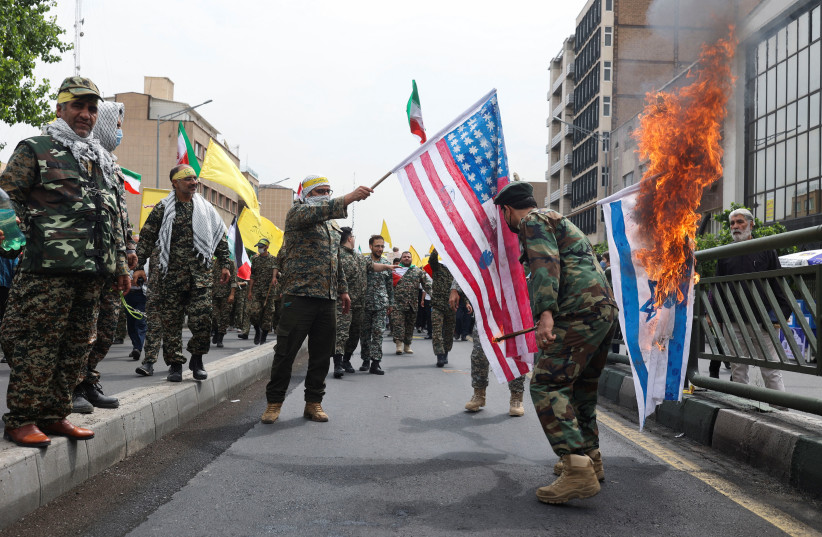
Iranians burn Israeli and US flags during a rally marking the annual Quds Day, or Jerusalem Day, on the last Friday of the holy month of Ramadan in Tehran, Iran April 29, 2022 (photo credit: WANA NEWS AGENCY/REUTERS)

Iranians burn Israeli and US flags during a rally marking the annual Quds Day, or Jerusalem Day, on the last Friday of the holy month of Ramadan in Tehran, Iran April 29, 2022
(photo credit: WANA NEWS AGENCY/REUTERS)

An Israeli citizen working in the Israeli consulate in Istanbul, Turkey was the target of an assassination plot by the Quds Force of Iran’s Islamic Revolutionary Guard Corps (IRGC), London-based Iran International reported on Saturday.

The Quds Force reportedly also planned to assassinate a senior American military general in Germany and a journalist in France, according to the report.

The assassinations were set to be carried out by drug cartels, with the Islamic Republic reportedly willing to pay over a million dollars for the targets.

The planned hits were organized by a member of Quds Force’s Unit 840 stationed in Europe, who was paid $150,000 to “prepare for the assassinations” by using his connections to various European drug lords, the report stated.

The Syrian cell, known as Unit 840, is a relatively secretive operational unit that plans terrorist infrastructure outside Iran against western targets and opposition groups, according to the IDF.

Iranian armed forces members march during a ceremony of the National Army Day parade in Tehran, Iran April 18, 2022 (credit: WANA NEWS AGENCY/REUTERS)
Turkish, British, and American reports over the last number of years have accused Iran of using major international crime organizations to help advances its goal abroad, which includes carrying out terrorist plots. According to reports, Iranian intelligence employed the Zindashti cartel, headed by heroin kingpin Naji Sharifi Zindashti, to assassinate or abduct Iranian dissidents living in Turkey since 2015.

In 2020, Turkish police said 13 members connected to Zindashti were arrested on charges of collaboration with the Islamic Republic of Iran’s intelligence operations.

Iran had been targeting Israeli citizens, along with US and Israeli senior officials, for a long time, Ali Afshari of Iran International reported, stating assassinations had “always been the Islamic Republic’s strategy.”

In February, Turkish media reported that Turkish and Israeli intelligence forces foiled an Iranian assassination attempt on the life of Israeli businessman Yair Geller. In October of last year, it was reported that more Israeli businessmen, including Teddy Sagi, were the targets of “Iranian terror” in Cyprus.


Hundreds of Hezbollah supporters carried out a demonstration along the Lebanese-Israeli border.

A woman sits near a poster of Lebanon's Hezbollah leader Sayyed Hassan Nasrallah, during an event marking Resistance and Liberation Day, in Khiam, near the border with Israel (photo credit: REUTERS/AZIZ TAHER)
A woman sits near a poster of Lebanon’s Hezbollah leader Sayyed Hassan Nasrallah, during an event marking Resistance and Liberation Day, in Khiam, near the border with Israel
(photo credit: REUTERS/AZIZ TAHER)

Hezbollah Secretary-General Hassan Nasrallah warned Israel against continuing its “aggression against the Iranian presence in the region,” saying Iran may “attack Israel directly” during a video address delivered at a ceremony in Beirut on Friday as Iran and its proxies marked Quds Day.

The address was one of Nasrallah’s first speeches since a rocket was fired from southern Lebanon into northern Israel earlier this week. The IDF responded to the rocket fire with over 50 artillery shells toward southern Israel.

The Hezbollah leader referenced the Iranian missile attack on Erbil, Iraq in March, which Iran said it carried out after an alleged Israeli attack on Iran was launched from there, saying that the strike was a message to countries in the region that any attack on Iran from these countries would be responded to with an attack on those countries.

Nasrallah warned that “in the event of the continuation of the Israeli aggression against the Iranian presence in the region” Iran may “attack Israel directly.” The statement from Nasrallah comes just two days after an alleged Israeli airstrike targeted sites near Damascus, killing four Syrian soldiers. Such strikes are often conducted against Iranian forces and proxies in Syria.

Nasrallah pushed what he called the “regional equation on Jerusalem” and called on countries in the region to send a message to Israel that “the demise of Jerusalem means the demise of Israel.”

 A snow covered taxi drives past a picture of Lebanon's Hezbollah leader Sayyed Hasan Nasrallah in Jbaa village, south Lebanon February 20, 2015. (credit: REUTERS/ALI HASHISHO)A snow covered taxi drives past a picture of Lebanon’s Hezbollah leader Sayyed Hasan Nasrallah in Jbaa village, south Lebanon February 20, 2015. (credit: REUTERS/ALI HASHISHO)The Hezbollah leader also referred to a large exercise the IDF is planning in May, saying that Hezbollah is not frightened but is being cautious. Nasrallah added that Hezbollah has been conducting exercises for a number of scenarios in the past few weeks.

“When the Israeli maneuvers begin, whether before the elections in Lebanon or afterward, we will be at the highest levels of alertness and readiness,” said Nasrallah. Lebanon is set to hold parliamentary elections on May 15.

Nasrallah warned that “any mistake, stupidity or aggressive act that the Israeli enemy might commit” would receive a “quick and direct” response. “Your major maneuvers do not frighten us and do not prevent us from establishing the deterrence equations that exist in Lebanon.”

The Hezbollah leader additionally referenced the terrorist attacks carried out in Beersheba, Bnei Brak, Hadera and Tel Aviv earlier this month and in March, saying that such attacks are “among the most dangerous things the enemy is facing and they are very specific and important.”

“The lone operations indicated the level of fragile and weak security and the inability of the security services to discover these Mujahideen (Muslims who engage in jihad) and strongly shook the confidence of the Zionists in their safety and their security services,” said Nasrallah.

Nasrallah’s speech comes after weeks of tensions in Jerusalem and multiple days of clashes on the Temple Mount between Muslim rioters and Israeli forces. On Friday, rioters threw rocks and fired fireworks toward Israeli forces and the Western Wall.


As Nasrallah addressed the event in Beirut, hundreds of Hezbollah supporters carried out a demonstration along the Lebanese-Israeli border near Metulla. IDF troops were present in the area.

Last May, a Hezbollah member was killed by IDF fire when pro-Hezbollah protesters tried to storm the border with Lebanon and Israel. Demonstrations were carried out by Hezbollah supporters along the Israeli border multiple times last May.
