by Reuters and Algemeiner Staff

Greek Foreign Minister Nikos Dendias, Israel’s Foreign Minister Yair Lapid and Cyprus’s Minister of Foreign Affairs Ioannis Kasoulidis shake hands during a news conference following a meeting, at the Ministry of Foreign Affairs in Athens, Greece, April 5, 2022. REUTERS/Louiza Vradi

Greece, Cyprus and Israel will continue working together on natural gas pipeline projects with European energy dependency a new focus because of the war in Ukraine, their foreign ministers said on Tuesday.

Israeli Foreign Minister Yair Lapid, who met his Greek and Cypriot counterparts in Athens, said that Russia’s invasion of Ukraine has changed the structure of the energy market in Europe and in the Middle East.

The three allies, he said, would seek to boost their energy ties and expand their cooperation in the coming months to include more countries.

The European Union aims to cut its reliance on Russian gas by two-thirds this year and end all Russian fossil fuel imports by 2027 due to Moscow’s invasion of Ukraine.

Cyprus, Greece and Israel have agreed to build the world’s longest and deepest underwater power cable that will traverse the Mediterranean seabed and link their electricity grids. The project, called the Euro-Asia interconnector, is expected to be completed by 2024.

Another project which has been agreed between the three is the EastMed subsea pipeline. Designed to supply Europe with natural gas from the eastern Mediterranean, it has been in the planning for several years.

“We are proceeding with projects such as the Euroasia Interconnector and the EastMed pipeline… and we are confident that when materialized they will have another practical and geo-strategical value for the Eastern Mediterranean and the European Union,” said Ioannis Kasoulides, the Foreign Minister of Cyprus.

Israel, Greece and Cyprus to Expand Energy Cooperation Amid Ukraine War


Can Israel help wean Europe off Russian gas? – opinion

Israeli climate-tech companies may join both global and European efforts to reduce the level of consumption of Russia’s gas.


 A PICTURE taken by a drone using a slow shutter speed shows pipes at the landfall facilities of the Nord Stream 2 gas pipeline in Lubmin, Germany, last month.  (photo credit: HANNIBAL HANSCHKE/REUTERS)

After a decades-long hiatus, war has once more erupted in Europe, reminding us all that the scenes we are used to seeing from ill-fated regions in the Middle East or developing countries can also appear in the old continent. The present war will have many consequences, particularly for the European and global energy markets.

Russia is one of the largest suppliers of gas to Western Europe and literally “controls the valve” that warms houses in winter and drives industry in Europe. About 40% of Europe’s gas supply comes from Russia. Similarly, about 27% of Europe’s crude oil imports – approximately 6 million barrels a day – come from Russia.

At a press conference, the US president’s declaration that his country will boycott Russia’s gas and ban imports led Britain to join the boycott; together with the suspension of the Nord Stream 2 project – the gas pipeline from Russia to Germany – the West is trying to put insurmountable pressure on Russian President Vladamir Putin to stop the war that he declared on Ukraine.

It’s clear to us all that the West will need to find new sources of energy to provide warmth to its citizens during winter and to set industry and the economy in motion – without being dependent on Russia’s gas. The EU has already declared that by the end of the year Europe’s dependence on Russia’s gas will be reduced by two-thirds. The Europeans plan to obtain one-third of this saving from other sources of gas – including Israel. The other third will be obtained through a few immediate steps: expanded use of biomass burning, increased production of renewable energy, reduced energy consumption for heating in the public and private sectors, improved thermal insulation of buildings and more. The likely solutions for the current crisis fulfill the urgent need to provide solutions for the climate crisis, which hit the headlines recently following the Glasgow Climate Change Conference.

 An image of Earth is projected on the venue for COP26 summit in Glasgow, Scotland Britain, November 1, 2021. (credit: REUTERS/HANNAH MCKAY)An image of Earth is projected on the venue for COP26 summit in Glasgow, Scotland Britain, November 1, 2021. (credit: REUTERS/HANNAH MCKAY)

It should be noted that heat – particularly from the combustion of gas – for residential uses, industry, agriculture, and commerce, comprises approximately 50% of all final energy consumption globally, compared to only 20% of the energy provided through electricity grids. The way to reduce dependence on Russia’s gas, therefore, requires a focus on heat, which these days is generally not provided by electricity.

Israeli climate-tech companies may join both global and European efforts to reduce the level of consumption of Russia’s gas. Israel has many accomplishments and significant technological depth in all aspects of thermal and solar thermal energy and is a global leader in the use of solar energy for residential hot water. Several leading technology companies in the field of energy generation and storage for heating and cooling currently operate in Israel, including TIGI (solar thermal systems for energy production of industrial process heat), Brenmiller (thermal energy storage) and Nostromo, (cold thermal energy storage). These and other companies may take a front seat in the effort to provide the technological solutions that Europe will need in the coming years.

Global order is being undermined by wars in Eastern Europe. In parallel, the need to act quickly to mitigate the climate crisis is becoming clearer. The world has been given the opportunity to shift gears with respect to all aspects of renewable energy and to invest thought and resources into tipping the scales with respect to our dependence on the earth’s energy sources. Even Israel has something to offer.

The writer is the CEO of TIGI – provider of renewable energy solutions for water heating and storage for industrial and commercial uses, saving energy and heating costs and reducing emissions.


https://www.jpost.com/business-and-innovation/opinion/article-703234


Hamas and other extremist groups have encouraged Palestinian tensions with Israel in Jerusalem during Ramadan.

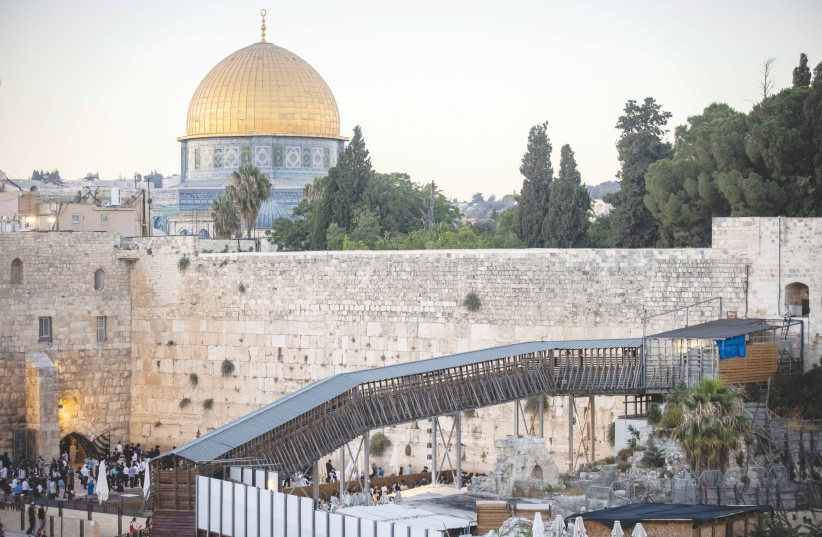
 THE MUGHRABI Bridge that leads to the Temple Mount compound with the Western Wall and the Dome of the Rock seen in the background in Jerusalem’s Old City.  (photo credit: YONATAN SINDEL/FLASH90)
THE MUGHRABI Bridge that leads to the Temple Mount compound with the Western Wall and the Dome of the Rock seen in the background in Jerusalem’s Old City.
(photo credit: YONATAN SINDEL/FLASH90)

Israel is concerned about an incident in Jerusalem, and it could be planning a “major operation in a sensitive area near al-Aqsa Mosque in occupied Jerusalem,” Iran’s Tasnim News Agency reported.

Iran termed this an “unexpected event.” This is language coming from senior Iranian media sources close to the Islamic Revolutionary Guard Corps. The IRGC backs Hamas.

Hamas and other extremist groups have encouraged Palestinian tensions with Israel in Jerusalem during Ramadan. There were clashes and Palestinian media incitement against Israel’s foreign minister and other leaders on Sunday night.

The familiar cycle of accusing Israelis of “storming” the Old City of Jerusalem is imminent. Hamas incitement claiming it has a “right” to fire rockets will soon begin. The goal is another war with Israel like last year, a conflict orchestrated by Iran to test new rockets and drones.

This could be the messaging behind the Tasnim article. Iran is outraged by the recent Negev Summit of Arab foreign ministers in Israel, and it needs to increase its profile in the region.

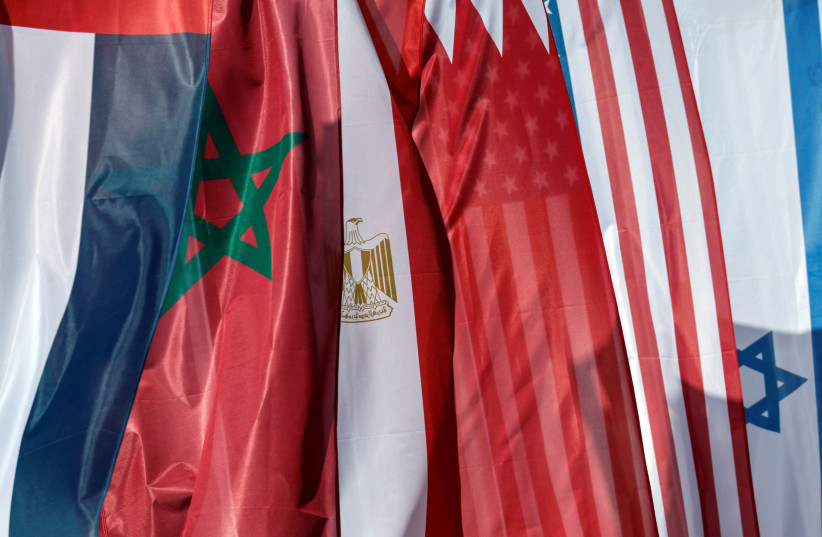
 Flags are seen ahead of ''The Negev Summit'', hosted by Israel's Foreign Minister Yair Lapid and attended by U.S. Secretary of State Antony Blinken, and the foreign ministers of the UAE, Bahrain, Morocco and Egypt, in Sde Boker, Israel, March 27, 2022. (credit: REUTERS/AMIR COHEN)Flags are seen ahead of ”The Negev Summit”, hosted by Israel’s Foreign Minister Yair Lapid and attended by U.S. Secretary of State Antony Blinken, and the foreign ministers of the UAE, Bahrain, Morocco and Egypt, in Sde Boker, Israel, March 27, 2022. (credit: REUTERS/AMIR COHEN)Tehran wants to use Palestinian suffering to increase these profits. The profits for Iran are not necessarily financial, but rather using proxies against Israel.

Iranian media claim Israel is concerned that a new “operation” in Jerusalem could “bring a new wave of dangerous conflicts and will lead the Hamas movement and the [Palestinian] Islamic Jihad to a very bloody and serious reaction.”

Israeli media have indeed reported that Israel could be ready for another conflict of the sort that took place last year. The driver behind these conflicts is Hamas and PIJ, as well as Iran.

Iran says Israel will launch an “operation [that] may target Palestinian Muslim worshipers who go to al-Aqsa Mosque to offer prayers during the holy month of Ramadan.”

Iranian media say Qatar and Jordan are trying to mediate in an effort to reduce the chance of violence. Yet Iran’s leader reportedly spoke to his Qatar counterpart this week.

It is unclear if that is linked to the claim that Qatar might reduce tensions. Since Iran wants tensions, it’s unclear what the discussion would be about.

“According to the same sources, Israeli Prime Minister Naftali Bennett spoke with Jordanian King Abdullah II last night and praised his efforts to calm the situation in the occupied territories,” an Iranian media outlet reported.

Obviously, Tehran is not happy to see peacemakers trying to reduce the tensions.https://www.jpost.com/middle-east/iran-news/article-703194