Israel will continue to strike Iranian targets in Syria after condemning Bucha massacre.
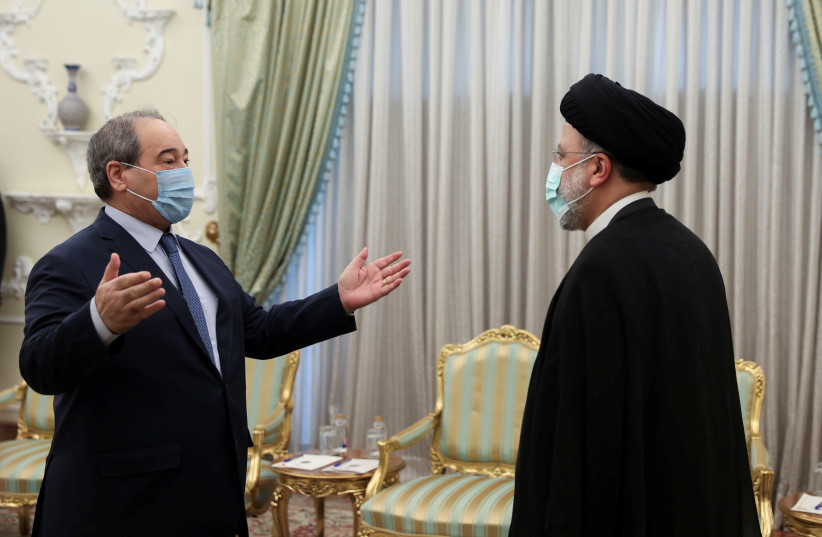
Iran’s President Ebrahim Raisi meets with Syria’s Foreign Minister Faisal Mekdad in Tehran, Iran, December 6, 2021.
(photo credit: MAJID ASGARIPOUR/WANA (WEST ASIA NEWS AGENCY) VIA REUTERS)

Israel will be able to do what it needs to defend itself even after condemning Russia for committing war crimes in Bucha, Ukraine, Defense Minister Benny Gantz said on Monday.

“We will continue to act everywhere in the Middle East where we need to act,” Gantz told Kan Radio when asked whether Foreign Minister Yair Lapid’s condemnation will impact coordination with Russia in Syria

Israel strikes Iranian targets in Syria, in order to prevent the Islamic Republic from entrenching itself near Israel’s northern border or transferring weapons to Hezbollah in Lebanon.

Jerusalem notifies Moscow before the strikes in order not to hit the Russian Army, which is the dominant military force in Syria. This deconfliction mechanism has been one of the reasons Israeli leaders have cited for not taking a more vocal and active stance in supporting Ukraine in its war with Russia.

Lapid said on Sunday that “It is impossible to remain indifferent in the face of the horrific images from the city of Bucha near Kyiv, from after the Russian army left. Intentionally harming a civilian population is a war crime and I strongly condemn it.”

Defense Minister Benny Gantz joined Lapid on Monday, saying: “I condemn murder of this kind; it really is a war crime.

“Even in war, we must make sure to follow the values that are called morality in fighting,” Gantz told Kan Radio. “Unfortunately, civilians can be harmed in the framework of war, but they cannot be murdered as part of a war. This is something that looks very serious.”

Corpses were found in the streets of Bucha, outside of Kyiv, shortly after Ukraine retook the town from Russian forces over the weekend.

Ukrainian Foreign Minister Dmytro Kuleba said that hundreds of dead bodies of civilians were found.

Photos released of the incident show that Russian forces organized the killing of civilians in Bucha by a gunshot with their hands tied behind their backs, according to a report by The Kyiv Independent. Similar killings took place in the city of Irpin, the report added.

Israeli Ambassador to Ukraine Michael Brodsky also tweeted on Sunday that the Bucha massacre was “a war crime and cannot be justified.”

Finance Minister Avigdor Liberman, however, refused to condemn Russia for war crimes, taking a neutral stance.

“We all condemn war crimes,” Liberman told Army Radio in response to a question about the massacre. “There are mutual accusations here – Ukraine blames Russia and Russia blames Ukraine.”

Rather than condemn one side, Liberman said, “we need to understand there is a bloody war there and we need to maintain Israel’s moral position and, at the same time, our interests.”

Asked about his comment on Kan Radio hours later, Liberman persisted to say only that there were “difficult images” from Bucha.

“My priorities are clear,” Liberman said. “First and foremost, we have to deal with threats to Israel.

The primary threat, the finance minister said, is that world powers may sign a nuclear deal with Iran “that lets the ayatollahs…earn $300 million each day from gas and oil. We will see that money in Lebanon, Gaza, Iraq and Yemen.”

Ukrainian Ambassador to Israel Yevgen Korniychuk invited Liberman to visit Ukraine.

“We will take him with a convoy to Bucha and to other places where he can see for himself the bodies of civilians and meet the women who were tied up and raped. Maybe then he will know what happened,” the ambassador wrote on Facebook

Diaspora Affairs Minister Nachman Shai called for an international investigation into the war crimes taking place in Ukraine.

“The State of Israel must take an unequivocal position,” said Shai. “Only international pressure from governments, organizations and public opinion will stop Russia. Now is the time to act, for the benefit of us all.”

Jerusalem Post Staff contributed to this report.


As Israel and Arab states build a thriving relationship, those who are against normalization – be it Iran or ISIS – are being phased out of the conversation.

 TURKISH PRESIDENT Recep Tayyip Erdogan. Turkey recently condemned terrorism against Israel, despite years of support for Hamas terrorists. (photo credit: Gonzalo Fuentes/Reuters)
TURKISH PRESIDENT Recep Tayyip Erdogan. Turkey recently condemned terrorism against Israel, despite years of support for Hamas terrorists.
(photo credit: Gonzalo Fuentes/Reuters)

It’s been a difficult week for Israel, with a wave of terror attacks gripping the nation, leaving 11 innocent people dead. And it’s become painfully obvious that these attacks target not just Jews, but all Israelis.

In addition to the murder of seven Israeli Jews, the victims included two Ukrainians; Israeli Arab policeman Amir Khoury, a Christian; and Israeli Druze border policeman Yazan Falah. From these tragic events, an important conclusion can be drawn: the enemies of peace are increasingly threatened as the people of Israel and the Middle East draw closer to unity and peace.

Although many factors likely contributed to the recent acts of terrorism, it’s no coincidence that an attack from ISIS-aligned terrorists occurred at the same time as the historic Negev Summit, where four foreign ministers from Arab states gathered in Israel for the first time.

Israel’s relations with the Arab world are growing infinitely stronger by the day, with new memorandums of understanding, and even defense agreements, being signed nearly every week. Part of this is genuinely shared values and mutually beneficial peace agreements, and part of this is a result of the alliance against Iran and its destabilizing and violent attacks throughout the region.

As Israel and Arab states build a thriving relationship, those who are against normalization – be it Iran or ISIS – are being phased out of the conversation. The way of the future in the Middle East, for once, is not extremism, but cooperation.

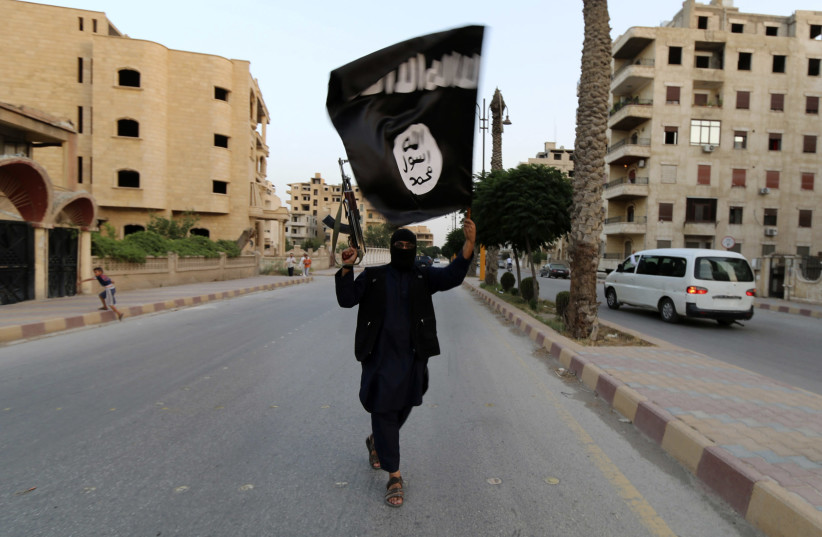
A member loyal to the Islamic State in Iraq and the Levant (ISIL) waves an ISIL flag in Raqqa June 29, 2014. The offshoot of al Qaeda which has captured swathes of territory in Iraq and Syria has declared itself an Islamic ''Caliphate'' and called on factions worldwide to pledge their allegiance, a st (credit: REUTERS/STRINGER)A member loyal to the Islamic State in Iraq and the Levant (ISIL) waves an ISIL flag in Raqqa June 29, 2014. The offshoot of al Qaeda which has captured swathes of territory in Iraq and Syria has declared itself an Islamic ”Caliphate” and called on factions worldwide to pledge their allegiance, a st (credit: REUTERS/STRINGER)Since 1948, Israel has struggled to achieve acceptance in the Arab world largely as a result of a pan-Arab ideology that used the Palestinians as political pawns. The logic was that if the Arab world refused to have relations or recognition of Israel (including refusal to assist Palestinian refugees), this would pressure Israel until the Arab world could wipe it off the map.

This rejectionist thinking has proven to be damaging and unproductive, more to the Arab world and the Palestinians than to anyone else. Israel succeeded despite all odds, and after more than 70 years of a delusional, self-damaging approach, the Arab world had enough.

The Abraham Accords were not merely a peace agreement with the United Arab Emirates, Bahrain, Sudan and Morocco, but a symbol of acceptance instead of rejection, of progress instead of stagnation. The byproduct, however, is that extremists are growing more desperate.

Iran and its proxies like the Houthis in Yemen and Hezbollah in Lebanon are becoming increasingly aggressive and violent, even against Arab states like Saudi Arabia and the UAE. At the same time, as the region shifts, terrorist organizations like Hamas and ISIS are being rejected more than ever.

AS THE Negev Summit went on, extremists tried to derail the atmosphere of peace. While the attacks are heartbreaking and must be stopped, they actually proved that Israel’s alliance with the Arab world is authentic. For the first time we saw foreign ministers of Arab states condemning terrorism against Israelis, openly speaking out about the importance of people-to-people peace in preventing and stopping extremism.

In the days following the Negev Summit, we also saw Turkey strongly condemn terrorism against Israel, despite years of tension and support for Hamas terrorists, and a historic visit of Defense Minister Benny Gantz and President Isaac Herzog to Jordan to meet King Abdullah.

Simultaneously, a similar phenomenon is occurring within Israel: Israeli society and the younger generation of Israeli Arabs are pushing further toward unity, as understanding grows that Israelis really are one people, and those who attack us, attack all of us.

Despite that, extremists from the Israeli Arab society have tried to hijack the narrative to distract and fight this reality. This occurred last May with the riots, and it occurred this past week with several of the terrorists murdering their fellow citizens.

Israel must do everything it can to stop this wave of terrorism, but we have more reason than ever to be hopeful as the momentum is continuing to head in the right direction, both regionally and within Israel. The path to normalization isn’t easy, but at this point it is inevitable.

Israeli society is diverse and unique, composed of Jews, Arabs, and Druze, the vast majority of whom want to be Israeli, and want to live together in peace. As time goes on, the silent majority who support normalization will prevail.

The writer is the CEO of Social Lite Creative, a digital marketing firm that specializes in geopolitics.

https://www.jpost.com/opinion/article-703226


North Korea opposes war, but if South Korea chooses military confrontation or makes a preemptive strike, then the North’s nuclear forces will have to attack, the powerful sister of leader Kim Jong Un said on Tuesday.

Kim Yo Jong, a senior official in the government and ruling party, said it was a “very big mistake” for South Korea’s minister of defense to make recent remarks discussing a preemptive attack on the North, state news agency KCNA reported.

https://www.jpost.com/breaking-news/article-703244