Iran was surprised to see the recent Negev Summit where Israel hosted the foreign ministers of the UAE, Bahrain, Morocco and Egypt. It is now examining how strong this new alliance might be.
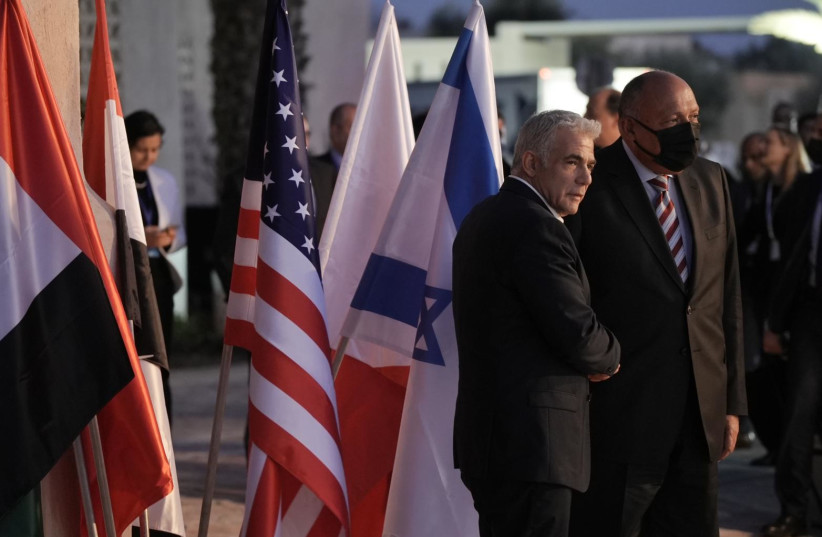
Foreign Minister Yair Lapid welcomes Egyptian foreign minister Sameh Shoukry to Israel ahead of the Negev Summit (photo credit: ASSI EFRATI/GPO, BOAZ OPPENHEIM/GPO)
Foreign Minister Yair Lapid welcomes Egyptian foreign minister Sameh Shoukry to Israel ahead of the Negev Summit
(photo credit: ASSI EFRATI/GPO, BOAZ OPPENHEIM/GPO)

Iran was surprised to see the recent Negev Summit where Israel hosted the foreign ministers of the UAE, Bahrain, Morocco and Egypt. While Tehran has been shouting about the Abraham Accords since the beginning, accusing Arab states of betraying the Palestinian cause and threatening them against working with Israel, it appears that the Islamic Republic now understands that this new era of peaceful diplomacy is actually happening and it can’t prevent it.

In a recent article at Tasnim News, which reflects the views of the IRGC, the Iranian media said that the Gulf states have become closer to Israel because they see the US leaving the region. The US withdrawal from Afghanistan was one aspect of this new shift.

“Last year’s US withdrawal from Afghanistan woke up the well-to-do sheikhs on the southern shores of the Persian Gulf and raised the question in their minds: what to do after the US? Who is going to save security for countries that are mostly lacking in strategic depth and are on the verge of collapse?” Iran’s answer is that the Gulf states are shifting to Israel for support.

Iran’s media acknowledged that the recent meeting was the first time that the foreign ministers of these countries have all gone to Israel together, which is historic. “The Zionists chose the meeting place of the ministers of the four Arab countries with the foreign minister of the Zionist regime in the Sdeh Boker area in the Negev desert, the area where David Ben-Gurion, the founder and the first prime minister of the regime, built a house for himself and his wife.”

Iran monitored these developments closely. They understand that the countries also have some concerns about it and its nuclear deal. “It is clear that this meeting was held against Iran and provoked by the Zionist regime.”
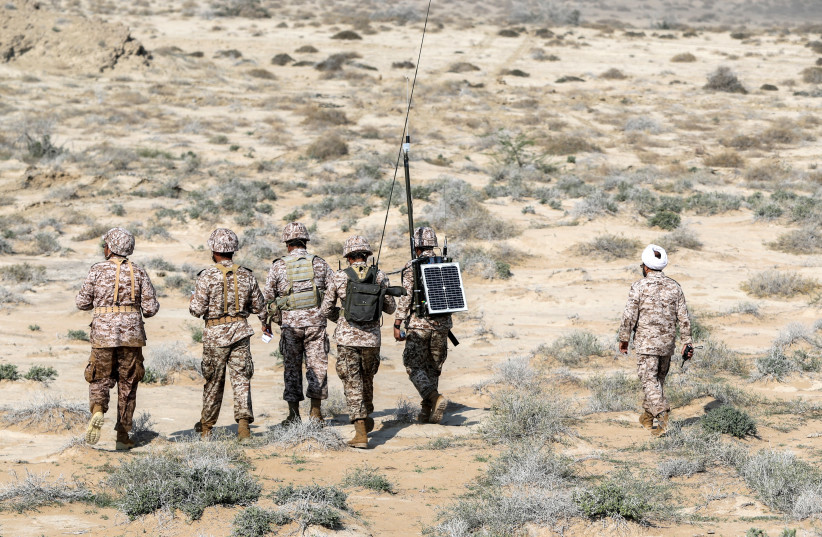
Military units of the IRGC Ground Force are seen as they launched war games in the Gulf, December 22, 2018 (credit: HAMED MALEKPOUR/TASNIM NEWS AGENCY VIA REUTERS)Military units of the IRGC Ground Force are seen as they launched war games in the Gulf, December 22, 2018 (credit: HAMED MALEKPOUR/TASNIM NEWS AGENCY VIA REUTERS)

Tehran also followed closely another meeting where Egypt hosted Israel and the UAE, in which Iran says that regional defense cooperation against “drones, missiles and other hazards were on the agenda of the three leaders.” It reads reports that this could mean shared air defense technology, including Israel’s advances in laser technology. Recent reports in Gulf media have said Morocco wants Israeli air defense systems.

Iran has taken account of efforts to form what is called an “Arab NATO… with the participation of Bahrain, Egypt, Jordan, Kuwait, Oman, Qatar, Saudi Arabia and the UAE.” No such Arab NATO has come into being, however, and Iran continues to use the Houthis in Yemen to target Saudi Arabia and the UAE. “Eventually, escalating tensions in the Persian Gulf and attacks on the Aramco…led Qatar, Jordan and Egypt to oppose the formation of such a coalition, preventing the United States from forming such an alliance.”

Former US “President Donald Trump and his unprecedented pressure on Arab countries to normalize relations with the Zionist regime led the UAE, Bahrain, Morocco and Sudan to agree to” do so, Tasnim said.


NOW IRAN wonders if this new era will mean these countries will work successfully with Israel. “Will the Zionist regime be large enough to lead this coalition against Iran or any other country? The leaders of small Arab countries do not seem to have thought enough about this question….Can an alliance with the Zionists, who are far weaker in all aspects of power than the United States, be able to bring security to those who are willing to impose such a cost on their country in foreign policy?” This shows that Iran predicts more security risks for the Gulf.

Iran is now examining how strong this new alliance might be. “The United States and the Zionist regime, by intimidating the leaders of rich Arab countries and making Iran look bigger, intend to throw the Arab countries into a big trap that they themselves have been avoiding entering for two decades.”

Tehran says it will not turn a blind eye to this coalition. That could mean new Houthi attacks on the Gulf. Iran also points to Hamas having waged war against Israel in May 2021. “the Islamic Resistance [Hamas] fired more than 12,000 rockets at the occupied territories.”

Iran notes that none of the countries that are now working with Israel have been historically against the Jewish state. “Normalizing relations with these countries will not bring much for the Zionists, especially since [Israel]’s neighboring countries are not willing to normalize relations with the Zionists.” This refers to Lebanon and Syria where Iran has influence.

The Islamic Republic praises the recent terror attacks on Israel in Beersheba and Hadera, claiming that “five Zionists” were killed in one of the attacks. “These operations have shocked and confused the Israeli security services.”

Iran concludes that “if the calculations take into account Hezbollah in Lebanon and the advanced missiles, as well as the drones that the resistance group has, the exact weight of the Arab-Zionist NATO that is likely to be formed will be determined.” Tehran is hinting here that it will seek to use proxies to attack Israel in the coming months.

Pakistan’s political chaos could spill over – analysis

What matters is that Pakistan is a populous, nuclear-armed nation that maintains its historic rivalry with India. This means that countries around Pakistan are maneuvering in this new world order.

PAKISTANI PRIME MINISTER Imran Khan. Last month, a Pakistani minister said the 2019 Pulwama terrorist attack was a ‘success of the whole nation.’  (photo credit: REUTERS)
PAKISTANI PRIME MINISTER Imran Khan. Last month, a Pakistani minister said the 2019 Pulwama terrorist attack was a ‘success of the whole nation.’
(photo credit: REUTERS)

Political chaos looms in Pakistan as the country’s National Assembly is trying to convene to remove its leader Imran Khan as prime minister.

Khan is a divisive figure who came to power in 2018. He styles himself as a populist but has also been soft on extremism and terror groups. Trying to survive the attempt to unseat him, he has begun to blame foreign conspiracies. It is entirely possible that whatever happens today or this week in Pakistan could unleash extremism and spill over into other countries. This is because Pakistan has been a key backer of the Taliban in Afghanistan — and Khan is an ally of other Islamist-oriented political parties, from Malaysia to Turkey.

According to media reports, Khan’s PTI Party has suffered some setbacks and some of the leader’s allies are deserting him.

The BBC notes that “a simple majority of 172 in the 342-seat National Assembly against the former cricket legend would cut short his tenure as PM. On Wednesday, the magic number was breached when his main coalition ally, the MQM, joined the opposition. It means on paper that the opposition now commands 175 votes to the government’s 164.”

Pakistan’s parliament speaker rejected the opposition’s no-confidence motion against Khan on Sunday. But it may come back – and the chaos and controversy could cause other problems.

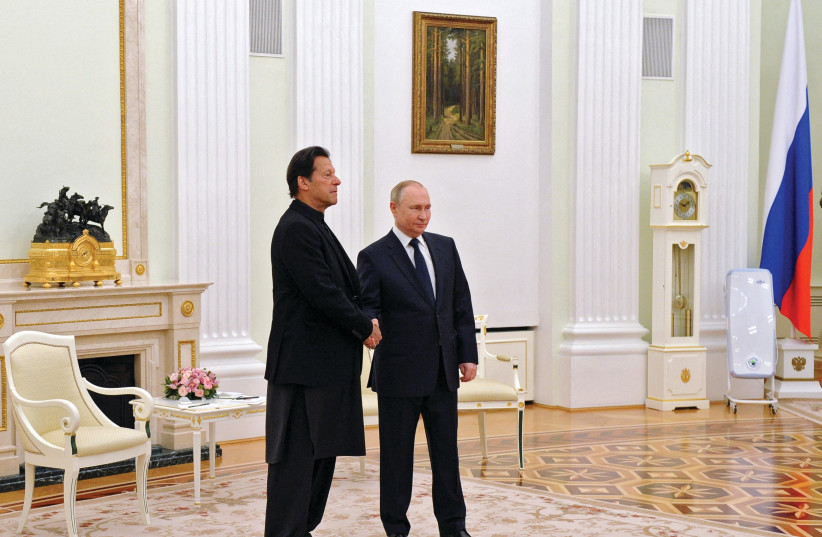
 RUSSIAN PRESIDENT Vladimir Putin shakes hands with Pakistan’s Prime Minister Imran Khan during a meeting in Moscow on February 24, the day Russia invaded Ukraine. (credit: Sputnik/Kremlin/Reuters)RUSSIAN PRESIDENT Vladimir Putin shakes hands with Pakistan’s Prime Minister Imran Khan during a meeting in Moscow on February 24, the day Russia invaded Ukraine. (credit: Sputnik/Kremlin/Reuters)

As usual, it is not clear who is behind the efforts to get rid of Khan. “To many observers, the genesis of the current crisis can be traced back to October when Mr. Khan refused to sign off on the appointment of a new chief of Pakistan’s powerful ISI intelligence agency,”the BBC said.

The ISI was the architect of backing the Taliban back in the 90s. Pakistan has long had shadowy ties to extremists and terror groups that have targeted the West and India. For instance, Al Qaeda leader Osama Bin Laden fled to Pakistan and was found living next to a military academy in a key city there.

The country has also suffered from extremists who have attacked schools, minorities and women. Pakistan is one of the countries where religious extremists often murder minority Christians and Hindus after accusing them of “blasphemy.” As such, the country is one of the most far-right extremist countries in the world, with a veneer of democracy that it holds up because it still has some kind of parliamentary politics.

Back in 1999, the country had a military coup and was run by Pervez Musharraf. He left office in 2008. Opposition leader Benazir Bhutto was assassinated in 2007. Other key leaders in the country’s recent history have been convicted of corruption and other crimes, including Nawaz Sharif and his daughter Maryam. All of this makes for uncertain politics, with political rivals trying to imprison each other, and a legal system that can only barely keep up with the charges of corruption and other issues that plague the political system.

What matters is that Pakistan is a populous, nuclear-armed nation that maintains its historic rivalry with India. India recently hosted Russia’s foreign minister, and Iran’s foreign minister was in China. This means that countries around Pakistan are maneuvering in this new world order.

Pakistan’s Khan has long sought to champion a multi-polar world free from US power and hegemony. He dislikes the United States and uses populist fervor against the Americans. As such, he could unleash extremist demons that lurk in Pakistan. The country has long tried to balance normalized politics with the shadowy intelligence agency that backs extremists who have targeted India and who backed the Taliban.

What might come next if Khan is pushed out — or if he holds onto power but there is violence?

This matters because Pakistan is also a friend of Gulf countries in the Gulf and former Pakistani leaders have found their way there.


Palestinians vow to avenge three gunmen killed near Jenin

Hamas described the killing of the gunmen as a “cowardly assassination.”

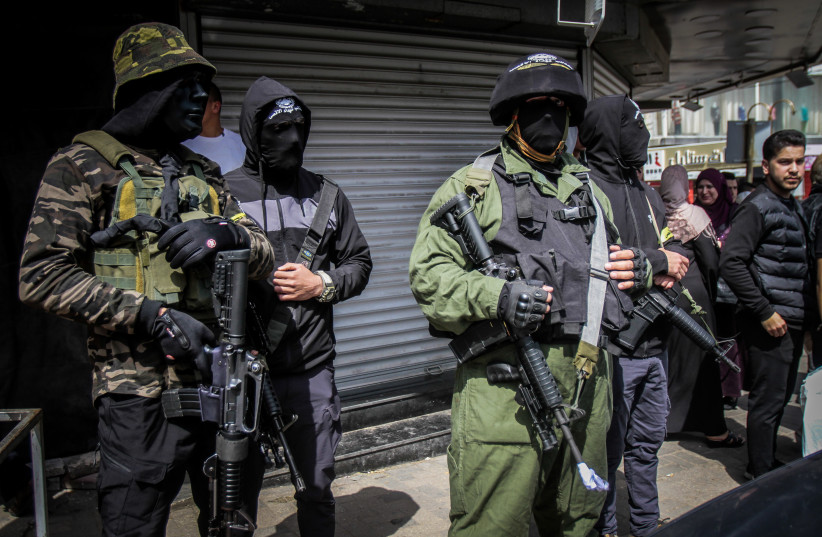
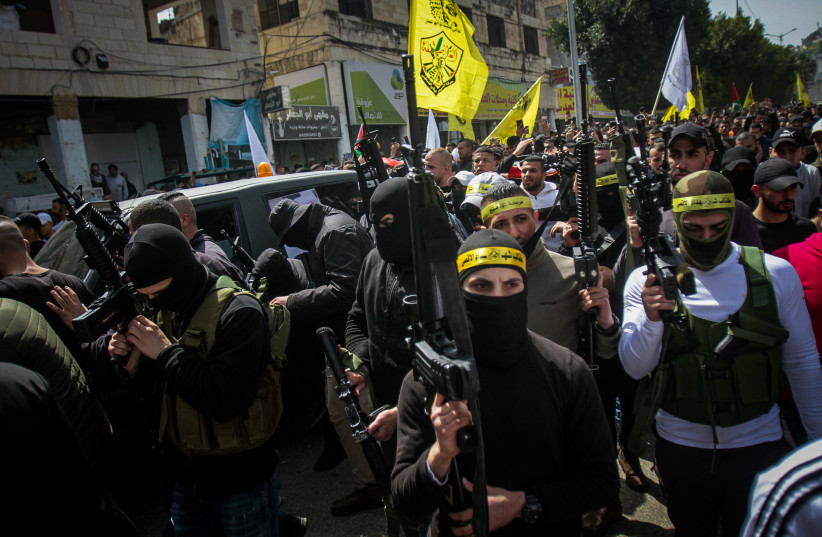
 Palestinian gunmen take part in the funeral of two Palestinians who were shot dead by Israeli security forces  during clashes, during their funeral in Jenin, in the West Bank, March 31, 2022.  (photo credit: NASSER ISHTAYEH/FLASH90)
Palestinian gunmen take part in the funeral of two Palestinians who were shot dead by Israeli security forces during clashes, during their funeral in Jenin, in the West Bank, March 31, 2022.
(photo credit: NASSER ISHTAYEH/FLASH90)

Palestinian Islamic Jihad (PIJ), Hamas and other Palestinian groups have pledged to continue the fight against Israel after the killing of three Palestinian gunmen during an armed clash with Israeli security forces near Jenin on Friday night.

The Palestinian Authority, for its part, strongly condemned the killing of the gunmen and repeated its call to the international community to provide protection for the Palestinians.

PIJ said in a statement that the three gunmen – Saeb Abahreh, 30, Khalil Tawalbeh, 24, and Saif Abu Libdeh, 25 – were members of its military wing, the Al-Quds Brigades.

“The Zionist enemy committed an aggressive crime against three of our heroic mujahideen [warriors] on the first day of the holy month of Ramadan,” the statement read.

The organization vowed to avenge the death of the gunmen. “As we hold the enemy fully responsible for this crime, we affirm that the blood of our children will not be shed in vain,” it said. “The mujahideen will continue the jihad and resistance and the fight against the enemy, regardless of the sacrifices.”

 Palestinian gunmen take part in the funeral of two Palestinians who were shot dead by Israeli security forces  during clashes, during their funeral in Jenin, in the West Bank, March 31, 2022.  (credit: NASSER ISHTAYEH/FLASH90)Palestinian gunmen take part in the funeral of two Palestinians who were shot dead by Israeli security forces during clashes, during their funeral in Jenin, in the West Bank, March 31, 2022. (credit: NASSER ISHTAYEH/FLASH90)

Hamas described the killing of the gunmen as a “cowardly assassination.”

“The enemy’s policy of killings and assassination against our people in the West Bank and occupied Jerusalem will not provide them with the security that they are looking for, nor will they grant them legitimacy on our land,” Hamas said, also vowing retaliation.

The Popular Resistance Committees, an alliance of various armed groups in the Gaza Strip, said that “the blood of the heroic martyrs will remain torches for the revolution and resistance against the usurping Zionist enemy until victory, liberation and the return” of Palestinian refugees and their descendants to their former homes inside Israel.

The killings will not stop the Palestinians from pursuing the fight against Israel, the PRC stressed.

“Our people will continue their struggle until the occupation is defeated,” the group threatened, calling for “a strong and qualitative response to this heinous crime on every part of our occupied land.”

Another Gaza-based terrorist group, the Palestinian Mujahideen Movement, said that “the assassination of the resistance fighters in Jenin is a Zionist crime that will not go without a response. The blood of the martyrs will remain a fuel that increases the resistance against this criminal enemy.”

The group called on Palestinians to “respond quickly and urgently to the repeated crimes of the occupation.” It also called on the Palestinian Authority to halt security coordination with Israel.

In Ramallah, the PA said that it condemns and rejects the “dangerous Israeli escalation, which coincided with the beginning of the holy month of Ramadan.”

PA presidential spokesperson Nabil Abu Rudaineh said that Friday’s incident came at a time when many parties, led by the US, are working to de-escalate tensions during Ramadan.

“This Israeli policy constitutes a threat and a flagrant challenge to international legitimacy and international law, and the occupation forces must stop all these dangerous practices, which threaten security, stability and calm, in addition to the continued storming by Jewish extremists of the blessed al-Aqsa Mosque,” Abu Rudaineh said in a statement.

The only way to achieve security is by compelling Israel to abide by the resolutions of international legitimacy, he said, and not to take any unilateral measures.

“We also call on the international community to provide international protection for the Palestinian people,” the PA spokesperson said. “Israel bears the consequences of this dangerous escalation.”

PA Prime Minister Mohammad Shtayyeh condemned the killing of the three gunmen as a “crime,” called on the International Criminal Court to hold those responsible accountable and demanded that Israel hand over their bodies.