The Biden administration looks willing to make a deal on Iran’s nuclear program at all costs.

After eight weeks of gridlocked and often grueling negotiations through international intermediaries in Vienna, the United States and Iran looked on track to secure an agreement aimed at curbing Iran’s expanding nuclear program this month. But last week nearly saw the efforts derailed in their final stages after Washington roundly rejected demands by Russia—a key player in the talks—to shield its own trade with Iran from Ukraine-related sanctions. Instead of the broad protections Moscow requested, U.S. negotiators agreed to Russia’s involvement in a much narrower scope of nuclear-related activities.
So why did Russian Foreign Minister Sergey Lavrov take a victory lap with his Iranian counterpart in Moscow this week, claiming that talks had entered the homestretch and touting the two countries’ growing economic ties?
A recently rediscovered $10 billion contract between Iran’s atomic energy organization and a Russian state-owned company, Rosatom, might explain why. The contract detailed plans now underway for Russia to build two nuclear reactors at Bushehr nuclear plant in Iran, an enterprise the new Iran-U.S. nuclear agreement would explicitly protect. And there could be more to follow. A November 2014 protocol between Russia and Iran, outlined in a Rosatom document obtained by The Dispatch, left the door open for Russia to build six additional reactors and generate billions more in revenue in the future.
This carveout could extend President Vladimir Putin a meaningful monetary lifeline as the West has backed Russia into an economic corner with sanctions. For context, Russia’s entire bilateral trade with Iran last year was only $4 billion in total, which was an 80 percent increase from the previous year.
Russia’s last-minute move to force the United States’ hand seemed to bet on the administration’s willingness to make concessions—even to Russia, despite simultaneously pressuring Putin to halt his unprovoked war on Ukraine—all for the sake of inking a new nuclear deal. The Biden team’s conciliatory approach last year marked a sudden reversal from the Trump administration’s 2018 withdrawal from the Joint Comprehensive Plan of Action (JCPOA) and full enforcement of a “maximum pressure” sanctions regime. The Biden administration says the concessions are justified if they keep Iran from developing nuclear weapons, but critics—which include regional experts, lawmakers, and former government officials—say the administration is willing to concede too much, including so-called “inherent guarantees” to Iran that could bind future U.S. administrations.
While the precise shape of the current draft agreement remains uncertain, it’s clear that the administration’s early hopes of pressuring Iran into a more robust version of 2015’s JCPOA have dwindled. When assessing the value of the forthcoming deal, experts typically ask two questions: Does this compromise meet the goal of meaningfully curbing Iran’s future atomic ambitions? And does it empower or impede the ability of the U.S. and allies to respond to non-nuclear threats currently posed by Iran?
In the early days of the Biden presidency, administration officials peddled a “longer and stronger” version of the JCPOA, promising follow-up talks to extend the deal’s fast-approaching or already expired sunset provisions. But it didn’t take long for Tehran to dash these hopes. Iranian officials opened negotiations last spring with a high asking price: that the U.S. lift all sanctions imposed or re-imposed since 2015, including those targeting transgressions—like terrorism and human rights violations—technically sanctionable under the original agreement.
The regime also demanded a legal pledge to prevent future administrations from pulling out of any future accord (a violation of the U.S. Constitution). “It’s just a fact, and the Iranians now understand this quite well, that one president cannot dictate what a future administration might or might not do,” Daryl G. Kimball, executive director of the Arms Control Association, told The Dispatch.
But it now appears, in the absence of a binding assurance, U.S. negotiators in Vienna may have offered Tehran “inherent guarantees”: By keeping significant portions of Iran’s existing nuclear arsenal intact, the provisions would—in theory—deter future U.S. administration from pulling out of the deal.
John Bolton—former national security adviser to Trump and a key player in the administration’s 2018 withdrawal from the JCPOA—said the possible addition of a contingency plan to limit the options of administrations to an international agreement should “provoke outrage.”
“Any president can withdraw from any agreement, treaty or not if he decides that’s in the best interest of the United States. But there has been a lot of speculation about what might satisfy Iran in lieu of that kind of commitment,” Bolton said in an interview with The Dispatch. “This is a concession that has one purpose, which is to impair the ability of a future president to disagree with this administration’s policy to the benefit of a foreign country, and that to me gets very close to the definition of treason.”
The existence of these provisions threatens the first and primary goal of the new deal—i.e., the real reduction of Iran’s nuclear capabilities—but it also lays bare broader issues surrounding its longevity. In attempting to bind future presidents to an agreement, the administration tacitly acknowledged its lack of popular support in the United States. Even fellow Democrats have voiced their opposition.
Last week, a group of 21 members of Congress—12 Democrats and nine Republicans—outlined their concerns in an open letter to the White House, including the deal’s expiration dates and potential financial gains by Russia. While information about the draft’s specifics have been hard to come by on Capitol Hill, “it is hard to envision supporting an agreement along the lines being publicly discussed,” the lawmakers wrote.
Democratic Sen. Bob Menendez, chairman of the chamber’s foreign relations committee, is a longtime critic of his party’s Iran policy. “We can’t live in a counterfactual world where all parties remained in full compliance, but we do know that even for the first couple years of the JCPOA, Iran’s leaders gave absolutely no indication they were willing to look beyond the scope of these limited terms, and fought vigorously to keep their highly advanced nuclear infrastructure in place,” Menendez said in a speech to the Senate last month. “That was under a more ‘moderate’ regime.”
“They continued their destabilizing activities and support for terrorism in the greater Middle East with abandon,” he added. “So today, I ask why we would try to simply go back to the JCPOA—a deal that was not sufficient in the first place—and still doesn’t address some of the most serious national security concerns we have.”
Menendez’ address got to the heart of the Vienna negotiations’ main omission: credible efforts to deter Iranian domestic and regional aggression. What’s more, a portion of the nearly $100 billion in sanctions relief extended to Iran will likely go to its development and purchase of weapons systems and sponsorship of proxy terror groups in Lebanon, Iraq, Yemen, and elsewhere. (In January 2016, then-Secretary of State John Kerry acknowledged that Iran would use some of the money from the sanctions relief in the original Iran nuclear deal to fund terrorism.)
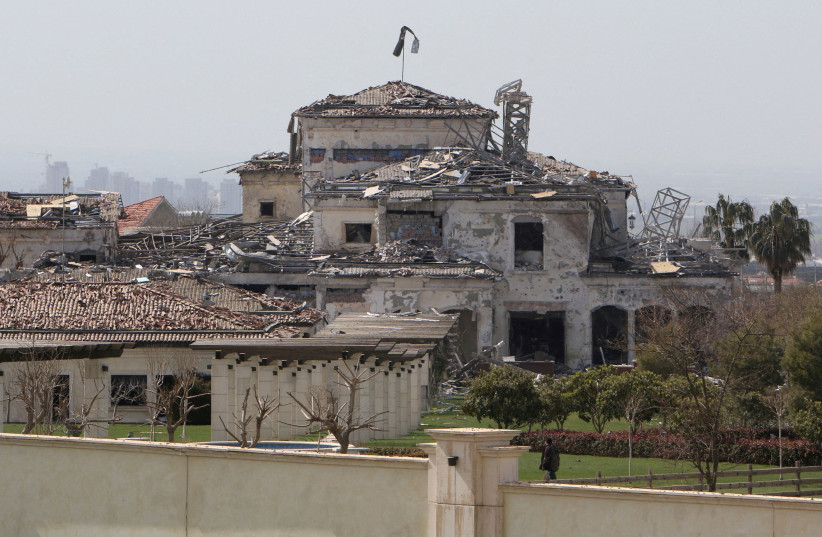
This unresolved problem came into sharp relief last Sunday, after the Islamic Revolutionary Guard Corps (IRGC) took credit for ballistic missiles launched into Iraq. The attack on the Kurdish regional capital of Erbil struck perilously close to a U.S. consulate, though the Biden administration made every effort to publicly downplay suggestions that the IRGC was targeting Americans. Experts say both Iranian officials and U.S. allies in the region have come to expect such tepid reactions from the Biden administration.
“By any definition, this is an act of war against Iraq. Yet, Iran once again escaped serious consequences over its use of ballistic missiles against its neighbors,” Norman Roule, the former U.S. national intelligence manager for Iran, said of the attack on Erbil. “This failure to respond not only undermines Iraqi sovereignty but reinforces the regional sense that the international community judges Iran’s aggression by a different standard than those applied elsewhere.”
“Second, the lack of a robust response to Iran’s missile attacks likely reinforces Tehran’s sense that it can achieve strategic diplomatic and economic gains from a West indifferent to its regional violence,” he added.
Iran’s feeling of impunity seems to be well-founded. As the nuclear negotiations creep to a close, the Biden administration is reportedly discussing whether to lift the IRGC’s Foreign Terrorist Organization designation per Iranian demands. News of the gained renewed attention Wednesday, the same day that Outgoing U.S. Central Command Commander Gen. Kenneth McKenzie said that the group fit the definition of a terrorist organization in testimony before the Senate Armed Services Committee—and three days after the Erbil attack.
Recent reports that the IRGC is operating on U.S. soil to target for assassination former U.S. officials—including Bolton, Former Secretary of State Mike Pompeo, and former Iran envoy Brian Hook—show that such a threat is far from contained to the region.
According to Gabriel Noronha, the State Department’s former special adviser for Iran, the administration also plans to reverse a Trump-era executive order sanctioning the supreme leader’s office once the deal is inked. Among the nearly 112 entities and individuals currently soon to be exempt from U.S. sanctions are Mohsen Rezaei and Ali Akbar Velayati, who both had a hand in the 1994 suicide bombing on Jewish center in Argentina that killed 85 people. Also exempt would be IRGC Brigadier General Hossein Dehghan, a Iranian planner in the Hezbollah attack that killed 241 U.S. personnel in Beirut, Lebanon.
“They are a terrorist regime,” Bolton said. “The very idea that you would deal with them on the nuclear side and leave the terrorism alone—knowing that when you relieve these nuclear-related sanctions, you are going to strengthen their economy and therefore enable them to engage in more terrorist activity—it just makes no sense at all.”
But the Biden administration argues that the trade-offs are necessary, given the challenges of trying to alter the behavior of a nuclear or nuclear threshold state. This mentality explains the State Department’s one-track focus on Iran’s nuclear program: “Every challenge that we face and would face from Iran—whether that is its support for proxies, its support for terrorist groups, its ballistic missile program—all of those challenges would become all the more difficult to confront if Iran were in the possession of a nuclear weapon,” State Department spokesman Ned Price said Wednesday.
Some analysts agree with the Biden team’s underlying logic. “Ultimately there have to be some trade-offs,” Naysan Rafati, a senior analyst at Crisis Group, told The Dispatch. “Iran has expanded its ballistic missile technology, it has improved the deployment and proliferation of drones. None of those things are particularly good, but they’re even worse when the nuclear question is bubbling in the background.”
Eric Brewer, the former national security council director for counterproliferation under the Trump administration, pointed to the JCPOA’s inspection protocol as one of the deal’s most important achievements. In addition to the International Atomic Energy Agency’s (IAEA) in-person and remote access to uranium enrichment levels, the monitoring mechanisms put eyes on centrifuge production facilities, to deter the diversion of enrichment to remote sites. These features would likely be included in the forthcoming agreement.
“These are the things that give the IAEA inspectors eyes on all elements of Iran’s nuclear program, from the time the uranium comes out of the ground, through the fuel cycle process, to the time it comes out of the back of the reactors,” Brewer told The Dispatch. “The theory behind the case is that you set up enough trip wires, enough alarms, that Iran knows that if it ever tries to either dash to a bomb, to divert material, to set up a covert enrichment facility, chances are pretty good that somebody’s going to catch onto it sooner or later.”
But others argue that the deal—even if rigorously enforced—would grant Iran a long-term victory in exchange for a short-term delay in its nuclear program, particularly if the “inherent guarantees” to pause rather than reverse many of the Islamic Republic’s key enrichment activities remain intact.
Some experts warn that the regime will build out its foreign federal reserves to withstand future penalties implemented as a result of its increased enrichment activities and potential weaponization after the agreement’s 2030 end-date. “A restored deal also means nine years of diminishing restrictions on Iranian nuclear activity, during which time an increasingly hardline Iran can build a fortress economy much as Putin undertook in Russia after 2014,” Roule explained.
And as Tehran strengthens its economy, it can enrich low-grade uranium with an international green light. Therein lies the “central flaw” of the first JCPOA, Bolton said: “Even if Iran completely complied with every requirement of the deal, the fundamental flaw, the original sin, is allowing any enrichment at all. Because when you enrich to reactor-grade levels, you’ve done 70 percent of the enrichment work necessary to get the weapons-grade levels.”