Should our leaders not be warning the people of what is coming? Why the silence? Why the seeming indifference?

 AN IRANIAN cleric walks past an anti-US mural on a wall of the former American Embassy in Tehran this week. (photo credit: Atta Kenare/AFP via Getty Images)
AN IRANIAN cleric walks past an anti-US mural on a wall of the former American Embassy in Tehran this week.
(photo credit: Atta Kenare/AFP via Getty Images)

Two weeks ago, the Russian envoy to the nuclear talks in Vienna dropped a bombshell. “I am absolutely sincere in this regard when I say that Iran got much more than it could expect – much more,” Ambassador Mikhail Ulyanov told Iranian news outlet IRNA. “Realistically speaking, Iran got more than, frankly, I expected or others expected. This is a matter of fact.”

And in Israel, there was silence.

A week earlier, an IAEA report was leaked, which showed that the stockpile of enriched uranium amassed by Iran has dramatically grown to the point that its most highly-enriched material is just a jump away from a nuclear weapon.

And in Israel there was silence.

And then this week, on Wednesday, reports emerged that – in the framework of a new deal – the United States is considering removing the Islamic Revolutionary Guards Corps (IRGC) from the Foreign Terrorist Organization list. The news was earth shattering and would be an amazing prize to Iran, just days after Tehran took responsibility for firing ballistic missiles at a US consulate in Erbil.
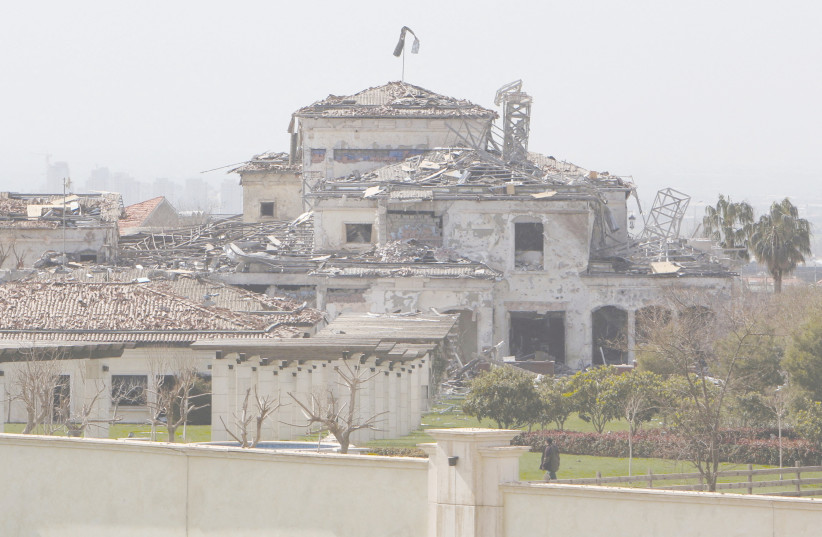
 VIEW OF a damaged building in the aftermath of missile attacks in Erbil on Sunday, for which Iran’s Revolutionary Guards Corps claimed responsibility. (credit: AZAD LASHKARI/REUTERS)VIEW OF a damaged building in the aftermath of missile attacks in Erbil on Sunday, for which Iran’s Revolutionary Guards Corps claimed responsibility. (credit: AZAD LASHKARI/REUTERS)

And again, in Israel there was silence.

At this point, there is no longer hiding what should be obvious to every Israeli: Iran is on its way to getting the best deal it could have imagined, which will pave the way for it to one day obtain a nuclear weapon. At the same time, Israel is on its way to potentially facing a threat of an existential nature – and instead of fighting it tooth and nail, the leadership in this country is, for the most part, silent.

There are a number of reasons why Israel is largely silent. While it is true that Prime Minister Naftali Bennett, Foreign Minister Yair Lapid and Defense Minister Benny Gantz occasionally issue a statement against the coming deal and speak frequently with their foreign counterparts about it, this type of activity is a far cry from the way Israel has fought against nuclear proliferation in the past.

According to senior government sources, one of the reasons Israel is quiet is because its silence was a condition made by the Americans if Jerusalem wanted to receive regular updates from what was happening in Vienna. To get the information, Israel needed to tamp down its criticism – and the decision made was that knowing what was happening was crucial for Israel to potentially influence the outcome.

The problem is that Israel does not seem to have influenced the deal at all. Instead, what we are about to see signed is a deal that will be remembered as the worst possible for Israel and the best possible for Iran. It is shorter and weaker than the original JCPOA signed in 2015 and will ultimately lead to Iran obtaining a nuclear weapon if and when it decides to.

AND THIS leads to the second reason for Israel’s quiet, which is the more significant one – a general resignation that a bad deal is coming and Israel cannot do anything to stop it. It is almost an acceptance of the fact that Iran is going to get a bomb.

While this might be true, should Israel not at least try? Should our leaders not be warning the people of what is coming? Why the silence? Why the seeming indifference?

This is not to advocate for what former prime minister Benjamin Netanyahu did in 2015 when he went to Washington, spoke before Congress and poked a finger in the eye of President Barack Obama. The speech did not stop the deal but it did cause damage to the bipartisan support for the Jewish state that is still felt seven years later.

On the other extreme is Israel’s current policy of staying quiet.

In between these two options, though, there is a wide-open field of steps that can be taken. Bennett could fly next week to Europe and ask for meetings with leaders in Paris and London. He could get the leader of China on the phone or fly to Washington and demand a meeting with Biden.

He and Lapid could also hit the airwaves and speak every day on another international news channel. With the war in Ukraine still dominating the news cycle, it won’t be easy to get the world’s attention, but shouldn’t Israel try?

An example of Israeli paralysis was evident this week when it was thrown a softball – 49 Republican senators pledged to do everything in their power to reverse an agreement that does not “completely block” Iran’s ability to develop a nuclear weapon. But instead of hitting it out of the park, Bennett and Lapid didn’t say a word. They didn’t issue their own statement. Silence once again.

Bennett wasn’t always like this. Back in 2015, he traveled to Washington at the same time as Netanyahu and ran from studio to studio and back again to speak out against the JCPOA. When he became defense minister in 2019, he claimed to have come up with a new strategy for how to stop Iran, one that would take the battle to the Iranians and make it clear that they have too much to lose.

What happened to all of that? Where did it go? And why does it seem like Israel has given up? The resignation coming out of Jerusalem does not demonstrate strength; it shows weakness – and it should have Israelis concerned. While it is nice to see our prime minister serve as a mediator between Russia and Ukraine, let’s not forget that what is happening there has almost nothing to do with the State of Israel. On the other hand, what is happening in Vienna has everything to do with Iran. Shouldn’t we hear his voice on that, too?

THE SILENCE on Iran and the flurry of activity on Ukraine has some officials wondering if Bennett’s involvement in the war talks is not meant to distract attention away from what Israelis should really be caring about – the terrible deal that is coming in Vienna.

And this is what is important to keep in mind – when that deal is signed, there will be little way to explain it except as a failure by the Israeli government. When this government took office in June, its top members explained that they were resetting the ties with the United States and would be working to repair the damage Netanyahu had caused, especially to Israeli relations with the Democratic Party.

To some extent, they have repaired those ties, which is not something that can just be dismissed. On the other hand, the payoff is not seen when it comes to Iran.

And while it is important to not burn all its bridges so it will not be able to work with the Biden administration and its European allies the day after, it is also important for Israel to take a stand, especially on an issue like this that will have wide-ranging ramifications for the State of Israel, the Jewish people and the entire world for years to come.

DOES THIS mean all is lost? While our leaders like to say that Israel retains all options and will continue to do whatever is needed to protect itself, the chance of a military strike against Iran in the aftermath of a deal is between unlikely and impossible.

On the one hand, the diplomatic failure means that the only chance Israel has to make a difference is through military force. On the other hand, the ability to attack with a new deal in place will be limited – because if Jerusalem wasn’t willing to attack the negotiations before the deal was reached, why would it attack the facilities now that there is a deal? This is barring a scenario where there is a blatant violation and clear evidence that Iran is actively building a bomb.

In addition, what is important to keep in mind is that Iran’s nuclear facilities were built by Iran for Iran. This is unlike Iraq’s nuclear reactor, which was built by France and destroyed by Israel in 1981, and Syria’s nuclear reactor which was built by North Korea and destroyed by Israel in 2007. In both cases, when the reactors were destroyed, Iraq and Syria could not rebuild them on their own. They were still dependent on external assistance.

Iran is different. It has mastered the technology and know-how, so even if its facilities would be damaged, the ability to rebuild them would remain. This casts a cloud over the effectiveness of any future strike.

With that said, it is impossible to know what will happen after an attack. When Israel attacked Iraq’s reactor, the initial assessment was that it would delay Saddam Hussein’s plans by a year or two. It stopped them forever.

Is the same possible now with Iran? That is difficult to know. But now that it’s clear that diplomacy failed to stop Tehran, the specter of military force has risen higher than ever.
https://www.jpost.com/opinion/article-701626


The fight against terrorism is a global one, a shared mission of the entire world,” they said. IRGC’s proxies are behind attacks across the region.

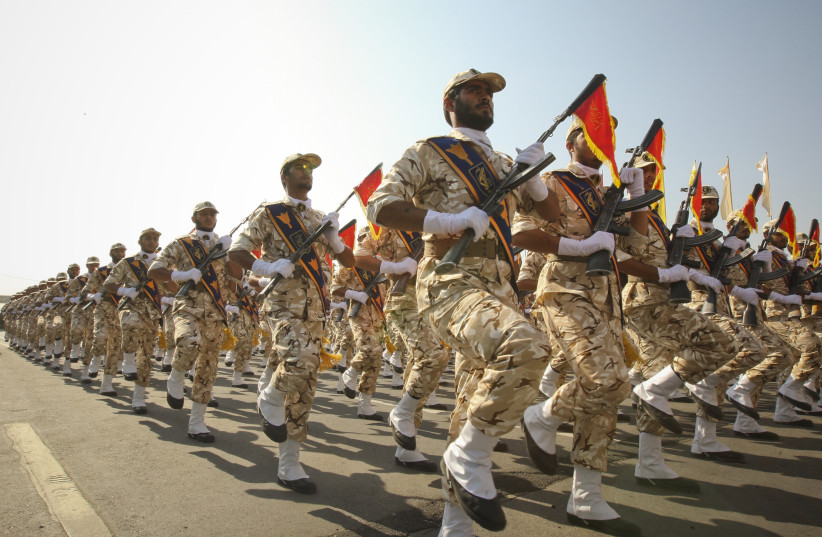
 Members of the Iranian revolutionary guard march during a parade to commemorate the anniversary of the Iran-Iraq war (1980-88), in Tehran September 22, 2011. (photo credit: REUTERS/STRINGER)
Members of the Iranian revolutionary guard march during a parade to commemorate the anniversary of the Iran-Iraq war (1980-88), in Tehran September 22, 2011.
(photo credit: REUTERS/STRINGER)

The US must not remove the Islamic Revolutionary Guards Corps’ designation as a foreign terrorist organization, Prime Minister Naftali Bennett and Foreign Minister Yair Lapid warned in a joint statement on Friday.

“We believe that the United States will not abandon its closest allies in exchange for empty promises from terrorists,” the ministers said.

The remarks came as Israeli diplomatic sources said the US was considering acceding to Iran’s demand to lift the IRGC’s designation in exchange for a commitment by Tehran to regional de-escalation and not to attack Americans, as a side deal to the revival of the 2015 Iran nuclear deal.

“We find it hard to believe that the IRGC’s designation as a terrorist organization will be removed in exchange for a promise not to harm Americans,” they said. “The fight against terrorism is a global one, a shared mission of the entire world.”

Bennett and Lapid listed the IRGC’s proxies, such as Hezbollah in Lebanon, Islamic Jihad in Gaza, the Houthis in Yemen, and militias in Iraq, and pointed out that the branch of the Iranian military is behind attacks throughout the Middle East, including in the past year, plans to assassinate American officials, the killing of hundreds of thousands of Syrian civilians, and more.

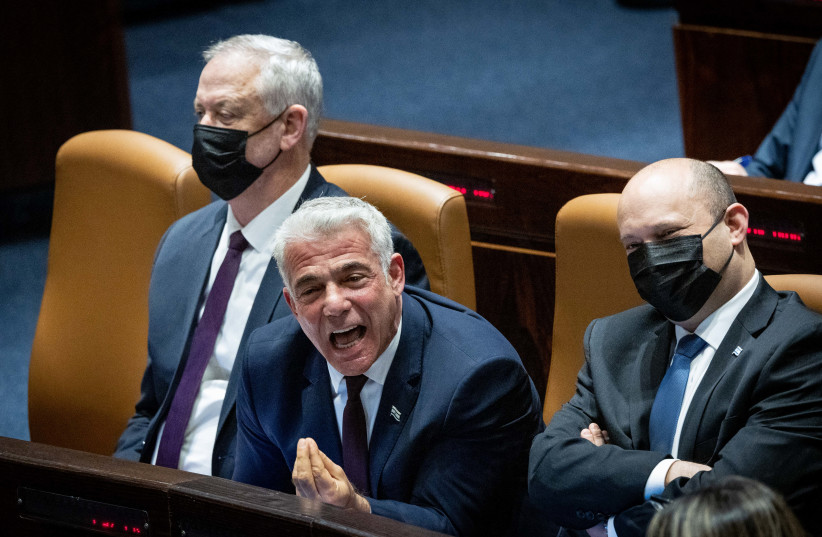
 Israeli prime minister Naftali Bennett, Minister of Foreign Affairs Yair Lapid and Minister of Defense Benny Gantz seen during a discussion on the Electricity Law connecting to Arab and Bedouin towns, during a plenum session in the assembly hall of the Israeli parliament in Jerusalem, January 5, 20 (credit: YONATAN SINDEL/FLASH90)Israeli prime minister Naftali Bennett, Minister of Foreign Affairs Yair Lapid and Minister of Defense Benny Gantz seen during a discussion on the Electricity Law connecting to Arab and Bedouin towns, during a plenum session in the assembly hall of the Israeli parliament in Jerusalem, January 5, 20 (credit: YONATAN SINDEL/FLASH90)

“They kill Jews because they are Jews, Christians because they are Christians, and Muslims because they refuse to surrender to them,” the ministers stated. “They are an integral part of the brutal machine of oppression in Iran. Their hands have on them the blood of thousands of Iranians and the crushed soul of the Iranian society.”

“The attempt to delist the IRGC as a terrorist organization is an insult to the victims and would ignore documented reality supported by unequivocal evidence,” they said.

MK Yuli Edelstein (Likud) said he doubts the Americans will really remove the IRGC’s terrorist designation, “but the fact that we are talking about it is further proof of the great loss of control and international status of Israel.”

“The Bennett-Lapid government manages to fail again and again and harm Israeli interests,” Edelstein stated. “They are not up to the job.”

While the US is likely to keep post-Iran-deal sanctions on IRGC-affiliated individuals for terrorism and human rights offenses, the removal of the IRGC’s terrorist designation will be a boon to Iran’s economy, in addition to lifting nuclear-related sanctions as per the 2015 Joint Comprehensive Plan of Action.

The IRGC has played a huge role in Iran’s economy for decades, with its hands in a range of industries like energy, water, transportation, communications, infrastructure and more. This is what Iran’s leadership has called the “resistance economy,” making the Islamic Republic less vulnerable to sanctions by becoming more self-reliant.

With the IRGC considered a terrorist group, the US would be able to initiate legal proceedings against companies that work with its subsidiaries – though it has never done so

Lifting the IRGC’s terrorist designation, enacted by the Trump administration in 2019, will allow foreign companies to do business with subsidiaries of the group, which is behind warfare and terrorism across the Middle East and beyond.

World powers have been negotiating with Iran for the past 11 months to return to compliance with the 2015 nuclear deal with the US, which restricted Tehran’s uranium enrichment to 3.67% and cut almost all of its stockpile of enriched uranium in exchange for gradually lifting sanctions.

The US left the deal in 2018, arguing that Iran lied about its nuclear program, and that the agreement was too weak. US President Joe Biden promised to return to it.

Israel opposed the original deal and the return to it, pointing out that most of its limitations on Iran’s nuclear activities expire at the end of 2025, and that the agreement does not restrict Iran’s malign actions in the region or its ballistic missile program, while lifting sanctions would lead to a major cash influx for terrorism, proxy warfare and weapons.

In recent months, the US, EU and E3 – Britain, France and Germany – have warned that weeks remain before the deal’s nonproliferation benefits will become irrelevant, as Iran continues to violate the JCPOA.

Reuters reported on Wednesday that Iran has converted some of its 60% enriched uranium – weapons-grade is 90% – to a form that will be more difficult to dilute or transfer out of the country.

A secret report by the International Atomic Energy Agency said that Iran converted the uranium earlier this month.

“We strongly urge Iran to avoid undertaking any new escalations and in particular, call upon Iran to immediately cease all activity related to conversion of highly enriched uranium, which will have practical implications for returning to JCPOA limits,” the E3 said in a statement.

Later on Friday evening, Defense Minister Benny Gantz spoke with US Secretary of Defense Lloyd Austin in a call that “focused” on the deal being negotiated with Iran and Israel’s position on it.

According to a statement released by his office,  Gantz “emphasized the importance of deepening cooperation between the US, Israel and regional partners in the face of ongoing Iranian aggression.”

He also thanked Austin for the $4.8 billion of security assistance, which includes “critical” Iron Dome replenishment.

Anna Ahronheim contributed to this report.

https://www.jpost.com/breaking-news/article-701677?utm_source=rss&utm_medium=rss&utm_campaign=article-701677


Both Moscow and Kyiv expressed openness to holding peace talks in Jerusalem.

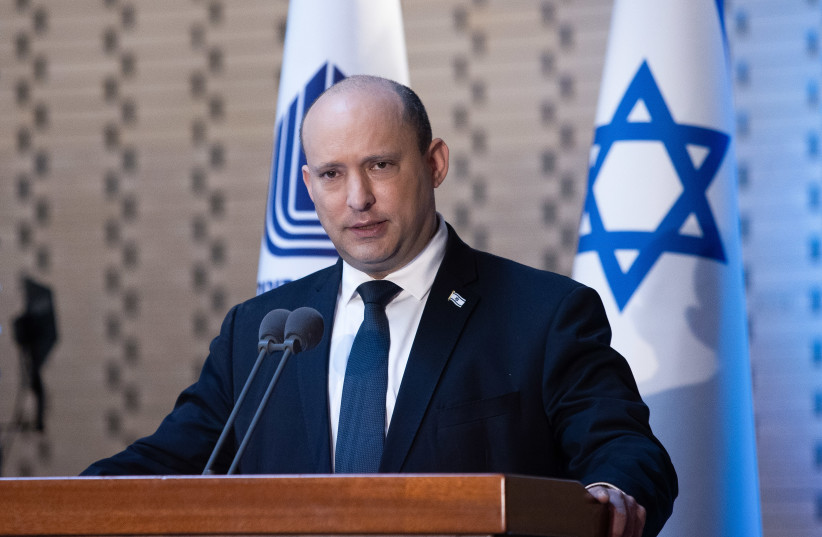
 Israeli Prime Minister Naftali Bennett speaks at the annual ceremony for soldiers whose burial places are unknown, at the National Hall of Remembrance, Mount Herzl, Jerusalem, March 10, 2022. (photo credit: ALEX KOLOMOISKY/POOL)
Israeli Prime Minister Naftali Bennett speaks at the annual ceremony for soldiers whose burial places are unknown, at the National Hall of Remembrance, Mount Herzl, Jerusalem, March 10, 2022.
(photo credit: ALEX KOLOMOISKY/POOL)

Prime Minister Naftali Bennett was the lead mediator between Russia and Ukraine, according to three officials close to the talks, the Financial Times reported on Wednesday. According to the officials, the talks that were mediated by Bennett led to the first draft of the ceasefire agreement which is currently being discussed.

In the last day, reports came from both Moscow and Kyiv that there has been significant progress in the peace negotiations. According to reports, the plan for a ceasefire involves Russia withdrawing from Ukrainian territory in exchange for Kyiv dropping its attempts to join NATO and limiting its military forces.

On Tuesday, Ukrainian President Volodymyr Zelensky said in a televised interview that he did not believe there was an “open door” for Ukraine to join NATO and said that it would have to explore alternative methods to ensure its safety independently.

However, sources in Kyiv have expressed doubt and claimed that Russian President Vladimir Putin is not fully committed to peace and said they are concerned that Putin is just buying time to reorganize his forces for a renewed attack.

The Financial Times report claimed that Bennett was leading the negotiations in light of his surprise visit to Moscow on March 5 and constant phone calls with Putin and Zelensky. At the beginning of the week, the possibility of peace talks being held in Israel was raised, a suggestion that both Russia and Ukraine expressed openness towards.

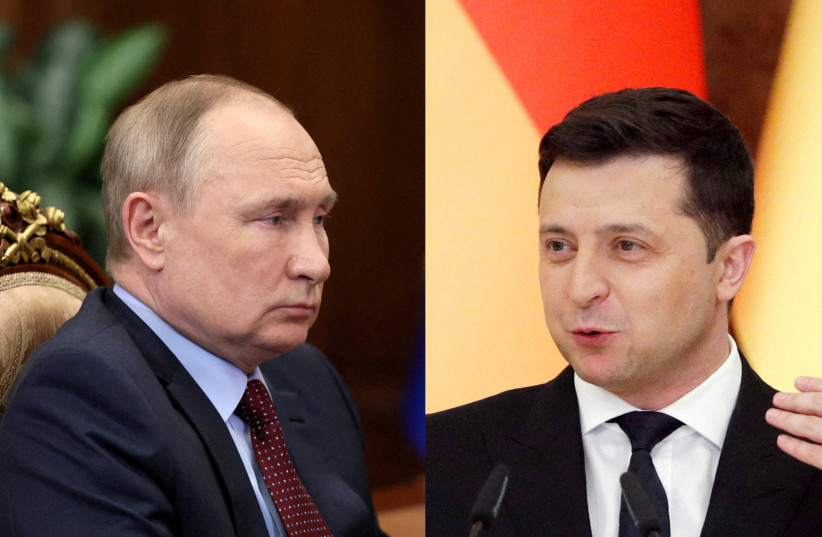
 Russian President Vladimir Putin, Ukrainian President Volodymyr Zelensky (credit: SPUTNIK/MIKHAIL KLIMENTYEV/KREMLIN VIA REUTERS, VALENTYN OGIRENKO/REUTERS)Russian President Vladimir Putin, Ukrainian President Volodymyr Zelensky (credit: SPUTNIK/MIKHAIL KLIMENTYEV/KREMLIN VIA REUTERS, VALENTYN OGIRENKO/REUTERS)

Peace talks resumed on Tuesday after taking a pause on Monday.