Overnight Sunday, Iran launched some 12 ballistic missiles that landed near the US consulate building in Erbil, the capital of the Kurdish region of Iraq. According to one US official, there were no reports of casualties. However, An Iraqi official in Baghdad initially reported that several missiles had hit the consulate building. Eventually, a high official in Kurdistan’s foreign media office confirmed the American version that the missiles did not hit the consulate, but some landed around the consulate compound.

According to pro-Iranian sources, the missiles launched were Fateh 110, a.k.a. NP-110, an Iranian road-mobile single-stage solid-fueled surface-to-surface missile produced by Iran’s Aerospace Industries Organization.

Iran’s Fateh-110 Missile / Hossein Velayati

Some sources on social media suggested the Iranian missiles landed in Erbil at exactly 1:20 AM (local time), the exact time Qasem Soleimani, the Islamic Revolutionary Guard Corps’ glorified leader, was assassinated by the Trump administration. Except that the assassination took place in January 2020. Unless they were using the Lunar calendar. Maybe.

The Iranian news agency Tasnim’s coverage of the story was headlined: “US Base, Mossad Training Centers in Northern Iraq Targeted in Ballistic Missile Attack: Reports.” It cited “reports suggesting that Washington’s new consulate building and two advanced training centers run by the Israeli spy agency, Mossad, in Erbil have been targeted in the missile attack.”

Tasnim also said that “a fire has been also reported at the airbase housing the American troops in Erbil while sirens have gone off at US consulate there.” It also cited “some reports” that indicated “alarm sirens have also been activated in the US embassy inside the highly secured Green Zone of the Iraqi capital, Baghdad.”

IRNA cited Iraqi media reports that “two bases of the Israeli Intelligence and Special Operations Organization (Mossad) in the city of Erbil in the Iraqi Kurdistan region were targeted by missiles.”

According to IRNA, Iraqi media quoted security sources as saying that “the two bases were advanced training centers of the Zionist regime (Mossad) in Iraq, which were targeted by ballistic missiles. In this regard, the Iraqi Security Information Headquarters announced in a statement that the city of Erbil was targeted by several missiles on Sunday morning and that an investigation is underway.”

Sabreen News, which is affiliated with the Iranian militias, reported that dozens of explosions shook the city of Erbil Sunday morning, but stressed that “yesterday’s operation was not a response to the recent harassment of IRGC officers in Syria, and the response to the killing of our leaders will be in the place and time chosen by the resistance.”

Kurdish prime minister Masrour Barzani issued a statement saying: “We condemn this terrorist attack launched against several sectors of Erbil, we call on the inhabitants to remain calm.”

On a separate but related note, IRNA reported on Saturday night that the Director-General of Intelligence of West Azerbaijan had stated that “during the past month, the anonymous soldiers of Imam Zaman inflicted heavy blows on the largest spy network of the Zionist regime in this province.”

West Azerbaijan Province is one of the 31 provinces of Iran, located in its northwestern corner and bordered by Turkey, Iraq, and Azerbaijan’s Nakhchivan Autonomous Republic.

The Director General of Intelligence of West Azerbaijan added: “The thugs hired by the Zionist regime’s intelligence service in this network were attracted only for the money and intended to sabotage it.”

Russia open to Ukraine negotiations in Jerusalem

Israel is not sure if it should host talks between Russia and Ukraine.

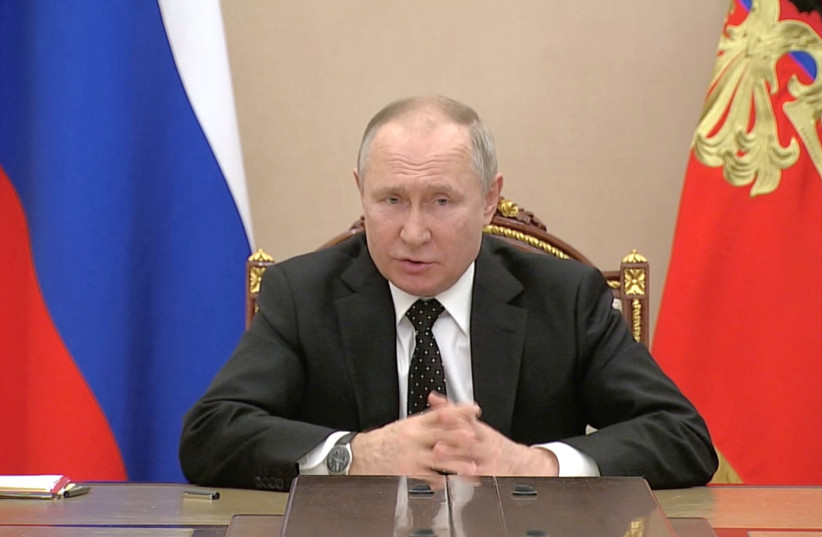
 Russian President Vladimir Putin speaks about putting nuclear deterrence forces on high alert, in this still image obtained from a video, in Moscow, Russia, February 27, 2022. (photo credit: Russian Pool/Reuters TV via REUTERS ATTENTION EDITORS)
Russian President Vladimir Putin speaks about putting nuclear deterrence forces on high alert, in this still image obtained from a video, in Moscow, Russia, February 27, 2022.
(photo credit: Russian Pool/Reuters TV via REUTERS ATTENTION EDITORS)

Russia has been open to holding negotiations with Ukraine in Jerusalem, a senior diplomatic source said on Saturday, soon after Prime Minister Naftali Bennett and Ukrainian President Volodymyr Zelensky spoke on the phone.

Zelensky said earlier Saturday that “at present it’s not constructive to hold meetings in Russia, Ukraine, or Belarus. These are not the places where we can agree to stop the war… Do I consider Israel, Jerusalem in particular, to be such a place? I think the answer is yes.”

Russia has not rejected the idea of negotiations in Jerusalem, the diplomatic source said, but Israel is not sure it should host the talks.

“We know from our experience that negotiations that don’t have a chance lead to a worse situation on the ground,” the source said.

“We have to see if we can really be helpful,” the source added. “If there can be a breakthrough, we’ll do anything.”

 Prime Minister Naftali Bennett at a previous meeting with Russian President Vladimir Putin in Sochi, Russia. (credit: Sputnik/Kremlin/Reuters)Prime Minister Naftali Bennett at a previous meeting with Russian President Vladimir Putin in Sochi, Russia. (credit: Sputnik/Kremlin/Reuters)

When it comes to Prime Minister Naftali Bennett’s mediation between Russia and Ukraine, “we aren’t forcing anything,” the source said.

The remark came after Kyiv and Jerusalem denied a report that Bennett told Zelensky to accept Russian President Vladimir Putin’s offer to end the war.

“People need to understand that we will never pressure Zelensky in either direction,” the source said. “It’s the wrong thing to do…The President of Ukraine and the Ukrainians have to make the decision, and they will have our support.”

“This isn’t Bennett’s initiative,” the source added, saying Zelensky asked to speak to Bennett on Saturday and has long sought Israel as a mediator with Russia.

Bennett’s view is that he will always take Zelensky’s calls and try to help if he can, the source added.

The source cited recent statements by Zelensky that he is willing to give up on Ukraine’s attempt to join NATO, and Russia no longer demanding a full demilitarization of Ukraine- which the source said shows that they “aren’t trying to bring Ukraine to its knees” – as an indication that Ukraine and Russia are moving gradually in the direction of an agreement.

https://www.jpost.com/israel-news/article-701101


US and Ukraine call on Israel to impose sanction on Russia

Israel has sought, despite the conflict, to maintain its deconfliction agreement with Russia through which it coordinates its aerial attacks against Iranian-backed targets.

 Ambassador Victoria Nuland, US Undersecretary of State for Political Affairs, points her finger while joking with a photographer before testifying as a witness during a hearing to examine U.S.-Russia policy at the U.S. Capitol in Washington, D.C., US, December 7, 2021. (photo credit: SARAHBETH MANEY/POOL VIA REUTERS)
Ambassador Victoria Nuland, US Undersecretary of State for Political Affairs, points her finger while joking with a photographer before testifying as a witness during a hearing to examine U.S.-Russia policy at the U.S. Capitol in Washington, D.C., US, December 7, 2021.
(photo credit: SARAHBETH MANEY/POOL VIA REUTERS)

The Biden admiration and Ukraine have called on Israel to impose economic sanctions on Russia, with US Undersecretary of State for Political Affairs Victoria Nuland warning Jerusalem against being a haven for “dirty money.”

The US, Nuland told Channel 12 on Friday, is asking every “democracy around the world to join us in the financial and export control sanctions that we have put on [Russia].

“We have to squeeze the regime. We have to deny it the income that it needs,” Nuland said, adding that this includes squeezing the oligarchs around Russian President Vladimir Putin.

“In that context we are asking as many countries as we can to join us. We are asking that of Israel as well. Among other things, you [Israel] don’t want to become the last haven for dirty money that is fueling Putin’s wars,” Nuland said.

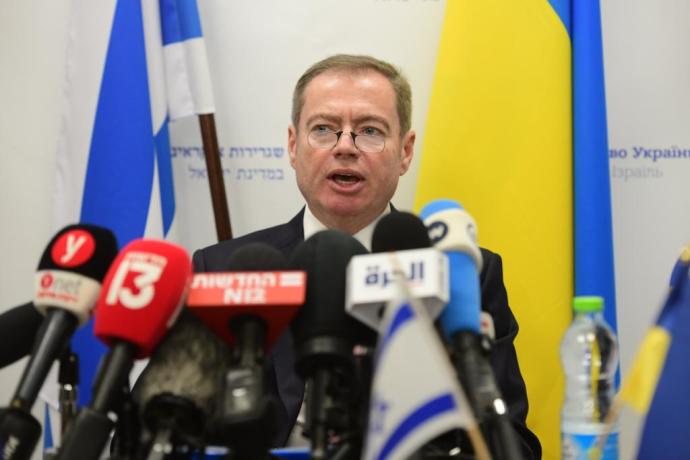
Ukraine’s Ambassador to Israel Yevgen Korniychuk on Friday called on Israel to fully sanction Russia, to accept more refugees and to send Ukraine military help and increased humanitarian assistance.

In a series of press events, Korniychuk has held at the Ukrainian Embassy since the start of the war over two weeks ago, he has expressed his frustration with Israel, a country that he believes should stand shoulder-to-shoulder with his.

Ukraine expects Israel “to join the sanctions of the alliance including, but not only, those of the United States and the European Union,” he said.

“We do believe that the current war is a war of values,” the ambassador said, adding that the Israeli business community must take a value-based stand in support of Ukraine.

“We hope that morally the decision will be taken by every single big business in Israel to stop collaboration with Russia.” Korniychuk called on Israel to send more “medical support and defense equipment.”

He was not placated, he said, by Israeli fears of antagonizing Russia given their military presence in Syria, which borders Israel in the North. Israel has sought, despite the conflict, to maintain its deconfliction agreement with Russia through which it coordinates its aerial attacks against Iranian-backed targets.

The ambassador told the journalists that there are Russian planes and anti-missile systems in Syria, and as a result Israel “is afraid.”

At the same time, he said, “Let me point you to the Baltic states that directly neighbor Russia, which has thousands of troops on those borders.”

Those Balkan states “do not care. They are sending military assistance to Ukraine. They are not afraid,” he said.
Korniychuk also called on Israel to lift its cap of 25,000 on the number of Ukrainian refugees who can stay in the country. Some 20,000 were already in Israel prior to the war and over 3,000 have arrived since, so the quota is almost filled.

Israel is prepared for a massive influx of Ukrainian Jews who are eligible for immediate immigration under the Law of Return. At issue are those Ukrainians who are ineligible for immigration but who have made it to Ben-Gurion Airport seeking shelter in the Jewish state.

Korniychuk said he met with Interior Minister Ayelet Shaked during the week to discuss increasing the quota.
“I hope we will reach an amicable solution,” he said, noting that most of the European countries had lifted their quotas on Ukrainian refugees in light of the war.

Israel is not an easy country to live in, so those who have arrived are ones who have friends or relatives here, Korniychuk said.

The ambassador noted that President Zelensky feels a “special emotion for Israel because his mother is Jewish,” but that that feeling has to be reciprocal.

When asked about the Palestinian Authority’s position, he said that Ukraine had received “very little support from the Palestinians.”

On Korniychuk’s list of issues was Israel’s response to Zelensky’s request to address the Knesset virtually from Ukraine. Knesset Speaker Mickey Levy (Yesh Atid) offered Zoom as a venue, given that the Knesset is on a break and renovations are underway in the building.

Korniychuk said he thought Zoom was an inappropriate forum and that the event should be scheduled for the plenum, particularly given that Zelensky has addressed the US Congress, the European Parliament and the British Parliament.

“I do not think it was a proper excuse that the Knesset was on holiday or offices are under renovation,” he said.

Zelensky has also asked to address the Yad Vashem-World Holocaust Remembrance Center.

“Yad Vashem Chairman Dani Dayan will be meeting with the Ukrainian ambassador to Israel on Sunday [to] further understand the nature of this request,” a spokesman for the museum said. He added that Zelensky had sought to address a gathering that would include Dayan and experts.

The Foreign Ministry has continued its efforts at the Ukrainian border to rescue Israelis and Jews caught in the war. It estimated that 11,000 Israeli citizens have fled Ukraine in the last month and that only another 1,500 are still in the country.

The ministry said that in many cases those who remained have chosen to stay in Ukraine or have been prevented from leaving under the Ukrainian recruitment law.

Foreign Minister Yair Lapid was scheduled to fly on Saturday night to Romania and Slovakia. Lapid will arrive at the border crossing between Romania and Ukraine and meet with officials working over the past two weeks to help refugees move across the border.

He will also meet with heads of state and discuss with them the situation in Europe and bilateral relations with Israel.

https://www.jpost.com/international/article-701098