Ukraine’s President Volodymyr Zelensky says he believes Israel can play an important role in helping his country reach a ceasefire with Russia.

Speaking on Saturday at a news briefing held in a secret location in Kiev, Zelensky said in response to a question from a Haaretz reporter that he believes it will be difficult, if not impossible, to reach an “understanding” at talks held in Russia, Ukraine, or in Belarus – where negotiations have been held up to this point.

“We generally support mediation by anyone,” he said, “but I wouldn’t call Prime Minister [Naftali] Bennett ‘anyone.’ You can play an important role because Israel is a country with a rich history.”

Noting that Ukrainian immigrants were among the founders of the reborn State of Israel, Zelensky cited that as one reason “to have such mediation.”

Pessimistic about the chances for success at talks held in Belarus – as well as in Ukraine or Russia – Zelensky said, “These are not places where we can come to any understandings on ending the war. I’m not talking about technical meetings, but meetings between leaders. I believe Israel can be such a place, especially Jerusalem. I think so, and I said this to Bennett,” he said.

Israeli Ambassador to Ukraine Michael Brodsky told Israel’s Channel 12 News in an interview that the idea is not new.

“The idea to hold a summit in Jerusalem has also been raised before,” Brodsky said. “If it can contribute, I think we of course must agree and take the idea forward.”

But, he added, “The question is not really where, but what. If we get to the ‘what,’ then of course there can be a meeting in Jerusalem. There can be a meeting anywhere, but Jerusalem has symbolic significance, and I think President Zelensky is referring precisely to that significance.”

Brodsky said Jerusalem’s significance stems from its status as a “city of all the faiths. A city where individuals and people of different faiths live in coexistence. A city that is equally important for Ukrainians and Russians.”

https://www.jewishpress.com/news/israel/zelensky-israel-can-play-important-role-suggests-talks-in-jerusalem/2022/03/12/


US State Department official calls on Israel to join Western sanctions, as Jerusalem’s attempt to publicly stay in a neutral position becomes increasingly precarious


An explosion is seen in an apartment building after Russian's army tank fires in Mariupol, Ukraine, on March 11, 2022. (AP Photo/Evgeniy Maloletka)

An explosion is seen in an apartment building after Russian’s army tank fires in Mariupol, Ukraine, on March 11, 2022. (AP Photo/Evgeniy Maloletka)

The US warned Israel on Friday against taking in “dirty money” from Russia and called on Jerusalem to join Western sanctions to punish the Kremlin for its invasion of Ukraine.

Israel has avoided sanctions or strident criticism against Russia and its president Vladimir Putin as it seeks to balance its warm ties with both Kyiv and Moscow.

Western countries and companies have enacted crippling sanctions against Russia’s economy, its oligarchs, and some officials, including Putin, since the start of the invasion.

However, Israel has not joined the efforts, including not taking action against Russian-Israeli billionaire Roman Abramovich who has been sanctioned by the United Kingdom and Canada.

In addition, a number of private jets have reportedly traveled from Russia to Israel in recent days.

The US undersecretary of state for political affairs, Victoria Nuland, told Israel’s Channel 12 news on Friday that Israel should get onboard with Western sanctions, and bar Russian oligarchs.

State Department Under Secretary for Public Affairs Victoria J. Nuland speaks during a briefing at the State Department in Washington, Jan. 27, 2022. (AP Photo/Susan Walsh, Pool, File)

“You don’t want to become the last haven for dirty money that’s fueling Putin’s wars,” Nuland said. “So whatever Israel is able to do, Ukrainians would welcome and the international coalition in support of Ukraine would welcome.”

Asked about Israel joining the Biden administration’s sanctions, Nuland said, “We are asking among other things is for every democracy around the world to join us in the financial and export control sanctions that we have put on Putin. We have to squeeze the regime, we have to deny it the income that it needs.”

“We squeeze the oligarchs around him, we squeeze its economy. So in that context, we’re asking as many countries as we can to join us. We’re asking that of Israel as well,” she said.

As for whether Israel should provide military aid to Ukraine, Nuland said that was in the hands of the Israeli government.

“That’s a sovereign decision for Israel to make. Many, many democracies around the world are stepping out of their comfort zone to supply security and military support to Ukraine. But what’s most important from our point of view right now is [for Israel] to join the financial sanctions,” she said.

Israel has provided humanitarian aid to Ukraine, including medical equipment and generators for a hospital. However it has refused to send military equipment, including defense gear such as flak jackets and helmets.

As Israel avoids imposing sanctions, flight traffic has suggested that some wealthy Russians are seeking refuge in Israel.

Channel 12 reported Friday that in the last 10 days, 14 private jets that took off from St. Petersburg landed at Israel’s Ben Gurion International Airport.

Last week, the outlet reported that an unusual number of rented private jets have reportedly been flying from Russia to Israel since the invasion of Ukraine, a possible indication that some rich Russians are looking at ways to slip around sanctions.

A destroyed tank is seen after battles between Ukrainian and Russian forces on a main road near Brovary, north of Kyiv, Ukraine, on March 10, 2022. (AP Photo/Felipe Dana)

Israel has attempted to walk a tightrope between Kyiv and Moscow, and sought to use its relations with the two countries to mediate between them, so far unsuccessfully. Israel is also fearful of angering Russia due to its powerful presence in Syria, where Israel carries out strikes against Iran-linked targets.

Israel’s attempt to remain neutral has become increasingly fraught in recent days, as Russia’s onslaught intensifies, exacting a staggering humanitarian toll against its neighbor.

Ukraine has repeatedly pressed Israel to take a stronger stance against Russia, and is reportedly growing exasperated with Jerusalem’s reluctance to take a side.

Friday reports said that Prime Minister Naftali Bennett pushed Ukrainian President Volodymyr Zelensky to take up an offer from Putin, which Zelensky rejected. Bennett’s office denied the report.

Ukrainian President Volodymyr Zelensky speaks in Kyiv, on March 10, 2022. (Ukrainian Presidential Press Office via AP)

Zelensky, who is Jewish and a declared admirer of Israel, is hoping to broadcast a speech to the Knesset plenum as he has done in other parliaments around the world, but the plans for the speech remain unclear.

Israel has instead proposed that he hold a less formal Zoom session with all MKs invited, Walla reported. Knesset Speaker Mickey Levy said Thursday that Zelensky will speak to lawmakers via Zoom in the coming days.

Zelensky was reportedly uninterested in a Zoom talk, and has considered a speech to Yad Vashem, but the details are murky.

On Friday, Tel Aviv Mayor Ron Huldai said that he has told Ukraine’s ambassador to Israel that any speech made by Zelensky to Israelis could be broadcast on screens in a major square in the city.

Bennett traveled to Moscow to meet with Putin on Saturday, becoming the first foreign leader to sit down with the Russian president since he invaded his neighbor. He spoke to Zelensky before and after the meeting.

Israel’s refugee policy has also caused tensions, as incoming Ukrainians have reportedly been left for days with amenities at Ben Gurion airport, and Israel has been reluctant to accept non-Jewish refugees. A Friday report said Israel has turned away around 200 refugees from Ukraine.


Josep Borrell says he will continue to be in touch with all parties ‘to overcome the current situation,’ as Russia’s Ukraine invasion complicates final stages of diplomacy


European Union foreign policy chief Josep Borrell speaks during a press statement at EU headquarters in Brussels, February 27, 2022. (Stephanie Lecocq,Pool Photo via AP, File)

European Union foreign policy chief Josep Borrell speaks during a press statement at EU headquarters in Brussels, February 27, 2022. (Stephanie Lecocq,Pool Photo via AP, File)

DUBAI, United Arab Emirates (AP) — The European Union’s foreign policy chief said Friday that “a pause” was needed in ongoing talks over Iran’s tattered nuclear deal with world powers, blaming “external factors” for the delay.

The comments by Josep Borrell come as a roadmap appeared imminent for the US to rejoin an accord it unilaterally withdrew from in 2018 and for Iran to again limit its rapidly advancing nuclear program. And while Borrell didn’t elaborate, it also comes as Russia last week tied the ongoing negotiations to sanctions Moscow faces over its war on Ukraine.

“A pause in (hashtag)ViennaTalks is needed, due to external factors. A final text is essentially ready and on the table,” Borrell wrote on Twitter. “As coordinator, I will, with my team, continue to be in touch with all (hashtag)JCPOA participants and the US to overcome the current situation and to close the agreement.”

The JCPOA, or the Joint Comprehensive Plan of Action, is the 2015 nuclear deal’s formal name. Talks have been going on for months in Vienna over trying to come up with a way to restart the deal.

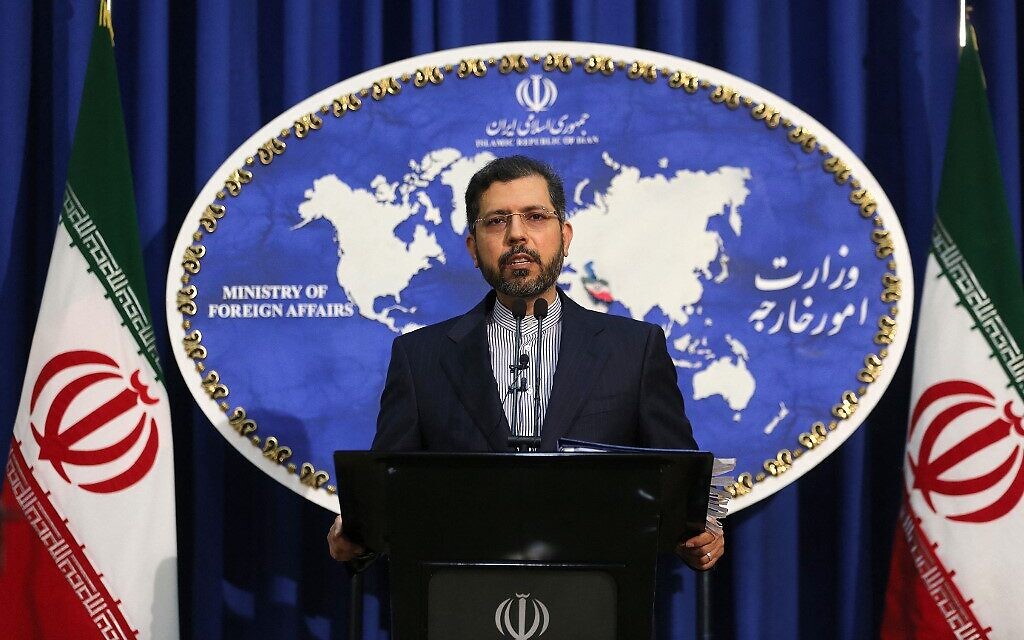
Responding to Borrell, Iranian Foreign Ministry spokesperson Saeed Khatibzadeh said the pause “could be a momentum for resolving any remaining issue and a final return.”

“Successful conclusion of talks will be the main focus of all,” Khatibzadeh wrote on Twitter. “No external factor will affect our joint will to go forward for a collective agreement.”

Iranian foreign ministry spokesman Saeed Khatibzadeh during a press conference in Tehran, on February 22, 2021. (Atta Kenare/AFP)

Khatibzadeh as well did not identify the “external” issue. However, Iran has been careful in the waning days of the talks not to upset Russia, which it views as an ally against the US.

Iran also partnered with Russia in Syria to support President Bashar Assad. But historic distrust between the nations also remains over Russia’s invasion of Iran during World War II and later refusing to leave afterward.

On Thursday, State Department spokesperson Ned Price had said America was “close to a possible deal — it’s really down to a very small number of outstanding issues.”

But last week, Russian Foreign Minister Sergey Lavrov said he wanted “guarantees at least at the level of the secretary of state” that the US sanctions would not affect Moscow’s relationship with Tehran. That threw into question the months of negotiations held so far on restoring the 2015 deal, which saw Iran agree to drastically limit its enrichment of uranium in exchange for the lifting of economic sanctions.

“The new Russia-related sanctions are wholly unrelated to the JCPOA and should not have any impact on a potential mutual return to compliance with it or its ultimate implementation,” Price said Thursday.

“We also have no intention of offering Russia anything new or specific as it relates to the (Ukraine) sanctions, nor is anything new required to successfully reach an agreement on a mutual return to full compliance with the” deal.

TV cameras in front of the ‘Grand Hotel Vienna,’ where closed-door nuclear talks take place in Vienna, Austria, on June 20, 2021. (AP Photo/Florian Schroetter)

The 2015 nuclear deal saw Iran put advanced centrifuges into storage under the watch of the International Atomic Energy Agency, while keeping its enrichment at 3.67% purity and its stockpile at only 300 kilograms (661 pounds) of uranium. It also halted enrichment at its underground Fordo nuclear facility.

But then-president Donald Trump unilaterally withdrew America from the accord in 2018, fulfilling a campaign pledge to tear up the deal as it didn’t address Iran’s ballistic missile program and support for regional militias. Iran in 2019 then began methodically breaking all the deal’s limits as a series of escalating attacks put the wider Mideast on edge.

As of February 19, the IAEA says Iran’s stockpile of all enriched uranium was nearly 3,200 kilograms (7,055 pounds). Some has been enriched up to 60% purity — a short technical step from weapons-grade levels of 90%. Meanwhile, Iran has stopped the IAEA from accessing its surveillance camera footage and has resumed enrichment at Fordo.

In this image made from April 17, 2021, video released by the Islamic Republic Iran Broadcasting, IRIB, state-run TV, various centrifuge machines line the hall damaged on April 11, 2021, at the Natanz Uranium Enrichment Facility, some 200 miles (322 km) south of the capital Tehran. (IRIB via AP, File)

That worried nuclear nonproliferation experts. While Iran insists its program is peaceful, the IAEA and Western governments say Iran had an organized military nuclear program up until the end of 2003.

Trump left office without ever meaningfully engaging in diplomacy with Iran over the nuclear deal. President Joe Biden entered the White House last year, saying he was willing to see America rejoin the agreement.

Seeing Iran able to sell its crude oil and natural gas in the global market also could push down energy prices. Americans now are paying the highest-ever prices at the pump for gasoline, fueled by Russia’s war on Ukraine.