PLO renounces all agreements with Israel

March 6, 2022

PLO renounces all agreements with Israel
PLO renounces all agreements with IsraelIsraeli PM Yitzhak Rabin (L), U.S. Pres. Bill Clinton, and PLO head Yasser Arafat at the Oslo Accords signing in 1993. (GPO)

“We are outside of the path of Oslo, the security coordination… we have entered a path of resistance in all its forms.”

By Maurice Hirsch, Adv., Palestinian Media Watch

Speaking after the recent meeting of the Palestinian National Council (PNC), its Deputy Chairman Ali Faisal clarified that there is a binding Palestinian decision to “renounce… all agreements with Israel.”

He added that from the point of view of the Palestinian leadership, the Palestinians “have entered a path of resistance in all its forms” – a term that clearly includes the use of violence and terror.

To understand the ostensible importance of this statement, it is necessary to explain what the PNC is and what authority it carries.

Constitutionally, the PNC is the highest authority in the Palestine Liberation Organization (PLO) and is responsible for formulating its policies and programs.

The PLO Central Council was established by the 11th PNC meeting, in January 1973, as a legislative organ to function when the PNC is not in session and to follow up and implement its resolutions. Its members are drawn from the PNC (including the entire PLO Executive Committee) and it is chaired by the PNC president.

The Executive Committee is the PLO’s primary executive organ, its “cabinet” and represents the organization internationally. The Executive Committee answers to the PNC.

In other words, the PNC is the primary and most senior organ of the PLO. Its decisions are binding on the entire organization.

What impact do decisions of the PNC have on the Palestinian Authority (PA)?

According to the PLO, the PA — created by the Oslo Accords — is merely an interim governing body that functions within, and subjected to, the authority of the PLO. Since the signing of the Oslo Accords, the head of the PLO has also held the position of PA Chairman.

Accordingly, to this day, the PLO governing bodies appear to make all the major decisions on behalf of the Palestinians, expecting the head of the organization and the chairman of the PA to implement the decisions made.

When the PLO makes an internal decision to “renounce… all agreements with Israel,” with impact on both the security coordination and economic relations (referred to by Faisal as the “economic Paris Agreement”) between Israel and the PA, that decision should have a binding effect.

A decision of that nature, taken by the highest Palestinian source of authority, should not only bind the PLO and the PA, but should also have ramifications vis-à-vis Israel.

Despite the ostensible severity of the PNC decision, nothing on the ground has changed. Neither the PLO nor the PA has announced severing the security coordination, and they certainly did not decide to stop taking the hundreds of millions of dollars of taxes Israel collects every month and gives to the PA.

In stark contrast, in May 2020, PA President Mahmoud Abbas decided alone and announced the renunciation of all agreements with Israel, including the severing of the security coordination and the refusal to accept the tax income. That decision held for six months, after which the coordination was renewed and the PA agreed to accept the billions of shekels (over a billion dollars) in tax revenue that had accrued.

PLO declarations aside, the reality is that everyone – including the Palestinians themselves – knows that the PLO is a defunct institution that lacks any real legitimacy. Both the PLO and the PA are run as a de facto dictatorship, in which decisions are made by one person.

The PLO only continues to exist thanks to the hundreds of millions of dollars given annually from the PA budget to the “PLO institutions.” No one truly puts any stock in the decisions made by the PLO, and the organization itself is incapable of enforcing the decisions it and its institutions make.

PLO recognition was always empty
In a recent report, Palestinian Media Watch concluded that the PLO decision to revoke its recognition of Israel’s right to exist was devoid of any real meaning or influence. That conclusion was based on the fact that the PLO recognition of Israel’s right to exist was always empty.

The most dominant organization in the PLO is Fatah. To date, the head of Fatah — first Yasser Arafat and then Mahmoud Abbas — has been the head of the PLO. The head of the PLO has always been the chairman of the PA. Similar to other PLO members, Fatah never recognized Israel’s right to exist.

For many years, the PLO enjoyed the title of the “sole legitimate representative of the Palestinian people.” That historic role brought Israel to sign peace agreements with the PLO.

However, with the passage of time, the reality is that the PLO has lost its unique status. Surveys conducted by the Palestinian Center for Policy and Survey Research show even declining Palestinian support for the PLO as the “sole legitimate representative of the Palestinian people.” The March 2019 survey showed that only 54% of those surveyed still viewed the PLO as the “sole legitimate representative” of the Palestinians, down from 69% in 2006.

While the PLO may have renounced all agreements with Israel, the reality is that the PLO is simply irrelevant.


by Algemeiner Staff

MARCH 6, 2022 3:22 PM

Deputy Secretary General of the European External Action Service (EEAS) Enrique Mora and Iran’s chief nuclear negotiator Ali Bagheri Kani wait for the start of a meeting of the JCPOA Joint Commission in Vienna, Austria November 29, 2021. Photo: EU Delegation in Vienna/Handout via REUTERS

Russia’s top representative at ongoing nuclear negotiations in Vienna said Iran already secured more concessions than Moscow and other powers expected.

In an interview published Sunday by Iran’s official news agency IRNA, Mikhail Ulyanov said, “Iran got much more than it could expect. … Realistically speaking, Iran got more than frankly I expected, others expected.”

He added that “Iranian colleagues are fighting for Iranian national interests like lions,” as well as “every comma, every word.”

The parties to the talks — which also include the United Kingdom, France, Germany, and China — are in disarray, Ulyanov said. “There was no united front against Iran,” he explained, implying that both Russia and China were inclined toward the Iranian position. The United States has participated in the talks indirectly, having withdrawn from the original agreement in 2018.

“To my surprise, I find many speculations in Iranian mass media and social networks, claiming that Russia and me personally are extremely hostile to Iran and to the nuclear deal,” Ulyanov continued. “It is nonsense and even insulting because it is not fair.”

“Iran is not an alien for us,” he asserted. “It is a neighbor with whom we want to develop an active trade and economic relations.”

He described Russia and Iran as “natural allies.”

Ulyanov’s comments came as the massive international sanctions levied against Russia since its invasion of Ukraine began to affect the Vienna talks, with Russian Foreign Minister Sergei Lavrov calling them a “problem.”

“It would have all been fine, but that avalanche of aggressive sanctions that have erupted from the West — and which I understand has not yet stopped — demand additional understanding by lawyers above all,” Lavrov said on Saturday.

“We have asked for a written guarantee … that the current process triggered by the United States does not in any way damage our right to free and full trade, economic and investment cooperation and military-technical cooperation with the Islamic Republic,” he added.

A senior Iranian official responded by describing the demand as “not constructive.”


Since Iran has deployed new air defense batteries in Syria last year, the IAF has had to change how they carry out their strikes

Israeli Air Force F-35 flies during an aerial demonstration at an air force graduation ceremony (photo credit: AMIR COHEN/REUTERS)
Israeli Air Force F-35 flies during an aerial demonstration at an air force graduation ceremony
(photo credit: AMIR COHEN/REUTERS)

Iran has used advanced air-defense batteries against Israeli planes carrying out war-between-war operations in Syria in an attempt to challenge IAF pilots.

Tehran first deployed the batteries to Syria last year as Israeli strikes against Iranian weapons and military infrastructure intensified.

Since Israel began its war-between-wars campaign (known as mabam in Hebrew) in 2013, the IAF has carried out thousands of strikes to thwart Iranian entrenchment and the smuggling of advanced weapons to Hezbollah in Syria and Lebanon. According to foreign reports, it has also carried out strikes in Iraq and Yemen.

The Syrian Arab Army is equipped with a range of older Russian-made surface-to-air missile systems, including the SA-2, SA-3, SA-5, SA-6,-SA-8, SA-11, SA-17, SA-19, SA-22 and the Pantsir 1.

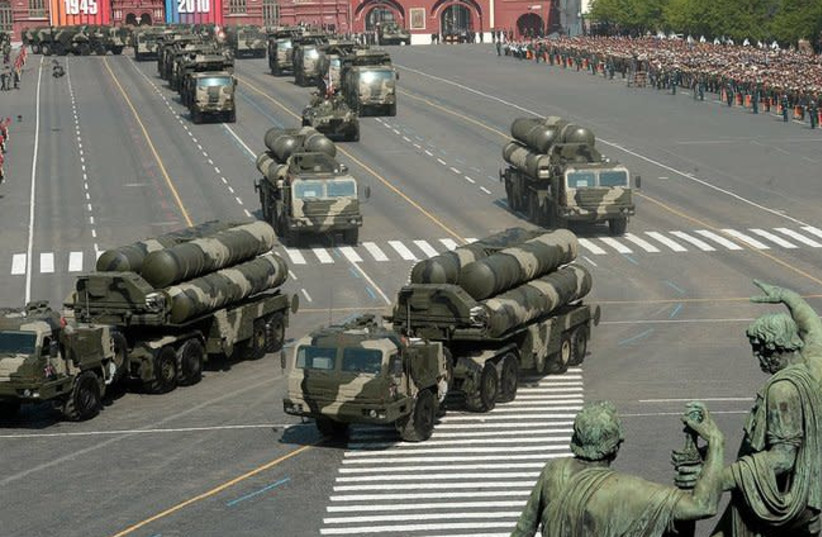
Russia has also deployed advanced S-300 and S-400 air-defense batteries but has not given them to the Syrians; instead, they are manned by Russian forces. They have yet to be used against Israeli pilots due in part to the ongoing safety mechanisms in place between Jerusalem and Moscow.

S-400 surface-to-air missile systems displayed during the May Day parade 2010. (credit: Wikimedia Commons)S-400 surface-to-air missile systems displayed during the May Day parade 2010. (credit: Wikimedia Commons)

The response time of Syrian SAMs has decreased, and more than 1,000 missiles have been fired at IAF jets over the past seven years, but they have been unable to deter their missions.

Iran also separates the radars of their SAMs from the missile launchers, leading the IAF to change its operational procedures by sending up larger formations to hit more targets at once rather than having jets return to the same target and risk being downed.

In 2018, an F-16 crashed in northern Israel after it was struck by an SA-5 missile fired by Syrian forces during an IAF operation. Syrian missiles have also landed in Israel in recent years, including this year, when shrapnel from one missile hit northern Tel Aviv, and another errant interceptor missile landed close to the Dimona nuclear site in the Negev Desert.

In July 2020, Ali Abdullah Ayyub, the deputy commander of Syria’s armed forces, and Maj.-Gen. Mohammad Bagheri, chief of staff of Iran’s Armed Forces, signed an agreement to broaden bilateral military cooperation and to develop a robust air-defense system for Bashar Assad’s regime.

“From now on, Iran will strengthen its ties with Syria even more on all levels,” Bagheri said at the time.

Since their introduction, the IAF has been studying the Iranian batteries, which have architecture unlike that of the Russian batteries.

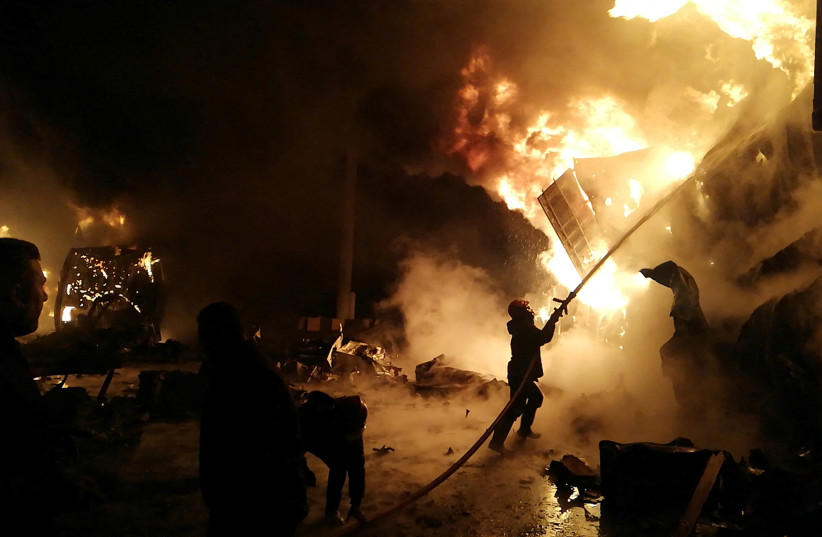
 A Firefighter douses flames after Syrian state media reported an alleged Israeli missile attack in a container storage area, at Syrian port of Latakia, Syria (credit: SANA/HANDOUT VIA REUTERS)A Firefighter douses flames after Syrian state media reported an alleged Israeli missile attack in a container storage area, at Syrian port of Latakia, Syria (credit: SANA/HANDOUT VIA REUTERS)

While the IAF continues to carry out missions successfully over Syria, the Iranian batteries are still a new challenge to Israeli pilots.

The IAF understands that the Islamic Republic’s defense industry is robust and constantly works to improve and manufacture systems and platforms that can threaten Israel and other countries in the region.

Last October, Iran carried out a large-scale air-defense drill called Defenders of Velayat Sky 1400, which showcased the capabilities of upgraded systems and weapons, including cruise missiles, radar, surveillance, electronic warfare, communication systems, advanced manned and unmanned stealth drones and optical surveillance networks.

During the drill, Iran used its 3rd Khordad, Mersad, Talash, Khordad 15, Majid and Dezful SAM systems.

Following the drill, Supreme Leader Ayatollah Ali Khamenei said: “In the face of these realities, the enemy must consider Iran’s power and defense capabilities in its calculations and decisions.”

https://www.jpost.com/middle-east/iran-news/article-700471