
Russia Warns Countries Hosting Ukraine Fighter Jets

Photo Credit: US Air Force photo by Senior Airman Jordan Castelan
An Air Force F-16 Fighting Falcon refuels during operations in support of US-led coalition forces in Syria.

In a new escalation, Russia is warning that countries offering airport facilities to Ukraine’s military could end up being involved in the conflict.

Russian Defense Ministry spokesperson Igor Konashenkov said Sunday in a video briefing quoted by the UK’s Daily Mail that if Russian forces are attacked by Ukrainian military aircraft from the territory of other nations, it “could be considered as those countries’ engagement in the military conflict.

Advertisement


“We know for sure that Ukrainian combat aircraft have flown to Romania and other neighboring countries.

“The use of the airfield network of these countries for basing Ukrainian military aviation with the subsequent use of force against Russia’s army can be regarded as the involvement of these states in an armed conflict,” Konashenkov said.

NATO ‘Green Lights’ Warplanes for Ukraine
The threat comes on the same day that US Secretary of State Antony Blinken told CBS ‘Face the Nation’ host Margaret Brennan in an interview, that plans for Poland to send fighter jets to Ukraine have been approved by the US and NATO.

‘That gets the green light,” Blinken said. “In fact, we’re talking with our Polish friends right now about what we might be able to backfill their needs if in fact they choose to provide these fighter jets to the Ukrainians. What can we do? How can we help to make sure that they get something to backfill the planes that they’re handing over to the Ukrainians? We’re in very active discussions with them about that.”

Poland has 28 Russian-made MiG-29 combat planes, which may be given to Ukraine. The US would then replace those with a new batch of F-16 fighter jets. The Polish Air Force uses both in its combat operations.

‘Ukraine Will Prevail’
“I’m afraid this could go on for some time,” he told Brennan. “But it’s going to end, and it’s going to end with Ukraine prevailing, because even as Putin has the capacity because he can – the manpower, the equipment that he has that he can bring to bear, can continue to grind down these incredibly brave and resilient Ukrainians, winning a battle is not the same thing as winning a war. Taking the city is not the same thing as capturing the hearts and minds of Ukrainians.

“What they’ve demonstrated with extraordinary courage is that they will not be subjugated to Vladimir Putin’s will to – and be under Russia’s thumb. So, whether that takes another week, another month, another year to play out, it will. And I know how this is going to end. But the question is: Can we end it sooner rather than later with less suffering than to – going forward?”

Blinken had a busy day, speaking with multiple news outlets and then with reporters following a meeting on the Ukraine-Poland border with Ukraine’s Foreign Minister, Dymytro Kuleba.

Speaking to reporters from a spot a few feet inside Ukrainian territory at the border crossing with Poland, following his meeting Kuleba, Blinken said the “entire world” stand with Ukraine, citing “an extraordinary surge of support” for the country “against Russia’s aggression. . .Russia’s war of choice.”

Kuleba concurred, adding that he and Blinken had “meaningful discussions about weapons, about sanctions, about isolation of Russia in the international arena. . .The message that I have to convey is very simple: Ukraine will win this war anyway, because this is the people’s war for their land.”

At least one and a half million refugees have fled Ukraine into neighboring countries to the West, including almost half a million who crossed the border into Poland, and an estimated 240,000 more who have made it to Moldova.

https://www.jewishpress.com/news/us-news/russia-warns-countries-hosting-ukraine-fighter-jets/2022/03/06/

Since Iran has deployed new air defense batteries in Syria last year, the IAF has had to change how they carry out their strikes

Israeli Air Force F-35 flies during an aerial demonstration at an air force graduation ceremony (photo credit: AMIR COHEN/REUTERS)
Israeli Air Force F-35 flies during an aerial demonstration at an air force graduation ceremony
(photo credit: AMIR COHEN/REUTERS)

Iran has used advanced air defense batteries against Israeli planes carrying out war-between-war operations in Syria, in an attempt to challenge Israel Air Force pilots.

Tehran first deployed the batteries to Syria last year as Israeli strikes against Iranian weapons and military infrastructure have intensified.

Since Israel began its war-between-wars campaign (known as MABAM in Hebrew) in 2013, it has carried out thousands of strikes in an attempt to thwart Iranian entrenchment and the smuggling of advanced weapons to Hezbollah in Syria and Lebanon. According to foreign reports, it has also carried out strikes in Iraq and Yemen.

The Syrian Arab Army is equipped with a range of older Russian-made surface-to-air missile systems such as the SA-2, SA-3, SA-5, SA-6,-SA-8, SA-11, SA-17, SA-19, SA-22, and Pantsir 1 air defense systems.

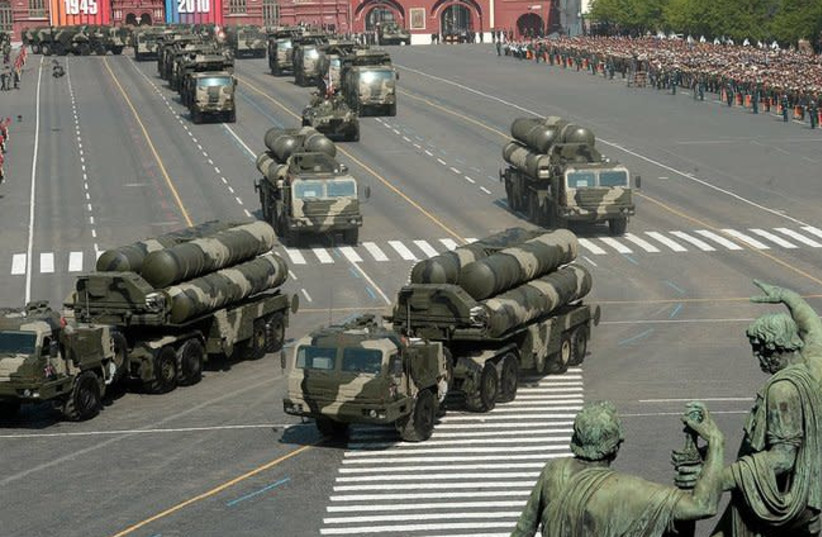
Russia has also deployed their advanced S-300 and S-400 air defense batteries but has not given them to the Syrians, rather they man themselves. They have yet to be used against Israeli jets, in part due to the ongoing safety mechanisms in place between Jerusalem and Moscow.


S-400 surface-to-air missile systems displayed during the May Day parade 2010. (credit: Wikimedia Commons)S-400 surface-to-air missile systems displayed during the May Day parade 2010. (credit: Wikimedia Commons)

While the response time by Syrian SAMs to Israeli operations has become quicker and they have fired over a thousand missiles towards Israeli jets in the past seven years, they have been unable to stop them from carrying out their missions.

The deployment of Iranian batteries to the arena is an attempt to intercept more Israeli munitions than before.

Iran also separates the radars of their SAMs from the missile launchers, leading the Israel Air Force to change how it acts during operations, including by having larger formations so that more targets can be struck at once rather than having jets return to the same target and risk being downed.

In 2018, an F-16 crashed in northern Israel after it was struck by an SA-5 missile fired by Syrian forces during an Israeli operation. Syrian missiles have also landed in Israel in recent years, including this year when shrapnel from one missile hit northern Tel Aviv, and when another errant interceptor missile landed close to the Dimona nuclear site in the Negev Desert.

In July 2020, Ali Abdullah Ayyub, the Deputy Commander of Syrian armed forces and the Chief of Staff of Iran’s Armed Forces Major General Mohammad Bagheri signed an agreement to broaden bilateral military cooperation and to develop a robust air defense system for the regime of Bashar Assad.


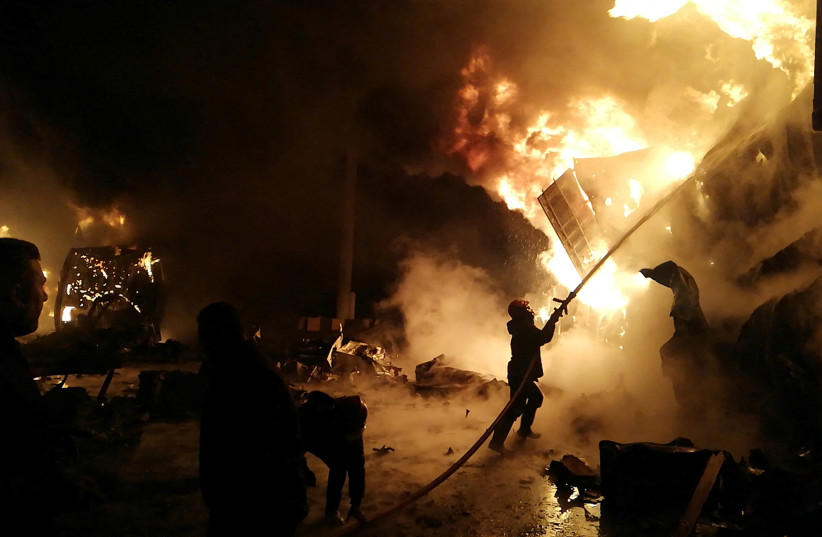
 A Firefighter douses flames after Syrian state media reported an alleged Israeli missile attack in a container storage area, at Syrian port of Latakia, Syria (credit: SANA/HANDOUT VIA REUTERS)A Firefighter douses flames after Syrian state media reported an alleged Israeli missile attack in a container storage area, at Syrian port of Latakia, Syria (credit: SANA/HANDOUT VIA REUTERS)

“From now on Iran will strengthen its ties with Syria even more, on all levels,” Bagheri said at the time.

Since their introduction, the IAF has been studying the Iranian batteries that have a different architecture than the Russian batteries. While the IAF continues to carry out their missions successfully over Syria, due to being a new and different system that Israel does not fully understand yet, the Iranian batteries are a new challenge to Israel.

The IAF understands that the Islamic Republic’s defense industry is robust and constantly works to improve and manufacture systems and platforms that can threaten Israel and other countries in the region.

In October 2021, Iran carried out a large-scale aerial defense drill called Defenders of the  Velayat Sky 1400 that showcased the capabilities of upgraded systems and weapons including missiles including cruise missiles, radar, surveillance, electronic warfare, communication systems, advanced manned and unmanned stealth drones, and optical surveillance networks.

During the drill, Iran used it 3rd Khordad, Mersad, Talash, Khordad 15, Majid, and Dezful SAM systems.

Following the drill, Iran’s Supreme Leader Ayatollah Ali Khamenei said that “in the face of these realities, the enemy must consider Iran’s power and defense capabilities in its calculations and decisions.”


Prime Minister Naftali Bennett poses for a picture at the Prime Minister's Office in Jerusalem, on January 26, 2022; Ukrainian President Volodymyr Zelensky addresses the nation in Kyiv, Ukraine, on February 24, 2022. (Olivier Fitoussi/Flash90; Ukrainian Presidential Press Office via AP)

Prime Minister Naftali Bennett poses for a picture at the Prime Minister’s Office in Jerusalem, on January 26, 2022; Ukrainian President Volodymyr Zelensky addresses the nation in Kyiv, Ukraine, on February 24, 2022. (Olivier Fitoussi/Flash90; Ukrainian Presidential Press Office via AP)

Prime Minister Naftali Bennett just spoke again with Ukraine’s President Volodymyr Zelensky, his office says, for the third time in 24 hours.

The Prime Minister’s Office doesn’t give any details about what the two discussed.

Today’s call follows Bennett’s whirlwind trip to Moscow and Berlin, where he held talks with Russian President Vladimir Putin and then German Chancellor Olaf Scholz to discuss the war in Ukraine.
