
Fierce fighting in the Kyiv area • Russian forces frustrated by resistance • Casualties continue to climb • NATO allies send aid to Ukraine
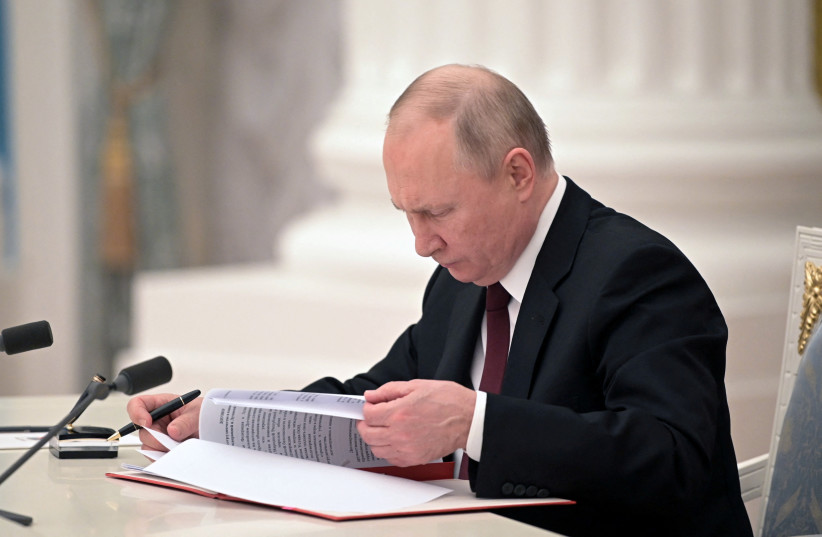
 Russian President Vladimir Putin signs documents, including a decree recognising two Russian-backed breakaway regions in eastern Ukraine as independent entities, during a ceremony in Moscow, Russia, in this picture released February 21, 2022.  (photo credit: SPUTNIK/ALEXEY NIKOLSKY/KREMLIN VIA REUTERS)
Russian President Vladimir Putin signs documents, including a decree recognising two Russian-backed breakaway regions in eastern Ukraine as independent entities, during a ceremony in Moscow, Russia, in this picture released February 21, 2022.
(photo credit: SPUTNIK/ALEXEY NIKOLSKY/KREMLIN VIA REUTERS)

Russian President Vladimir Putin ordered his military command to put Russia’s deterrence forces – a reference to units which include nuclear arms – on high alert, citing aggressive statements by NATO leaders and economic sanctions against Moscow.

“As you can see, not only do Western countries take unfriendly measures against our country in the economic dimension – I mean the illegal sanctions that everyone knows about very well – but also the top officials of leading NATO countries allow themselves to make aggressive statements with regards to our country,” Putin said on state television.

US Ambassador to the United Nations Linda Thomas-Greenfield slammed Putin’s move as an unacceptable escalation.

“It means that President Putin is continuing to escalate this war in a manner that is totally unacceptable and we have to continue to stem his actions in the strongest possible way,” she said in an interview with CBS Face the Nation.

Fighting between Russian and Ukrainian forces entered its fourth day on Sunday as Russian forces continued to push into the Ukrainian capital of Kyiv and the city of Kharkiv in the northeast.

Russian forces advanced over the weekend towards Ukraine’s major cities, but on Sunday morning the Ukrainian Armed Forces claimed that the Russian military movement had slowed due to the need to replenish fuel and ammunition.

The Ukrainian military also claimed that enemy troops, mostly young conscripts, are exhausted from the previous military exercises they had participated in just prior to the invasion. They claim that there is desertion and low morale, but this assessment may itself be psychological warfare.

Read more on the Russia-Ukraine War:

“The main goal of the opponent is to block the capital of our homeland, the city of Kiev, which remains unfulfilled,” said the Ukrainian military.

“Where are all those who promised to capture Kyiv in 72 hours? Where are they?” Ukrainian Defense Minister Oleksii Reznikov said in a Sunday morning statement.

The Battle of Kyiv

A series of blasts were heard to the west of the Ukrainian capital Kyiv’s center on Sunday, minutes after air raid sirens sounded, a Reuters correspondent reported.

Ukrainian media reported explosions and a gunfight in a nearby town.

According to the Ukrainian news website Segodnya.ua, a bridge has been blown up near the town of Bucha west of Kyiv. It was unclear whether it had been bombed by Russian troops or destroyed by the Ukrainian side.

Anton Herashchenko, an advisor to Ukraine’s interior minister, said fighting was underway in Bucha with Russian forces that were trying to advance towards Kyiv.

Gunfire and the sound of explosions echoed through Kyiv on Saturday night as well.

Kyiv’s mayor Vitali Klitschko said on Saturday that there was no major Russian military presence in the capital, but that saboteur groups were active and he was imposing a curfew from Saturday evening until Monday morning. Klitschko, a former world heavyweight boxing champion, later told Germany’s Bild tabloid the city was “nearly encircled.”
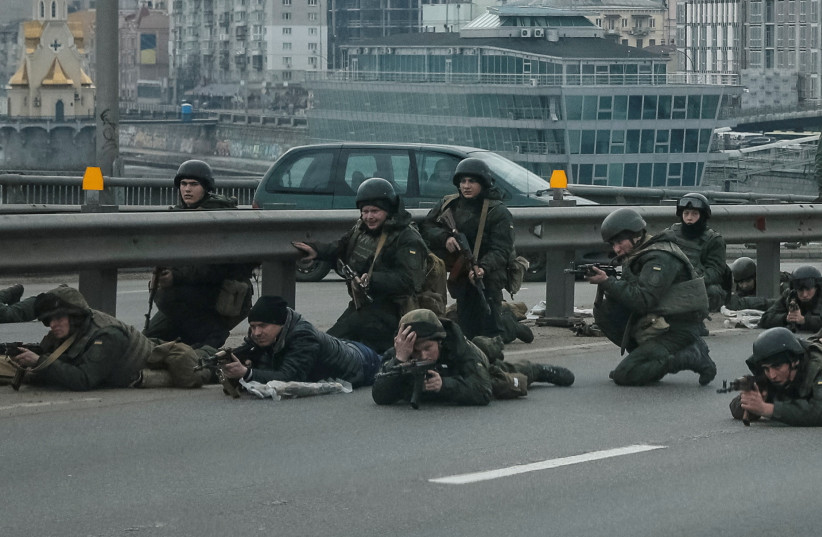
Servicemen of the Ukrainian National Guard take positions in central Kyiv, after Russia launched a massive military operation against Ukraine, February 25, 2022. (credit: REUTERS/GLEB GARANICH)Servicemen of the Ukrainian National Guard take positions in central Kyiv, after Russia launched a massive military operation against Ukraine, February 25, 2022. (credit: REUTERS/GLEB GARANICH)

Chechen leader Ramzan Kadyrov, a close Putin ally, said on Saturday his fighters were also deployed in Ukraine. He said Russian forces could easily take Kyiv and other large cities but their task was to avoid loss of life.

However, Defense Minister Oleksii Reznikov was defiant on Sunday morning, extolling Ukrainian success in repelling Russian advances in the city.

Instead of seeing Russian forces in the capital, Reznikov said that all he saw was a “heroic army, a civil guard, fearless border guards, selfless rescuers, reliable police officers, tireless medical rescuers who all do their duty.”

Authorities have handed thousands of assault rifles to residents and told citizens to make petrol bombs to help repel the invaders. The government press has also issued instructions on how to sabotage the Russian advance through non-military means.

“I see thousands and thousands of citizens who have taken arms, and have become a level of territorial defense,” Reznikov said Sunday.
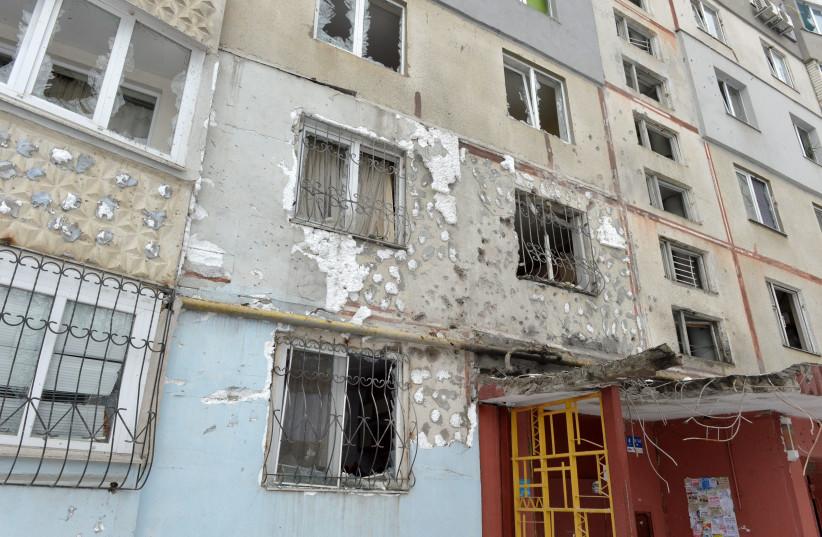
 A view of a residential building damaged by recent shelling in Kharkiv on February 26, 2022. (credit: SERGEY BOBOK/AFP via Getty Images)A view of a residential building damaged by recent shelling in Kharkiv on February 26, 2022. (credit: SERGEY BOBOK/AFP via Getty Images)

Fighting across Ukraine

“The main tactics of the occupiers’ actions remain to move and capture small cities, villages and connecting roads,” the Ukrainian armed forces said on Sunday. “Attempts to take control of major cities were unsuccessful.

“Russian occupants are actively deploying sabotage intelligence groups that destroy civilian infrastructure facilities and kill civilians in major cities,” the statement continued.

Russian troop vehicles were seen on the streets of Ukraine’s northeastern city of Kharkiv on Sunday, Anton Herashchenko, an adviser to Ukraine’s interior minister, wrote on Telegram.

Videos published by Herashchenko and Ukraine’s State Service of Special Communications and Information Protection showed several light military vehicles moving along a street and, separately, a burning tank.

“We know that (Russian forces) have not made the progress that they wanted to make, particularly in the north. They have been frustrated by what they have seen is a very determined resistance,” a US official said, without providing evidence.

Putin on Sunday thanked Russia’s special forces, singling out those who are “heroically fulfilling their military duty” in Ukraine, in a televised address that was also published on the Kremlin website.

Russia and Ukraine casualties and refugees

The Ukrainian Defense Ministry has claimed that as of Sunday morning there were some 4,300 Russian soldiers killed in combat, and over 200 captured as prisoners of war. The ministry also claimed to have destroyed 146 tanks, 540 armored vehicles, 27 aircraft, 26 helicopters, and one anti-aircraft emplacement.

At least 198 Ukrainians, including three children, have been killed and 1,115 people wounded so far in Russia’s invasion, Interfax quoted Ukraine’s Health Ministry as saying. It was unclear whether the numbers comprised only civilian casualties.

Interfax later cited the regional administration in Donetsk, eastern Ukraine, saying 17 civilians had been killed and 73 wounded by Russian shelling.

Zelensky said on Sunday that Russian actions verged on “genocide.”

“This is terror. They are going to bomb our Ukrainian cities even more, they are going to kill our children even more subtly. This is the evil that has come to our land and must be destroyed,” Zelensky said on a short video message.

Russia has not released casualty figures and it was impossible to verify tolls or the precise picture on the ground. Both Ukrainian and Russia casualties are suspect of inflation and downplaying by both sides, for morale and propaganda purposes.

About 100,000 people have crossed into Poland from Ukraine since Thursday, including 9,000 who have entered since 7 a.m. on Saturday, Polish Deputy Interior Minister Pawel Szefernaker said.

Romania announced on Sunday that in cooperation with Ukrainian border authorities, Romanian ambulances will pick up children, pregnant women and the elderly waiting in long queues to cross the border into Romania at the northeastern Siret crossing, speeding up the process.

The United Nations High Commissioner for Refugees (UNHCR) said on Sunday that some 368,000 Ukrainian citizens fled the country in the past week.


Humanitarian and military aid to Ukraine

“The world has seen – Ukrainians are strong, Ukrainians are powerful, Ukrainians are brave. So it is not surprising that such people always have more powerful friends than enemies,” Ukrainian President Volodymyr Zelensky said in an address on Saturday night. “During the day, I spoke every hour with the leaders of Ukraine’s friends.”

Zelensky said that he had spoken with the leaders of Italy, India, Azerbaijan and others about how they could aid Ukraine.

NATO countries have been “boosting their support for our partner Ukraine.” NATO said Saturday night.
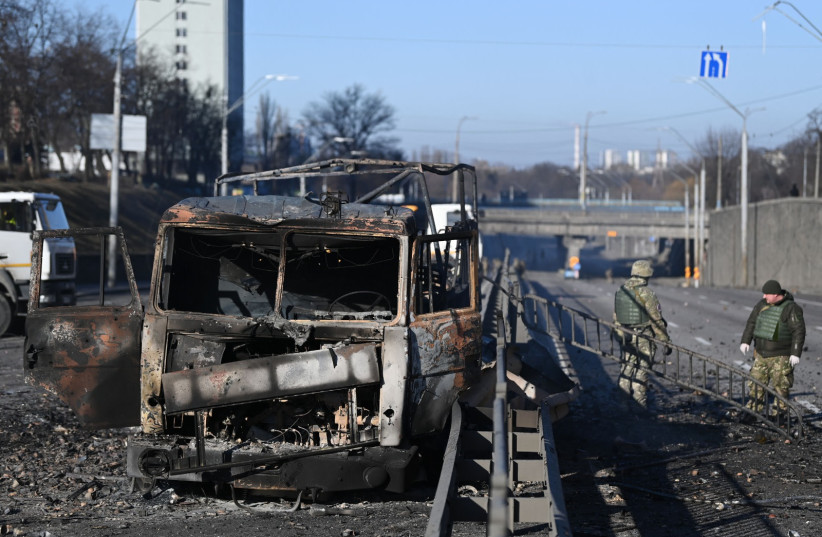
 Ukrainian soldiers stand past a burnt Ukrainian army vehicle on the west side of the Ukrainian capital of Kyiv on February 26, 2022.  (credit: DANIEL LEAL/AFP via Getty Images)Ukrainian soldiers stand past a burnt Ukrainian army vehicle on the west side of the Ukrainian capital of Kyiv on February 26, 2022. (credit: DANIEL LEAL/AFP via Getty Images)

“Allies Belgium, Canada, Czech Republic, Estonia, France, Germany, Latvia, Lithuania, Netherlands, Poland, Slovakia, United Kingdom and United States have sent or are approving military aid such as guns, ammo and missiles, including air defense and anti-tank equipment,” NATO said in a Saturday night Instagram post. “Italy is preparing financial support and Spain humanitarian aid. Turkey is deepening defense ties with our Ukrainian partners.”

“We keep our word on defense,” The Czech Defense Ministry said on Sunday morning, sharing a video of a train presumably full of military supplies and headed for Ukraine. “We’re sending machine guns, assault rifles, pistols, ammunition and artillery shells. Further assistance will be approved by the Sunday government.”

Romania said on Sunday that it will send provisions and equipment worth 3 million euros ($3.38 million) to Ukraine and has offered to care for the wounded in military and civilian hospitals, government spokesperson Dan Carbunaru said on Sunday.

Provisions to be sent include fuel, ammunition, bullet-proof vests, helmets, military equipment, food and water, he added.

Ukraine is also receiving financial support from individuals around the world, even as crowdfunding site Patreon closed a campaign raising funds for Ukrainian soldiers and gear over the weekend.  The General Staff of the Ukrainian Armed Forces thanked supporters on Sunday morning, saying that they had received 1.160 billion Ukrainian hryvnias, or $39 Million US dollars from supporters, which included 900,000 transactions from personal sources.

Israel’s Prime Minister Naftali Bennett said on Sunday that Israel plans to send 100 tons of medical aid and other equipment to help Ukrainian civilians under attack.

The aid will include water purification kits, medical equipment and medicines, tents, blankets, and sleeping bags.

Sanctions

Western nations have also announced new sanctions on Russia, including blacklisting its banks and banning technology exports.

One of the biggest results in Zelensky’s eyes was the limited disconnection of SWIFT from some Russian institutions. They have so far stopped short of forcing Russia out of the SWIFT system for international bank payments, though Germany’s foreign and economic ministers and French presidential official indicated on Saturday that such a move may come soon.

“Our diplomats fought around the clock and with inspiration for all European countries to agree on a strong and fair decision to disconnect Russia from the international interbank network. We also have this victory. This is billions and billions of losses for Russia – a concrete price for this vile invasion of our state,” Zelensky said on Saturday night.


Background on the war

After amassing some 190,000 troops to the north, east and south of Ukraine, Putin on Monday signed a decree to recognize two breakaway regions of eastern Ukraine, the Donetsk People’s Republic and the Lugansk People’s Republic, as independent entities in a signing ceremony shown on state television.

On Thursday Russia finally launched what Putin called a “special military operation” after weeks of denying its intention to invade Ukraine. Putin argued that Ukraine, a democratic nation of 44 million people, is an illegitimate state carved out of Russia, a view Ukrainians see as aimed at erasing their more than thousand-year history.

It is unclear what is Putin’s endgame for the conflict.

https://www.jpost.com/international/article-698772


How Biden has empowered evil in both Russia and Iran

Behind the administration’s perverse policy is the belief system fundamental to the West’s governing and intellectual classes which links their Iran strategy with their approach to Vladimir Putin — and also with their hostility towards Israel.Op-ed.


Melanie Phillips

Melanie PhillipsChannel 1

(JNS) The contrast could scarcely be more glaring. America’s strategy to deter Russian President Vladimir Putin’s aggression against Ukraine is to impose sanctions. But its strategy to deter aggression by the Iranian regime is to lift sanctions.

Not only is this contradictory, but in terms of effectiveness, it’s precisely the wrong way round. Sanctions were pointless once Putin’s assault on Ukraine was already underway, as its president, Volodymyr Zelenskyy, so bitterly observed.

But sanctions did weaken the Iranian regime as it raced towards achieving nuclear weapons breakout capacity. Sanctions were aimed at encouraging the Iranian people to rise up and topple the regime, the best chance of avoiding a nuclear-armed Iran short of war.

Now the administration of U.S. President Joe Biden has reportedly reached an agreement that’s even worse than the disastrous 2015 nuclear deal, lifting all constraints on Iran’s manufacture of nuclear weapons within two and a half years.

If this is so, Biden will have played midwife to the Iranian bomb which his administration has so vapidly pledged to prevent and towards which Tehran has already taken huge strides through America’s policy of appeasement.

In return for a commitment to Iranian restraint that won’t be worth the paper on which it’s written, the deal means the Biden administration will lift those sanctions that it has not quietly lifted already.

America will thus enable billions of dollars to be funneled into Tehran to fund its global terrorism, its arming of Hamas and Hezbollah against Israel and its march to regional hegemony.

Why is the Biden administration set upon such a dreadful course of action? One suggestion is malice against Israel, which Tehran has targeted for genocidal destruction. This malice is evidenced by the role of the virulently anti-Israel Tehran apologist Robert Malley as Biden’s point man on Iran.

But a nuclear-armed Iran threatens America too. Iran is developing ballistic missiles which could reach America, against which it’s been at war ever since the Islamic regime came to power in 1979.

So, the reason for this extraordinarily perverse policy must lie deeper. The real cause is surely the belief system fundamental to the West’s governing and intellectual classes, and which links their Iran strategy with their approach to Putin — and also with their hostility towards Israel.

This is the conviction that the brotherhood of man can be created by avoiding conflict through the application of reason, which is assumed to be a universal value. Adherents place their faith in interdependence, globalization and the power of diplomacy to avoid war.

The principal architect of the 2015 nuclear deal, former President Barack Obama, reportedly believed that since Iran was in his view a historic victim of the West, empowering it would draw its aggressive sting and promote stability and peace in the region.

Israel — a westernized nation stubbornly insisting on defending itself against annihilation — couldn’t be allowed to frustrate that vision. And Obama’s thinking seems also to be the Biden administration’s default position.

Moreover, according to this thinking, the real problem for the world is not the threats that human beings represent towards each other. It is instead the threat they collectively represent to the existence of the planet itself through man-made global warming.

This is intimately linked to the West’s catastrophic weakness against Putin. For its obsession with “climate change” has handed Putin a devastating blackmail weapon with which he can paralyze any deployment of effective sanctions.

That’s because the green agenda has sent the west into a trap of its own making.

Its determination to reduce carbon emissions has turned it away from fossil fuels in favor of renewables. Because these are so unreliable as sources of energy, however, the west has become increasingly dependent upon natural gas.

Europe now gets most of its gas from Russia. So, Putin, with his hand on the spigots which he can open or shut at will, has the power to restrict gas supplies, send the price of gas shooting up and inflict on Western nations both power outages and eye-watering increases in their cost of living.

Last year, the Biden administration made this trap even worse. It withdrew its support from the gas pipeline that would have linked Israel to Europe through Cyprus and Greece.

That pipeline would not only have promoted energy independence and economic prosperity for Israel, Cyprus and Greece. It would also have helped diversify gas supplies and thus eased European dependency on Russia.

The U.S. ostensibly opposed it over concerns about fossil fuels. Yet last year, Biden greenlighted the final construction of Nord Stream 2, the gas pipeline from Russia to Germany which bypasses Ukraine.

If this were to start operating, it would give Putin a devastating weapon with which to blackmail western Europe by threatening to cut off its energy supplies.

Biden has now reversed himself and pressurized Germany to junk Nord Stream 2. But by originally greenlighting it while vetoing the eastern Mediterranean pipeline, America privileged its Russian foe over its allies. This suggests something malign beyond the green agenda.

In addition to the “climate change” obsession, the West’s fantasy of a world governed by interdependence, reason and diplomacy is imploding in both Ukraine and Iran.

Faith in interdependence meant the West viewed Putin as someone with whom it could do profitable business without any problem. It assumed that close financial and economic links would knit him into the community of nations so that he would pose no threat to anyone beyond Russia.

Western countries believed that buying Russian gas would cement the ties that created peace. Instead, they merely handed Putin the means to blackmail them.

The doctrine of interdependence similarly created the fantasy that empowering Iran would turn it from the West’s most lethal terrorist foe into a civilized partner in mutually profitable endeavor.

Above all, the West has told itself that war is unconscionable — even in self-defense — and can always be avoided by diplomacy. This doctrine has reached its nadir in the Iran negotiations, where American diplomacy has become a euphemism for abject surrender.

The Iranian regime’s perception that Biden would never take military action, despite repeated attacks by its proxies against the U.S. and its allies, emboldened it to dig in its heels in the nuclear talks. Ramping up its aggression resulted in more American concessions and the conviction in Tehran that America would give it whatever it demanded.

U.S. Secretary of State Antony Blinken said this week that he would not allow Putin’s pretense of diplomacy to obscure his aggressive acts. Yet that’s precisely what he’s been doing with Iran — as Putin will have noted.

For the Russian leader, sanctions are but a minor irritant. Serious intent against him by the West would entail putting its military boots on the ground.

Tyrants respect only power. The absence of serious intent is viewed as weakness and spurs more aggression. The only reason the 1962 Cuban missile crisis was defused was that Cuba’s prime minster, Fidel Castro, understood that the U.S. was prepared to fight and sacrifice American lives — which it then was.

The paradox of peace is that its maintenance depends on making the credible threat of war. Western liberals reject this as “war-mongering.” For them, diplomacy has become a religion.

When it comes to resisting abuses of power, however, diplomacy is the god that fails over and over again. When used as a strategy against implacable aggression, it turns its adherents into accessories to killing.

That’s why the Israel “peace process” resulted in thousands of murdered Israelis. It’s why Iran is poised to get its genocide bomb. And it’s why Ukraine will now pay a terrible price — at the hands of a tyrant empowered by a West consumed by its own ludicrous and lethal illusions.

Melanie Phillips, a British journalist, broadcaster and author, writes a weekly column for JNS. Currently a columnist for “The Times of London,” her personal and political memoir, “Guardian Angel,” has been published by Bombardier, which also published her first novel, “The Legacy.” Go to melaniephillips.substack.com to access her work.

https://www.israelnationalnews.com/news/322948


As the international community focuses on the Ukraine/Russia crisis in the U.N. General Assembly, U.S. Deputy Ambassador to the U.N. Richard Mills is critical of the diplomatic time and energy that monthly meetings on the Israeli-Palestinian file take up at the Security Council.
Vassily Nebenzia. Permanent Representative of the Russian Federation to the United Nations and President of the Security Council for the month of February, chairs the Security Council meeting on the situation in the Middle East, including the Palestinian question. Credit: UN Photo/Loey Felipe

Vassily Nebenzia. Permanent Representative of the Russian Federation to the United Nations and President of the Security Council for the month of February, chairs the Security Council meeting on the situation in the Middle East, including the Palestinian question. Credit: UN Photo/Loey Feli

 Russia denounced Israel’s sovereignty over the Golan Heights at a meeting of the U.N. Security Council on Wednesday, hours before it launched its invasion of Ukraine.

“We are concerned over Tel Aviv’s announced plans for expanding settlement activity in the occupied Golan Heights, which directly contradicts the provisions of the 1949 Geneva Convention,” said Russia’s United Nations envoy Dmitry Polyanskiy in a statement. “Russia doesn’t recognize Israel’s sovereignty over Golan Heights that are part of Syria.”

These were Russia’s first comments about Israel in the hours since the Israeli Ministry of Foreign Affairs released a statement voicing support for Ukraine’s sovereignty and territorial integrity on Wednesday, without mentioning Russia by name, in what was seen as an effort not to anger Moscow, which has allowed Israel to operate with a large degree of freedom in its attacks on Iranian targets in Syria.

Addressing the U.N. Security Council’s monthly briefing on the Middle East on Wednesday, Polyanskiy said, “Russia’s unchanging position, according to which we do not recognize Israeli sovereignty over the Golan Heights that are an inalienable part of Syria.”

The Security Council meeting came despite the fact that most of the international community’s attention was focused on the opposite end of the building, as the body’s General Assembly took up the Ukraine/Russia crisis.

Meanwhile, at the Security Council meeting, the Palestinian Authority ambassador to the U.N. Riyad Mansour used the occasion to slam Israel, notably wearing a mask printed with the words “End Apartheid.”

Mansour made sure to utter “apartheid” at every opportunity, attempting to capitalize on any anti-Israel momentum generated by a recent Amnesty International report which labeled Israel’s treatment of Arabs, both within the disputed territories and Israel proper. It is a claim, as Israeli Ambassador to the U.N. Gilad Erdan noted on Wednesday, that no one has taken up outside of the P.A. and designated terrorist groups.

“You can see the campaign that started here today on the mask of my counterpart. But make no mistake, this is a joint campaign between these organizations and the Palestinians with the mission of delegitimizing Israel as a Jewish democratic state,” said Erdan, adding, “Can anyone honestly look me in the eye and tell me that Israel, a country that protects the social and political equality of all of its citizens, is guilty of systematic injustice? A country in which Arab doctors, Arab members of parliament and Arab ministers serve alongside their Jewish counterparts. “

Riyad Mansour, Permanent Observer of the State of Palestine to the United Nations, addresses the Security Council meeting on the situation in the Middle East, including the Palestinian question. Credit: UN Photo/Mark Garten/Shutterstock.

Erdan went on the offensive against an open-ended Commission of Inquiry (COI) established by the U.N. Human Rights Council that was formed in the aftermath of last May’s Israel-Hamas conflict, in which the terror group that runs the Gaza Strip launched more than 4,000 rockets into Israel. The COI, however, will have the ability to investigate every Israeli government and military decision since the founding of the state, with a budget that is nearly double that of one-time investigations into human rights violations in Syria or Venezuela, Erdan noted. The COI is the first one ever launched by the UNHRC with no end date built into its mandate, and its appointed chair has regularly vilified Israel.

“Amnesty International, Human Rights Watch, and other so-called ‘human rights organizations’ have chosen to launch a Jihad war against the only vibrant democracy in the Middle East. Some of the very same organizations that could not find the time to write up reports on Syria, Myanmar, Iran or other horrific human rights abusers, managed to find the time to write up hundreds of pages delegitimizing the existence of Israel. These recent reports have attempted to brand Israel with absurd claims and heinous accusations,” said Erdan.

Mansour countered, “This council might not be ready to use the word, but apartheid is and has been for a while now, our reality….Israel may be outraged by the word apartheid. Everyone else should be outraged by the policy.”

The debate was originally scheduled to be closed. But the Palestinians requested that it be changed to an open format, and Russia, holding the presidency of the Security Council this month, acceded. Most Security Council ambassadors were at the General Assembly meeting on Ukraine and Russia, taking place at the exact same time, something not lost on Erdan.

“As we sit here debating legal disputes and false allegations, the clouds of unrest, violence, and war cast long shadows across the world. One might wonder what the urgency was to turn a closed monthly debate into an open one while such critical matters to global security are being discussed in the General Assembly as we speak. That being said, if we are here today to discuss the situation in the Middle East, then the real threat to the region must be the focus of this meeting,” said Erdan, turning the focus of the conversation to Iran’s growing nuclear program and other menacing activities by the Islamic Republic and its proxies throughout the region.

Gilad Erdan, Permanent Representative of Israel to the United Nations, addresses the Security Council meeting on the situation in the Middle East, including the Palestinian question. Credit: UN Photo/Loey Felipe

‘Good-faith engagement can build confidence and create a path to cooperation’

U.S. Deputy Ambassador to the U.N. Richard Mills was also critical of the diplomatic time and energy the monthly meetings on the Israeli-Palestinian file take up at the Security Council, saying, “The fundamental reality is that any solution must be agreed by the parties themselves. In this context, holding meetings for the sake of meetings is not going to help. But when the parties are ready to move forward, the United States will be here to support them.”

Mills began his remarks by praising the progress afforded by the Abraham Accords, noting Israeli Prime Minister Naftali Bennett’s recent visit to Bahrain and this month’s Emirati Federal National Council delegation to the Knesset.

“These visits demonstrate that good-faith engagement can build confidence and create a path to cooperation towards greater security, prosperity, and dignity. In addition to these visits, we support the efforts by the signatories of the Abraham Accords to further their relationships through working groups and other initiatives to develop trade, cultural, and people-to-people ties. These deepening relations offer new opportunities for the people of the region,” said Mills.

Ghana called on Israelis and the Palestinians to resume peace talks, saying it supports the efforts of Munich Group (Jordan, Egypt, Germany and France) to restart negotiations. China said it’s working with Egypt to provide COVID-19 vaccines to the Palestinians.

https://www.jns.org/at-un-russia-denounces-israels-sovereignty-in-golan-heights-after-jerusalem-backs-ukraine/?fbclid=IwAR2hWhC_C89fEog1ckhgyA1lrJpS5gUW1Na5lIukOMGWcl40w_fECfQpSMc
