
Israeli military is watching the war in Ukraine closely – analysis

The IDF will study footage released on social media as well as all the military power being used by both sides in order to better prepare for the next war that it will be engaged in.

By ANNA AHRONHEIM Published: FEBRUARY 24, 2022 13:35

IDF tanks along the Gaza border  (photo credit: REUTERS)
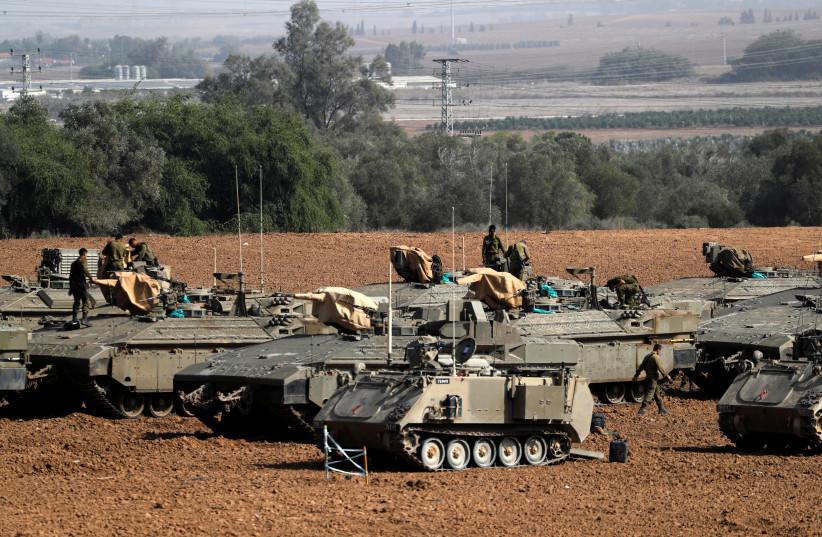
IDF tanks along the Gaza border (photo credit: REUTERS)

At 5 am on Thursday morning Russia fired hundreds of missiles towards Ukraine, the beginning of its full-scale invasion of the European country which got its independence from Moscow in 1991.

It is a war that will be played out on social media and will showcase Russia’s military might against Ukraine and Western weapons systems. If Russia’s latest weapons were tested in Syria, they are now being battle-proven in Ukraine.

Videos have already spread over social media of missiles flying over Ukraine, with some reports indicating that they could be naval Kalibr or Iskander ballistic missiles or cruise missiles fired by Russian jets towards strategic Ukrainian targets including military airfields, air defense systems, ammunition depots, infrastructure and more.

Read more on the Ukraine-Russia War:

Israelis in Ukraine told to evacuate, Israeli diplomats to help
Rabbis stay in Ukraine to support Jewish community
Guterres to Putin: ‘In the name of humanity stop this war against Ukraine’
How war in Ukraine increases Iran’s threat against Israel – analysis
After the initial missile barrages, that may have been launched by multi-rocket launch systems (MRLS) like the 9A52-4 Tornado, Russian tanks were filmed crossing into Ukraine as well as jets and helicopters flying over Ukrainian cities and towns.

A Russian Yars intercontinental ballistic missile is launched during the exercises by nuclear forces in an unknown location in Russia, in this still image taken from video released February 19, 2022. (credit: Russian Defence Ministry/Handout via REUTERS)
While reports out of a warzone are always tricky, Ukraine reported that at least six fighter jets and one helicopter were downed by their air defenses on Thursday morning.

It was just the beginning of a war that Israel’s military will be keeping a close eye on in order to learn what they might face in a future war on its northern front where Syrian forces have been trained by and received military aid from Russia.

Both Ukraine and Russia have been upgrading their militaries in recent years, but Russia far overpowers both in terms of personnel (850,000 vs 250,000) and weaponry. In terms of airpower, Russia has a total of 4,100 aircraft compared to 318 Ukrainian aircraft.

Russia has one of the most powerful militaries in the world and spent $61.7 billion on its military in 2020. According to Global Firepower, which analyzes the military capabilities of countries around the world, Russia is the second most powerful military in the world. Ukraine meanwhile is ranked 22 out of 140.

Prior to the invasion, Russia had an estimated 200,000 troops deployed to Ukraine’s borders, Moscow also deployed Iskander short-range ballistic missile systems, tanks and artillery. They began their attack at night and waited until morning to start moving their ground forces into place.

Israel watched closely as Russia tested various platforms in Syria and will be watching even closer to see if they can take on the Western arms provided to Ukraine. The IDF will also be watching how the Russian military moves its forces and uses its heavy armored vehicles and tanks in urban areas.

Though the IDF has been investing in precision munitions that can be fired from standoff ranges in order to reduce the risk to ground forces, tanks and armored fighting vehicles remain a central aspect of any battle the IDF engages in.

No IDF tanks have maneuvered into dense urban areas since the 2014 war in the Gaza Strip and the Second Lebanon War in 2006, and the Israeli military will look to learn lessons from any urban combat in this war conducted by the Russians. The Ukrainian response to Russian tanks will also be studied by Israel.

While most of Kyiv’s military is based on antiquated Soviet systems, it has received new equipment from the West including Javelin anti-tank missiles, Stinger anti-aircraft missiles, and Turkish-made Bayrakhtar drones which could be a game-changer.

Turkish and Israeli-made drones were key platforms in another recent war that involved Russia. In the 2020 conflict between Armenia and Azerbaijan, small tactical drones ripped through Armenian tanks and even Russian air defenses.

Though Kiev is no major drone power and does not have any Israeli-made drones, Ukraine’s military has been fielding an array of small tactical drones, some that can survive GPS jamming, since 2014 and while they alone won’t defeat the Russian military, they likely could become a deadly nuisance.

Among the drones in its arsenal is the Yatagan-2 (“Scimitar”) drone that can cruise for up to 12 minutes searching for targets before diving into one with a two-pound explosive, or the fixed-wing drone called the AN-BK1 Horlystisa made by Antonov (which has built some of the world’s largest transport planes) that are capable of carrying munitions to engage targets.

The IDF is a military that praises itself for its in-depth investigations and its ability to incorporate battlefield lessons. And while Israel’s military will very likely watch Europe’s war from the sidelines but it will watch it closely.

It will study the tweets, Snapchats, Instagram stories and other footage released on social media as well as all the military power being used by both sides in order to better prepare for the next war that it will be engaged in.

https://www.jpost.com/middle-east/article-698498?fbclid=IwAR1qIj7AcfijCwVu7KMH7kZV7gqsHB0sH5jc3ZFU4syna6vJ_KClSMxx2Ug


Ukrainian Jews arrive in Israel: There are miracles

Opinion: Yael Eckstein describes the “miracle” of a flight holding new immigrants from Ukraine landing in Israel just days before the war began.

 New immigrants arrive from Ukraine in February 2022 (photo credit: IFCJ)
New immigrants arrive from Ukraine in February 2022
(photo credit: IFCJ)

Even in a world full of conflict and strife, there are miracles. I know, because I was privileged to witness one recently.

When a Fellowship Freedom Flight landed at Ben-Gurion Airport in Tel Aviv, I was on the tarmac, along with other Fellowship staff, Israel’s minister of aliyah and other dignitaries, to welcome it. It was a flight of olim (immigrants) from Ukraine. The flight miraculously landed just a few days before the full on assault, when all the skies and flights are closed.

They came to Israel seeking new life in their biblical homeland. There was a wide range of people – old and young, men and women, families. Each brings with them their talents and their commitment to living freely and proudly as Jews. Each individual makes Israel stronger and helps secure the Jewish future in our biblical homeland.

As festive music played and I greeted the olim, I couldn’t help but think of how unlikely this all was. Who would have thought, in the middle of the last century, that the Jewish people would have their own sovereign country? Who would have thought that in our lifetime we would see the fulfillment of the biblical prophecy that promises that God will gather the exiles of Israel?

The only word I can think of to describe such events is “miraculous.”

(Credit: IFCJ)(Credit: IFCJ)

In our daily lives, we can easily get bogged down by our tasks and worries. But when we step aside and look at our lives from a greater perspective, we can see how God is at work, and how prophecy is unfolding before our very eyes each day. No matter what is going on in the world, there is nothing that will stop God’s plans – that is one thing we can count on.

We must – and, of course, we will – continue to pray for those in need. But even as we do, let us also pause and give thanks to God that, in a world of conflict and strife, there are miracles. I am so grateful that we all get to be witnesses.

Yael Eckstein is president and CEO of the International Fellowship of Christians and Jews.

https://www.jpost.com/christianworld/article-698461


Russian leader says military operation meant to ‘protect people who have been subjected to bullying and genocide’


In this image made from video released by the Russian Presidential Press Service, Russian President Vladimir Putin addresses the nation in Moscow, Russia, on, February 24, 2022. (Russian Presidential Press Service via AP)

In this image made from video released by the Russian Presidential Press Service, Russian President Vladimir Putin addresses the nation in Moscow, Russia, on, February 24, 2022. (Russian Presidential Press Service via AP)

As Russian troops launched their attack on Ukraine on Thursday, Russian President Vladimir Putin said the “special military operation” would seek the “denazification” of its sovereign neighbor.

“Its goal is to protect people who have been subjected to bullying and genocide… for the last eight years. And for this we will strive for the demilitarization and denazification of Ukraine,” Putin said during an address on state television.

Ukraine’s President Volodymyr Zelensky is Jewish. It was not clear what exactly the Russian leader was referring to in his claims of Nazism. Russian media has repeatedly sought to portray Ukraine as being aligned with Nazism, without evidence to support such accusations.

Meanwhile, Ukraine’s official Twitter account shared a caricature of Putin being groomed by Nazi dictator Adolf Hitler, apparently implying the Russian leader had similar dreams of domination.

In his speech, Putin cast aside international condemnation and sanctions, warning other countries that any attempt to interfere would lead to “consequences you have never seen.”

Big explosions were heard before dawn in Kyiv, Kharkiv and Odessa as world leaders decried the start of a Russian invasion that could cause massive casualties and topple Ukraine’s democratically elected government.

Ukraine’s Zelensky introduced martial law, saying Russia had targeted Ukraine’s military infrastructure. Zelensky said he had talked to US President Joe Biden and the US was rallying international support for Ukraine.

Biden pledged new sanctions meant to punish Russia for an act of aggression that the international community had for weeks anticipated but could not prevent through diplomacy.

Putin justified it all in a televised address, asserting the attack was needed to protect civilians in eastern Ukraine — a false claim the US had predicted he would make as a pretext for an invasion. He accused the US and its allies of ignoring Russia’s demand to prevent Ukraine from joining NATO and offer Moscow security guarantees, and claimed that Russia doesn’t intend to occupy Ukraine but will move to “demilitarize” it and bring those who committed crimes to justice.

Biden in a written statement condemned the “unprovoked and unjustified attack” on Ukraine and he promised the US and its allies “will hold Russia accountable.” Biden said he planned to speak to Americans on Thursday after a meeting of the Group of Seven leaders. More sanctions against Russia were expected to be announced Thursday.

Ukraine’s Foreign Minister Dmytro Kuleba described the action as a “full-scale invasion of Ukraine” and a “war of aggression,” adding, “Ukraine will defend itself and will win. The world can and must stop Putin. The time to act is now.”

The Russian military said it has struck Ukrainian air bases and other military assets and hasn’t targeted populated areas. The Russian Defense Ministry statement said the military is using precision weapons to target Ukrainian air bases, air defense assets and other military infrastructure. It claimed that “there is no threat to civilian population.”

Anton Gerashchenko, an adviser to Ukraine’s interior minister, said on Facebook that the Russian military had launched missile strikes on Ukrainian military command facilities, air bases and military depots in Kyiv, Kharkiv and Dnipro.

Russian President Vladimir Putin attends a wreath-laying ceremony at the Tomb of the Unknown Soldier, near the Kremlin Wall during the national celebrations of the ‘Defender of the Fatherland Day’ in Moscow, Russia, on February 23, 2022. (Alexei Nikolsky, Kremlin Pool Photo via AP)

After the initial explosions in Kyiv, people could be heard shouting in the streets. But then a sense of normality returned, with cars circulating and people walking in the streets as a pre-dawn commute appeared to be starting in relative calm.

Beyond casualties that could overwhelm Ukraine’s government, the consequences of the conflict and resulting sanctions levied on Russia could reverberate throughout the world, affecting energy supplies in Europe, jolting global financial markets and threatening the post-Cold War balance on the continent.

Asian stock markets plunged and oil prices surged after the military action got underway. Earlier, Wall Street’s benchmark S&P 500 index fell 1.8% to an eight-month low after the Kremlin said rebels in eastern Ukraine asked for military assistance

Anticipating international condemnation and countermeasures, Putin issued a stark warning to other countries not to meddle, saying, “whoever tries to impede us, let alone create threats for our country and its people, must know that the Russian response will be immediate and lead to the consequences you have never seen in history.”

Putin urged Ukrainian servicemen to “immediately put down arms and go home.”

A Ukrainian soldier talks with her comrades sitting in a shelter at the line of separation between Ukraine-held territory and rebel-held territory near Svitlodarsk, eastern Ukraine, on Wednesday, February 23, 2022. (AP Photo/Evgeniy Maloletka)

In a stark reminder of Russia’s nuclear power, Putin warned that “no one should have any doubts that a direct attack on our country will lead to the destruction and horrible consequences for any potential aggressor.” He emphasized that Russia is “one of the most potent nuclear powers and also has a certain edge in a range of state-of-the-art weapons.”

Putin announced the military operation after the Kremlin said rebels in eastern Ukraine asked Russia for military assistance to help fend off Ukrainian “aggression,” an announcement that the White House said was a “false flag” operation by Moscow to offer up a pretext for an invasion.

Putin’s announcement came just hours after the Ukrainian president rejected Moscow’s claims that his country poses a threat to Russia and made a passionate, last-minute plea for peace.

“The people of Ukraine and the government of Ukraine want peace,” Zelensky said in an emotional overnight address, speaking in Russian in a direct appeal to Russian citizens. “But if we come under attack, if we face an attempt to take away our country, our freedom, our lives and lives of our children, we will defend ourselves. When you attack us, you will see our faces, not our backs.”

Zelensky said he asked to arrange a call with Putin late Wednesday, but the Kremlin did not respond.

Ukrainian President Volodymyr Zelensky during a joint news conference with Estonian President Alar Karis, following their talks in Kyiv, Ukraine, on February 22, 2022. (Ukrainian Presidential Press Office via AP)

In an apparent reference to Putin’s move to authorize the deployment of the Russian military to “maintain peace” in eastern Ukraine, Zelensky warned that “this step could mark the start of a big war on the European continent.”

“Any provocation, any spark could trigger a blaze that will destroy everything,” he said.


https://www.timesofisrael.com/in-attacking-ukraine-putin-calls-for-denazification-of-country-with-jewish-leader/
