CHINESE AMBASSADOR to the United Nations, Wang Qun, waits for the start of talks on reviving the 2015 Iran nuclear deal in Vienna, last month.
(photo credit: REUTERS)
China encouraged Iran to respond to an American proposal, in a rare statement by the Chinese representative to the nuclear talks in Vienna.
Wang Qun, China’s ambassador to the UN in Vienna, said on Saturday that the negotiators “all agree that we have reached the concluding stage, especially I think after our Iranian colleagues have come up with their final package.”
That statement was made a week after the US gave the other world powers in the negotiations – in which the Iranian team refuses to sit with American negotiators – submitted their proposal for a return to the 2015 nuclear deal.
Wang broke his negotiating team’s relative silence compared to the delegations on Thursday, saying that he hoped that Iran will “formally come up with its written feedbacks on the proposed package for discussion by all parties,” Chinese media outlet CGTN reported.
In the ensuing days, Iranian media and officials repeatedly blamed the Americans for the talks dragging on, despite that the other countries are waiting for a proposal from Tehran.
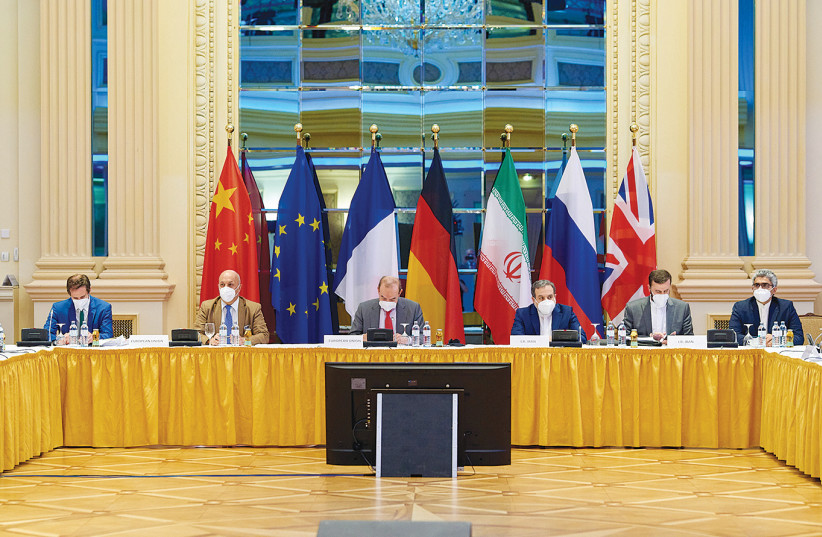
DELEGATES WAIT for the start of talks on reviving the 2015 Iran nuclear deal, in Vienna, Austria, last month. (credit: EU DELEGATION IN VIENNA/HANDOUT VIA REUTERS)
Iran also delayed the talks by five months last year, walking away from the table in Vienna ahead of its presidential election in June and refusing to return until the end of November.
Iranian President Ebrahim Raisi said on Friday that he is not pinning his hopes on the nuclear talks.
“We put our hopes on the east, west, north, south of our country and never have any hope in Vienna and New York,” Raisi said in a televised address marking the anniversary of the 1979 Iranian Revolution.
A source on the Iran negotiating team claimed that Iran was “pioneering in putting forward new ideas and proposals” and that “the US finally needs to make a decision and end dragging its feet,” Iranian journalist Abas Aslani reported on Saturday.
The Islamic Republic News Agency claimed on Saturday that “an informed source in Vienna said that China and Russia along with the European Union have complained about the United States’ bewilderment and incapability to take [a] political decision on the result of negotiations.”
Nour News called the Biden administration “powerless to negotiate and cannot be flexible in negotiations.”
Secretary of Iran’s Supreme National Security Council Ali Shamkhani tweeted last Wednesday – when the US had tabled a proposal and Iran had not – that “there is no coherence in the [US government] to make political decisions in the direction of advancement in the Vienna Talks.”
On Saturday, Shamkhani said that “maintaining and strengthening Iran’s peaceful nuclear capabilities and defense capabilities, [and] regional security-making policies of the Islamic Republic” are non-negotiable.
The US and Iran have been engaged in indirect negotiations since April 2021 to revive the 2015 Joint Comprehensive Plan of Action, which restricted Iran’s enrichment and stockpiling of uranium until 2030, in exchange for the gradual lifting of sanctions.
The US left the deal in 2018, citing evidence that Iran hid details of its nuclear program and of malign Iranian behavior in the Middle East, including proxy warfare and its ballistic missile program.
Iran has since enriched uranium to 60%, higher than any country that does not have nuclear weapons; weapons-grade is 90% enriched. The Islamic Republic launched a new class of advanced centrifuges days after the talks resumed late last year.
Since then, the US and the E3 – France, Germany and the UK – have warned that there are only weeks left to restore the JCPOA’s nonproliferation benefits and have lamented the slow pace of talks.
Meanwhile, Iran and Russia began working together last week to evade sanctions.
The countries are working together “to develop a mechanism to protect trade and financial exchanges from the threat of sanctions,” Iran’s Mehr News quoted a Russian official as saying. “The Russian Foreign Ministry has also stressed in a statement that Moscow does not take any restrictions into account in developing technical and military cooperation with Tehran.”
Skeptics and cynics abound, but there is growing evidence the Iraqi government is serious about rebuilding this ancient wonder of the world
by Joel C. Rosenberg | February 11, 2022
Iraqis celebrate after UNESCO designated the ancient city of Babylon as a World Heritage Site, in front of a replica of Ishtar Gate near Hillah, Iraq ,July 5, 2019. (Photo: REUTERS/Thaier Al-Sudani)
A fascinating story is being written in the shifting sands of Arabia.
A story that will confound atheists and agnostics.
And should thrill Jews and Christians.
Yet few are paying attention.
In 2006, I wrote my first non-fiction book, “Epicenter,” in which I explained that according to Bible prophecy, the ancient and long-forgotten city of Babylon will one day be literally rebuilt.
I also explained that the once-so-powerful nation of Babylon – the country which we now call Iraq – will one day rise to become the most wealthy and powerful nation in the world, according to Old and New Testament prophets and apostles.
Few believed me at the time. Fewer still cared.
But things are changing and it’s time for an update.
SKEPTICS AND CYNICS ABOUND
I should acknowledge up front that those who reject the teachings of the Bible understandably have a difficult time imagining a season of peace and prosperity emerging in Iraq.
They certainly have long had a difficult time imagining the rebuilding of the ancient Iraqi city of Babylon, at least on the scale described in the “Left Behind” novels about the End Times (written by Evangelicals Tim LaHaye and Jerry Jenkins, and which sold more than 60 million books in the 1990s), or any of my novels or non-fiction books.
Kevin Phillips, the best-selling author and former Republican strategist, was one such skeptic, among many.
“Evil Babylon, the antithesis of Jerusalem, the good city, prompted its own literature in the 1990s, and [Tim] LaHaye’s tens of millions of readers praised his series as making the Bible and its supposed predictions ‘come alive,’” sniped Phillips in his own 2006 book, American Theocracy, in which he mocked “prophecy believers” who accept the biblical view that Babylon will one day actually be rebuilt “on its ancient ruins.”
I certainly understand such views, but I completely disagree with them.
True, neither the city nor the country is what they will one day be.
Nevertheless, what fascinates me is that top Iraqi officials are determined to rebuild both, even though as Muslims they don’t believe in the Bible, or know much about the prophecies it contains.
Indeed, as I was doing research for “Epicenter,” I interviewed then-Iraqi Finance Minister Ali Abdul-Amir Allawi.
He told me he absolutely loved the idea of rebuilding Babylon.
“Cultural, religious, archeological, and biblical tourism is a big opportunity for Iraq,” Allawi told me.
“I think rebuilding Babylon is a wonderful idea, as long as it is not done at the expense of the antiquities themselves.”
He even added that “a theme park” built near Babylon to draw more tourists would be a good idea, “as long as it’s done outside of Babylon, away from the archeological sites.”
Still, since the publication of “Epicenter” sixteen years ago, the skeptics and cynics certainly seem to have had the upper hand.
Iraq has been a basket case.
War. Terrorist insurgencies. ISIS-led genocide. Crumbling infrastructure. High poverty. And these are just a few of the nation’s myriad of troubles.
No wonder so many Iraqis fled to other Arab countries, to Europe, and even to the United States, if they could.
If this weren’t bad enough, record low oil prices in recent years – as low as $20 a barrelin 2020 – severely hampered any chance at a true and lasting recovery.
“Over the last decade, oil revenues have accounted for more than 99% of [Iraq’s] exports, 85% of the government’s budget, and 42% of GDP,” notes the World Bank.
So, terribly low oil revenues – along with COVID-related lockdowns and travel restrictions – flatlined economic growth and caused unemployment to spike.
Removing modern concrete flooring to reduce groundwater moisture at the Ishtar Gate, 2013 (Photo: World Monuments Fund)
A CHANGE IN THE WIND
Suddenly, however, we are seeing a change in the wind, yet few people have noticed.
With the war and insurgencies finally finished, and the ISIS caliphate destroyed, Iraq is finally turning itself around.
And oil prices are now skyrocketing, hitting $90 a barrel this month for the first time since 2014.
Should the trend continue, and security continue to improve, Iraq will be awash with petrodollars. Growth will surge. Unemployment will plummet. And Iraq will become vastly more attractive for investors and even for tourists.
Now Iraqi officials are hoping to get back to the ambitious construction and investment plans they were hoping to pursue soon after the country was liberated from Saddam Hussein in the spring of 2003, and rebuilding Babylon is one of their most intriguing priorities.
The head of the Prussian Cultural Heritage Foundation, Hermann Parzinger (L) talks to Japan’s Crown Prince Naruhito as they look at the Ishtar Gate during a tour through the Pergamon Museum in Berlin, June 24, 2011. (Photo: REUTERS/Thomas Peter)
WILL BABYLON REALLY RISE AGAIN?
Once the wealthiest and most powerful cities in the world – indeed, a wonder of the ancient world – Babylon’s empire was defeated by the Persian monarch, Cyrus the Great, in 539 B.C.
Later, the Persian empire was defeated by Alexander the Great, and the Greeks ruled the earth. Then came the Romans.
Along the way, Middle East trade routes shifted, and Babylon and its glorious history was abandoned and forgotten.
Back in the late 1970s and early 1980s, however, Saddam Hussein ordered his archaeologists and engineers to begin excavating and rebuilding the city once home to the much-feared King Nebuchadnezzar, who took over most of the known world in his day, conquered Jerusalem, destroyed the nation of Judah, and enslaved the vast majority of Jews in the world at that time.
Indeed, they began rebuilding the famed Ishtar Gates and the city’s walls, as well as restore the city walls and some of its buildings.
During the 8-year-long war between Iraq and Iran, however, all such work ground to a halt.
Improving the presentation of the Lion of Babylon statue, 2015 (Photo: World Monuments Fund)
MAKING THE NEW BABYLON “A SHOWCASE” OF THE NEW IRAQ
Since the liberation of Iraq in 2003, however, a great deal has happened.
On April 18, 2006, the New York Timesreported in a front-page story that “Babylon, the mud-brick city with the million-dollar name, has paid the price of war. It has been ransacked, looted, torn up, paved over, neglected and roughly occupied. . . . But Iraqi leaders and United Nations officials are not giving up on it. They are working assiduously to restore Babylon, home to one of the Seven Wonders of the World, and turn it into a cultural center and possibly even an Iraqi theme park.”
“The United Nations Educational, Scientific and Cultural Organization is pumping millions of dollars into protecting and restoring Babylon and a handful of other ancient ruins in Iraq,” noted correspondent Jeffrey Gettleman. “UNESCO has even printed up a snazzy brochure, with Babylon listed as the premier destination, to hand out to wealthy donors.”
“Cultural tourism could become Iraq’s second biggest industry, after oil,” said Philippe Delanghe, a United Nations official helping with the project.
“One day millions of people will visit Babylon,” said Donny George, head of Iraq’s Board of Antiquities. “I’m just not sure anybody knows when.”
I cited this important story in “Epicenter.”
In April 2009, I reportedthat “the government of Iraq is moving forward with plans to protect the archaeological remains of the ancient City of Babylon, in preparation for building a modern city of Babylon. The project, originally started by the late Saddam Hussein, is aimed eventually at attracting scores of ‘cultural tourists’ from all over the world to see the glories of Mesopotamia’s most famous city. What’s more, the Obama Administration is contributing $700,000 towards ‘The Future of Babylon Project,’ through the State Department’s budget.”
In January 2011, I shared with my readers an intriguing article published by the New York Times “about Iraq’s latest efforts to preserve, protect, restore and then rebuild the ancient city of Babylon and make it a draw for tourists, with U.S. taxpayer assistance.”
“The Babylon project is Iraq’s biggest and most ambitious by far, a reflection of the ancient city’s fame and its resonance in Iraq’s modern political and cultural heritage,” the Times reported, noting that the State Department had announced “a new $2 million grant to begin work to preserve the site’s most impressive surviving ruins. They include the foundation of the Ishtar Gate, built in the sixth century B.C. by Nebuchadnezzar’s father, Nabopolassar, and adorned with brick reliefs of the Babylonian gods Marduk and Adad.”
Relief detail on the Ishtar Gate, 2009 (Photo: World Monument Fund)
In February 2021, National Public Radio reported on the state of tourism in Babylon.
“Since Babylon reopened in 2009, tourist numbers have fluctuated,” said Alice Fordham. “The local tourist board says the best recent year for Iraqi tourists was 2017, when more than 35,000 visited. This winter — normally peak season because of the cool weather — the pandemic affected the numbers and about 10,000 came. The year before, many stayed away for fear of being caught up in violence at demonstrations in nearby cities.”
“But some local investors believe in the promise of domestic tourism in places like this that have long been under-visited,” she added. “Several tours now run from Baghdad to the scenic marshlands of the south — which some scholars say may have been the biblical Garden of Eden — where sleek buffalo swim through grasses and people live on islands. Tourism has been growing there gradually, as security has improved and hotels have opened.”
Just this month, an Arab newspaper reported that the Iraqi government is going to convert “a palace overlooking the UNESCO World Heritage site [in Babylon] into a museum.”
WHAT DO YOU BELIEVE ABOUT THE FUTURE OF BABYLON?
So, should we believe the Hebrew prophets such as Ezekiel, Isaiah, Jeremiah, and Daniel that Babylon will really rise again in the last days?
Should we believe the Apostle John, the author of the Book of Revelation, that Babylon will one day become a “great city” and a center of “extravagant luxury,” as he wrote in Revelation chapter 18?
Should we believe him when he describes Babylon as one of the world’s great commercial hubs, where “the merchants of the world” come to trade “great quantities of gold, silver, jewels, and pearls,” along with all kinds of other “expensive” goods and services that entice “the kings of the world” and draw ships from everywhere on the planet (Revelation 18:9-12)?
Will people one day say of Babylon – a city that didn’t exist for much of the past 2,000 years – “Where is there another city as great as this?” as John predicts in Revelation 18:18?
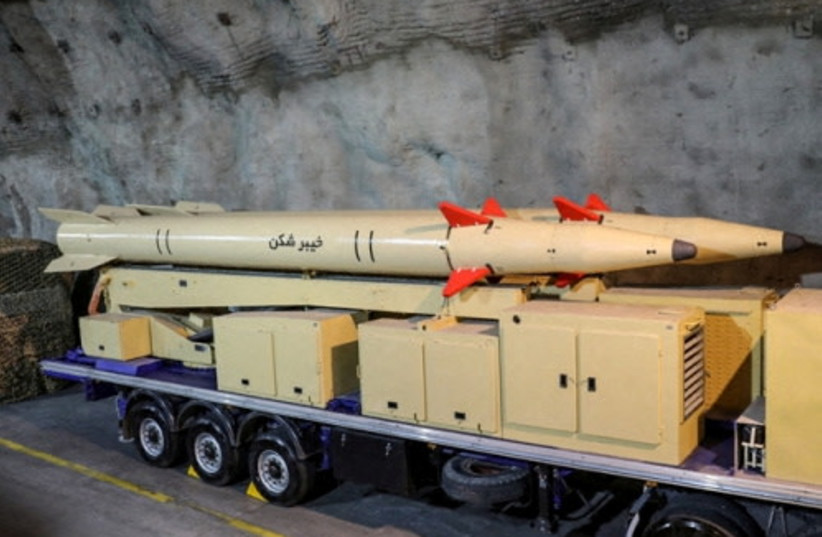
The missile, called “Khaybar Shekan” (Khaybar buster), refers to a Jewish oasis called Khaybar that was overrun by Muslim warriors in the 7th century.
By REUTERS
Published: FEBRUARY 9, 2022 10:11
Updated: FEBRUARY 9, 2022 15:28
New Iranian “Kheibarshekan” missiles are seen in an undisclosed location in Iran, in this picture obtained on February 9, 2022.
(photo credit: IRGC/WANA (West Asia News Agency)/Handout via REUTERS)
Iran unveiled a new domestically-made missile with a range of 1,450 kilometers on Wednesday, state TV reported, a day after Tehran and Washington resumed indirect talks to salvage a 2015 nuclear deal.
Iran, which has one of the biggest missile programs in the Middle East, says its ballistic missiles have a range of up to 2,000 km (1,200 miles) and are capable of reaching its arch-foe Israel and US bases in the region.
State TV displayed the new surface-to-surface “Khaybar Shekan” (Khaybar buster) missile, which refers to an ancient Jewish oasis called Khaybar in the Arabian Peninsula’s Hijaz region that was overrun by Muslim warriors in the 7th century.
“This long-range missile is domestically manufactured by the Revolutionary Guards (IRGC)… It has high accuracy and is propelled by solid fuel and is capable of penetrating missile shields,” Iranian state media reported.
Tehran regards its missile program as an important deterrent against the United States, Israel and other adversaries. It has rejected Western demands to halt its ballistic missile work.
“Iran will continue advancing its ballistic missile program,” Iran’s armed forces chief of staff Maj.-Gen. Mohammad Bagheri told a ceremony at an IRGC base where the new missile was displayed, Iranian media reported.
Iranian flag flies in front of the UN office building, housing IAEA headquarters, amid the coronavirus disease (COVID-19) pandemic, in Vienna, Austria, May 24, 2021. (credit: LISI NIESNER/ REUTERS)
NUCLEAR DEAL
Sunni Muslim Saudi Arabia, a regional rival of Shi’ite-led Iran, has repeatedly called on major powers to address Gulf Arab concerns about Tehran’s missiles.
Israel, which the Islamic Republic does not recognize, has long threatened military action against Iran if the talks in Vienna fail to curb Tehran’s nuclear work. Iran says its nuclear ambitions are peaceful.
In 2018, then-US president Donald Trump withdrew from the nuclear deal – designed to stop Iran developing a nuclear weapon – and reimposed sanctions in a bid to force Tehran into talks on a broader agreement that would have also addressed its ballistic missile program and support for proxies in the Middle East.
Iran responded a year later by gradually breaching the pact’s nuclear limits, rebuilding stockpiles of enriched uranium, refining it to higher fissile purity and installing advanced centrifuges to speed up output.
Indirect talks between Tehran and Washington to revive the deal started after Joe Biden replaced Trump in the White House, but despite eight rounds since April differences remain between Iran and world powers.
Tehran and Washington have blamed each other for the lack of progress.
“Voices from the US government show there is no coherence in that country to make political decisions in the direction of advancing the Vienna talks,” Iran’s top security official Ali Shamkhani tweeted on Wednesday.


 Iraqis celebrate after UNESCO designated the ancient city of Babylon as a World Heritage Site, in front of a replica of Ishtar Gate near Hillah, Iraq ,July 5, 2019. (Photo: REUTERS/Thaier Al-Sudani)