
FM Yair Lapid says Israel won’t build anything that will prevent a future two-state solution, but homes will be built in existing settlements.

 Foreign Minister Yair Lapid and German Foreign Minister Annalena Baerbock, February 10, 2022.  (photo credit: MIRI SHIMONOVITZ)
Foreign Minister Yair Lapid and German Foreign Minister Annalena Baerbock, February 10, 2022.
(photo credit: MIRI SHIMONOVITZ)

Israel won’t engage in settlement activity that would harm the two-state solution, Foreign Minister Yair Lapid said as the state has advanced plans to authorize a yeshiva on the West Bank Evyatar hilltop over 26 km. beyond the pre-1967 lines.

“This government has made a policy of do no harm,” Lapid said in a response to a question about settlements posed to him during a joint press conference in Jerusalem on Thursday with his German counterpart Annalena Baerbock.

When it comes to the settlements, Lapid said, homes “will be built according to natural growth in the existing settlements.”

He added that “we are not going to build anything that will prevent the possibility of a future two-state solution.”

He spoke as Prime Minister Naftali Bennett’s government is under pressure from the Right and the settlement movement to uphold the Evyatar deal arranged on its behalf by the cabinet secretary and Defense Minister Benny Gantz (Blue and White).

The deal was arrived at in late June when the government was in its infancy, agreed to the authorization of both a yeshiva and a new community at Evyatar, in exchange for the voluntary evacuation of 50 families from that hilltop until the bureaucratic steps had been completed.

 Settlers and right-wing activists hold a study session at the Evyatar outpost, to demand that the Defense Minister Benny Gantz allow a yeshiva to be opened at the site. (credit: Courtesy)Settlers and right-wing activists hold a study session at the Evyatar outpost, to demand that the Defense Minister Benny Gantz allow a yeshiva to be opened at the site. (credit: Courtesy)

Lapid, along with the coalition’s Meretz party, have opposed the deal.

In the Knesset on Monday, Lapid said that the Evyatar “agreement was not made with me. I represent half of the government and therefore in my eyes it is not valid and I oppose it.”

But Gantz’s Blue and White party members, including Culture and Sports Minister Chili Tropper and Deputy Defense Minister Alon Schuster, have spoken clearly about the government’s intention to uphold its end of the bargain.
In the Knesset on Wednesday, Schuster said there that a yeshiva would be built at Evyatar, located off of Route 505 in the Samaria region.

“The Civil Administration conducted a land survey to examine the status of the land in the area. The survey found land that can be declared state land,” Schuster said in response to a formal query by MK Itamar Ben-Gvir (Religious Zionist Party).

Outgoing Attorney-General Avichai Mandelblit examined the situation, Schuster said. It was decided to consider the advancement of technical plans for the educational institution simultaneously within the 45-day objection period, he explained.

“There is an agreement and we intended to stand by our agreements,” Schuster said.

He added that of course security, political and diplomatic considerations would be taken into account.

Lapid and the Foreign Ministry have warned that the advancement of the Evyatar deal could harm Israel’s international standing.

The Palestinian Authority and the international community have rejected all settlement activity and called for a two-state solution within the pre-1967 lines.

At Thursday’s press conference, Baerbock said that Germany believed that settlement activity was “harmful” and “against international law.”

Former prime minister Ehud Olmert (Kadima) accepted the idea of two-states based on the pre-1967 lines.

When his successor Benjamin Netanyahu (Likud) spoke of two states, he insisted that he looked to include all the settlements within Israel’s final sovereign borders. Others in Israel who support a two-state solution have looked at an option that includes high-density population blocs and excludes isolated settlements in areas where Evyatar is located.

Bennett has opposed any creation of a Palestinian state.

Left-wing groups plan to hold a protest rally outside of Evyatar on Friday morning. Settlers and right-wing supporters have set up a protest encampment outside Evyatar this week as part of their push to ensure that a yeshiva is built there.
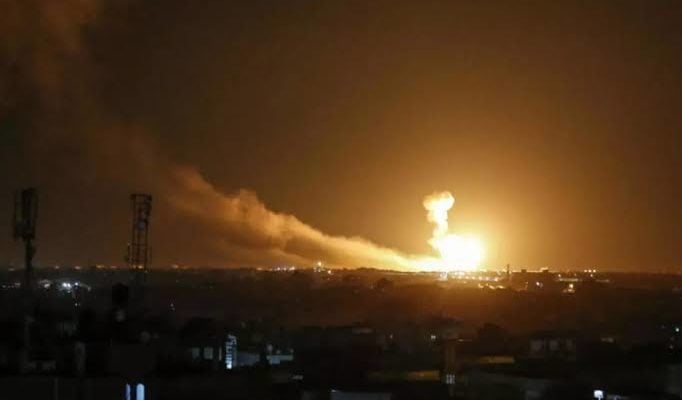

Russia denounces Israeli air strikes in Syria

Russia denounces Israeli air strikes in Syria
Explosion in Damascus area after IDF airstrike, June 8, 2021. (Syrian Observatory for Human Rights)
(Syrian Observatory for Human Rights)

Russia denounces Israeli air strikes in Syria

Moscow calls on Israel to halt its attacks.

By David Hellerman, World Israel News

Russia’s Foreign Ministry called on Israel to stop its air strikes on targets in Syria on Thursday.

“Israel’s continuing strikes against targets inside Syria cause deep concern. They are a crude violation of Syria’s sovereignty and may trigger a sharp escalation of tensions,” said ministry spokeswoman Maria Zakharova.

Her comments were first reported by Russia’s state-owned TASS News Agency.

Russia “systematically and resolutely opposes attempts to turn Syria into a scene of armed confrontation between third countries,” said Zakharova, adding, “Once again we are insistently calling upon the Israeli side to refrain from such use of force.”

She also said the air strikes endanger civilian aircraft.

To avoid inadvertent conflict between the Israeli and Russian Air Forces, the two countries have a hotline and Jerusalem gives Moscow advance warning. However, Zakharova said these measures should not be regarded as Russian approval.

The Russian comments after an errant Syrian anti-aircraft missile exploded in Israeli skies over Samaria in the predawn hours of Wednesday morning. The missile was fired during air strikes near Damascus attributed to Israel. The IDF doesn’t comment on its strikes in Syria, though Israeli officials confirm the strikes in general.

Israel has launched numerous air strikes on Iran and its proxies operating in Syria, targeting weapons and communications facilities.

Israel’s Kan News reported in January that Russian military activity in Syria has interfered with Israeli GPS systems, posing a potential risk to flights landing at Ben Gurion International Airport. IDF officials said the signals are coming from the Khmeimim Air Base, Russia’s primary air base in Syria and do not appear to be intentional.

A December air strike on the port of Latakia also raised Moscow’s ire. Israel has refrained from striking the port due to the presence of Russian personnel. It was widely speculated that the target of the pinpoint strike were munitions or dangerous material based on the unusually heavy fires that were sparked.

Analysts speculated that Iran is deliberately endangering Russian lives by transferring and storing weapons in the port.


Russia worried by Israel’s strikes against targets in Syria — Foreign Ministry

Maria Zakharova called these actions “a crude violation of Syria’s sovereignty”

https://tass.com/politics/1401261


The target of the operation was an Israeli businessman, in retaliation for the killing of Iranian nuclear scientist Mohsen Fakhrizadeh in 2020.

A Turkish flag flutters atop the Turkish embassy as an Israeli flag is seen nearby, in Tel Aviv, Israel June 26, 2016 (photo credit: REUTERS/BAZ RATNER)
A Turkish flag flutters atop the Turkish embassy as an Israeli flag is seen nearby, in Tel Aviv, Israel June 26, 2016
(photo credit: REUTERS/BAZ RATNER)

Turkish and Israeli intelligence forces came together to foil an assassination attempt of Israeli businessman Yair Geller, according to Turkish media.

The alleged assassination attempt, which in this case included a team of nine, is in response to the killing of Iranian nuclear scientist Mohsen Fakhrizadeh in 2020, which Iran has attributed to Israel, according to Turkish and Israeli media reports. It is unclear what Geller’s connection is.

“I am an Israeli businessman in Turkey with an engineering research and development company. I was informed that the Iranians are tracking and are attempting to assassinate me,” Geller told KAN in the first response to Israeli media on the story.

His company, CNC İleri Teknoloji, a metal machinery supplier for the automotive, aerospace and medical industries, is based in Istanbul.

The Iranian cell tracked Geller and took photos of him in his home. Turkish intelligence was aware of the tracking movements done by the Iranian cell and reportedly shared the information with the Mossad once the activity neared operational status.

ISTANBUL MAYOR Ekrem Imamoglu of the main opposition Republican People’s Party (CHP) addresses supporters from atop a bus outside city hall in Istanbul on June 27. (credit: HUSEYIN ALDEMIR/REUTERS)ISTANBUL MAYOR Ekrem Imamoglu of the main opposition Republican People’s Party (CHP) addresses supporters from atop a bus outside city hall in Istanbul on June 27. (credit: HUSEYIN ALDEMIR/REUTERS)

The cell was reportedly run by Yassin Tahermkandi, 53, an Iran-based intelligence officer, and Saleh Mushtag Bhighus, 44, his Turkish counterpart. Bhighus was among the eight arrested.

Around this time last year reports circulated of Israeli involvement in Fakhrizadeh’s death in the form of a “remote-controlled gun” that was smuggled into the country by the Mossad.

Reportedly, the team responsible for smuggling it numbered more than 20 Israeli and Iranian nationals.

Ties between Turkey and Israel have been warming up lately, with a renewed interest in relations expressed by Turkish President Recep Tayyip Erdogan, and an expected visit to Ankara by Israeli President Isaac Herzog.

On Monday, Prime Minister Naftali Bennett announced in a press briefing that he is treading cautiously regarding relations with Turkey.

Last week, Erdogan extended his wishes beyond diplomatic ties, suggesting the two countries work together to carry Israeli natural gas to Europe.

Two days earlier, Erdogan met the president of Iraq’s semi-autonomous Kurdish region, in a push towards a natural gas supply deal with Iraq.

“We have now taken the Iraq issue on our agenda. We are now thinking about it. There may be a supply on the natural gas side from Iraq to Turkey,” Erdogan said, adding Barzani had promised to facilitate talks.

Lahav Harkov and Reuters contributed to this report.
