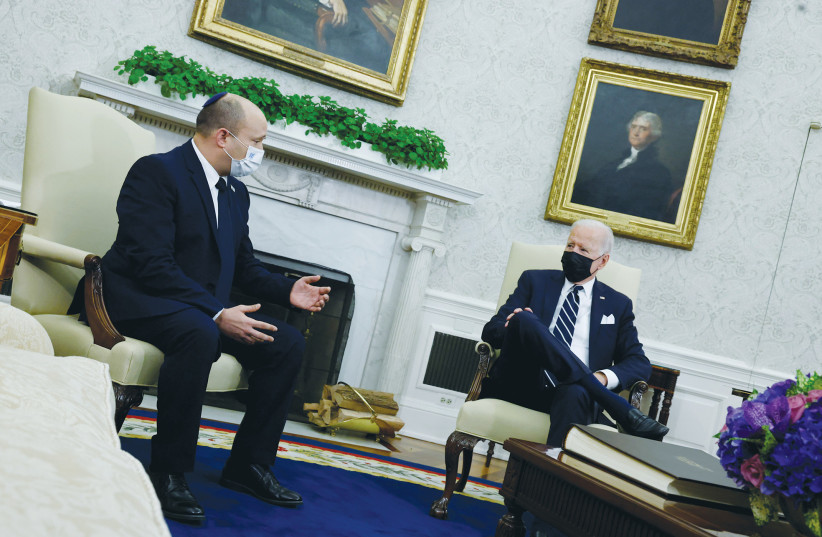
PRIME MINISTER Naftali Bennett meets with US President Joe Biden in the Oval Office in August.
(photo credit: JONATHAN ERNST/REUTERS)
Prime Minister Naftali Bennett urged US President Joe Biden not to return to the 2015 JCPOA Iran nuclear deal on their Sunday phone call, saying: “Nothing will happen if you don’t sign the deal with Iran,” a diplomatic source confirmed on Thursday.
Bennett has remained consistent on Israel’s stance: Iran’s return to the deal, currently in its eighth round of talks, makes it harder to keep Iran from going nuclear, not easier.
On Monday, Bennett said that Biden had accepted Israel’s freedom to act independently of whatever deal is reached among world powers. However, “freedom of action” was not mentioned in the context of Iran in the White House readout of the latest call.
“The leaders discussed regional challenges, foremost of which is growing Iranian aggression and steps to restrain the Iranian nuclear program,” the Prime Minister’s Office said after the call.
Earlier on Sunday, Bennett told the cabinet he was closely following the negotiations with Iran in Vienna to return to the 2015 nuclear deal between world powers and Iran. Biden has promised to return to that deal.
“The agreement and what appears to be its conditions will damage the ability to take on the nuclear program,” Bennett said.
“Whoever thinks an agreement will increase stability is wrong,” he added. “It will temporarily delay enrichment, but all of us in the region will pay a heavy, disproportionate price for it.”
‘This is the last minute’: Amos Hochstein tells Beirut to make a deal for energy exploration at sea as it contends with economic collapse and energy shortages
An Israeli Navy Sa’ar 5 corvette defends a natural gas extraction platform off Israel’s coast, in an undated photograph. (Israel Defense Forces)
US envoy Amos Hochstein urged Lebanese authorities Wednesday to settle a maritime border dispute with Israel, saying it was the “last minute” for an agreement that could facilitate hydrocarbon exploration at sea.
Longtime foes Israel and Lebanon have no diplomatic relations and are technically in a state of war. They each claim about 860 square kilometers (330 square miles) of the Mediterranean Sea as being within their exclusive economic zones.
“I think that we’re at the moment of narrowing those gaps towards a deal,” Hochstein told Lebanese broadcaster LBCI in an interview.
“There’s no later anymore. This is the later. This is the last minute,” he added.
Hochstein, the US State Department’s Senior Adviser for Global Energy Security, arrived in Lebanon on Tuesday to revive talks between Lebanon and Israel over a maritime border dispute that is holding up oil and gas explorations.
Israel and Lebanon had resumed negotiations over their disputed maritime border in 2020 but the process was stalled by Beirut’s claim that the map used by the United Nations in the talks needed modifying.
Lebanese politicians hope that commercially viable hydrocarbon resources off Lebanon’s coast could help lift the debt-ridden country out of an unprecedented financial crisis branded by the World Bank as one of the planet’s worst in modern times.
“I am confident that there will be a unified position in Lebanon and that there’ll be a unified position in Israel, and that we’ll be able to move forward,” the Israel-born envoy said.
“My advice to people in Lebanon — focus on not what you’re missing, not what you may lose if you compromise. Think about what you gain,” the he said.
Lebanese Parliament Speaker Nabih Berri, right, meets with US envoy Amos Hochstein, left, in Beirut, Lebanon, February 9, 2021. (AP Photo/Bilal Hussein)
Lebanon is currently grappling with its worst ever financial crisis, and fuel shortages have ground the country to a halt in recent months.
With a bankrupt state unable to deliver more than an hour or two of electricity a day, individuals, businesses and institutions have relied almost entirely on diesel-powered generators.
In October, the leader of Lebanon’s powerful Hezbollah terror group, Hassan Nasrallah, warned Israel against unilaterally searching for natural gas in the disputed maritime region before any agreement is reached.
Russia’s military build-up around Ukraine is moving into a new phase. Emerging from under a veil of ‘drills’, 6 landing ships and a submarine are now sailing into the Black Sea. This brings them ever closer to potential operations in Ukraine.
The first part of a Russian Navy amphibious landing ship force, which can carry troops, tanks and supplies, has entered the Dardanelles, connecting the Mediterranean to the Black Sea. This is significant, representing a point of no return in their controversial voyage towards the Black Sea and Ukraine.
The narrow waterways running through Istanbul connects the Black Sea and Mediterranean. The first is the Dardanelles, followed by the famous Bosporus. Due to traffic regulation ships do not turn around. 6 amphibious warfare ships and a submarine are expected to pass north into the Black Sea over the next few days.
Entering these waterways removes any final ambiguity surrounding their mission. Their travel from the Baltic and Northern fleets are undeniably part of President Putin’s Ukraine build-up. These ships are, due to their amphibious warfare role, suitable for offensive troop landings. Or vital logistics support to land operations along the coast.
Veil lifted On Strategic Ambiguity, Or Misinformation
The ships only recently arrived at Tartus, Syria, which is Russia’s forward naval base in the Mediterranean. Their stop was brief and they were soon on their way towards the Black Sea.
Western observers have been tracking their progress since they left the Baltic. Many have been under no illusion that their voyage is part of the Ukraine buildup. Yet it has not been framed that way by Russian media. When the ships arrived in Tartus it was described as “part of the drills under the direction of Russian Navy” according to the Russian Ministry of Defense. While drills no doubt took place along the way, there really is no viable veil left to hide the movements behind.
The ships will pass north over several days. The first package will consist of the three Ropucha class ships: Minsk (127), Korolev (130) and Kaliningrad (102). Based on information shared with Naval News the second package is expected to follow on February 9th. This will consist of Pyotr Morgunov (117) and two Ropucha class ships Georgy Pobedonosets (016) and Olenegorsky Gornyak (012). The submarine, KILO Class boat Rostov-na-Donu (B-237) will follow on February 11th.
Russian Navy landing ship RFS Kaliningrad (102) Photographed by Yörük Işık, with permission.
The amphibious landing ships are made up of one Ivan Gren class, Pyotr Morgunov (017) and six Ropucha class ships. The 6,600t Ivan Gren class can carry up to 13 main battle tanks, or 40 armored vehicles, and 300 troops. It can also carry two helicopters for airborne assault and logistics. The smaller 4,080t Ropucha class ships can each carry 10 main battle tanks and 340 troops.
This gives the ships a combined capacity of up to 63 main battle tanks and about 2,000 troops. Of course the exact load of the vessels currently is unknown, and is likely to be more mixed. However, the massive cargo capacity will greatly add to Russian capabilities off Ukraine.
Kilo Class Submarine
The submarine, Rostov-na-Donu (B-237), is a separate variable, and is sailing independently on February 11th. But the timing of her return to the Black Sea after operations in the Mediterranean is inevitably seen as part of the Ukraine situation.
She had been sent for repairs in the Baltic, using the long sea route. This involved spending a lot of time in the Mediterranean along the way. This is controversial because the Montreux Convention limits the reasons submarines can transit the Bosporus. She returned to the Mediterranean in March 2021 and now, 11 months later, is heading back to the Black Sea.
Her return to the Black Sea will bring the Russian submarine force there up to 3 operational boats, all Improved KILO Class. Two more will be in the Mediterranean and two are undergoing maintenance.
The ones remaining in the Mediterranean provide capabilities against NATO carrier battle groups there.
The Big Picture
Russia is moving a lot of vessels around. While some movements have local purposes, the bulk are seen as part of the tensions with NATO. Russian warships have been particularly active in the Atlantic, focusing on Europe’s western flank. The Northern Fleet’s Slava Class cruiser, Marshal Ustinov, is forward deployed and has been active off Ireland. Then yesterday it slipped into the Mediterranean.
Meanwhile the Pacific Fleet’s Slava, Varyag, transited the Suez Canal into the Mediterranean on February 2nd. So that is two Slava Class cruisers in the Mediterranean. Both cruisers are accompanied by other warships, many equipped with cruise missiles. Together with the Kilo Class submarines in Tartus, these may be seen as a direct counter to NATO carrier battle groups there.
Russian Navy nuclear submarines have not been reported for obvious reasons, but are also likely active.
The 6 amphibious ships now heading into the Black Sea will add to the already overwhelming military might facing Ukraine. They will increase the options open to the Russian military. Observers are still guessing President Putin’s plans. But there is no doubt it looks like a pre-invasion build up.