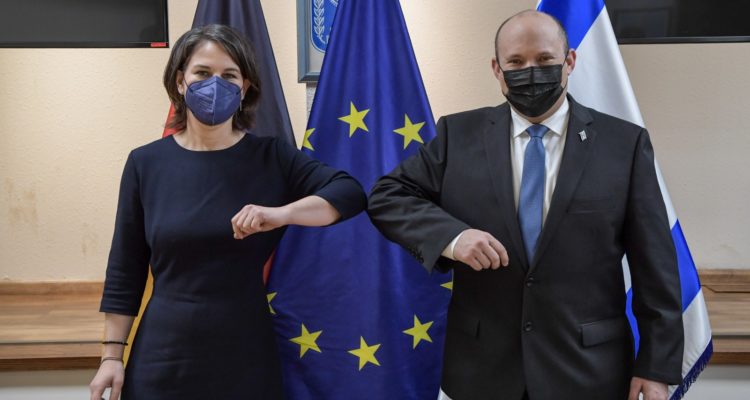
Israel is “not going to build anything that will prevent the possibility of a future two-state solution,” the foreign minister stated.

By World Israel News Staff

During a joint press conference Thursday with his German counterpart in Tel Aviv, Foreign Minister Yair Lapid vowed that the current government — headed by Prime Minister Naftali Bennett, head of the right-wing Yamina party — is “not going to build anything that will prevent the possibility of a future two-state solution,” The Jerusalem Post reported.

“This government has made a policy of do no harm,” he said, in response to a question about Jewish settlements.

Rather, homes “will be built according to natural growth in the existing settlements,” he said, referring to Jewish communities in eastern Jerusalem, Judea and Samaria.

Currently on a visit to Israel, Egypt and Jordan – Israel being the first stop — Germany’s top diplomat Annalena Baerbock expressed her goal to help revive the Israeli-Palestinian peace process.

“Even if the Middle East conflict seems like a crisis that has always existed for many, we cannot accept it as the status quo,” Baerbock said before her trip.

She reiterated Germany’s commitment to a negotiated two-state solution with a “functional, democratic and sovereign Palestinian state.”

“Every individual has the right to hold on to hope — especially the hope for peace,” she said.

Regarding the Iranian threat, Baerbock said that nuclear talks in Vienna are in the final stages.

She also pledged support for Israel’s security, saying that Germany has a “special historical responsibility for Israel’s security.”

Lapid stressed Israel’s security concerns amid the Iranian threat. “Iran is Hezbollah in the north, Iran is Hamas in the south, Iran is an exporter of terror from Yemen to Buenos Aires,” he said.


Bennett presented the Israeli position, according to which signing a nuclear agreement with Iran would be a mistake that would endanger the entire region.

By World Israel News Staff and Associated Press

Germany’s foreign minister, on an official visit to Israel, said Thursday that nuclear talks with Iran are entering a “final phase” and that, despite Israeli reservations, a return to a nuclear agreement would make the region safer.

Annalena Baerbock’s remarks were made as negotiations between Iran and world powers reconvened this week in an effort to revive a 2015 nuclear accord – an agreement that Israeli leaders across the political spectrum had said was a “bad deal.”

That deal crumbled after the Trump administration withdrew from the agreement in 2018.

Prime Minister Naftali Bennett met with Baerbock at his office in Tel Aviv, where he welcomed her on her first visit to Israel in her official capacity.

They discussed at length the security and regional challenges, especially the Iranian nuclear issue, the PMO said.

“The Prime Minister presented the Israeli position, according to which signing a nuclear agreement with Iran would be a mistake that would endanger the entire region,” Bennett’s office stated.

“He also emphasized that a target date must be set for the conclusion of the negotiations since their extension, even as the enrichment of uranium continues, only serves Iranian interests.”

Baerbock later visited Ramallah for a meeting with Palestinian Foreign Minister Riad Malki.


Palestinian president says operation that killed 3 men in West Bank was ‘premeditated murder,’ vows incident ‘will not go idly by’

Palestinian Authority President Mahmoud Abbas during a meeting with German Foreign Minister Annalena Baerbock in Ramallah, on February 10, 2022. (Mohamad Torokman/Pool Photo via AP)

Palestinian Authority President Mahmoud Abbas during a meeting with German Foreign Minister Annalena Baerbock in Ramallah, on February 10, 2022. (Mohamad Torokman/Pool Photo via AP)

Palestinian Authority President Mahmoud Abbas threatened on Thursday to “get back at [Israel] twice as hard,” after Israeli undercover police killed three Palestinians in the West Bank who allegedly carried out a string of recent shooting attacks.

On Tuesday, the Israeli troops conducted a rare daytime operation inside the Palestinian city of Nablus, killing the three terror suspects.

The three men were members of the Al-Aqsa Martyrs’ Brigades, a coalition of armed groups loosely affiliated with the Palestinian Authority’s ruling Fatah party.

“This was premeditated murder perpetrated by the vile Zionist occupier against our sons, our youth, our people,” Abbas said in an audio recording played by deputy Fatah leader Mahmoud al-Aloul at a mourners’ gathering for the dead gunmen.

“These incidents will not go idly by. We will not allow them to reoccur, nor will we remain quiet. We have been patient, we have borne this for 70 years. We will not bear this anymore,” he said.

“We will get back at them twice as hard,” Abbas warned. “We are the one [who are] aggressed upon; we did not aggress upon anyone.”

Abbas’ remarks came following harsh criticism by PA opponents, who argued that Ramallah’s policy of coordinating with Israel on security likely led to the police raid that targeted the three Palestinians.

The PA regularly works with Israel to crack down on Palestinian terror groups in the West Bank, a policy that is widely unpopular with the Palestinian public. Israeli security forces often warn their Palestinian counterparts beforehand that a raid is taking place.

Palestinians man inspects a bullet-riddled car belonging to three Palestinians killed by Israeli forces in the West Bank city of Nablus, on February 8, 2022. (Jaafar Ashitiyeh/AFP)

The Yamam counterterrorism unit officers who conducted the raid used a so-called share taxi with Palestinian number plates to block the car carrying the suspects in Nablus’s al-Makhfiya neighborhood.

Israeli police denied that the operation was a targeted killing, saying that officers first sought to arrest the suspects. Police also said officers fired when they saw the suspects getting ready to shoot at them and killed them before they fired a shot.

The Israeli troops fired dozens of rounds into the car before seizing two M-16 rifles from the vehicle and driving away from the scene.

Recent weeks had seen a spate of shooting attacks directed toward Israeli security forces and military positions in the northern West Bank, most recently on Saturday evening when shots were fired at a Border Police vehicle near Jenin. At least five such shooting attacks have been carried out in the past two weeks, none of which have caused Israeli injuries.

An Israeli security official said the Palestinian suspects were on their way to commit another attack, necessitating their intervention.

“They were a ticking bomb,” the official said, speaking on condition of anonymity in accordance with departmental regulations. Designating a suspect an imminent threat gives security services legal leeway to use more force than they would otherwise be permitted to use.

M16 rifles seized during a Nablus terror operation on February 8, 2022. (Police spokesperson)

After the attacks, thousands of Palestinians participated in the mens’ funerals, chanting for revenge against Israel.

Though the number of successful attacks on Israeli soldiers and civilians has been relatively low, recent months have seen a rise in tensions in the West Bank.

In early December, Palestinian terrorists affiliated with Islamic Jihad shot and killed an Israeli civilian, Yehuda Dimentman, near the Homesh outpost in the northern West Bank. Israeli forces later arrested several suspects in the attack.

Judah Ari Gross contributed to this report.