European diplomat says centrifuge plant at Karaj has been moved to ‘better protected’ facility in Isfahan; IAEA says cameras installed at new site


The alleged Karaj centrifuge parts plant near Karaj, Iran, seen in a photo posted online by Google user Edward Majnoonian, in May 2019. (Screenshot/Google Maps)

The alleged Karaj centrifuge parts plant near Karaj, Iran, seen in a photo posted online by Google user Edward Majnoonian, in May 2019. (Screenshot/Google Maps)

VIENNA — Iran has informed the International Atomic Energy Agency it has stopped production at one of its nuclear facilities attacked last June and transferred work to another site, the watchdog said Monday.

The move responded to a “security concern” following the attack, with the new site “better protected,” a European diplomat told AFP.

The TESA complex in Karaj, which is near the capital Tehran, hosted a workshop to build components for centrifuges, machines used to enrich uranium.

Iran said cameras at the site were damaged on June 23, 2021 during what it called an Israeli “sabotage” operation.

In the aftermath, the Vienna-based IAEA said it did not receive permission to gain access and replace the surveillance equipment damaged in the attack.

The two parties finally struck an agreement in December and new cameras were installed.

However, IAEA Director General Rafael Mariano Grossi said “Iran had informed the Agency on 19 January that it intended to produce centrifuge rotor tubes and bellows at a new location in Isfahan,” according to the UN watchdog.

Rafael Mariano Grossi, director general of the IAEA, presents a surveillance camera at the International Atomic Energy Agency’s headquarters in Vienna, Austria, on December 17, 2021. Alex Halada/AFP)

It said “the Agency could adjust its surveillance and monitoring measures accordingly.”

“A few days later, Agency inspectors applied seals on all the relevant machines in the Karaj workshop, placed them under containment and then removed the surveillance cameras installed there,” it said.

“As a result, the production of centrifuge rotor tubes and bellows at the Karaj workshop had ceased,” it added.

Then on January 24 IAEA inspectors set up cameras at a site in Isfahan “to ensure the machines intended for the production of centrifuge rotor tubes and bellows were under monitoring,” it said.

It added that the production of the centrifuge equipment at the new workshop had yet to begin.

In this image made from April 17, 2021, video released by the Islamic Republic Iran Broadcasting, IRIB, state-run TV, various centrifuge machines line the hall damaged on April 11, 2021, at the Natanz Uranium Enrichment Facility, some 200 miles (322 km) south of the capital Tehran. (IRIB via AP, File)

Iran has sharply accelerated its nuclear activities in the years since then-US president Donald Trump withdrew from the 2015 international nuclear deal and imposed sweeping sanctions on Tehran.

The 2015 deal — struck between Iran and the United States (under president Barack Obama), Germany, France, Britain, China and Russia — offered Iran drastic relief from international sanctions in return for draconian curbs on its nuclear program.

After US President Joe Biden entered the White House just over a year ago, talks to revive the nuclear deal began in April 2021 in Vienna.

But they stopped for several months as the Islamic Republic elected a new ultraconservative government.

The talks finally resumed in late November and are now in their final phase that requires political decisions, according to parties involved in the talks.


Will Israel Attack Iran to Stop its Nuclear Program?

01-31-2022

JERUSALEM, Israel – Israeli leaders insist they will not allow Iran to get a nuclear weapon. For years, the overshadowing question has been whether Israel would take pre-emptive action to cripple or destroy the regime’s nuclear program.

Yaakov Katz, the Editor-in-Chief of The Jerusalem Post, has studied the question for more than a decade. In 2012, he served as the paper’s Defense Analyst.

As co-author of “Israel Vs. Iran: The Shadow War”, he examined the potential for an attack on Iran’s nuclear program.


“It seemed at the time (in 2012) that Israel was capable of doing it. I distinctly remember one meeting that I was brought into at the Air Force headquarters in Tel Aviv with the top Air Force general, who basically laid out – you know, rolled out a map on a table and showed us how the Israeli Air Force squadrons would fly to Iran,” Katz tells CBN News.

At the time, Israel prepared night and day.

“The Air Force had been training extensively for this operation. Billions and billions of shekels had been poured into this planning and to training and to buying up the munitions and the technology and the weapons that would be needed to take out some of the facilities,” he says.

Then-Prime Minister Benjamin Netanyahu and Defense Minister Ehud Barak tried but failed to convince the cabinet, army and security chiefs to take action.

“In the end, that never happened. So that was the backdrop back in 2012 and it seemed real. It seemed viable and it seemed like Israel had a real opportunity to cause enough damage to set back Iran’s nuclear program,” says Katz.

Ten years later, the problem and targets remain the same. They Include Natanz, which is Iran’s main uranium enrichment facility, and the Fordow facility, which has thousands of centrifuges burrowed into a mountain. In the western city of Arak, a heavy water plutonium facility is under construction. Meanwhile, further south, Iran has a uranium conversion facility in Isfahan.

Even though this scenario hasn’t changed in 10 years, Katz says Israel’s military capability is stronger than it was back in 2012.

“Back in 2012, we had F-15s and F-16s, there [were] 4th generation fighter jets that are detectable on radar. Today, we have F-35s. These are the JSF, the Joint Strike Fighters that have stealth-like capabilities, that can, basically, go fly into an enemy airspace and not be detected … the big, heavy bombers, the F-15s and the F-16s come in and drop a ton of munitions all over these different facilities to destroy them. We have that.”

But with all that, the question for many has been, can Israel do it? Katz says it’s “a little more complicated today.”

“I think that back in 2012, the feeling was that ‘yes, it could do it.’ Then, Iran’s nuclear program was not as advanced as it is today. It was not as heavily fortified as it is today. It was not as dispersed as it is today. With that said, even then, it would have been just causing enough damage to set them back for a period of time, right?”

Katz points out even if there were an attack, it wouldn’t be the end of the story.

“I think that no one has any illusion to believe that if Israel attacks Iran, that there’s never going to be a nuclear program. No, there can be because the Iranians have the domestic know-how, they have the technology. It’s in their heads. And while you can destroy their facilities and infrastructure, you can’t take away their knowledge,” says Katz.

Plus, any military move likely leads to a regional war with Iran unleashing Hezbollah, its proxy army in Lebanon, to fire thousands of missiles into Israel.

“Is the damage that you will cause Iran’s nuclear infrastructure going to be worth the war that will ensue, the international condemnations that you will almost definitely face from the world, which is not going to be happy to see Israel attack Iran, especially if there’s going to be a new nuclear deal that comes out of these talks in Vienna that are taking place as we speak? So, there’s a lot of other factors that Israel needs to take into consideration.”

It’s an age-old dilemma that now faces a new set of Israeli leaders.

“I don’t think Israel can live with a nuclear Iran. I think a nuclear Iran has the potential to pose an existential threat to the State of Israel. So, it’s not like I’m saying we should just sit back and let this happen. No, we have to do what we have to do. But we also have to realize that sometimes power has its limits. So, it’s complicated,” says Katz.

Still, Israeli military and political leaders have increased talk about the possibility.

“Israel is beating those war drums now, not because we’re about to attack tomorrow. I don’t think that’s what it is. And I also don’t think it’s a bluff. I think it’s real, but it’s aimed at getting Biden, getting Johnson, getting Macron, getting the world leaders to understand that a bad deal ain’t going to fly for Israel. And Israel’s going to have to do what it’s going to have to do to keep itself safe.”

Despite the preparation and bluster, Katz says Israel wants to avoid war.

“The threat, sadly, is still there and it needs to be dealt with. I would hope and pray that it can be dealt with without the use of force, without the need for war and bloodshed. That is always the Israeli and Jewish preference…to be able to do this through peaceful means, through dialogue, through discussion, through a deal. But unfortunately, we are dealing with a murderous regime that has so much blood on its hands that it’s only seeking and hungry for more. And that’s why it needs to be stopped.”

And another part of history also remains, as Katz points out, often the Jewish people stand alone.

“That famous saying of Hillel the Elder, a Jewish scholar from the period of the Talmud, from a couple of thousand years ago, who said back in the time, in Hebrew, ‘If I am not for myself, who will be for me?’ And what was true thousands of years ago for the Jewish people is still so true in the year 2022.”


Pilot says spoofing, which tricks plane’s GPS into thinking it is elsewhere, is affecting civilian flights over Mediterranean; Israel complained publicly of issue in 2019


Illustrative: An El Al plane lands at Ben Gurion Airport on October 13, 2021. (Tomer Neuberg/Flash90)

Illustrative: An El Al plane lands at Ben Gurion Airport on October 13, 2021. (Tomer Neuberg/Flash90)

Airplanes flying into Israel from the direction of the Mediterranean Sea are again experiencing navigation problems, due to a signal spoofing system installed by Russia in Syria, Kan news reported Monday.

According to the report, pilots began having issues a few weeks ago and Israel has sent a message to Moscow informing it that the system is interfering with its civilian airspace.

Russia, however, has reportedly rebuffed the Israeli request, insisting the system is needed to protect its soldiers stationed in Syria.

The interference with the airplanes’ GPS reception appears to stem from a form of electronic warfare known as “spoofing,” which Russia has been accused of doing in the past as a defensive measure, despite the disruptions it causes to nearby aircraft and ships.

The report said Israel was working to “neutralize” the jamming, without elaborating.

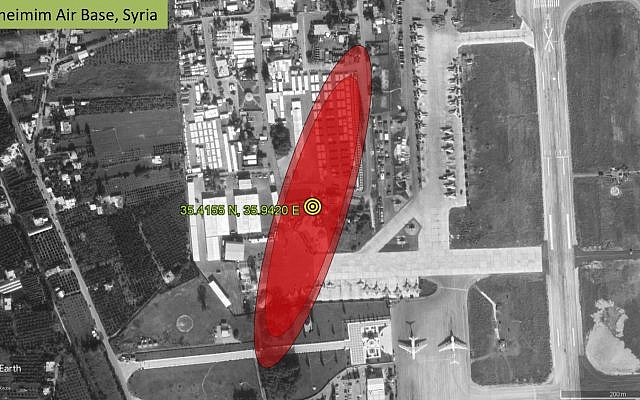
According to Kan, the issue is related to a signal jammer installed at Hmeimim Air Base in Latakia, close to where some alleged Israeli airstrikes have taken place recently. However, officials reportedly believe the jamming to be aimed at other targets, with Israel as collateral damage.

Russian President Vladimir Putin, right, meets troops alongside Syrian President Bashar Assad on a visit to the Hmeimim air base in Syria, December 11, 2017. (Mikhail Klimentyev, Sputnik, Kremlin Pool Photo via AP/File)

One pilot told the broadcaster that the spoofing has caused pilots to have to react suddenly, such as when a plane’s GPS guidance system tells it is in a different place than it is, or that it suddenly has to pull up immediately.

“What we’ve run into is [electromagnetic] spectrum interference from the east, which has taken us a while to understand,” the pilot said.

Even before the report on the jamming, some amateur radar watchers took notice of odd behavior by planes nearing Israel.

In 2019, Israel civil air authorities complained publicly that similar Russian interference was having a “significant impact on all aspects of operating a plane from the cockpit, as well as on managing air traffic.”

Russia dismissed the allegations as fake news, but the problem was dealt with, until recently.

This time, there has been no official confirmation or complaint about the interference.

The pilot charged that officials knew of the problem but were “burying their heads in the sand,” rather than issuing an official complaint.

“The IDF controls the spectral dimension and defends and acts against threats as part of the multidimensional defense of the State of Israel,” the military told Kan in response.

The broadcaster also said some in Israel believe the jamming was an effort by Russia to show who is boss in Syria, noting the many airstrikes there attributed to the Israeli military.

The source of a signal interfering with GPS reception for planes flying over Israel, located on Russia’s Hmeimim Air Base in western Syria, from a presentation by aerospace engineer Todd Humphreys to the US government in June 2019. (Courtesy)

The report comes after Syrian state TV said Israel carried out strikes near Damascus early Monday. It was the first such attack since Russia announced last week it was carrying out joint military jet patrols with the Syrian air force of the airspace along Syria’s borders, including in the Golan Heights area.

Following the patrol, the Ynet news site reported that Israeli military officials were holding talks with Russian army officers to calm tensions.

According to the report, Israeli officials were struggling to understand why Russia, which announced that such joint patrols were expected to be a regular occurrence moving forward, had apparently changed its policy toward Israel.

The report claimed, without citing a source, that Israel may limit its air campaign in Syria as a result of Russia’s move, even after discussions end.

Israel has staged hundreds of strikes on targets inside government-controlled Syria over the years, but rarely acknowledges or discusses specific operations. Many of the strikes in the past targeted the main airport in the capital Damascus, through which Iran is believed to transfer advanced arms to its proxies.

Israel has acknowledged that it targets the bases of Iranian forces and Iran-allied terror groups, particularly along the Golan border, such as Lebanon’s Hezbollah, which has fighters deployed in southern Syria. It says it also attacks arms shipments believed to be bound for those groups.

Russia, Iran and Hezbollah are all fighting on the side of Syrian President Bashar Assad’s forces in the decade-long civil war.

Judah Ari Gross contributed to this report.