
Israeli airstrikes said to hit targets near Damascus

Strikes are first since Russia publicly carried out joint air-defense patrols with Syrian air force; state TV says attack caused ‘material damage’
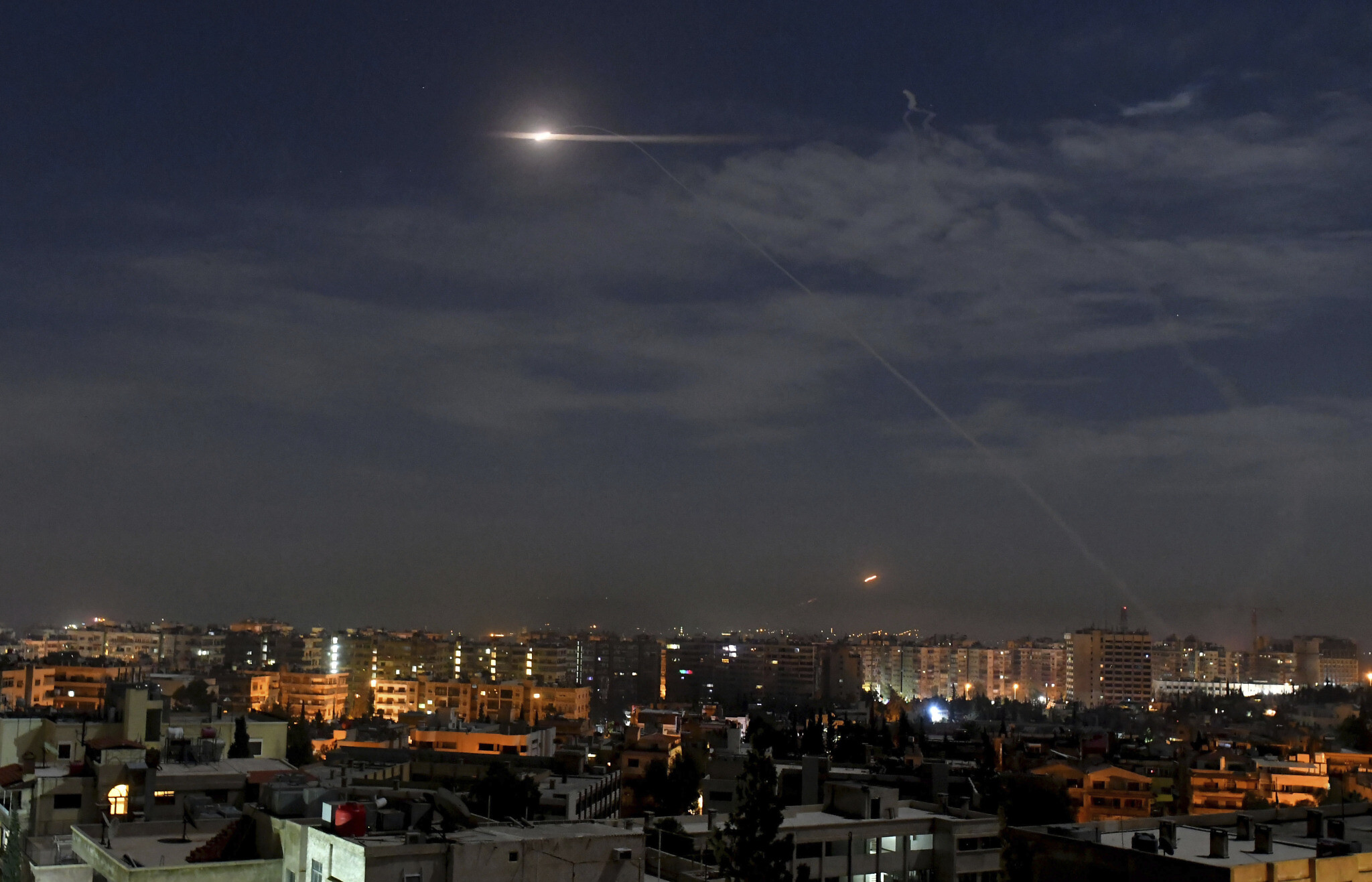
 

Illustrative: In this photo released by the Syrian official news agency SANA, shows missiles flying into the sky near international airport, in Damascus, Syria, on January 21, 2019. (SANA via AP)

Illustrative: In this photo released by the Syrian official news agency SANA, shows missiles flying into the sky near international airport, in Damascus, Syria, on January 21, 2019. (SANA via AP)

Israeli jets carried out airstrikes against targets near the Syrian capital of Damascus early Monday morning, Syrian state TV reported.

The alleged strikes were the first since Russia announced last week it was carrying out joint military jet patrols with the Syrian air force of the airspace along Syria’s borders, including in the Golan Heights area.

Syrian state media SANA said the strikes caused “material damage,” but did not elaborate further. There were no immediate reports of casualties. Israeli airstrikes generally target arms shipments from Iran to its proxies in Syria and Lebanon, notably the Hezbollah terrorist militia.

According to SANA, the Israeli missiles were fired at approximately 3 a.m. from aircraft flying near Beirut.

The report said the Syrian military’s air defenses were activated in response to the strike. The state broadcaster alleged that several of the incoming missiles were intercepted, but analysts generally dismiss such claims — heard after nearly every Israeli airstrike — as false, empty boasts.

Israel has staged hundreds of strikes on targets inside government-controlled Syria over the years but rarely acknowledges or discusses specific operations. Many of the strikes in the past targeted the main airport in the capital Damascus, through which Iran is believed to transfer advanced arms to its proxies.

Israel has acknowledged that it targets the bases of Iranian forces and Iran-allied terror groups, particularly along the Golan border, such as Lebanon’s Hezbollah, which has fighters deployed in southern Syria. It says it also attacks arms shipments believed to be bound for those groups.

Hezbollah is fighting on the side of Syrian President Bashar Assad’s forces in the decade-long civil war.

In December, Israel reportedly carried out two high-profile strikes on the Syrian port of Latakia.

In this photo released by the Syrian official news agency SANA, flames rise from containers at the scene of missiles attack, at the seaport of the coastal city of Latakia, Syria, early December 28, 2021. (SANA via AP)

Last week Russia carried out a joint air patrol with the Syrian air force along the border with Israel, prompting speculation that Israel would be more hesitant to strike Syria.

Following the patrol, Ynet reported that Israeli military officials were holding talks with Russian army officers to calm tensions.

According to the report, Israeli officials were struggling to understand why Russia, which announced that such joint patrols were expected to be a regular occurrence moving forward, had apparently changed its policy toward Israel.

The report claimed, without citing a source, that Israel may limit its air campaign in Syria as a result of Russia’s move, even after discussions end

Explosive device found in kindergarten in Muqeible in Gilboa

An explosive device was found in a kindergarten in the town of Muqeible in Gilboa.

The wireless explosive device was found under a kindergarten by one of the police patrol dogs.

The children were evacuated from the kindergarten and the explosive device was neutralized by a sapper robot.


Nearly 10 months after the negotiations started – with a five-month break imposed by Iran – the hardest issues remain, they say.

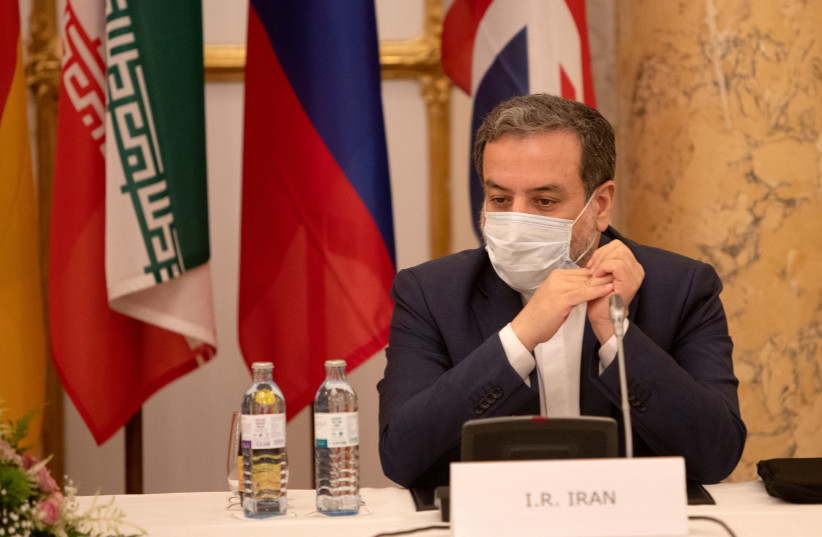
Iran's top nuclear negotiator, Abbas Aragchi, attends a meeting of the JCPOA Joint Commission in Vienna, Austria, September 1, 2020. (photo credit: REUTERS)
Iran’s top nuclear negotiator, Abbas Aragchi, attends a meeting of the JCPOA Joint Commission in Vienna, Austria, September 1, 2020.
(photo credit: REUTERS)

Negotiations for the US and Iran to return to the 2015 nuclear deal are nearing the point where a decision must be made or that agreement will no longer be salvageable, European diplomats said on Friday, as the negotiating teams returned to their capitals for consultations.

“January has been the most intensive period of these talks to date,” negotiators from the US State Department and the E3 – France, Britain and Germany – said in a statement at the end of the eighth round of talks in Vienna. “Everyone knows we are reaching the final stage, which requires political decisions.”

Brett McGurk, the White House’s national security council Middle East coordinator, said on Thursday that “we’re in the ballpark of a possible deal… [but] there’s also a very real chance that these talks could collapse very soon.”

Western diplomats have said that Iran is moving too slowly in the talks to revive the Joint Comprehensive Plan of Action while it enriches and stockpiles uranium, and that weeks, not months, remain until the restrictions of that deal will have been irreversibly hollowed out.

Nearly 10 months after the negotiations started – with a five-month break imposed by Iran – the hardest issues remain, they say.

Brett McGurk, U.S. envoy to the coalition against Islamic State, speaks during a news conference at the U.S. Embassy in Amman, Jordan, November 6, 2016. (credit: REUTERS/MUHAMMAD HAMED)Brett McGurk, U.S. envoy to the coalition against Islamic State, speaks during a news conference at the U.S. Embassy in Amman, Jordan, November 6, 2016. (credit: REUTERS/MUHAMMAD HAMED)

A French presidential official told reporters the main sticking points included the guarantees Iran is seeking to ensure that there is no second US withdrawal from the deal.

“The negotiation today remains difficult because the question of guarantees and the modalities to put Iran’s nuclear program back under control need to be clarified, but there are a few indications that the negotiation can conclude [positively],” the official said.

Iran has demanded that the US promise that its next president will not withdraw from the JCPOA, which is supposed to last until the end of 2030. However, US law does not allow a current president to dictate foreign policy for the next one, especially since the nuclear deal is not a treaty ratified by Congress.

One of the other issues in the negotiations is sequencing, meaning the order in which sanctions are lifted and nuclear restrictions are implemented, through measures like the shipping of excess enriched uranium abroad. Iran sees the resumption of economic activities, after the announcement that sanctions are lifted, as verification of their removal and part of the deal.

Also slowing down the talks is Iran’s refusal to negotiate directly with the US, requiring the EU, E3, Russia and China to go back and forth between the Iranian and American delegations.

“Participants will go back to capitals for consultations and instructions… [but] political decisions are needed now,” the Vienna talks’ coordinator, Enrique Mora of the European Union, tweeted.

A separate EU statement said talks would resume next week.

The JCPOA restricted Iran’s nuclear program, while gradually lifting sanctions. The US left the deal in 2018 and added more sanctions to pressure the regime in Tehran, which had continued its proxy warfare throughout the Middle East in the interim. Iran has since enriched uranium to 60%, far beyond the JCPOA’s limitations, within reach of 90%-enriched weapons-grade uranium.

US National Security Adviser Jake Sullivan said in a call with his Israeli counterpart Eyal Hulata on Wednesday that “the United States is preparing alternative options, in coordination with its partners, should diplomacy fail.”

How much any political decisions will accelerate the talks remains to be seen. Russia’s top envoy, Mikhail Ulyanov, who is often the most optimistic delegate, tweeted: “My instinct tells me that agreement will be reached soon after mid-February.”

The International Atomic Energy Agency is expected to release its next report on Iran’s nuclear program in mid-February, regarding decades-old nuclear material found at four sites in Iran, for which the regime has not provided a convincing explanation.

The next IAEA board meeting is scheduled for March 7. Iran has repeatedly used JCPOA negotiations as leverage to avoid censure by the agency’s board for obstructing inspections and violating the nuclear agreement.