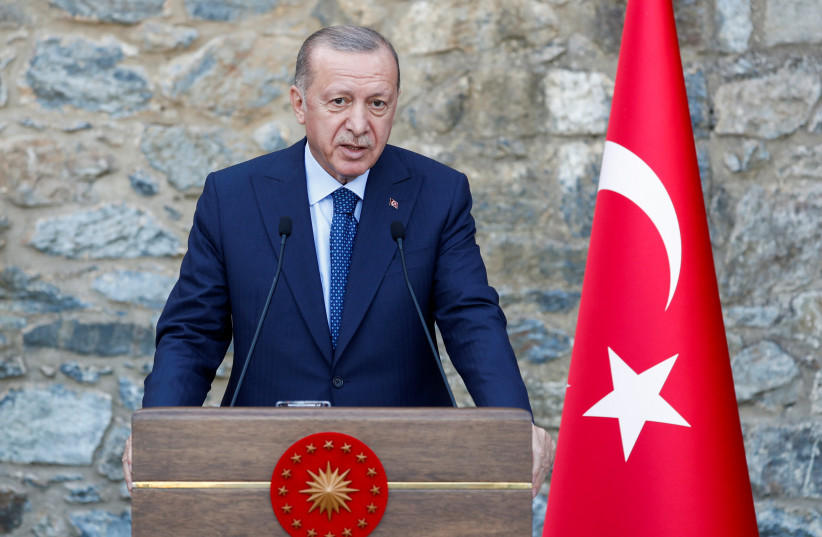
Last week, Ankara said President Isaac Herzog would soon visit Turkey. As part of propaganda about the visit, Turkey announced it unilaterally, rather than through normal diplomatic channels with Israel, via the far-right pro-government media outlet Daily Sabah. That article was then recycled by reports in Israeli media about Turkish President Recep Tayyip Erdogan claiming the visit would happen.
The next day, Turkish Foreign Minister Mevlut Cavusoglu spoke with Foreign Minister Yair Lapid. It was the first call at the ministerial level in 13 years, reports said.
Meanwhile, Ankara was pushing other types of propaganda to its lobbyists abroad. It wants Jerusalem to know it is celebrating the decision by the US to no longer support an Israel-Greece gas pipeline. The message is that Israel’s natural gas now has nowhere to go and will have to go through Turkey.
Turkey has hosted and backed Hamas terrorists for years. In short, its narrative today is that Israel should route its gas through Turkey so that it can use profits to fund Hamas and other extremist groups in the region, many of which are antisemitic and genocidal.
Ankara’s ruling party, for instance, frequently orders the bombing of minorities in Syria and Iraq, including Kurds, Yazidis and Christian communities. Wherever its forces operate in the region, minorities are generally ethnically cleansed, such as in Afrin in Syria, which Turkey invaded in 2018. This persecution of minorities is not in line with the general consensus of Israel and its friends in the Gulf, who are pushing tolerance, peace and stability.
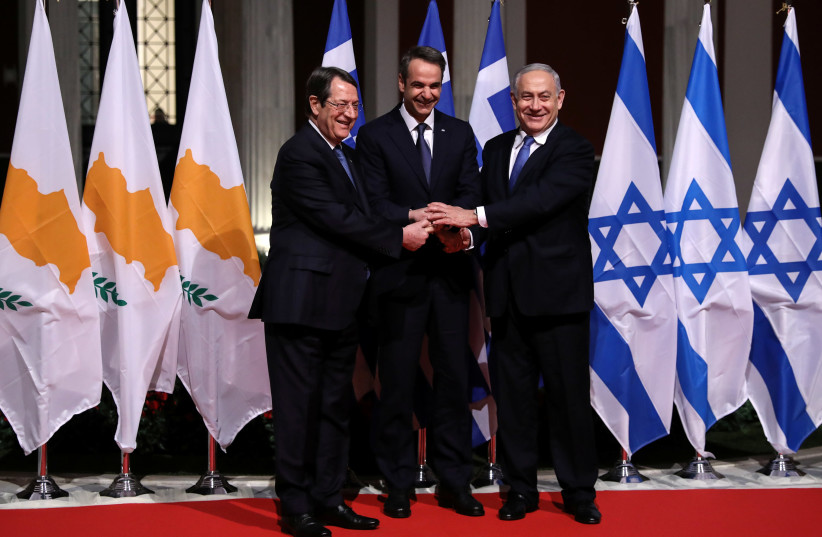 Cypriot President Nicos Anastasiades, Greek Prime Minister Kyriakos Mitsotakis and Israeli Prime Minister Benjamin Netanyahu pose for a photo before signing a deal to build the EastMed subsea pipeline to carry natural gas from the eastern Mediterranean to Europe, at the Zappeion Hall in Athens, Gree (credit: REUTERS/ALKIS KONSTANTINIDIS)
Turkey’s false reconciliation
Turkey’s pitch regarding Israel relations is rooted in a 1950s outlook. In this analysis, Turkey believes Israel is completely isolated in the region and therefore needs it. Turkey can thus benefit from Israel’s isolation while reaping profit. In essence, in all the discussions with Ankara or claims of reconciliation, the only narrative that comes out is that Turkey profits and Israel gets nothing.
For instance, Turkey hosts Hamas, which murders Israelis, and it has backed Hamas extremism. Turkey’s religious authorities increasingly incite against Israel, vowing to “liberate” Jerusalem. When it reconsecrated the Church of Hagia Sophia as a mosque, its leadership compared this to helping Palestinians take over Jerusalem.
Turkish media also incites against Israel. It competes with Iran to not just be the most pro-Palestinian media but to whitewash Hamas and other terrorist groups. There is little recognition in Turkey of the reality in the region: Israel is no longer isolated, and Hamas is a far-right terrorist group.
Turkey wants to have the cake and eat it too, hosting Hamas terrorists, bashing Israel in the media and also pretending to host Israeli officials. If that’s not enough, it also detained Israeli tourists recently.
Israeli media has generally disabused itself of the constant “Turkey wants reconciliation” story. This is because Ankara has floated this idea several times over the past years, almost always timed to try to spoil Israel-Greece-Cyprus ties.
In 2019 and early 2020, Turkey floated ideas about reconciliation, even as it tried to sabotage growing ties between Israel and Greece. It didn’t want the EastMed gas pipeline to come into fruition. It also sought to reach out to Israel when it was clear that Egypt, the UAE, France, Cyprus and Greece were going to sign off on a declaration expressing concern about Ankara’s threats in the Eastern Mediterranean.
In May 2020, Turkey again tried to pretend it would reconcile with Israel. It even fed media entirely unsubstantiated stories about how Ankara had clashed with Hezbollah in Syria and that Jerusalem might share common views there about Iran’s role. In reality, Turkey works closely with Iran and has worked with Tehran, Hezbollah and the Syrian regime in the past. Toward this end, Erdogan had a pleasant phone call with Iran’s leader over the weekend.
Janus-faced Turkey
The Turkey-Iran ties are a contrast to the reality of Turkey-Israel ties. One narrative about its ties with Israel is that they can “compartmentalize” issues they don’t agree on and work on files they do agree on. Reading the Turkish propaganda media and what it feeds its lobbyists in the West who are pro-Israel, the obvious message is that Israeli gas should flow through Turkey and that Israel should recognize Turkish claims to areas of the Mediterranean that are part of Cyprus economic zones.
In short: Turkey should get gas profits and Israel’s support against Cyprus and Greece. What does Israel get? Nothing.
Ankara gets to control Israel’s gas shipments to Europe, giving it leverage over the Jewish state to cut off the gas flow every time there are tensions with Hamas. Then Turkey can route gas profits to Gaza and Jerusalem to push Turkish influence at al-Aqsa Mosque.
Israel doesn’t want cash in Turkey going toward more “flotilla” operations like the Mavi Marmara affair in 2010. In that incident, Turkey enabled the sailing of a large ship full of far-right activists to Gaza, and Israel had to interdict the ship. Turkish activists attacked the Israeli forces and were shot in the melee. This would be tantamount to Israel supporting terrorist groups against Turkey.
In the “compartmentalize” narrative, Turkey gets everything it wants in the “compartments” that it shares with Israel. Then it works with Hamas, Hezbollah, Iran and other Israeli enemies throughout the Middle East and the world, including antisemitic groups.
In these “compartments,” Turkey works alone without taking into account Israel’s views. That means Ankara gets everything and continues to fund extremists and work against Jerusalem’s interests at international forums. Turkey, Malaysia, Pakistan, Iran and a handful of other countries are the ones currently working against Israel at such forums and hosting antisemitism. In those compartments, Israel is absent and Turkey continues to do as it did before.
The other narrative is that since Israel needs Turkey, it “must” work with Ankara. This is Cold War analysis positing that Turkey is an ally of the US and the West, and thus Israel should work with it.
But things have changed since 1990. Today, Turkey is a close partner of Russia and Iran. It is part of the rising authoritarian regimes. It is not a partner of the West or NATO any longer, even if officially it is part of the North Atlantic intergovernmental military alliance.
Israel has also carved out its own independent foreign policy since the 1990s. Like Turkey, it has open channels of communication with Russia. However, unlike Turkey, it is not working with anti-Western regimes or extremists. Israel prefers the stability and tolerance offered by partnerships in the Gulf and with countries like India and South Korea, among others.
Given this setup, Israel does not need Turkey. But Turkey may need Israel since its economy is in tatters. Ankara similarly did outreach to the UAE and the Gulf to get money. It knows Iran has no money to give it.
For that reason, even though Erdogan had positive conversations with his Iranian counterpart over the weekend, he knows promises of Iranian energy supplies and cooperation won’t lead to big profits soon. That is why Turkey floated the idea of UAE investments in its defense industry last month. Like the fake news Ankara’s media spreads about Israel, these stories appeared in Daily Sabah and were then fed to the regime’s friends in Western media.
Is Israel naive in how it interacts with Turkey?
The overall story of Israel-Turkey ties is thus one in which Ankara does outreach primarily to sabotage Israel-Greece and Israel-Cyprus ties. Turkey wants to continue to fund extremist and antisemitic groups, mobilizing the global far Right of groups linked to Hamas, while working closely with Iran and getting profits from potential Israeli gas exports. In no scenario has Ankara done anything for Israel or allowed Israel to profit.
As long as Ankara’s analysis of its Jerusalem relations is that Israel is a naive country that doesn’t remember how Erdogan compared it to Nazi Germany at the UN in 2019, or how Ankara hosts Hamas and can profit off Israel’s gas needs without giving anything in return, the story of Israeli-Turkish ties will continue to be problematic.
Turkey thinks Israel doesn’t read its Janus-faced pro-government media, the one that floats “reconciliation” while pushing antisemitism in Turkish. For instance, when the Biden administration came into office, there were conspiracies in Turkish pro-government media that there were too many Jews in his administration. The US even condemned Turkey’s antisemitism last May.
A country will have trouble reconciling with Israel while also having close allies of its regime bashing Jews in America and comparing Israelis to the Nazis. Israelis also pride themselves on not being “suckers” in investments, so they will be wary of jumping into any investment opportunities with Ankara that don’t show profits quickly for Israel.