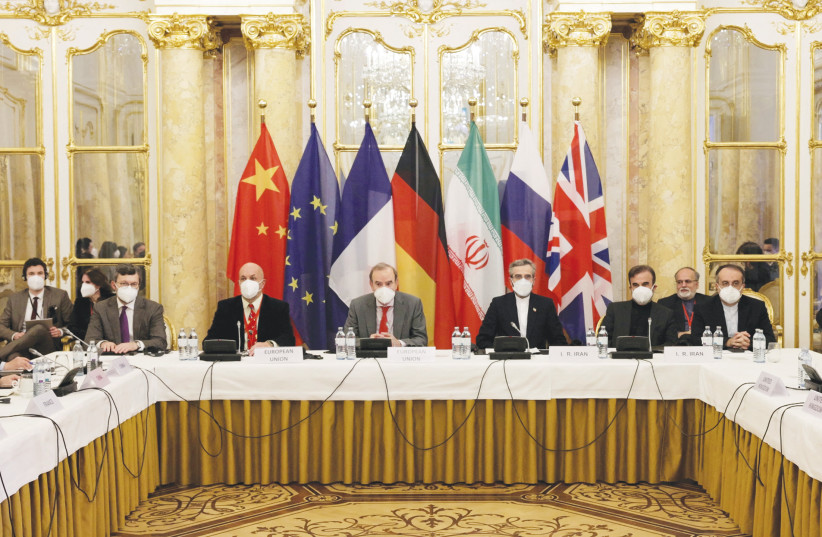
It was clear from the outset that the nuclear talks in Vienna would turn out to be a farce. Promoted by the administration of US President Joe Biden as a means of returning to the 2015 Joint Comprehensive Plan of Action (JCPOA) from which former president Donald Trump withdrew in 2018, the move to go back to the literal and figurative table was born of a pipe dream, at best. At worst, it stemmed from cynical disregard for the consequences of a hegemonic regime in Tehran armed with weapons of mass destruction.
The fantasy on the part of American and European liberals is that achieving a new and improved JCPOA is the safest — or only — way to prevent Iran from building atomic bombs. Western “pragmatists,” meanwhile, are concerned more about trade with the Islamic Republic than matters of war and peace.
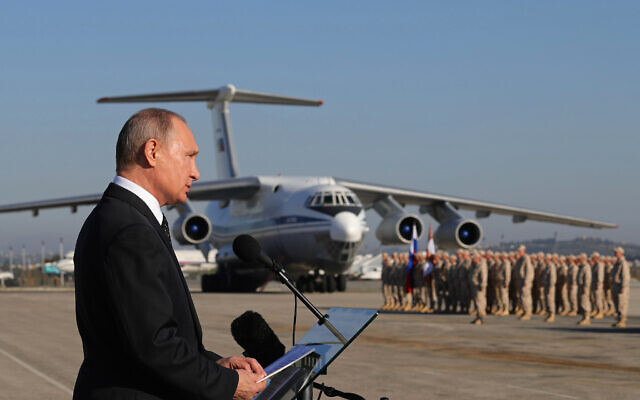
The far-left apologists for a Russia-China-Iran axis possess a mixture of the above, but with a heavier ideological bent. Members of this camp, which includes radical Islamists, have an inverted view of good and evil. They see the West in general, particularly the United States, as an embodiment of the latter.
But all share a desire for a deal to be forged with the mullah-led government of Ebrahim (“the butcher”) Raisi, along the lines of the one signed between the P5+1 countries (China, France, Russia, Britain, the US and Germany) and his “moderate” predecessor, Hassan Rouhani.
That the first JCPOA was a total failure, thanks to Iranian violations and loophole-manipulations, did not put a dent in Team Biden’s resolve to resuscitate it. This isn’t surprising.
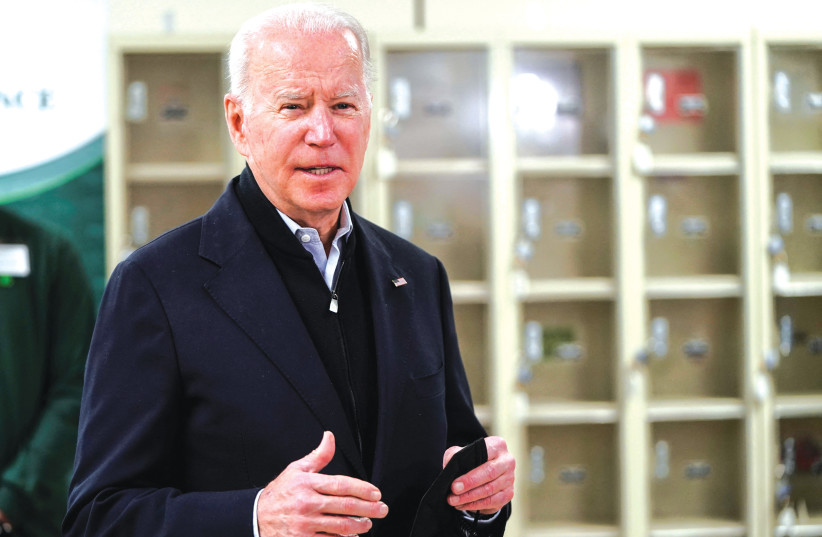 US PRESIDENT Joe Biden speaks in Philadelphia, the following day, about the hostage-taking at Congregation Beth Israel in Colleyville, Texas. He first said it was too early to know ‘why’ the gunman ‘was using antisemitic and anti-Israeli comments.’ (credit: JOSHUA ROBERTS/REUTERS)
The current White House, after all, contains many of the same people responsible for concocting the agreement in the first place. And had the deal been merely pointless — since no contract with or among radical Islamists is ever worth the paper on which it’s written — the years wasted on forcing its fruition could have been considered a pathetic exercise in futility.
Unfortunately, however, even if Iran had honored its commitments, the JCPOA provided the regime with cherished time and space to continue pursuing its nuclear agenda without the financial constraints of sanctions. It also enabled Tehran to charge full speed ahead with advanced drone and ballistic-missile development.
Two years after Trump withdrew from the deal, his administration adopted a “maximum pressure” policy that involved imposing a slew of additional sanctions on Iran in the remaining 10 weeks before Biden’s inauguration. According to an Axios report, the plan, coordinated with Israel and some Gulf states, was not aimed at the Islamic Republic’s nuclear program, as the assumption was that when Biden took the helm, he would cancel such sanctions in the framework of negotiations over a resumption of the JCPOA. Instead, it was directed at Iran’s ballistic-missile development, human-rights abuses at home and terrorism-funding abroad.
One figure instrumental in the above was Elliott Abrams, whom Trump appointed in September 2020 to replace Brian Hook as US Special Representative for Iran. The person picked by the Biden administration to fill that position couldn’t have constituted a starker contrast or a better fit for the State Department, headed by Secretary of American Appeasement Antony Blinken.
A “conflict resolution” expert and advocate of engagement with Hamas and the Muslim Brotherhood, Robert Malley — head of the Middle East desk of former president Barack Obama’s National Security Council — was a key negotiator of the JCPOA. Among the leftist groups and individuals who championed his decision to accept the post were Code Pink, J Street and prominent Israel-basher Peter Beinart.
Perhaps they weren’t so happy to read reports that Malley told Blinken that he wanted to put together a team with a “broad diversity of viewpoints on how best to renegotiate the Iran deal.” If so, they needn’t have worried, since only those determined to concede to Tehran’s bullying appear now to be remaining on board.
As The Wall Street Journal revealed on Monday, Malley’s second-in-command, Richard Nephew, has quit the team over what he considers to be its weak stance toward Iran in the Vienna talks. Though another throwback to the Obama administration, where he served as principal deputy coordinator for sanctions policy at the State Department, even Nephew is unable to stomach the current level of capitulation.
Nor is he alone in this respect. According to the WSJ report, another member of Malley’s team has also left, and for apparently the same reason. So much for the charade of “viewpoint diversity.”
Indeed, Biden has no intention of pulling out of the process, regardless of the stunts pulled by Tehran. These include brazenly denying International Atomic Energy Agency inspectors access to crucial nuclear facilities, and boasting about achieving 60% uranium enrichment.
As if this weren’t sufficient cause for Washington to put a stop to the unrequited courtship, Tehran still refuses to permit the US delegation to enter the venue at the Hotel Palais Coburg where the talks are conducted. Malley’s guys, then, are forced to convey messages through intermediaries in another room.
IT’S NOT a novel ploy. Humiliating America has been integral to Iran’s dealings with Democratic administrations since the Islamic Revolution in 1979 that ousted Shah Mohammad Reza Pahlavi and ushered in the reign of the ayatollahs.
Imagine the disdain of the honchos in Tehran listening to Blinken last week fumble his way through a response to the mockery being made of his country.
“My own assessment, talking to all of our colleagues, is that returning to mutual compliance [with Iran] remains possible,” he said on January 20 at a press conference in Berlin. “There is real urgency, and it’s really now a matter of weeks whe[n] we determine whether or not we can return to mutual compliance with the agreement.”
Seriously? A “return to mutual compliance?” Does Blinken actually believe that Iran ever fulfilled its already meager obligations?
Despite the stupidity regularly exhibited by him and his boss, the real explanation for their behavior is far more dangerous than delusion. Any acknowledgment that Iran cannot be stopped through diplomacy would require serious action — something that they’re not willing to take, not even the kind that Nephew, author of the 2017 book The Art of Sanctions, was pushing for, to no avail.
Alluding to a potential military operation by repeating some version of the mantra that “all options are on the table” is a way of pretending to mean business. Iran certainly doesn’t buy such “tough talk” from the likes of Biden.
On the contrary, Raisi realizes that the more his regime spits in Washington’s face, the better his chances are of getting what he wants. This isn’t only because of his Islamist ideology; it’s a function of observation.
For one thing, he sees the US team infighting, with its weak side winning the battle. For another, watching America genuflect rather than call the shots is enough for him to conclude that Iran is on a sure path to sanctions-relief and nuclear warheads. From Tehran’s point of view, the Vienna gatherings are proving to be a great success.