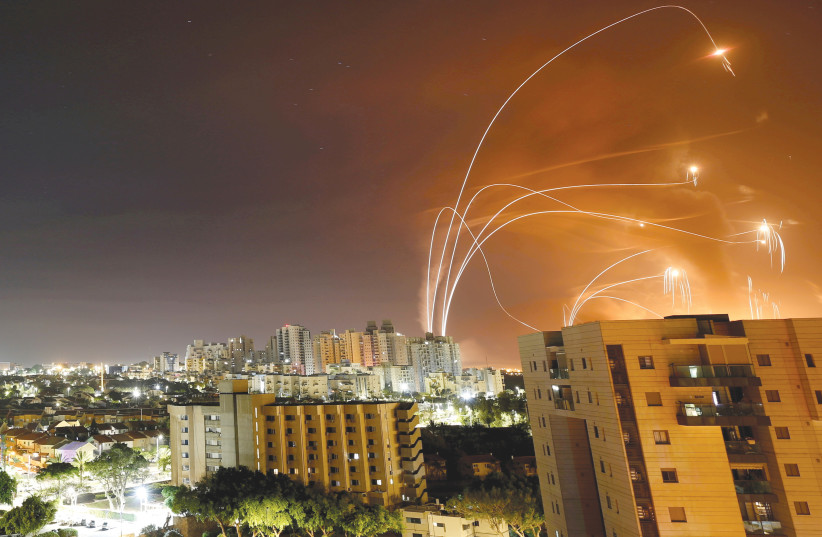
IRON DOME interceptors destroy rockets launched from the Gaza Strip toward Israel in the skies over Ashkelon in May.
(photo credit: AMIR COHEN/REUTERS)
Unknown individuals in Lebanon launched a rocket towards Israel on Wednesday night, according to Lebanese media.
Army Radio reported that there was no indication that there had in fact been a rocket launch.
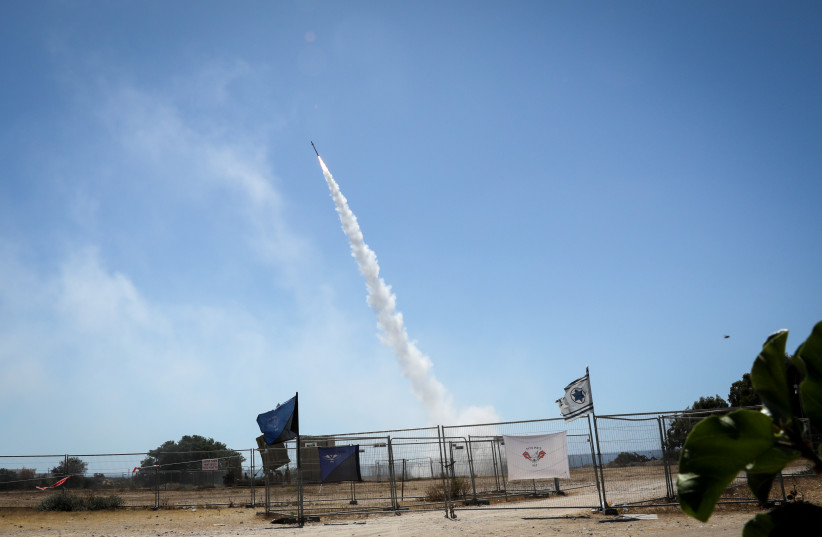
Iron dome anti-missile system fires interception missiles as rockets fired from the Gaza Strip to Israel, in the southern Israeli city of Ashkelon, May 19, 2021. (credit: OLIVIER FITOUSSI/FLASH90)
Other Lebanese outlets reported that an explosion was heard in the area from which the rocket was reportedly launched but that the source was unknown.
Over the last few months, Gaza fired multiple rockets towards Israel, claiming that they were mistakes and blaming other elements such as the weather.
The last time this happened was at the beginning of January when two rockets were launched by Hamas. It was claimed that they were launched by lightning strikes. The rockets fell into the coast off Israeli’s center, and no one was hurt.
Before that, two rockets were fired over within a week of each other, and Hamas once again claimed that extreme weather was the cause
The last time rockets were launched from Lebanon toward Israel was in August. Hezbollah fired 20 rockets into Israel, 10 of which were intercepted and six fell inside Lebanon.
Lebanon is currently undergoing a severe period of instability amid a massive economic crisis, a severe fuel shortage and tensions in the political sector.
Prime Minister Naftali Bennett proposed a Russia-Ukraine summit in Jerusalem to Russian President Vladimir Putin in their meeting last October, Ukrainian and Israeli officials told Barak Ravid of Axios on Wednesday.
Ravid noted Israel is one of the few countries that has good relations with both Kyiv and Moscow and is able to pass messages between them. The Ukrainian side first broached the idea of a summit in Israel with former Prime Minister Benjamin Netanyahu last spring when Russia was massing troops on the border, but it never gained much traction.
When a senior Ukrainian delegation visited Israel in April last year, the government decided to try to use its close relationship with Israel to promote dialogue with Russia, Ukraine’s ambassador to Israel, Yevgen Korniychuk, told Ravid.
Ukrainian President Volodymyr Zelensky’s closest adviser, Andriy Yermak, asked Netanyahu if he would be prepared to organize a summit between Zelensky and Putin. Netanyahu wasn’t very enthusiastic but said he’d consider it if both sides wanted it, according to an Israeli source.
Netanyahu’s advisers raised the idea with the Kremlin in April and again in May but didn’t get a positive response.
Bennett spoke to both Putin and Zelensky within days of replacing Netanyahu last June, the report noted. Then, in October, President Isaac Herzog visited Kyiv and met with Zelensky, who told him about Netanyahu’s mediation efforts and asked if the new Israeli government would resume them, Ukrainian and Israeli officials told Ravid.
Herzog briefed Bennett, who was scheduled to meet Putin two weeks later in Sochi. Bennett called Zelensky the day before traveling, and the Ukrainian president again raised the summit idea and said it could perhaps be at a lower level.
When Bennett raised the idea in Sochi, Putin wasn’t at all enthusiastic and harshly criticized Zelensky, according to Ukrainian and Israeli officials briefed on the conversation.
Bennett and Herzog’s offices both declined to comment, as did Netanyahu.
Korniychuk told Ravid Ukraine remains willing to attend a summit in Jerusalem but is also prepared to fight.
“Our main lesson is to be Israeli — don’t listen to anybody and be ready to defend ourselves by ourselves. A Russian invasion won’t be a picnic [for the Russians]. 30% of Ukrainians said they are ready to fight if Russia invades. The Russians will have heavy losses,” Korniychuk said.
Ahead of his departure for Moscow, President Ebrahim Raisi said joint cooperation between Iran and Russia will help build security in the region and counter unilateralism there.
Speaking at Tehran’s Mehrabad International Airport on Wednesday morning, the Iranian president said he was leaving for Moscow at the invitation of his Russian counterpart, Vladimir Putin, and “Efforts would be made during the trip to promote neighborly and regional diplomacy.”
He said, “Without any doubt, our relations with all neighbors, especially Russia, are good, and given the political, economic and commercial relations between the two countries, this trip could be a turning point for bolstering our ties with Russia.”
The Iranian president said issues of bilateral significance in the fields of politics, economy, energy, trade and aerospace will be on the agenda of his talks in Moscow.
“We have shared interests with Russia and these interactions and common interests will definitely build security in the region and counter unilateralism there,” Raisi said. “Mutual cooperation can be highly effective in the current regional and international circumstances.”
He said both Iran and Russia are powerful and influential in the region and thus dialog between such states can boost regional economic cooperation.
The president said Iran and Russia are party to many political and economic circles in the region, in which Moscow plays a significant role, including the Shanghai Cooperation Organization (SCO).
He said Iran, which was recently granted permanent membership in the SCO, will have good cooperation with all members, particularly Russia.