ANALYSIS’THEY DON’T WANT TO OPERATE ALONE’

Emiratis are taking care not to blame Tehran after Houthis send a violent message from Yemen; Israel’s offers of support will be well-received


Screenshot from video purportedly showing fire after drone attack in Abu Dhabi on January 17, 2022. The video could not be independently verified (Screen grab)

Screenshot from video purportedly showing fire after drone attack in Abu Dhabi on January 17, 2022. The video could not be independently verified (Screen grab)

Monday’s fatal drone attack on oil facilities in  Abu Dhabi and the Gulf state’s reticence to directly blame Tehran lays bare Emirati vulnerabilities in the face of Iran and its proxies.

The proximate cause of the attack, claimed by Houthi rebels in Yemen, is no mystery.

The civil war in Yemen escalated over the past two weeks, as the Saudi-led coalition undertook a major offensive to capture strategic provinces in central Yemen. The UAE-backed Giants Brigades militia played a central role in the capture of the oil-rich Shabwa Governate.

Since they revealed their drone capabilities in 2017, the Houthis have focused their attacks on the Saudis, not the UAE. Still, they made sure to caution the Emiratis against escalation.

“Targeting the UAE depends on military developments on the western front,” said a Houthi-allied journalist in 2019. “There is an understanding with Abu Dhabi not to escalate the situation in western Yemen through their allies. Otherwise, Houthis will have a strong response and will come after Abu Dhabi’s ports and airports.”

The Houthis clearly feel that the Emiratis recently violated understandings between the sides, even after they seized a UAE-flagged ship in the Red Sea, where it is still being held.

Though the UAE says it withdrew its military forces from Yemen in February 2020, it still backs tens of thousands of proxy fighters in the civil war. It also controls strategic Yemeni islands, and is building ports and airfields.

Abu Dhabi is also increasingly involved in internal Yemeni politics.

Armed Houthi fighters attend the funeral procession of Houthi rebel fighters who were killed in recent fighting with forces of Yemen’s internationally recognized government, in Sanaa, Yemen, Nov. 24, 2021. (AP Photo/Hani Mohammed)

“The timing was not surprising actually, because things have been moving toward escalation,” said Moran Zaga,  an expert on the Gulf region at Mitvim — The Israeli Institute for Regional Foreign Policies.

“Clearly it’s a message from Yemen to the Emirates on the costs of escalation inside the country,” said Katherine Zimmerman, a fellow at the American Enterprise Institute.

Still, she said, viewing the attacks solely within the context of the conflict in Yemen is short-sighted. “That comes from the Houthis increasing alignment with Iran and its axis of resistance, and the growing threats we see from the Houthis to other regional actors, including Israel.”

The Houthi relationship with Iran is different than that of other proxies, as they see themselves more as partners with the Islamic Republic. But Houthi interests are increasingly allied with Iran, said Zimmerman, and they have adopted Iranian narratives about the West’s malign influence in the region.

Illustrative: The remains of an Iranian Qasef-1 Unmanned Aerial Vehicle, used as a one-way attack UAV to dive on targets and then detonating its warhead, which was fired by Yemen’s Iran-backed Houthi rebels into Saudi Arabia, according to then-US ambassador to the UN Nikki Haley during a press briefing at Joint Base Anacostia-Bolling, December 14, 2017, in Washington. (AP Photo/Cliff Owen)

Moreover, Iran’s support for the Houthis goes well beyond military backing. Tehran provides money, media training, and diplomatic cover.

Tehran’s role

Most analysts believe that though the attacks were directed by the Houthis, Tehran had some involvement.

“I think they at least had to inform Iran, to get some sort of approval,” said Yoel Guzansky, a senior research fellow at the Institute for National Security Studies in Tel Aviv. “But the initiative here, and the trigger, the rationale is Yemeni.”

But Iran might have had more involvement than most assume. Shortly after the attack, a Houthi delegation met with Iranian President Ebrahim Raisi in Tehran. They met Iran’s Foreign Minister in Oman days before to discuss the fighting in Yemen.

Moreover, the Houthis have claimed attacks in the past that many believe were carried out by Iran.” Many recalled the attack against the Aramco facilities in Abqaiq in September 2019, for which the Houthis claimed responsibility, but with which a United Nations committee later disagreed,” pointed out Carnegie Middle East Center scholar Ahmed Nagi.

During a trip organized by the Saudi information ministry, workers fix the damage in Aramco’s oil separator at processing facility after the September 14 attack in Abqaiq, near Dammam in the Kingdom’s Eastern Province, September 20, 2019. (AP Photo/Amr Nabil)

“It’s hard to imagine that an attack on that level could be done alone at that distance,” said Zaga. “It’s a pretty primitive guerrilla group.”

The Abu Dhabi strike comes as Iran holds a series of talks with the Saudis, and sits with Western negotiators in Vienna for negotiations on a return to the 2015 nuclear deal.

“It’s a show of force,” said Guzanky. “This is exactly what they do. On the surface, they have good connections with the Emiratis and everyone is playing nice, but they have leverage on everyone. They don’t declare, but there is a force in Yemen, and elsewhere like Iraq, that serves Iranian interests.”

“This is the Iranian method. We’re good friends on the surface, but under the surface, beware.”

Careful response

The Emiratis seem to be taking care not to escalate in their response, as officials in Abu Dhabi are not mentioning Iran at all in their post-attack statements.

Above all, the UAE wants to maintain regional stability so that it can continue to shift its economy away from oil and gas. It doesn’t want to throw off talks with Iran, which it sees as a key to calming the region.

In addition, Expo 2020 is underway in Dubai, a major priority for the UAE as it moves its economy into the future.

The apprehensive response is also a sign of UAE weakness in the face of Iranian threats. In addition to Iranian threats to its shipping, now Abu Dhabi must contend with aerial threats from the west.

People attend the opening ceremony of the Dubai Expo 2020, on September 30, 2021. (Giuseppe Cacace/AFP)

It chose a similar path after the May 2019 attacks on oil tankers in Emirati waters.  In the ensuing months, the UAE announced it was leaving Yemen, sent a delegation to Iran, and declined to blame Tehran even as their Saudi allies pointed a finger squarely at the Islamic Republic.

“They don’t want to operate alone, because then all the weapons are pointed at them,” said Zaga.

The Emiratis are instead trying to bring together an international coalition to respond in Yemen. After the strikes, the UAE Foreign Ministry website focused on condemnation of the attack from regional leaders.

Shortly after the drone attack, the coalition launched fresh strikes “targeting Houthi camps and headquarters” in Sanaa, Saudi Arabia’s state-owned Al-Ekhbariya TV tweeted.

A firm US response would embolden the Emiratis, but such a reaction is unlikely. The Biden Administration is determined to come to a deal with Iran in Vienna, and has separated out the nuclear issue from Iran’s support for armed groups like the Houthi.

A time to support

Though Monday’s attack doesn’t directly involve Israel, officials should be paying attention. The range and accuracy of Houthi rockets and UAVs are increasing, and they can strike increasingly close to Israel. Even if they can’t yet hit Israel, the Houthi can disrupt Israeli shipping in the Red Sea and the Gulf of Aden.

On a broader scale, the Houthis fit into Iran’s regional designs against Israel, which include creating threats against Israel from new territories.

Prime Minister Naftali Bennett (left) meets with UAE Crown Prince Mohammed bin Zayed Al Nahyan in the latter’s Abu Dhabi palace on December 13, 2021. (Haim Zach/GPO)

With its wealth of experience in missile defense and UAVs, Israel has much to offer its new Emirati partners.

On Tuesday, Prime Minister Naftali Bennett “ordered the Israeli security establishment to provide their counterparts in the UAE with any assistance” that could help to protect against future attacks.

“Israel stands with the UAE,” he wrote in a letter to Bin Zayed. “I stand with [Crown Prince] Mohammed bin Zayed. The world should stand against terror.”

Even if any aid is turned down, the gesture will not go unnoticed.

“We can earn a lot in our relationship by standing by them in their time of need,” stressed Guzansky.


 

READ MORE:


Iran’s regime disturbed by rising will to protest and secularism

Ex-head of Iran’s nuke organization wants to inflict 50,000 wounds on Israel to ‘liberate Golan Heights and break siege of Gaza’

 DEMONSTRATORS STAND in front of anti-American murals on a wall of the former US embassy in Tehran last month, during an event commemorating the ‘US expulsion’ from Iran. (photo credit: MAJID ASGARIPOUR/WANA (WEST ASIA NEWS AGENCY) VIA REUTERS)
DEMONSTRATORS STAND in front of anti-American murals on a wall of the former US embassy in Tehran last month, during an event commemorating the ‘US expulsion’ from Iran.
(photo credit: MAJID ASGARIPOUR/WANA (WEST ASIA NEWS AGENCY) VIA REUTERS)
The deputy interior minister of the Islamic Republic of Iran, Taghi Rostamvandi, outlined factors on Sunday during a speech that could shake the foundations of the theocratic state.
The Islamic Republic News Agency, or IRNA, the regime-controlled news agency of the Islamic Republic of Iran, reported that Rostamvandi warned that Iranians are seeking with greater frequency “fundamental changes in the country,” and a secular government and way of life.
Rostamvandi delivered his remarks at a conference in Tehran titled the “Second National Conference on Social Harm from the Perspective of Islam.”

green movement teheran311 (credit: AP)green movement teheran311 (credit: AP)

He said that “The index of people’s desire to protest is very important. We should conduct a socio-political assessment when people come on to the streets showing intense forms of protests because those protests will break the norms.”
Rostamvandi added that “This will be extremely alarming if we find out that as a result of the incompetency of the government, people feel that the religious government is incapable of solving the country’s problems and that a secular government can be effective.”
Revolts against the clerical state have punctutated Iran since the 1979 Islamic revolution, including the widespread Green movement protests in 2009 and massive unrest  2019.
The deputy minister alluded to the apparent effect of international sanctions on Iran’s struggling economy to prevent the clerical regime from building a nuclear weapons device: “The public’s patience is wearing very thin as economic pressures continue to mount. We should also sound the alarm as more people are leaning toward a secular government due to ineptitude or mismanagement. This is very dangerous.”
The London-based news organization Iran International wrote in response to Rostamvandi’s speech that “According to Rostamvandi demand for fundamental changes in Iran are on the rise.The official did not explain how four decades of Shiite clerical rule have made the people turn their backs to the Islamic Republic government.”
The outlet cited a study published in September that revealed a mere “32 percent of Iranians identify themselves as ‘Shiite Muslim,’ and nearly half of the population have moved on from religiosity and are ‘atheists.”’
Iran International said that “In December 2017, an adviser to the Roads and Transportation Minister said that 5.1 million Iranians, mainly educated individuals and skilled workers, were in the waiting list for immigration to Australia and Canada.”
The Islamic Republic president Ebrahim Raisi recently declared that  “Western cultures and political systems are not attractive for the Iranian youths. No young Iranian would want to live in a Western cultural atmosphere.”
Separately, Iran International on Tuesday reported that Fereydoun Abbasi, the former head of  the Atomic Energy Organization of Iran (AEOI) and a current member of the Parliament Energy Committee in the parliament of the Islamic Republic, said “Instead of the thousand wounds they want to inflict on the body of the Islamic Republic, we must inflict 50,000 wounds on them,” in connection with Israel, adding that “The Resistance Front and the Islamic world must break the siege of Gaza and liberate the Golan Heights, then we will definitely get an answer in the negotiations.”


US informs Israel it no longer supports EastMed pipeline to Europe

Washington informed Athens that they no longer support the EastMed project earlier this month.

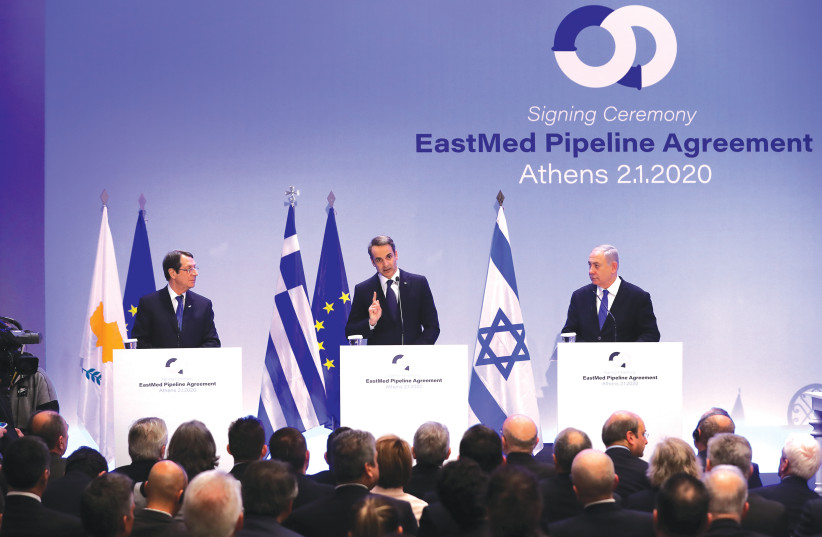
CYPRIOT PRESIDENT Nicos Anastasiades, Greek Prime Minister Kyriakos Mitsotakis and Prime Minister Benjamin Netanyahu attend a joint news conference following the signing of a deal to build the EastMed sub-sea pipeline to carry natural gas from the eastern Mediterranean to Europe, in Athens earlier t (photo credit: REUTERS)
CYPRIOT PRESIDENT Nicos Anastasiades, Greek Prime Minister Kyriakos Mitsotakis and Prime Minister Benjamin Netanyahu attend a joint news conference following the signing of a deal to build the EastMed sub-sea pipeline to carry natural gas from the eastern Mediterranean to Europe, in Athens earlier t
(photo credit: REUTERS)
The US no longer supports the proposed EastMed natural-gas pipeline from Israel to Europe, the Biden administration has informed Israel, Greece and Cyprus in recent weeks.
State Department officials conveyed the new position to the Foreign Ministry, a diplomatic source in Jerusalem confirmed Tuesday. The Foreign Ministry declined to comment on the matter.
The reversal of position from that of the Trump administration was first reported in Greece earlier this month.
Former US secretary of state Mike Pompeo and former energy secretary Dan Brouillette expressed US support for the pipeline when they were in office.
But Washington informed Athens it was reversing course from the Trump administration in a “non-paper,” a diplomatic term for an unofficial, or off-the-record, communication this month.

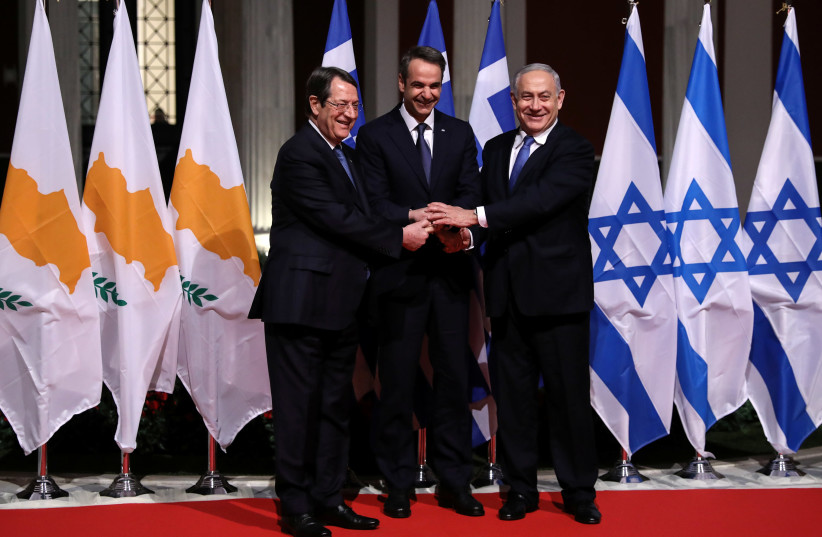
Cypriot President Nicos Anastasiades, Greek Prime Minister Kyriakos Mitsotakis and Israeli Prime Minister Benjamin Netanyahu pose for a photo before signing a deal to build the EastMed subsea pipeline to carry natural gas from the eastern Mediterranean to Europe, at the Zappeion Hall in Athens, Gree (credit: REUTERS/ALKIS KONSTANTINIDIS)Cypriot President Nicos Anastasiades, Greek Prime Minister Kyriakos Mitsotakis and Israeli Prime Minister Benjamin Netanyahu pose for a photo before signing a deal to build the EastMed subsea pipeline to carry natural gas from the eastern Mediterranean to Europe, at the Zappeion Hall in Athens, Gree (credit: REUTERS/ALKIS KONSTANTINIDIS)

“The American side expressed to the Greek side reservations as to the rationale of the EastMed pipeline, [and] raised issues of its economic viability and environmental [issues],” a Greek government source told Reuters.
“The Greek side highlighted that this project has been declared a ‘special project’ by the European Union, and any decision on its viability will logically have an economic impact,” the official said.
The EastMed pipeline, meant to transfer natural gas from Israeli waters to Europe via Greece and Cyprus, was announced in 2016, and several agreements have been signed between the three countries on the subject. The three states aimed to complete the €6 billion project by 2025, but no financing has been secured for it.
The US Embassy in Jerusalem said that the Americans “remain committed to the energy security and connectivity of the Eastern Mediterranean.”
Among the proposals the US supports is the EuroAsia interconnector linking Israeli, Cypriot and European electricity grids, “allowing for future exports of electricity produced by renewable energy sources, benefiting nations in the region.” The interconnector “would not only connect vital energy markets, but also help prepare the region for the clean energy transition,” the embassy said.
The US Embassy also said this is “a time when Europe’s energy security is – more than ever – a question of national security,” and as such, the US is “committed to deepening our regional relationships and promoting clean energy technologies.”
The US Embassy in Greece made a similar statement last week, saying Washington still supports the 3+1 mechanism of meetings between Israel, Greece, Cyprus and the US.
Claims over natural gas in the Eastern Mediterranean have been a point of contention with Turkey in recent years, with Ankara saying it should be part of the EastMed project.
Turkish President Recep Tayyip Erdogan took the opportunity of the US withdrawing its support to say: “[If Israeli gas] would be brought to Europe, it could only be done through Turkey. Is there any hope for now? We can sit and talk about the conditions.”
He also noted his recent phone calls with Prime Minister Naftali Bennett and President Isaac Herzog and said engagement with Israel had improved.
Turkish state media channel TRT last week aired a documentary opposing the EastMed pipeline titled The Pipe Dream, which includes footage of State Department Senior Advisor for Energy Security Amos Hochstein discussing the matter before he was appointed to his current position.
Hochstein said he would be “extremely uncomfortable with the US supporting this project” because of its environmental implications.
“Why would we build a fossil fuel pipeline between the EastMed and Europe when our entire policy is to support new technology… and new investments in going green and in going clean?” he asked. “By the time this pipeline is built we will have spent billions of taxpayer money on something that is obsolete – not only obsolete but against our collective interest between the US and Europe.”
Hochstein said the project was not financially feasible. It would cost more than €6b., he said, adding that international financial institutions no longer are committed to investing in fossil fuels.
The pipeline plan was “totally driven by politics,” but “multibillion-dollar deals should be driven by the commercial side,” Hochstein said.
“This idea came up in 2016, but no movement has been made except for signing some contracts, MOUs [memorandums of understanding] and the big hoopla of politics… Some ministers in the region are talking about the EU supporting [the plan]; they agreed to a feasibility study on the project. That’s a big difference,” he said.
“This is politicians talking, but there’s [nothing] there,” Hochstein said. “This project probably will not happen because it’s too complicated, too expensive and too late in the arch of history.”
Gabriel Mitchell, director of external relations for the Mitvim Institute for Regional Foreign Policy, said Israel’s relationship with Greece and Cyprus, which has grown very warm in recent years, does not depend on the EastMed pipeline.
“The cooperation between the parties has expanded beyond the narrow scope of an undersea pipeline project, incorporating multiple fields and interministerial cooperation,” he said.
Regarding Israel’s future in exporting natural gas, the EastMed was never its only option, Mitchell said.
“The story of the EastMed pipeline should serve as a reminder that these projects require a high level of commercial, technical and political feasibility,” he said. “As one door potentially closes, others could open that present a different but no less important set of commercial and geopolitical opportunities.”
“The EastMed pipeline’s feasibility issues were well-documented, but in the end, it may be other energy initiatives – such as the EuroAsia interconnector – that become the tripartite relationship’s flagship project,” Mitchell said.
Reuters contributed to this report.•