After China and Russia, both rising powers that are confronting the US, Iran is also courting Saudi Arabia with the fifth round of talks to heal ties with the Kingdom.

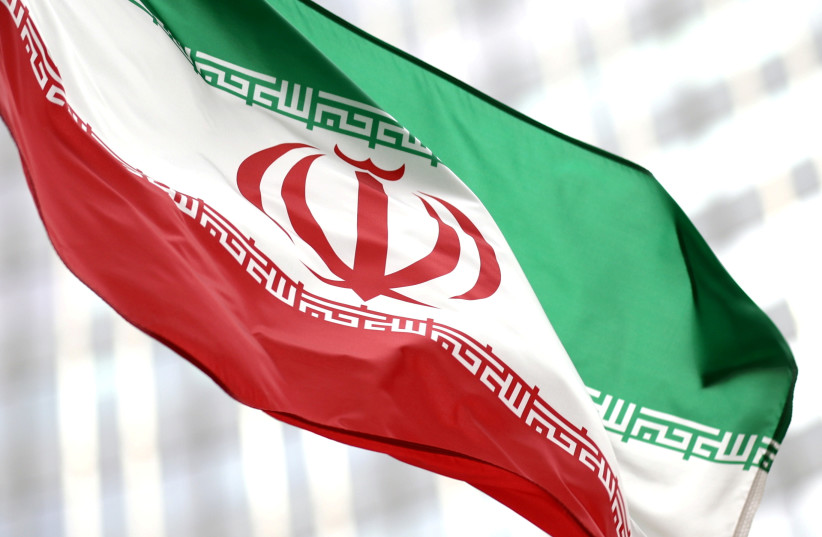
Iranian flag flies in front of the UN office building, housing IAEA headquarters, amid the coronavirus disease (COVID-19) pandemic, in Vienna, Austria, May 24, 2021. (photo credit: LISI NIESNER/ REUTERS)
Iranian flag flies in front of the UN office building, housing IAEA headquarters, amid the coronavirus disease (COVID-19) pandemic, in Vienna, Austria, May 24, 2021.
(photo credit: LISI NIESNER/ REUTERS)
As Iraq’s parliament finally gets moving on establishing a new government, and Iran hosts a delegation from Afghanistan, it is clear that Tehran is seeking to achieve multiple foreign policy goals in the coming months. This means that it is hoping to shore up security in Afghanistan and Iraq while expanding its influence across the Middle East. It has many challenges, including the Vienna talks with the West, but it is confident.
Evidence of this confidence was a wide-ranging talk with Iran’s foreign ministry spokesman which was broadcast to local media.
What are some of the major files that Iran is now working on? Buried in the discussion were hints of increasing talks with China. Iran is already part. Of a 25-year agreement with China and wants to cement that agreement with concrete items on the agenda. Iran is sending its foreign minister to China this week.
“The senior Iranian diplomat also mentioned the 25-year Iran-China agreement and operational measures in the field of oil and gas,” the Iranian reports say. “[Foreign Minister] Amir Abdullahian is going to China this weekend at the invitation of his Chinese counterpart and we have various issues on the agenda and a 25-year roadmap is one of them….Our agenda is very diverse and a variety of topics are being pursued in this context.”
Next, China is also focusing on Russia. Iran’s President Ebrahim Raisi is supposed to visit Russia. He is believed to be set to talk defense agreements with Moscow. Reports say that Raisi is expected to sign a 20-year, $10 billion security and defense cooperation agreement. This could lead to aerospace purchases and other items.
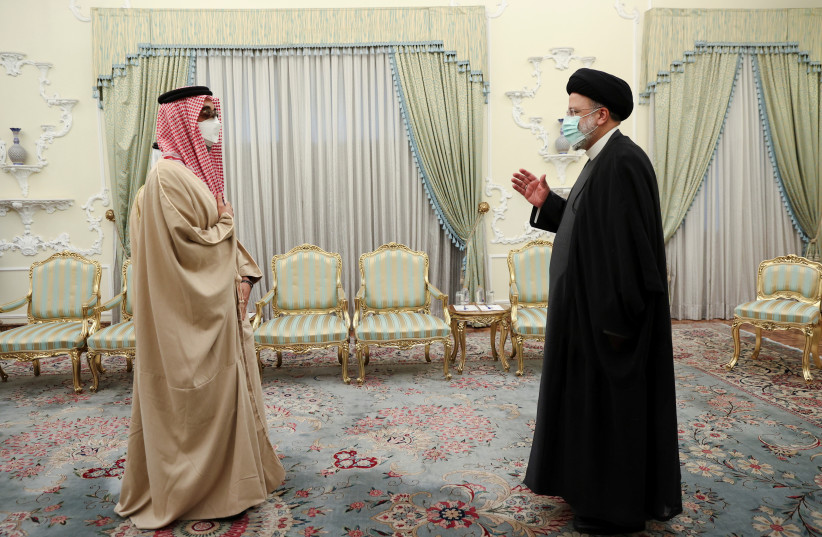
 Iran's President Ebrahim Raisi meets with UAE's top national security adviser Sheikh Tahnoon bin Zayed Al Nahyan in Tehran, Iran, December 6, 2021. (credit: MAJID ASGARIPOUR/WANA (WEST ASIA NEWS AGENCY) VIA REUTERS)Iran’s President Ebrahim Raisi meets with UAE’s top national security adviser Sheikh Tahnoon bin Zayed Al Nahyan in Tehran, Iran, December 6, 2021. (credit: MAJID ASGARIPOUR/WANA (WEST ASIA NEWS AGENCY) VIA REUTERS)

Iran also wants new jets and technology. Regarding Raisi’s visit to Moscow, the Iranian foreign ministry said that there are talks on further cooperation. “Iran-Russia relations are based on good neighborliness and are convergent and close, and these convergences have been translated into various actions and perspectives,” the ministry said. This includes Russia’s support for Iran at the Vienna talks. Russia has hinted at progress in those talks.
After China and Russia, both rising powers that are confronting the US, Iran is also courting Saudi Arabia with the fifth round of talks to heal ties with the Kingdom. Iraq has played a role in these talks. Riyadh enabled Iran’s ambassador to the Houthis in Yemen to be evacuated last month, for instance.
“The next round of talks with Saudi Arabia, hosted by Iraq, is on the agenda,” the ministry said. “ As soon as the information was finalized, I was shocked. On issues between us and Saudi Arabia, we tried to continue the talks, despite all the disputes in the mutual interest and the region, by distancing ourselves at points of disagreement on the basis of explicitness, and at the same time trying to establish stable relations between the two countries,” Iran’s Foreign Ministry spokesperson said.
Iran is also conducting talks with Turkey. According to the media, Iran is paying close attention to Ankara’s foreign minister Mevlut Cavusoglu’s comments on a “tripartite corridor.” Iran says the “region is tired of unhealthy competition and war and bloodshed, many of which are imposed by foreign interference…We welcomed bilateral and even trilateral and quadrilateral talks and tried to be one of their pillars. Ideas and initiatives are being explored, one of which is and is being pursued,” said Iranian Foreign Ministry Spokesman Saeed Khatibzadeh. Tasnim News says the new talks include a transit agreement with Iran, Turkey and the UAE. “What is forming a happy dynamism in this region,” the Iranian foreign ministry spokesperson said.
Iran is also conducting new dialogue with Turkmenistan and Venezuela, the ministry says. “Tehran is a place for diplomatic talks and delegations from Iran went to different countries and hosted various delegations and the visit of the President of Turkmenistan is on the agenda. The preliminary trip of their delegation has been done and will be done soon, and [Venezeula leader] Maduro’s trip is also on the agenda, and I will announce its date soon,” Khatibzadeh said.
In addition, Iran is closely watching the recent violence in Kazakhstan and calling for an inclusive government in Afghanistan. Iran does not want to see the persecution of Shi’ites in Afghanistan for instance. The foreign ministry says that it wants to see an Afghan government that should be such that it is stable and provides peace in Afghanistan in the future. “Iran will do its best to make Afghanistan’s future different from today, within the framework of good neighborly policy and kinship relations with the Afghan people.”
Meanwhile, Iran says that it is looking to make progress in talks with South Korea. South Korea sent a representative to the Vienna talks recently, according to the reports in Iran. Iran says South Korea should release frozen Iranian assets.
The context of the extensive Iranian diplomatic activity is that Iran has a lot on its agenda. It wants to increase ties with Russia and China, which it sees as rising powers that will replace the US. At the same time, it wants to repair ties with Saudi Arabia and work with the UAE and Turkey. It is also eyeing the Vienna talks and trips to Oman, to secure its finances, as well as looking to secure its borders by expanding influence into Iraq and Afghanistan.


White House national security adviser Sullivan says Tehran will ‘face severe consequences’ if it attacks those targeted by largely symbolic measure

By TOI STAFF and AGENCIES
Today, 8:22 pm

People carry portraits of late Iraqi commander Abu Mahdi al-Muhandis and Iranian commander Qasem Soleimani at Baghdad Airport, in Baghdad on January 2, 2021, at the site of their killing. (AHMAD AL-RUBAYE / AFP)


Iran announced sanctions against more than 50 American individuals over the killing two years ago of Tehran’s top general Qassem Soleimani, drawing a strong rebuke from Washington on Sunday.

The Islamic Republic’s foreign ministry said the 52 US nationals had been blacklisted for “their role in the terrorist crime by the United States against the martyred General Qassem Soleimani and his companions and the promotion of terrorism and violations of fundamental human rights.”

Many of those targeted are from the US military. They include Joint Chiefs of Staff Chairman General Mark Milley and former White House national security adviser Robert O’Brien.

The sanctions let Tehran confiscate assets owned by the American’s in Iran, but since they apparently do not have such assets, the move is largely symbolic.

Soleimani — the head of Iran’s Quds Force, the overseas arm of the Islamic Revolutionary Guard Corps — was killed in a US airstrike in Iraq in January 2020 ordered by then-president Donald Trump.

On Sunday, US National Security Adviser Jake Sullivan responded that “should Iran attack any of our nationals, including any of the 52 people named yesterday, it will face severe consequences.”

Sullivan noted in a statement that the sanctions came “as Iran’s proxy militias continue to attack American troops in the Middle East, and as Iranian officials threaten to carry out terror operations inside the United States and elsewhere around the world.”

“Make no mistake: the United States of America will protect and defend its citizens,” he added. “This includes those serving the United States now and those who formerly served.

“We will work with our allies and partners to deter and respond to any attacks carried out by Iran,” Sullivan said.

US national security adviser Jake Sullivan speaks during the daily briefing at the White House in Washington, December 7, 2021. (AP Photo/Susan Walsh)
A year ago, Iran imposed sanctions on Trump himself and other senior former US officials over Soleimani’s killing.

On Wednesday, Iran said it intended to prosecute 127 people for alleged involvement or cooperation with the assassination of Soleimani. According to Fars News, which is run by the Islamic Revolutionary Guard Corps, a judiciary spokesperson said the country sent 11 letters to nine countries, asking them to take measures against the alleged culprits.

The report did not provide details about who were among the 127 individuals.

Last Monday, as Tehran marked two years since the revered commander’s death, Iranian President Ebrahim Raisi vowed revenge against Trump unless the former US president is tried over the killing.

Raisi, addressing Tehran’s largest prayer hall, said: “The aggressor and the main assassin, the then president of the United States, must face justice and retribution” alongside former US secretary of state Mike Pompeo “and other criminals.”

Soleimani headed the Quds Force, the foreign operations arm of Iran’s Revolutionary Guards, with links to armed groups in Iraq, Lebanon, Gaza Strip, Syria and Yemen. The Quds force is designated by a number of countries as a terrorist organization, including the US and Israel.


Spokesman for the Revolutionary Guard Corps claims Israel has subdued rhetoric since Tehran held major exercises


This photo released Tuesday, Oct. 12, 2021, by the Iranian Army, shows a missile being fired during a military drill at an undisclosed location in Iran. (Iranian Army via AP)

This photo released Tuesday, Oct. 12, 2021, by the Iranian Army, shows a missile being fired during a military drill at an undisclosed location in Iran. (Iranian Army via AP)

The spokesman for the Islamic Revolutionary Guard Corps said Saturday that Iran’s recent show of force in military drills was acting as a deterrent for Israel’s “empty threats” against Tehran.

Brigadier General Ramezan Sharif claimed that Israel had subdued its rhetoric against Iran in the wake of military drills held by Tehran.

Most recently, Tehran held a five-day annual exercise last month which culminated in the firing of multiple ballistic missiles that generals said were a warning to Israel and included a mock strike on Israel’s nuclear facility.

“After the exercise, the Zionists’ prime minister officially ordered their military figures not to talk about Iran at all,” Sharif claimed in an interview with al-Alam news channel, cited by the Fars news agency.

Sharif said Iran assessed that Israel was interested in carrying out strikes against its nuclear program, but that the location of the sites would prevent it.

“Regardless of whether they act or not, our assessment is that [the threats] are rhetoric intended for political gains, especially to overcome their problems in their occupied lands, which makes them try to distract [the public] with an external issue,” Sharif said.

Iran’s Islamic Revolutionary Guard Corps spokesman Brigadier General Ramezan Sharif speaks on January 3, 2020 (Screen grab)

Israel has reportedly approved a budget of some NIS 5 billion ($1.5 billion) to be used to prepare the military for a potential strike against Iran’s nuclear program.

It includes funds for various types of aircraft, intelligence-gathering drones and unique armaments needed for such an attack, which would have to target heavily fortified underground sites.

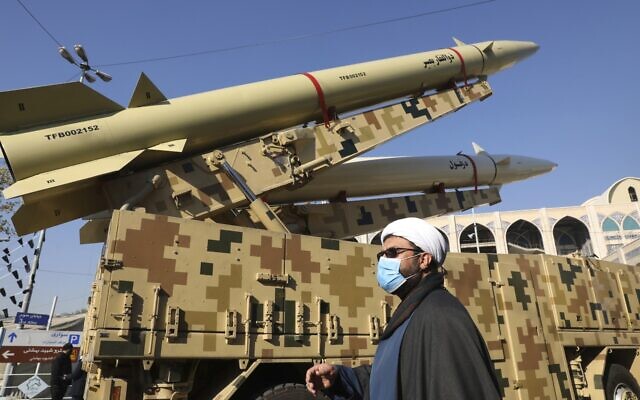
Sharif’s comments came a day after Iran displayed three ballistic missiles at an outdoor prayer esplanade in central Tehran.

The missiles — known as Dezful, Qiam and Zolfaghar — have official ranges of up to 1,000 kilometers (620 miles) and are already-known models, the Revolutionary Guard said.

A report by Iranian state television said the missiles on display were the same types as those used to strike US bases in Iraq.

A cleric walks past Zolfaghar, top, and Dezful missiles displayed by the paramilitary Revolutionary Guard, at Imam Khomeini grand mosque, in Tehran, Iran, Friday, Jan. 7, 2022 (AP Photo/Vahid Salemi)

The display came on the second anniversary of a ballistic missile attack on bases housing American troops in Iraq in retaliation for the US drone strike that killed top Iranian general Qassem Soleimani in Baghdad in 2020.

The missiles were displayed also as talks in Vienna aimed at reviving Iran’s nuclear deal with world powers, flounder.

Diplomats from countries that remain in the 2015 nuclear deal — Britain, France, Germany, Russia and China — are working with Tehran to revive the accord, which had sought to limit Iran’s nuclear ambitions in exchange for lifting economic sanctions.

American diplomats are present at the nuclear talks in Vienna but they are not in direct talks with Iranians. The accord collapsed in 2018 when then-president Donald Trump unilaterally withdrew the United States from the deal and re-imposed sanctions on Iran as Tehran began to publicly flout the terms of the agreement.

Posters of Iranian Gen. Qassem Soleimani, who was killed in Iraq in a US drone attack on Jan. 3, 2020, are seen in front of Qiam, background left, Zolfaghar, top right, and Dezful missiles displayed in a missile capabilities exhibition by the paramilitary Revolutionary Guard a day prior to second anniversary of Iran’s missile strike on U.S. bases in Iraq in retaliation for killing Gen. Soleimani, at Imam Khomeini grand mosque, in Tehran, Iran, Jan. 7, 2022 (AP Photo/Vahid Salemi)

Israel has long maintained its opposition to US plans to return to the terms of the original deal and has said it will not allow Iran to obtain nuclear weapons.

Prime Minister Naftali Bennett said last month that Israel is “without a doubt not a party to the deal in Vienna if it will happen.”

In response to recent public comments by Israel Defense Forces officials that Israel was ready to strike Iran at any moment, Bennett said: “I’m in favor of speaking little and doing a lot.”

Associated Press contributed to this report.