Iran prepares commemoration for Qasem Soleimani – analysis

As we approach 2022, the Iranian media is once again heralding Soleimani as a transformative figure who played a key role in the region.
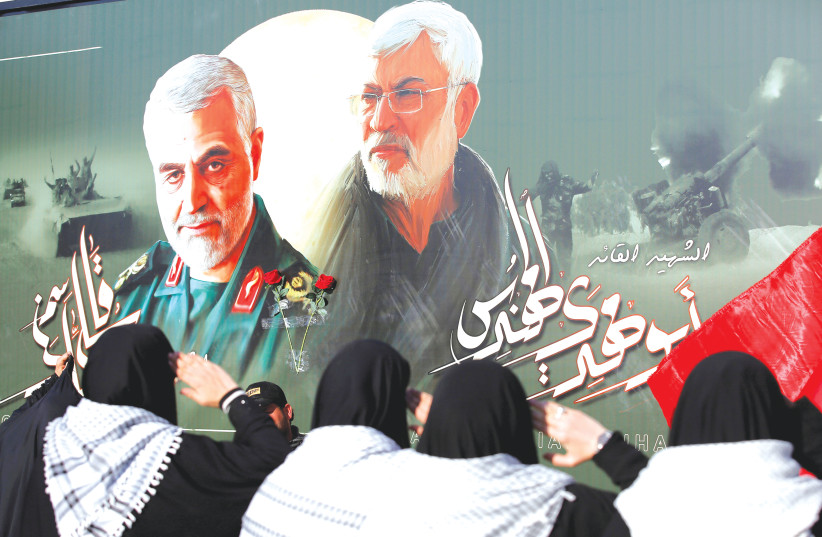
WOMEN GATHER at Baghdad Airport, where Iran’s Quds Force commander Qasem Soleimani and Iraqi militia commander Abu Mahdi al-Muhandis were killed in a US airstrike last year. (photo credit: WISSAM AL-OKAILI/REUTERS)
WOMEN GATHER at Baghdad Airport, where Iran’s Quds Force commander Qasem Soleimani and Iraqi militia commander Abu Mahdi al-Muhandis were killed in a US airstrike last year.
(photo credit: WISSAM AL-OKAILI/REUTERS)
It is almost two years since the US killed IRGC Quds Force commander Qasem Soleimani in a drone strike. Soleimani was leaving Baghdad international airport with Abu Mahdi al-Muhandis, a Shi’ite militia leader in Iraq. Together they were coordinating efforts against the US there. Since May 2019 they had been planning and executing rocket attacks on American forces in Iraq, as well as attacks on Saudi Arabia. Days before they were killed, tensions had risen dramatically and pro-Iranian forces in the country had tried to storm the US embassy.
Now, as we approach 2022, the Iranian media is once again heralding Soleimani as a transformative figure who played a key role in the region. Of interest is that the accounts of his life generally try to show how he played such a role in the battle against ISIS. If one of the narratives of Soleimani’s life is that he helped establish Iranian influence and militia roots across the region, empowering Iranian allies and proxies like Hezbollah, Iran has a slightly different story to tell.
A recent article in Iranian media praised Soleimani for his key role in 2014 helping to defend Samarra, a city north of Baghdad, from ISIS. He helped protect an important shrine even as areas around Samarra, such as Camp Speicher, had been overrun. The article portrays Soleimani’s bravery and willingness to go by himself into the most dangerous places and in the thick of battle to inspire fighters to stand fast against ISIS.
Other articles have portrayed his life in a similar manner. They emphasize that Soleimani, also known as Haj Qasim, was not merely a regional strategic asset for Iran, but was also a commander in the field since the 1980s. An article at Fars News notes how he played an increasing regional and global war in the last decades.
“He enters Afghanistan, Bosnia and Herzegovina, Iraq, Syria, Lebanon, etc.” Fars wrote. “In every field, he creates an epic. Haj Qasim made a statement about Bahrain. See how much people paid attention to this statement at that time. It is not common in the world for a military force [leader] to make a statement. But what did Haj Qasim do that friends and enemies in the world paid attention to this statement?

A HEZBOLLAH member holds a Lebanese flag in front of a picture depicting Iranian Gen. Qasem Soleimani and Iraqi militia commander Abu Mahdi al-Muhandis, in Khiam, Lebanon, last month. (credit: AZIZ TAHER/REUTERS)A HEZBOLLAH member holds a Lebanese flag in front of a picture depicting Iranian Gen. Qasem Soleimani and Iraqi militia commander Abu Mahdi al-Muhandis, in Khiam, Lebanon, last month. (credit: AZIZ TAHER/REUTERS)

“From this point on, the further we went, the more Haj Qasim grew,” the report said. “It seems that Haj Qasim’s foundation has reached a stage where he will be martyred at the height of his honor.”
Iran has sought to emphasize that Soleimani helped save Iraq from ISIS and that he played a key role in Syria, as well as helping Kurds fight ISIS in 2014. The conclusion of the articles about him is that his death has not damaged the Quds Force, but rather inspired it to new heights. Whether that is true is not clear. Iran has suffered a number of setbacks in key losses of personnel recently. Iran’s ambassador to the Houthis in Yemen, apparently a high-level IRGC officer as well, recently passed away.
The Islamic Republic’s remaining key figure in the region is Hassan Nasrallah. He also has problems trying to both control Lebanon and project Hezbollah influence. The terrorist group has been accused of greater involvement in Yemen, for instance. The question remains whether Iran’s role in the region has suffered a setback with the loss of Soleimani.
Clearly in terms of assets on the ground, Iran has a huge role from Lebanon all the way via Syria to Iraq and in Yemen. It also has a role in Gaza with Hamas. But Iran may be suffering from a bit of imperial overstretch, its economy is hungry for a reduction in sanctions and Iran has to decide if it wants to reduce its destabilizing activities and pivot to work with China, or if the Quds Force model is the only one it knows how to promote.


Syrian TV Reports Israeli Missile Attack on Latakia Port

Syrian television reported Tuesday morning that the Israeli Air Force had attacked the port of Latakia in western Syria, and the Syrian defense responded with anti-aircraft fire.


The videos that were released show explosions and fire in the location that was under attack. A Syrian TV reporter said there was a fire in several containers following the attack and extensive damage to buildings in the area. According to the report, the Syrian army opened anti-aircraft fire in response. Firefighters are working to put out the fire.

A Syrian army source said that “at 3:21 AM, the Israeli enemy carried out an airstrike using rockets from the depths of the Mediterranean Sea (west of the port of Latakia) on the container plaza in the commercial port of Latakia. As a result, fires broke out at the site and extensive damage was caused to property. The forces are still working to put out the fires and assess the results of the aggression.”


On December 7 it was also reported that Israel had carried out an attack on the same port (Syrian News Agency Practically Celebrates Israel’s Massive Attack on Iranian Weapons Shipment). Then, too, a fire broke out in the container area there following the attack.

The Syrian opposition claimed that the target of the attack was a weapons shipment intended for pro-Iranian militias. But Assad’s media insists that the attack hit innocent commercial containers.

Back on Dec. 7, it was estimated that the targets of the attack were advanced weapons smuggled from Iran by sea, either cruise missiles or suicide drones.

