Israeli and Arab officials urge Trump to delay major strikes on Iran despite intense protests and rising casualties, according to NBC News.
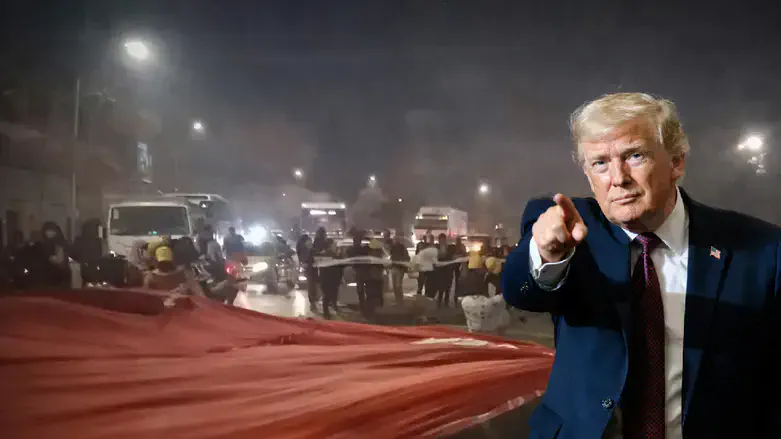
Trump with Iran protests in the backgroundWhite House Photo by Daniel Torok, Reuters
Israeli and Arab officials have privately cautioned the Trump administration in recent days that Iran’s regime may not yet be weakened enough for US military strikes to deliver a decisive blow, NBC News reported Tuesday.
The report cited a US official, a former US official briefed on the talks, a source familiar with Israeli leadership thinking, and two Arab officials.
These officials have advised President Donald Trump – who is weighing military action in response to Tehran’s deadly crackdown on protesters – to hold off on large‑scale strikes for now. Some prefer waiting until the regime is further strained, noting that Iran’s internal stability is shifting rapidly and could change dramatically in either direction.
The discussions, involving senior American political and military leaders, highlight the complex considerations Trump faces as he evaluates possible US responses. The President, who was expected to meet on Tuesday with his national security team, has warned that Iran will face US military action if the regime is killing protesters.
One Arab official said there is a “lack of enthusiasm from the neighborhood” for US strikes at this moment. Another warned that “any attack or escalation by Israel or the US will unite Iranians,” noting the rally‑around‑the‑flag effect after the American and Israeli attack in June.
Israeli officials have told the administration that while they fully support regime change in Iran, they fear outside military intervention now may not finish the job protesters have begun. They have suggested alternative US actions to further weaken the regime and bolster demonstrators before considering larger strikes.
Possible steps include improving communications access for Iranians to bypass the regime’s internet blackout, increasing economic sanctions, launching a cyberattack, or carrying out highly targeted military action against specific Iranian leaders, the sources said.
A spokesperson for the Israeli Embassy in Washington declined to comment.
A White House official said in a statement that “All options are at President Trump’s disposal to address the situation in Iran. The president listens to a host of opinions on any given issue, but ultimately makes the decision he feels is best.”
The official added that Trump “means what he says,” citing military action he ordered against Iran in June and the recent operation to capture Venezuela’s leader.
On Monday night, two Defense Department officials who spoke to CBS News stated that Trump has been briefed on a broad set of military and covert capabilities that could be used against Iran, extending far beyond conventional airstrikes.
Several sources familiar with the matter said the President’s national security team will meet at the White House today to review updated Iran options. It remains unclear whether the President will attend the meeting.
A separate report in the New York Times, citing a senior US source, said that the Pentagon presented Trump with a wide range of options for a strike in Iran, including the possibility of attacking parts of its nuclear program.
The source qualified the statement by noting that the more likely options at this stage are pinpointed, such as a cyberattack or a strike against Iran’s internal security apparatus.
Trump on Tuesday warned in an interview with CBS News that the United States is prepared to “take very strong action” if Iran begins hanging anti-government protesters.
Speaking to reporters later, following his visit to Detroit, Trump said, “I’m going back to the White House now, we’re going to look at the whole situation that’s going on in Iran… We’ll get some accurate numbers as to what’s happening with regard to the killing.”