
Turkey, Russia and Iran have coordinated on Syria increasingly since 2017.

RUSSIAN PRESIDENT Vladimir Putin meets with Turkey’s President Recep Tayyip Erdogan. (photo credit: REUTERS)
RUSSIAN PRESIDENT Vladimir Putin meets with Turkey’s President Recep Tayyip Erdogan.
(photo credit: REUTERS)
Turkey and Russia are meeting in Kazakhstan under the banner of the Astana talks that go back five years, hoping to continue their collaboration on Syria issues.
Turkey, Russia and Iran have coordinated on Syria increasingly since 2017. That was part of a process that took place in the wake of Syrian rebels losing Aleppo and Ankara, deciding it needed to take control of the Syrian rebels to use them to fight the US-backed Syrian Democratic Forces. Toward that end, Turkey sought to work with Iran and Russia to coordinate on Syria and to remove the US from the war-torn country.
During the Trump era, the US ignored Turkey’s invasion of Afrin in Syria and the ethnic cleansing of 160,000 Kurds. The US under former president Donald Trump, who used to speak to Turkish President Recep Tayyip Erdogan often, abandoned its SDF partners and enabled a Turkish invasion in October 2019. The ensuing chaos empowered Russia, Iran and Turkey.
According to Ankara-based media, “Delegations from Turkey, Russia and Iran have met in Kazakhstan’s capital, Nur-Sultan, for the 17th meeting of the Astana process that aims to find a solution to the decade-long crisis in Syria.” There were scant details on what each side hopes to achieve from this meeting.
Turkey is sending its Foreign Ministry’s director-general for Syria, Selcuk Unal, Russia is sending special envoy to Syria Alexander Lavrentiev, and Iran is represented by Ali Asghar Khaji. Syrian opposition members are backed by Turkey and are also represented. The US, which backs the SDF and helps control part of eastern Syria, is not represented.
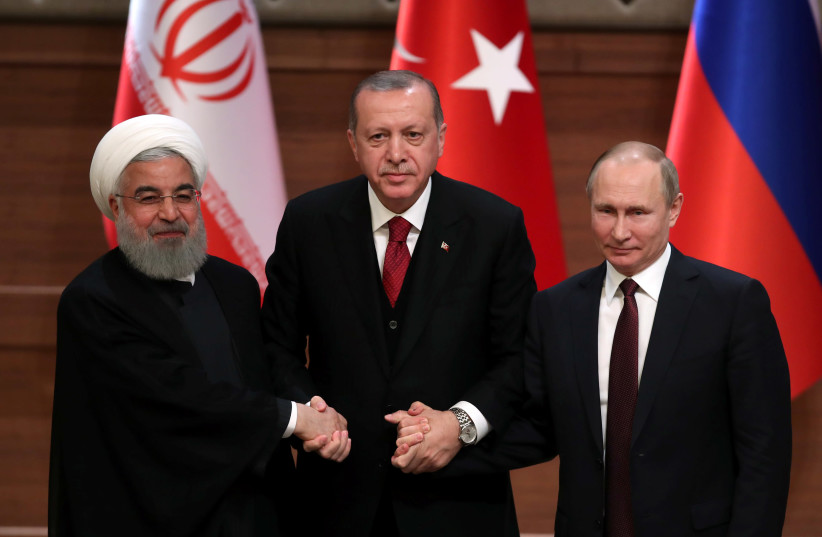
Presidents Hassan Rouhani of Iran, Tayyip Erdogan of Turkey and Vladimir Putin of Russia hold a joint news conference after their meeting in Ankara, Turkey April 4, 2018 (credit: UMIT BEKTAS / REUTERS)Presidents Hassan Rouhani of Iran, Tayyip Erdogan of Turkey and Vladimir Putin of Russia hold a joint news conference after their meeting in Ankara, Turkey April 4, 2018 (credit: UMIT BEKTAS / REUTERS)

Washington has generally sidelined its own SDF partners in Geneva and other forums, making sure that no one who works with the US gets any say in the future of Syria. This odd stance has resulted in the Kurdish Region – and other minorities who ended up living under the US-backed areas of Syria – having no say.
They only get a say if they work with the Syrian regime. But when they work with the regime, US-based think tanks then accuse them of collaborating with the regime and not being trustworthy. This is the Catch-22 of America’s Syria policy. People in eastern Syria are excluded by Turkey, Iran and Russia, but also by America.
“Khawla Mattar, deputy special representative of the United Nations to Syria, is also attending the talks, while Iraq, Jordan and Lebanon are participating as observers,” Turkey’s Daily Sabah reported.
“The talks are scheduled to take place for two days and will address several issues, including the current situation, the transfer of humanitarian aid, the launching of the Syrian constitutional committee’s works in Geneva, the exchange of prisoners, the release of hostages and further confidence-building measures,” the report said.
Russia says it wants a ceasefire, although it is unclear what that would entail. Turkish-backed extremists near Tel Tamr continue to shell Kurdish and Christian areas. Areas controlled by Turkey are generally ethnically cleansed of all minorities, such as Kurds, Christians and Yazidis.
Ankara also works with extremist groups that operate from its areas. When the US killed the leader of ISIS in 2019, he was found to be living near the Turkish border. Victims of ISIS were often trafficked to Turkey, and many extremists have transited the country over the years after wreaking havoc in eastern Syria.
It is unclear now if Turkey, Iran and Russia can come to some agreement to preserve the status quo in Syria, or if more operations by Turkey or the Syrian regime will take place. Russia has reportedly said, “We will give priority to this issue in our meetings with both our Turkish and Iranian partners.” There is talk of a “constitutional committee” relating to Syria as well.
It appears that, as usual, those groups working with America will be excluded, while Washington has not promised them that the US backs them having a future in Syria.
The US administration’s previous envoy to Syria said America’s role with the SDF was temporary, transactional and tactical. That doesn’t give much hope to Syrians in the eastern parts of the country.


Iran Pledges ‘Crushing’ Response Against Any Israeli Attack

by Reuters and Algemeiner Staff

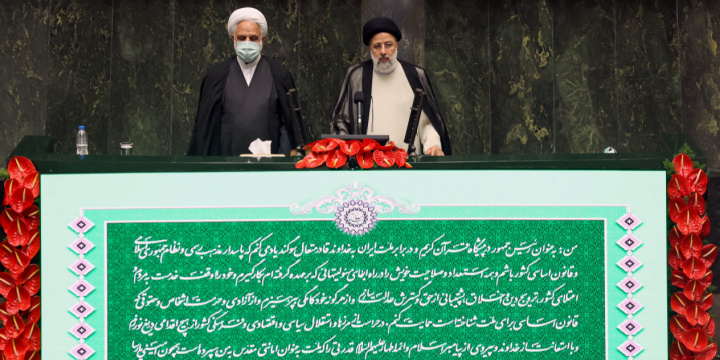
Iran’s new President Ebrahim Raisi takes the oath during his swearing-in ceremony at the parliament in Tehran, Iran, August 5, 2021. Majid Asgaripour/WANA (West Asia News Agency)/ via REUTERS

Iran will retaliate with a “crushing” response against any Israeli attack, a commander said according to an Iranian news agency linked to the country’s top security body.

“If Israel carries out attacks against Iran, our armed forces will immediately attack all centers, bases, routes, and spaces used to carry out the aggression,” Gholamali Rashid said during a military maneuver which started on Sunday, Nournews added.


Major General Rashid, chief of central command, says any Israeli attack will be met with a ‘crushing’ response


Iranian Air Force personnel work on air defense missiles during an exercise, in Iran, Oct. 21, 2021. (Iranian Army via AP)

Iranian Air Force personnel work on air defense missiles during an exercise, in Iran, Oct. 21, 2021. (Iranian Army via AP)

A senior Iranian commander said Monday that Israel does not have the ability to strike Iran’s nuclear or military bases without US approval and boasted that any Israeli aggression will be met with a powerful response that can accurately target the infrastructure used for the attack.

Gholamali Rashid, chief of the Iranian armed forces central command headquarters, made the remarks as Iran began a large military exercise.

Rashid asserted that Israel is not able to follow through on any threat to Iran’s nuclear and military facilities without “the green light and support of the United States,” local media reported.

He said that should any such threat by Israel be acted upon, the response would be “a crushing attack on all bases, centers, paths and space used to carry out the aggression without delay,” the semi-official Mehr news agency quoted Rashid as saying.

Israel has said it will not allow Iran to obtain nuclear weapons and that it reserves the right to act alone, without the support of other nations, against what it sees as an existential threat. Earlier this month, Defense Minister Benny Gantz said he notified US officials that he had instructed the Israel Defense Forces to prepare for a strike against Iran.

A senior US official also said that Israeli and American military leaders are set to discuss possible military drills to practice destroying Iranian nuclear facilities in a potential worst-case scenario if nuclear talks fail.

Iran’s paramilitary Revolutionary Guard staged the major military exercise across the country’s south amid heightened tensions over Tehran’s nuclear program, state TV reported.

The Guard’s aerospace division, ground troops and naval forces joined in the five-day drill, the report said, with maritime forces set to maneuver in the strategic Strait of Hormuz, the narrow gateway for 20% of the world’s traded oil.

Earlier Monday, an unnamed Iranian official warned Israel against any “acts of mischief” while talks continue in Vienna to save Iran’s 2015 nuclear deal with world powers, the Mehr news reported.

The official said that should Israel take steps to pressure Iran into giving in to Western nations’ demands at the negotiating table, the result would be counterproductive, impacting relations with the US and having a “negative and deterrent effect on Iran’s cooperation with the International Atomic Energy Agency.”

The European-sponsored talks aim to rescue the so-called Joint Comprehensive Plan of Action, which has unraveled since the US pulled out. The Islamic Republic publicly stepped up its nuclear projects after the US withdrawal from the deal in 2018, under then-president Donald Trump.

Western powers have reported some progress in the talks, though European diplomats warned at the end of last week that they were “rapidly reaching the end of the road.”

In a blow to European mediators, Iran requested a new pause in the talks in Vienna. The talks had just resumed in late November after a five-month break following the election of a new hardline government in Iran.

Underlying Western concerns are fears that Iran will soon have made enough progress that the accord — under which it was promised economic relief in return for drastic curbs on its nuclear work — will be obsolete.

Israel has reportedly approved a budget of some NIS 5 billion ($1.5 billion) to be used to prepare the military for a potential strike against Iran’s nuclear program. It includes funds for various types of aircraft, intelligence-gathering drones and unique armaments needed for such an attack, which would have to target heavily fortified underground sites.