C

Weren’t Latakia and the Russian military somehow connected? Was this attack much more dangerous than at first appeared? Was Israel sailing too close to the wind?

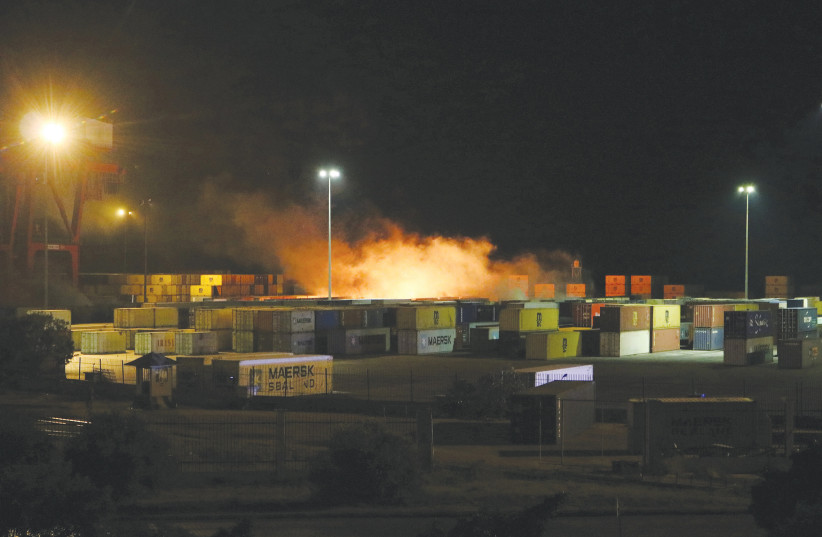
Smoke rises from a fire in a container storage area, after Syrian state media reported an Israeli air strike on the port of Latakia on December 7. (photo credit: SANA/REUTERS)
Smoke rises from a fire in a container storage area, after Syrian state media reported an Israeli air strike on the port of Latakia on December 7.
(photo credit: SANA/REUTERS)
When the news broke on December 7 that the Syrian port of Latakia had been bombed, and that an Israeli military spokesperson had declined to comment, a natural first reaction was that this airstrike was the latest of hundreds over the past few years targeting Syrian government facilities in receipt of Iranian-supplied military hardware. Although Latakia port is a vital gateway into Syria for goods of all kinds, it had not featured as the main reception point for Iranian weaponry, and had not been attacked in the past. Perhaps intelligence had revealed suspect cargo arriving from Iran.
Then warning lights began flashing in the media. Weren’t Latakia and the Russian military somehow connected? Was this attack much more dangerous than at first appeared? Was Israel sailing too close to the wind?
The key to the delicate situation lies in the Russian military presence in Syria. Close Russo-Syrian relationships go back a long way – as far back as July 1944, two years before the French finally withdrew and Syria was an independent state. Soviet support sustained the new nation in its early years, and in 1971 Syria’s then-president Hafez Assad granted the USSR permission to open a naval military base in the port city of Tartus, giving it a presence in the Mediterranean and easy access to the Suez Canal.
To bolster their close connection, Syria and the Soviet Union signed a Treaty of Friendship and Cooperation in 1980. With the Russian Federation recognized by Syria as the legal successor to the Soviet Union, that treaty remains in operation to this day.
This intimate relationship, secured by a pact, played an important part in the decision by Russian President Vladimir Putin to back Syria’s Bashar Assad from the start of the Syrian civil war, and later in Russia’s military intervention in 2015 in support of Assad against the groups seeking a democratic future for their country. It also explains how Putin was able to consolidate, and later extend, his military presence in Syria.

 A Sukhoi Su-24 fighter jet takes off from the Hmeymim air base near Latakia, Syria, in this handout photograph released by Russia's Defence Ministry on October 22, 2015.  (credit: MINISTRY OF DEFENCE/HANDOUT VIA REUTERS)A Sukhoi Su-24 fighter jet takes off from the Hmeymim air base near Latakia, Syria, in this handout photograph released by Russia’s Defence Ministry on October 22, 2015. (credit: MINISTRY OF DEFENCE/HANDOUT VIA REUTERS)

When Putin intervened in the fighting, Russian air cover was located in the airbase at Khmeimim, which is situated in Latakia province, about 15 miles southeast of Latakia city. During a surprise visit to Khmeimim in December 2017, Putin announced that he had signed a new 49-year deal with the Syrian government. Russia’s air base at Khmeimim, together with its naval facility in Tartus, was to be expanded and could henceforth be used “on a permanent basis.”
A glance at the map of Syria’s Mediterranean coastline shows Latakia, Khmeimim and Tartus running north-south down a 52-mile stretch of coast road. In short, Russia’s vital naval and air bases in Syria are literally within striking distance of Latakia port, hit by airstrikes in the early hours of December 7.
Although Israel rarely acknowledges or discusses such operations, it is generally accepted that Israel has staged hundreds of strikes on targets inside government-controlled Syria over the years. What Israel does say is that its strikes on Iran-provided facilities and weapons inside Syria are justified to protect its citizens on the country’s northern borders, and that it attacks arms shipments it believes are bound for Syrian government forces, Hezbollah or Iranian-backed militias. Israel rarely launches strikes close to the permanent Russian military and naval bases in government-controlled Syria.
The situation may appear alarming, with the potential to spiral out of control, but there is in fact a system in place aimed at avoiding any accidental clashes between Israel and Russia in Syria.
In September 2015, then-prime minister Benjamin Netanyahu visited Putin in Moscow. Briefing Israeli reporters after the meeting, Netanyahu said he had come with the aim of preventing misunderstandings between IDF and Russian forces in Syria, and that he and Putin had “agreed on a mechanism to prevent such misunderstandings.” They had decided that to avoid accidentally trading fire in Syria, their military activity would be coordinated.
That understanding was confirmed as recently as October, when Prime Minister Naftali Bennett met Putin in Sochi. They agreed that the two nations would continue to implement the so-called “deconfliction mechanism” that prevents Israeli and Russian forces from clashing in Syria. Housing Minister Ze’ev Elkin, who accompanied Bennett, confirmed that the “very wide” talks regarding the situation in Syria were focused on “safeguarding the coordination mechanism.”
The media reported that Putin agreed to Israel maintaining its freedom of action in Syria, but had asked for additional advanced warning of strikes.
There is little doubt, therefore, that if Israel had intended to bomb Latakia port on December 7, Russian military intelligence would have been informed well in advance, and that their nearby airbase at Khmeimim would have been in no danger. A safeguard system is up and running, but the potential for disaster lies just a human error away – as, for example, in 2018, when a Syrian air defense gunner, aiming for Israeli jets on a bombing run, downed a Russian military plane instead, killing all 15 people on board.
Until Syria can be stabilized and disconnected from Iran’s baleful involvement, avoiding a potentially disastrous military clash between Russia and Israel is dependent on the current precarious arrangements. The main consolation is that they have not failed, so far.
The writer is Middle East correspondent for Eurasia Review. His latest book is: Trump and the Holy Land: 2016-2020. Follow him at: www.a-mid-east-journal.blogspot.com.

oul

Could Israeli strike against Syria harm relations with Russia? – comment

d Israeli strike against Syria harm relations with Russia? – comment


Support growing for an Israeli strike on Iran

Support growing for an Israeli strike on Iran

Israeli leaders are again threatening to target the Iranian regime’s nuclear installations as they did in 2013 without making good on the warning. However, the geopolitical and sociopolitical situations are different this time, and Israel’s ultimatum must be taken seriously.

Two years before the Joint Comprehensive Plan of Action was reached in 2015, the Israeli government said that it would strike Iran’s nuclear facility. At the time, Benjamin Netanyahu, then prime minister, warned: “Our clocks are ticking at a different pace. We’re closer than the US. We’re more vulnerable. And therefore, we’ll have to address this question of how to stop Iran, perhaps before the US does. If sanctions don’t work, they have to know that you’ll be prepared to take military action —  that’s the only thing that will get their attention.”

But Israel did not attack. Some scholars, politicians and policy analysts may argue that since Israel failed to follow up its threats against Iran’s nuclear installations in the past, its current statements are merely rhetoric. However, several factors suggest Israel may, indeed, strike this time.

First, in order to take military action, Israel needs public support. Before the nuclear deal was reached in 2015, most Israelis opposed the government striking Iran’s nuclear sites alone. But according to a recent report by Israel Democracy Institute, a majority of Jewish Israelis, 58 percent, would now support an attack.

What is more intriguing is that most would support a strike even without the approval of Israel’s staunch ally the US. In a 2018 poll, only 10 percent of Israelis agreed with a “military assault on Iran’s nuclear facilities without coordinating with the US,” while almost 50 percent were in favor of a “military assault on Iran’s nuclear facilities in coordination with the US” if Iran renewed its nuclear activities.

In addition, an overwhelming majority believe that the Iranian regime represents an existential threat to a “large” or “very large” extent.

Second, public opinion in Iran has also shifted. Before 2015, there was a fear that an external Israeli attack on Iran would rally the Iranian people behind their government in the bid for nuclear enrichment. At the time Hassan Rouhani, the then president, enjoyed some popularity in Iran as he portrayed himself as a moderate seeking to improve the economy, promote human rights and normalize relationships with the West.

Public opinion in Iran has significantly shifted against the theocratic establishment, as seen in the latest protests.

Dr. Majid Rafizadeh 

There was also concern that an Israeli attack would also give the hard-liners a reason to quickly reach the nuclear threshold, and the Islamic Republic would likely decline to cooperate with the international community as well as pull out of the non-proliferation treaty. As a result, at the time, the unintended repercussions and negative consequences of an Israeli attack outweighed the benefits that the strikes might bring in delaying Iran’s nuclear program.

However, public opinion in Iran has significantly shifted against the theocratic establishment, as seen in the latest protests. Chants such as “Reformists, hard-liners, the game is now over” have become popular. In addition, Tehran is already violating all the restrictions and advancing its nuclear program at a rapid pace.

Third, Israel probably chose not follow up with its threats between 2013-2015 because some politicians were cautiously willing to give the Washington administration a chance to try diplomacy in the hope that the Iranian regime would halt its nuclear program and alter its destructive behavior in the region. Furthermore, former US President Barack Obama promised that he was “confident” the deal would “meet the national security needs of the US and our allies.”

But now Israel is less likely to trust any nuclear deal reached with the Islamic Republic because it has already seen its disastrous consequences. After the agreement was sealed in 2015, not only Israel but also other regional powers came to witness its negative impact first-hand. As sanctions against Iran were lifted, it quickly became clear that the treaty gave the Iranian regime global legitimacy.

This newfound legitimacy and the lifting of sanctions generated billions of dollars in revenue for Iran’s military institution, the Islamic Revolutionary Guard Corps, as well as for its proxy militia and terror groups. Tehran used this money to expand its influence throughout the region, including in Syria, Iraq, Yemen and Lebanon. Its expansionist campaign has proved to be immensely successful.

Israel, as well as Gulf Arab states, recognized that the threat Tehran poses was never adequately thwarted by the JCPOA. The region saw increased Houthi rocket launches at civilian targets in Saudi Arabia, the deployment of thousands of Hezbollah foot soldiers in Syria, and the near-constant bombardment of southern Israel by Iranian-funded Hamas rockets.

In summary, due to the latest geopolitical developments, as well as the shift in public opinion regarding the Iranian regime, Israel this time may well carry out its threats to strike Iran’s nuclear facilities.

  • Dr. Majid Rafizadeh is a Harvard-educated Iranian-American political scientist. He is a leading expert on Iran and US foreign policy, a businessman and president of the International American Council. He serves on the boards of the Harvard International Review, the Harvard International Relations Council and the US-Middle East Chamber for Commerce and Business. Twitter: @Dr_Rafizadeh
Disclaimer: Views expressed by writers in this section are their own and do not necessarily reflect Arab News’ point-of-view


One killed, two injured in Samaria terror attack

After the attack, security forces began searching for the gunmen who shot at the victims.

By World Israel News staff

One Israeli was killed and two were critically injured after they were shot at by terrorists Samaria on Thursday.

The victims were shot at while in their car, near the settlement of Shavei Shomron and Homesh, west of Nablus, the IDF said.

Yehuda Dimentman, 25, received a bullet to the head, critically injuring him. He was transferred to the Rabin Medical Center-Beilinson Campus in Petah Tikva, where he later passed away.

The other two travelers were lightly injured and taken to Meir Medical Center in Kfar Saba.

The three were leaving Homesh, a site home to a yeshiva despite the settlement having been abandoned in a 2005 eviction, Israeli media reported.

Following the attack, the IDF closed off the entrance to Nablus and set up checkpoints in the surrounding areas.

Dimentman was married, and father to a young child. He was also a resident of Shavei Shomron and a student at the Homesh yeshiva.

“Together with all the people of Israel, I send heartfelt condolences to the family of the victim killed tonight in Samaria,” Prime Minister Naftali Bennett tweeted.

He wished the two injured a speedy recovery and added that “Security forces will soon find and arrest the terrorists.”

Meanwhile, Public Security Minister Omer Bar Lev tweeted shortly after the attack that “Palestinian terror is once again rearing its ugly head.”

Hamas reportedly praised the attack.