
Experts suggest shekel coin may have been made by priests assisting Great Revolt against Romans, using precious metal from holy site’s plentiful reserves


  • The silver coin engraved with a cup and the caption "Israel Shekel" and the letters: Shin and Bet (the second year of the Great Revolt) (Eliyahu Yanai/City of David)
    The silver coin engraved with a cup and the caption “Israel Shekel” and the letters: Shin and Bet (the second year of the Great Revolt) (Eliyahu Yanai/City of David)
  • The silver coin with an engraving of the headquarters of the High Priest and the inscription 'Holy Jerusalem' (Yaniv Berman/City of David and the Israel Antiquities Authority)
    The silver coin with an engraving of the headquarters of the High Priest and the inscription ‘Holy Jerusalem’ (Yaniv Berman/City of David and the Israel Antiquities Authority)
  • Liel Krutokop, with the rare silver coin she found (Yaniv Berman/City of David and the Israel Antiquities Authority)
    Liel Krutokop, with the rare silver coin she found (Yaniv Berman/City of David and the Israel Antiquities Authority)
  • The rare silver coin (Yaniv Berman/City of David and the Israel Antiquities Authority)
    The rare silver coin (Yaniv Berman/City of David and the Israel Antiquities Authority)
  • The silver coin next to a charred coin that was burned in the destruction of Jerusalem (Yaniv Berman/City of David and the Israel Antiquities Authority)
    The silver coin next to a charred coin that was burned in the destruction of Jerusalem (Yaniv Berman/City of David and the Israel Antiquities Authority)
  • Dr. Robert Kool holds the rare silver coin (Yaniv Berman/City of David and the Israel Antiquities Authority)
    Dr. Robert Kool holds the rare silver coin (Yaniv Berman/City of David and the Israel Antiquities Authority)

A rare 2,000-year-old silver shekel coin, thought to have been minted on the Temple Mount plaza from the plentiful silver reserves held there at the time, has been uncovered in Jerusalem.

If it were indeed minted there, it would make the coin one of the very few items uncovered that were manufactured at the holy site.

The coin, found by an 11-year-old girl, Liel Krutokop, during a sifting project for dirt removed from an archaeological dig at the City of David National Park, was engraved with “second year,” i.e., the second year of the Great Jewish Revolt against the Romans (67-68 CE).

Dr. Robert Kool, head of the Coin Department at the Israel Antiquities Authority, suggested that the coin may have been minted at the plaza of the holy site by one of the priests who worked in coordination with the rebel leaders, providing them with assistance.

“Where else could you find silver in such quantity and such high quality in those days? Only in the Temple. If so, we can say with caution that this coin is, apparently, one of the only items we hold today that originated on the Temple [Mount] itself,” Kool said.

“This is a rare find, since out of many thousands of coins discovered to date in archeological excavations, only about 30 coins are made of silver, from the period of the Great Revolt,” said Kool.

Dr. Robert Kool holds the rare silver coin (Yaniv Berman/City of David and the Israel Antiquities Authority)

“Everyone knows the Arch of Titus in Rome and the descriptions of loot taken from the Temple that appear on it, but not many are familiar with the huge silver reserves that were in the Temple. You can learn about the huge silver reserves that were in the Temple from the ancient inscription uncovered by the researcher Géza Alföldy,” he said.

Kool was referring to a reconstructed inscription at the Colosseum in Rome, which explained that the amphitheater was built using spoils looted from the Temple.

The inscription at the site in Italy reads: “Emperor Vespasian [who, along with his son Titus, suppressed the Jewish Revolt and destroyed the Temple] ordered the construction of this new theater amphitheater [the Colosseum] from his share of the spoils.”

“One can only imagine the extent of the loot and the amount of money the Romans found in the Temple storehouses,” said Dr. Amit Reem, the IAA’s Jerusalem district archaeologist.

The silver coin engraved with a cup and the caption ‘Israel Shekel’ and the letters: Shin and Bet (the second year of the Great Revolt) (Eliyahu Yanai/City of David)

The IAA said in a statement that the coin would have been used for trade in Jerusalem during the period of the Second Temple.

“This street [where the coin was excavated], which connected the Siloam Pool in the south of the City of David to the Temple Mount in the north, was Jerusalem’s main street during the Second Temple period, where thousands of pilgrims marched on their way to the Temple,” Kool said. “There is no doubt that there would have been extensive trading here. This is evidenced by the many weights and bronze coins we have found here. But to find a rebel coin made of pure silver is definitely very special and exciting.”

The coin weighs approximately 14 grams (0.4 ounces) and has an engraving of an image of a cup on one side, with the caption “Israeli shekel” and the Hebrew letters Shin and Bet, shorthand for “second year,” i.e., the second year of the Great Revolt against the Romans (67-68 CE).

The other side of the coin has an inscription that the IAA said was an engraving of the headquarters of the high priest, as well as the words “Holy Jerusalem” in ancient Hebrew script.

The silver coin with an engraving of the headquarters of the High Priest and the inscription ‘Holy Jerusalem’ (Yaniv Berman/City of David and the Israel Antiquities Authority)

Kool said currency is used during rebellions as symbol of independence, and suggested the choice of ancient Hebrew script for the engraving showed a longing for a Jewish kingdom.

“A currency is a sign of sovereignty. If you go into rebellion, you use one of the most obvious symbols of independence, and you mint coins. The inscription on the coin clearly expresses the rebels’ aspirations,” he said.

“The choice to use ancient Hebrew script, which was no longer in use at the time, is not accidental,” Kool said. “The use of this script came to express the longing of the people of the period for the days of David and Solomon and the days of a united Jewish kingdom — days when the people of Israel had full independence in the land.”

Dozens of planes to participate in the drill, which is due to take place over the Mediterranean, according to Kan broadcaster

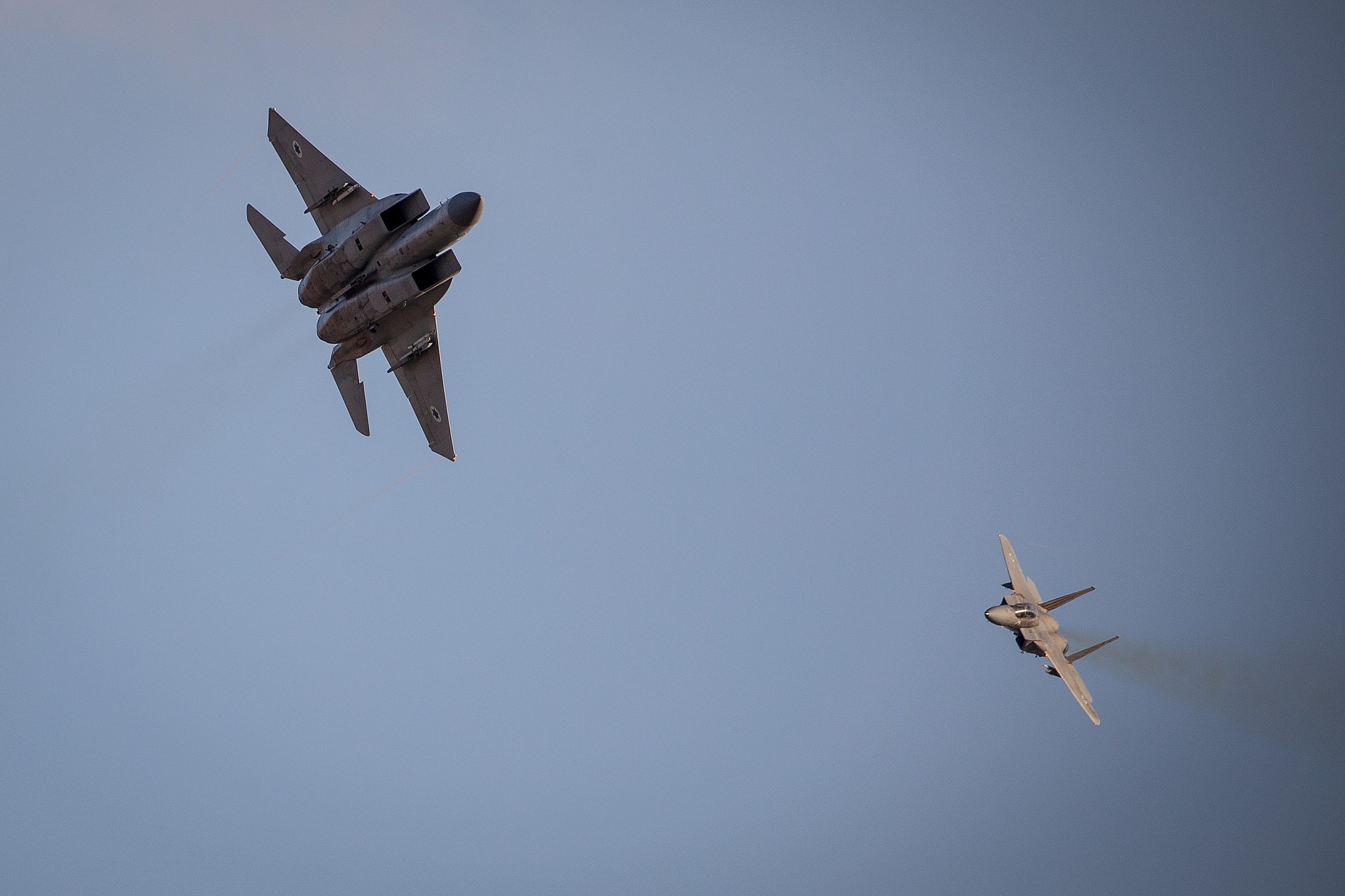
Israeli fighter jets performing an aerial show at a graduation ceremony at the Hatzerim Air Base in the Negev desert, December 26, 2018. (Aharon Krohn/ Flash90/ File)

Israeli fighter jets performing an aerial show at a graduation ceremony at the Hatzerim Air Base in the Negev desert, December 26, 2018. (Aharon Krohn/ Flash90/ File)

The Israel Defense Forces will hold a large-scale exercise over the Mediterranean in the spring with dozens of aircraft simulating a strike against Iran’s nuclear program, according to a report Wednesday.

The unsourced report from the Kan broadcaster came as Israeli officials have stepped up their rhetoric against the Islamic Republic, including threatening to take unilateral action against Tehran.

According to the Kan report, the drill will be one of the largest ever held by the Israeli Air Force and will include dozens of aircraft, including the F-15, F-35, and F-16 fighters, Gulfstream G550 spy planes, and refueling jets.

The planes will conduct the exercise far out over the Mediterranean Sea to simulate the distance — over 1,000 kilometers (620 miles) — that the aircraft would need to travel in a strike against Iran’s nuclear facilities.

This would not be the first time that the IAF has conducted exercises at these distances. Earlier this year, Israeli jets took part in a Greek-led exercise over the Mediterranean Sea.

The exercise is scheduled to be held in roughly six months, according to Kan.

The IDF did not immediately comment on the report.

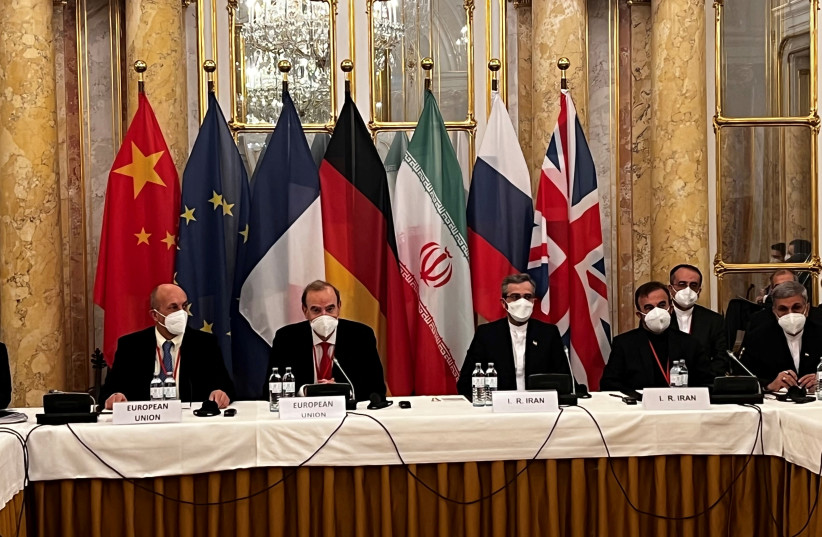
Talks between Iran and world powers over curbing Tehran’s nuclear program resumed last week after an extended freeze. Though Israeli politicians have said they would support a significantly bolstered pact, they have also stressed the need for a credible military threat against Iran as a “Plan B.”

In January, army chief Aviv Kohavi announced that he was instructing the military to draw up fresh plans for a strike against Iran’s nuclear program. The IDF received billions of shekels of additional funding to prepare for such an attack as part of the recently passed national budget.

Last month, Kohavi told the Knesset’s Foreign Affairs and Defense Committee that the army “is accelerating operational planning and preparedness to deal with Iran and the military nuclear threat.”

Though Israeli officials have stressed that Israel could carry out a strike without coordinating with the United States, some analysts have cast doubts on the IDF’s ability to do so, as several Iranian facilities are buried deep enough underground that it would require particularly powerful munitions, which currently only the US possesses.

Reports in recent weeks have indicated that the army is unprepared for dealing with Iran and months or more away from an actionable plan.


Russian FM headed to Israel after Latakia strike

Russian Foreign Minister Sergei Lavrov is expected to visit Israel on Sunday.

Israeli Foreign Minister Yair Lapid in a meeting with Russian Foreign Minister Sergey Lavrov (photo credit: Kobi Amsalem/GPO)
Israeli Foreign Minister Yair Lapid in a meeting with Russian Foreign Minister Sergey Lavrov
(photo credit: Kobi Amsalem/GPO)
Russian Foreign Minister Sergei Lavrov is expected to visit Israel on Sunday for meetings with Prime Minster Naftali Bennett and Foreign Minister Yair Lapid.
The visit was announced the day after an alleged Israeli bombing of the Latakia port in Syria, near the Russian Khmeimim Air Base. Israel and Russia have a deconfliction mechanism for IAF strikes in Syria, where Russia has a substantial military presence, but Israeli strikes in Latakia and in Syria more broadly, have been points of contention between Jerusalem and Moscow in recent years.
Lavrov last visited Israel with Russian President Vladimir Putin for the World Holocaust Forum in January 2020, but his last trip to Jerusalem for meetings with top Israeli officials was in 2018.
The Russian Foreign Minister will also be in Jerusalem as nuclear negotiations between world powers and Iran continue in Vienna.
Russia continued to call for a restoration of the 2015 Joint Comprehensive Plan of Action, which limited Iran’s uranium enrichment until 2030 while gradually lifting sanctions on the regime.

Deputy Secretary General of the European External Action Service (EEAS) Enrique Mora and Iran's chief nuclear negotiator Ali Bagheri Kani wait for the start of a meeting of the JCPOA Joint Commission in Vienna, Austria, December 3, 2021. (credit: EU DELEGATION IN VIENNA/HANDOUT VIA REUTERS)Deputy Secretary General of the European External Action Service (EEAS) Enrique Mora and Iran’s chief nuclear negotiator Ali Bagheri Kani wait for the start of a meeting of the JCPOA Joint Commission in Vienna, Austria, December 3, 2021. (credit: EU DELEGATION IN VIENNA/HANDOUT VIA REUTERS)

“We are fully convinced that we have a good chance to find common language at the Vienna Talks,” Russian Ambassador to international institutions in Vienna Mikhail Ulyanov tweeted on Monday.
In contrast, American and European diplomats have expressed deep skepticism that Iran is actually seeking an agreement, in light of the regime presenting what the Western JCPOA parties see as an unserious proposal and advancing its nuclear program even as negotiations take place.
