
The ‘First Iran War’ is just around the corner

As Jews and Israelis, these days are nothing short of bizarre. Iran, a terrorist state behind a global axis of evil, is once again having the last laugh. It is hard to watch as the US and Europe politely attempt to reach a deal with Tehran at the cost of an existential threat to Israel.


The murmurings in Europe of providing Iran an opportunity to take advantage of negotiations along with American ambiguity toward Israel on this issue are a warning sign to Jerusalem. The removal of sanctions will see billions of dollars pour into the Revolutionary Guard coffers for the country’s transformation into a nuclear state. No less dangerous, it will boost their confidence ahead of military action against Israel on multiple fronts.

The next war on our northern front won’t be a “Third Lebanon War” but the “First Iran War.” The Iranians are planning to strike Israel on six fronts: Lebanon, Syria, the Gaza Strip, Judea and Samaria, internally with the assistance of some Arab Israelis, and through the use of long-range missiles from Iran and Yemen. This will be a conventional war, but it will be far from straightforward.

To date, Iran has succeeded in establishing a regional axis of evil through the creation of a ring of armed divisions around the State of Israel.

In practice, Tehran is working toward the kind of warfare it is comfortable with, meaning far from its borders. Hundreds of thousands of Iranian missiles are dispersed on Israel’s borders, and they are launched in accordance with Tehran’s interests from time to time.

The Iranian working model is to build a security network in the form of Hezbollah, Islamic Jihad, and other terrorist organizations.

Change the equation

The time, therefore, has come to change the equation. For every missile that is launched from Lebanon, the address should be Tehran. Iran’s days of immunity are over. They need to pay a price at home, in Tehran, and every other place they hold dear.

That is why the talks in Vienna do not tell Iran’s story. The question is not whether or not Iran will or will not obtain nuclear weapons. This is a terrorist state aspiring toward expansion and world domination through the decimation of Western culture. Unfortunately, the West is always the last to know.

As a public official and Israeli citizen, I am personally unable to look on from the sidelines. I will leave for the US Saturday to try and wake Washington from its stupor. I will embark on a public diplomacy campaign within the framework of which I will meet with senior members of the US Congress, opinion leaders, and journalists. Every one of us must do everything we can to influence the situation. The window of opportunity may soon be closed completely.

Syria FM tells Iran it will respond to Israeli attacks

Iran denies it is enriching uranium to 90 percent in meeting with Syrians.

 POSTERS DEPICTING Hezbollah leader Hassan Nasrallah, Syrian President Bashar Assad and Iran’s Supreme Leader Ayatollah Ali Khamenei in a village near the Lebanese-Syrian border. (photo credit: AZIZ TAHER/REUTERS)
POSTERS DEPICTING Hezbollah leader Hassan Nasrallah, Syrian President Bashar Assad and Iran’s Supreme Leader Ayatollah Ali Khamenei in a village near the Lebanese-Syrian border.
(photo credit: AZIZ TAHER/REUTERS)
Syria’s Foreign Minister Faisal Mekdad was in Iran this week and told his counterparts that Syria will respond to Israeli attacks on Syria. “We are responding to these attacks every day,” Mekdad said, according to reports in Iranian media. He noted that the “Israeli regime’s attacks on Syria could not go unanswered,” Tasnim news said. “Those who attack Syria are the enemy of Syria and they supported the terrorists. Israel is doing this today. Maybe today’s answer is different from tomorrow and today’s answer is different from yesterday.”
He said that Syria is responding in “various ways.” He claimed Syria is pursuing “terrorists,” which apparently refers to Syria’s regime cracking down on former Syrian rebels in southern Syria near the Golan. “Some expect the response to the airstrikes, but Israel should not forget that Syria may waive such attacks, but it will not forget the essence of the issue…Israel should not be misunderstood and should know that these attacks will be answered,” he said.
These threats took place as he met Hossein Amir-Abdollahian, the Iranian Foreign Minister. They focused on strategic relations between the two countries. “Iran condemns the presence of foreign forces in Syria, which was done without coordination with the Syrian government. We welcome the review of the foreign policy of some Arab and European countries and the recent visits to Damascus and the reopening of some embassies,” the Iranian said. Amir Abdullahian also said: “We had a detailed discussion about Afghanistan and we agree on the need to form an inclusive government in Afghanistan.”
Abdullahian slammed Israel and claimed that the “Zionist regime” has carried out attacks on Syria. “The fake and terrorist regime of Israel is the root of insecurity in the region and in West Asia.” He then referenced the recent peace deals between Israel and the Gulf. He also said he hoped the Iranian president would soon meet Syria’s president. Mekdad invited the Iranian president. “Economic relations between Iran and Syria were the focus of the talks, and we talked about them during the meeting with the [Iranian] President and Amir Abdullahian,” Mekdad said, adding that talks between Afghanistan and Iraq had also taken place.
This last reference is interesting. The Iranian also mentioned recent clashes on the border with Afghanistan. Iran’s IRGC has recruited Afghan Shi’ites to fight in Syria. It may be that Syria and Iraq are now paying more attention to Afghanistan. This is part of an eastern shift in which all these countries are looking to China and the east.

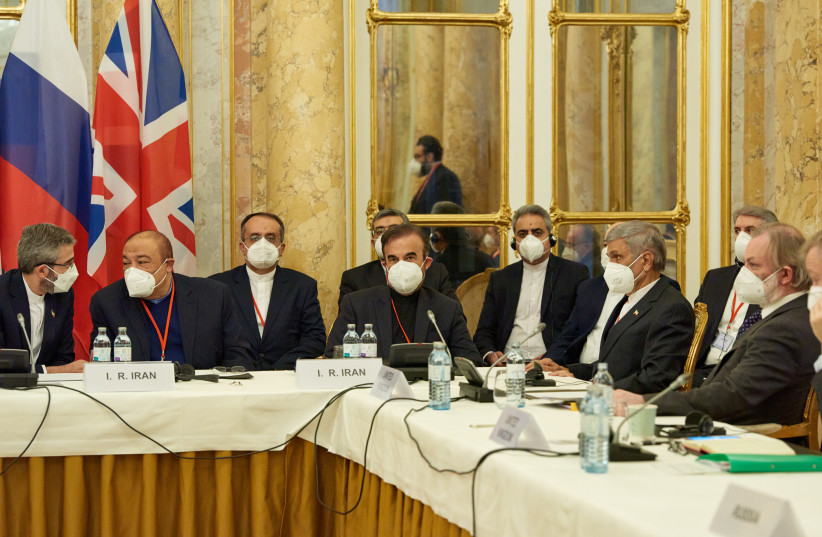
 Iran's chief nuclear negotiator Ali Bagheri Kani and members of the Iranian delegation wait for the start of a meeting of the JCPOA Joint Commission in Vienna, Austria November 29, 2021. (credit: EU DELEGATION IN VIENNA/HANDOUT VIA REUTERS)Iran’s chief nuclear negotiator Ali Bagheri Kani and members of the Iranian delegation wait for the start of a meeting of the JCPOA Joint Commission in Vienna, Austria November 29, 2021. (credit: EU DELEGATION IN VIENNA/HANDOUT VIA REUTERS)

“I think our region will see new developments in the future,” The Iranian foreign minister said. “According to messages and statements from US officials, they have no choice but to leave the region.” The report of meeting hints that the US may withdraw from another place in the “coming weeks or months.” It is not clear if Iran and Syria think the US might leave the Tanf garrison or some other location or if this is a hint that Iran may plot new attacks against the US in Iraq or Syria.
Iran called for countries to help reconstruct Syria. The Syrian foreign minister “stated that it may be thought that Syria has overcome the past and economic problems, but this is not the case: Syria attaches special importance to relations with Iran and paves the way for Iran’s participation in economic projects. We welcome any Iranian participation in Syria.”
Iran also told Syria it was negotiating in Vienna with western governments to get sanctions lifted. The point of this is that sanctions relief could help Syria. The Iranian foreign minister added: “The three European countries did not take any initiative in these negotiations, as if they were looking to evaluate our team.” He said that “until the last moment, 3 European countries could not present an operational plan and idea.” Iran then slammed western media.
“During the negotiations, some media and lobbies tried to insinuate that Iran has started 90% enrichment.” Iran says this is “pure fabrication and lying.”
Iran has said it rejects an interim agreement in Vienna. They added that “negotiations will resume soon…we are looking for a good agreement and we expect the other side to take such an approach.” The Syrian Foreign Minister also called the UAE Foreign Minister’s visit to Damascus a courageous step, adding: “We will take the next steps based on this step…we hope that other Arab countries will.”
These are important points. It shows that Syria and Iran believe that a new dawn may be emerging amid reconciliation with the Gulf states. It also means Iran is optimistic about talks in Europe, even though it may also be preparing to lay the groundwork for a chance at failure.


In rare strike, Israeli warplanes said to attack Latakia port

Syria says jets fired missiles at storage depots reportedly belonging to Iran-linked militias, causing large explosions


Smoke rises from an alleged Israeli missile strike on the Syrian port of Latakia on December 7, 2021 (Screencapture/Twitter)

Smoke rises from an alleged Israeli missile strike on the Syrian port of Latakia on December 7, 2021 (Screencapture/Twitter)

Syria’s military said Israeli warplanes fired missiles on the port of the coastal city of Latakia early Tuesday without inflicting any human losses.

Syria’s state media quoted an unnamed military official as saying that several missiles struck the containers area in the port, setting some of them on fire. The official gave no further details.

It was a highly irregular attack on the port of Latakia, a vital facility where much of Syria’s imports are brought into the war-torn country and through which Iran reportedly brings in weapons to its militias in the country, including the Lebanese terrorist army Hezbollah.

Though Israel has regularly conducted raids against Iranian-linked targets in Syria, it rarely strikes close to Latakia, let alone inside the terminal, as the Russian military maintains a base of operations nearby. Due to its delicate relationship with Moscow, Israel typically refrains from carrying out attacks against targets if there are Russian troops nearby, though Israel believes that this well-known policy has led Iran to seek to protect its arms transfers by conducting them near Russian-controlled areas.

The previous time that Israel reportedly conducted a strike on a target in the city of Latakia — though not in the port — was in 2018, during which a Russian spy plane was accidentally shot down by Syrian air defenses, causing a major confrontation between Jerusalem and Moscow. Israel has also reportedly carried out raids against targets in the port city in 2014 and twice in 2013.

Syrian state TV reported that following the initial strike at roughly 1:20 a.m. Tuesday, five blasts were heard in the port and a huge fire erupted in the containers area. Fire engines were reportedly rushed to the port, likely indicating secondary explosions caused by the arms inside the depot detonating.

There was no comment from the Israeli military.

Israel has staged hundreds of strikes on targets inside government-controlled Syria over the years but rarely acknowledges or discusses such operations. Many of the strikes in the past had targeted the main airport in the capital Damascus, through which Iran is also believed to transfer advanced arms to its proxies.

Israel has acknowledged, however, that it targets the bases of Iran-allied terror groups, such as Lebanon’s Hezbollah that has fighters deployed in Syria. It says it attacks arms shipments believed to be bound for the groups.

Hezbollah is fighting on the side of Syrian President Bashar Assad’s forces in the decade-old civil war.

Israel says Iranian presence on its northern frontier is a red line, justifying its strikes on facilities and weapons inside Syria.
