If the path to a return to compliance with the agreement turns out to be a dead-end, we will pursue other options,’ US Secretary of State Antony Blinken said.
By TOVAH LAZAROFF, REUTERS Published: DECEMBER 4, 2021 19:32
Updated: DECEMBER 4, 2021 22:07
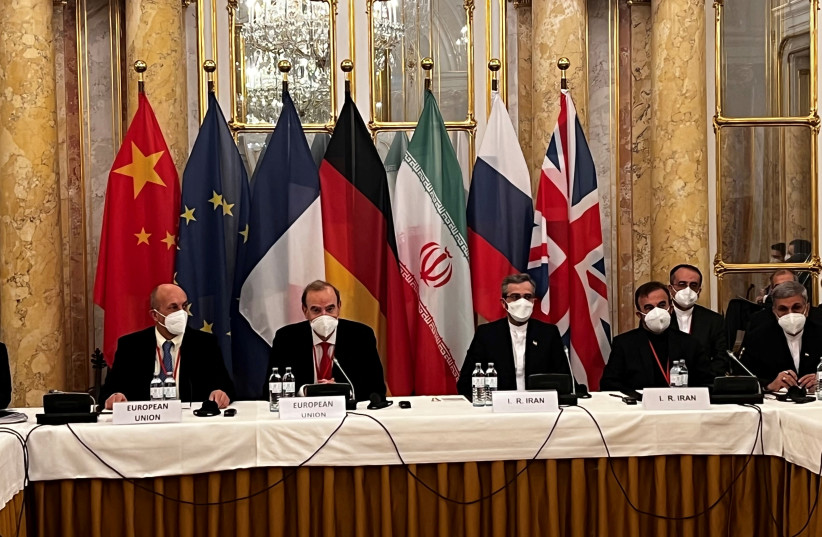
Deputy Secretary General of the European External Action Service (EEAS) Enrique Mora and Iran’s chief nuclear negotiator Ali Bagheri Kani wait for the start of a meeting of the JCPOA Joint Commission in Vienna, Austria, December 3, 2021.
(photo credit: EU DELEGATION IN VIENNA/HANDOUT VIA REUTERS)
Deputy Secretary General of the European External Action Service (EEAS) Enrique Mora and Iran’s chief nuclear negotiator Ali Bagheri Kani wait for the start of a meeting of the JCPOA Joint Commission in Vienna, Austria, December 3, 2021.
(photo credit: EU DELEGATION IN VIENNA/HANDOUT VIA REUTERS)
The United States warned it would thwart Tehran’s nuclear program but held fast to its hope of a revival of the 2015 agreement with Iran after negotiations in Vienna failed to make any progress over the weekend.
“If the path to a return to compliance with the agreement turns out to be a dead-end, we will pursue other options,” US Secretary of State Antony Blinken said after completion of the seventh round of indirect talks led by the European Union.
“Iran right now does not seem to be serious about doing what’s necessary to return to compliance, which is why we ended this round of talks in Vienna,” US Secretary of State Antony Blinken told the virtual Reuters Next Conference.
On Saturday a senior US official warned that time was running out to resurrect the deal, known as the Joint Comprehensive Plan of Action. He added that it was unclear when an eighth round of talks would be held, even as European negotiators spoke of the resumption of negations next week.
The Trump administration, with Israel’s support, had left the deal in 2018. US President Joe Biden has sought to resurrect the deal that was initially signed between Tehran and the six world powers; the US, Russia, China, Great Britain, France and Germany.
The JCPOA’s viability is dependent on how fast Iran accelerates its nuclear program, the US official said. Iran has continued to advance toward the enrichment of weapons-grade uranium during the talks, a move that has made even the JCPOA’s proponents questioning whether the deal can be resumed.
The factor would determine if the JCPOA’s revival is not a chronological clock but a technical one, the US official explained.
At this point, he said, the Biden administration still believes the deal can be saved.
Israel’s Defense Minister Benny Gantz is set to visit Washington this week to discuss Iran. Prime Minister Naftali Bennett spoke with Blinken on Thursday about Israel’s concerns with respect to the deal.
The US official told reporters on Saturday, that it agreed with Israel on the need to ensure that Iran does not acquire nuclear weapons, even as it disagreed with it tactically. The US official, noted, however, that even Israelis at this point were questioning the wisdom of the Trump administration’s withdrawal from the deal.
“We are seeing, I don’t know if I want to call it soul searching or interesting reflections in Israel by former senior officials about the decision to withdraw from the JCPOA and what it has meant,” the US official said.
He explained that he believed that it meant that the door was opened for an “unconstrained, uncontrolled Iran nuclear program, which was not the case while the US and Iran were both in compliance with the deal.”
The US official added: “I think the conversations we are having with Israel, are always interesting and always important, we strive to remain as transparent and as well-coordinated with Israel as possible, but it is taking place against the backdrop that we all need to take into account, which is to learn the lessons of the preceding three years.”
Conversations with Israel, the US official said, come with this “context in mind.”
The seventh round of talks in Vienna was the first with delegates sent by Iran’s anti-Western President Ebrahim Raisi on how to resuscitate the agreement under which Iran limited its nuclear program in return for relief from economic sanctions.
Raisi’s election in June caused a five-month hiatus in the talks, heightening suspicions among US and European officials that Iran is playing for time while advancing its nuclear program.
Diplomats said the Iranian delegation had proposed sweeping changes to a text that was painstakingly negotiated in previous rounds and that European officials had said was 70-80% finished.
“Over five months ago, Iran interrupted negotiations. Since then, Iran has fast-forwarded its nuclear program. This week, it has backtracked on diplomatic progress made,” senior officials from France, Britain and Germany said in a statement, adding that Iran was demanding “major changes” to the text.
It is “unclear how these new gaps can be closed in a realistic time frame,” they added.
The three European powers expressed “disappointment and concern” at Iran’s demands, some of which they said were incompatible with the deal’s terms or went beyond them.
The 2015 agreement imposed strict limits on Iran’s uranium enrichment activities, extending the amount of time it would need to produce enough fissile material for a nuclear bomb, if it chose to, to at least a year from around two to three months. Most experts say that period is now shorter than before the deal.
Iran denies seeking nuclear weapons, saying it only wants to master nuclear technology for peaceful purposes.
In exchange for the nuclear restrictions, the 2015 deal lifted many US, European Union and UN sanctions on the Islamic Republic.
Former US President Donald Trump reimposed painful US economic sanctions on Tehran after he pulled out of the deal.
Tehran retaliated in 2019 by breaching many of the deal’s limits on enrichment and other restrictions, and advancing well beyond them. With the deal’s nuclear benefits now badly eroded, some Western officials say there is little time left before the foundation of the deal is damaged beyond repair.
French President Emmanuel Macron said he thought it likely the current round of talks would not succeed and appeared to look beyond them, hinting at involving more nations, such as Gulf Arab states, in a wider discussion if the Vienna talks fail.
“I think it’s very difficult to find an agreement if the Gulf countries, Israel, all those whose security is directly affected, don’t take part,” he told reporters in Dubai.
Iranian nuclear negotiator Ali Bagheri Kani’s uncompromising stance is that since Washington left the deal, it should make the first move by lifting all sanctions imposed on Tehran since then, even those unrelated to Tehran’s nuclear activities.
Bagheri Kani told Reuters on Monday the United States and its Western allies also should offer guarantees to Iran that no new sanctions would be imposed on it in future.
However, he left the door ajar for more talks by saying European nations could propose their own drafts for discussion, Iranian state media reported.
Western negotiators take a return to the original deal as their baseline, meaning if Iran wants sanctions relief beyond it, Tehran should accept more nuclear restrictions.
The talks have been held indirectly, with the EU engaging in shuttle diplomacy in Vienna.
On Saturday night, Iranian air defenses fired a missile as part of an exercise on Saturday over the central town of Natanz, which houses nuclear installations, state TV reported, after local residents reported hearing a large blast.
The reports said air defense units fired the missile to test a rapid reaction force over Natanz.
“Such exercises are carried out in a completely secure environment … and there is no cause for concern,” Army spokesman Shahin Taqikhani told state TV.
Iranian news agencies earlier reported a large explosion in the sky above Natanz but said there was no official explanation of the incident.
The semi-official Fars news agency quoted its reporter in nearby Badroud as saying a short blast was heard which was accompanied by an intense light in the sky.