International talks on Iran’s nuclear program restarted Monday in Vienna after a five-month hiatus, with Tehran demanding the removal of American sanctions as a condition for restoring the 2015 nuclear deal.
Iran paused the negotiations in June after the election of an ultraconservative new president, Ebrahim Raisi. Diplomats at the time had said they were “close” to an agreement.
Iran ignored appeals from Western countries to restart the talks for several months, all the while strengthening the capabilities of its nuclear program in violation of the accord. In August, Raisi said Iran was again open to talks.
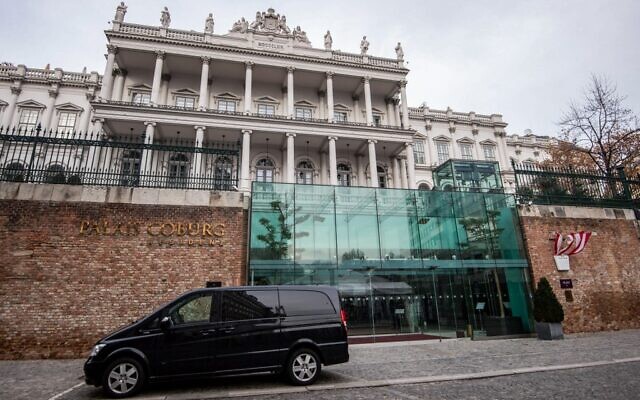
The talks started just after 3 p.m. local time in the Palais Coburg Hotel, where the 2015 agreement — known as the Joint Comprehensive Plan of Action (JCPOA) — was clinched.
Along with Iran, diplomats from Britain, China, France, Germany and Russia were attending.
Get The Times of Israel’s Daily Editionby email and never miss our top stories
By signing up, you agree to the
terms
The US, which withdrew from the nuclear accord in 2018 and reimposed sanctions on Iran, was taking part in the talks indirectly.
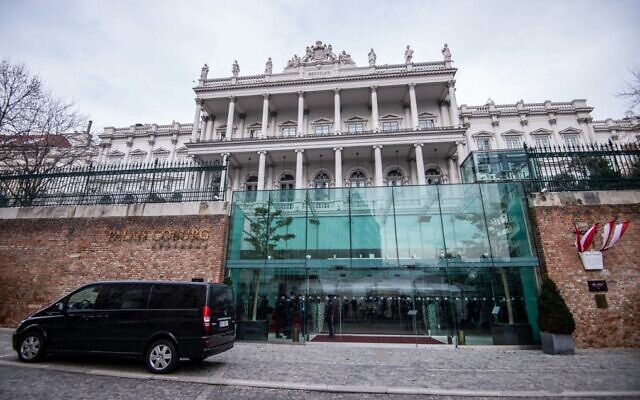
The Coburg Palais, the venue of the Iran nuclear talks, is pictured in Vienna on November 29, 2021. (Vladimir Simicek/AFP)
“The United States still fails to properly understand the fact that there is no way to return to the deal without verifiable and effective lifting of all sanctions imposed on the Iranian nation after the US departure,” Iranian Foreign Minister Hossein Amir-Abdollahian said in a statement as Monday’s talks began.
“The return of the US to the nuclear deal would be meaningless without guarantees to prevent the recurrence of the bitter experience of the past,” he added, according to Reuters.
Amir-Abdollahian also warned the US that “this opportunity is not a window that can remain open forever.”
Earlier Monday, Iran said it had “a firm determination to reach an agreement and is looking forward to fruitful talks.”
“If the other side shows the same willingness, we will be on the right track to reach an agreement,” Iranian foreign ministry spokesman Said Khatibzadeh said.

Iranian Foreign Minister Hossein Amir-Abdollahian is seen before meeting with his Russian counterpart in Moscow, on October 6, 2021. (Kirill Kudryavtsev/Pool/AFP)
Last week, US Special Envoy for Iran Robert Malley said Tehran’s attitude “doesn’t augur well for the talks.”
“If they start getting too close, too close for comfort, then of course we will not be prepared to sit idly,” Malley told the US National Public Radio.
The European Union, which is chairing the talks, said on Monday that it was “crucial to pick up from where we left it last June, and that all sides work swiftly and constructively to bring the JCPOA back on track as soon as possible.”
The EU official leading the talks sounded an upbeat note after the meeting concluded.
“I feel positive that we can be doing important things for the next weeks,” EU diplomat Enrique Mora told reporters.
All participants had shown a willingness to listen to the positions and “sensibilities” of the new Iranian delegation, Mora said. At the same time, Tehran’s team made clear it wanted to engage in “serious work” to bring the accord back to life, he said.
“There is a sense of urgency in putting an end to the suffering of the Iranian people,” said Mora, referring to the crippling sanctions the US reimposed on Iran when it quit the accord. “And there is a sense of urgency in putting the Iranian nuclear program under the transparent monitoring of the international community.”

Deputy Secretary General of the European External Action Service (EEAS) Enrique Mora speaks to journalists in front of the Coburg palace after nuclear talks in Vienna on November 29, 2021. (Vladimir Simicek/AFP)
“What has been the norm over the first six rounds will be again the practice in this seventh round,” Mora added. “Nothing new on working methods.”
Meanwhile, Russia’s top representative to the negotiations said he held “useful” informal consultations with officials from Iran and China on Sunday. That meeting, Mikhail Ulyanov said, was aimed at “better understanding … the updated negotiating position of Tehran.“ He tweeted a picture of a meeting Monday he described as a preparatory session with members before Iran joined the discussions.
As the negotiations resumed Monday, Prime Minister Naftali Bennett called on world powers not to “give in to Iran’s nuclear blackmail,” saying that Tehran was seeking “to end sanctions in exchange for almost nothing” and keep its nuclear program intact while receiving hundreds of billions of dollars once sanctions are lifted.
If the world powers capitulate, “Iran won’t just keep its nuclear program; from today, they’ll be getting paid for it,” Bennett warned in a video statement.
The premier highlighted Iranian leaders’ oft-repeated desire to see Israel destroyed. “Iran doesn’t hide its intentions,” he added. “Just a couple of days ago, the senior command of Iran’s Armed Forces declared, and I quote, ‘We will not back off from the annihilation of Israel, not even one millimeter.’”

Prime Minister Naftali Bennett speaks from his Jerusalem office in a video statement addressed to world powers at the opening of renewed nuclear talks with Iran, November 29, 2021. (Screenshot: Twitter)
Israel vocally opposed the 2015 agreement, and Israeli officials now say Iran is closer than ever to developing nuclear arms, which it will not abide. Foreign Minister Yair Lapid was visiting London and Paris to discuss Iran with British and French officials. Defense Minister Benny Gantz will head to Washington this week with the same aim.
‘Precarious situation’
The JCPOA offered a lifting of some of the array of economic sanctions Iran had been under in return for strict curbs on its nuclear program. But the deal started to unravel in 2018 when then-US president Donald Trump pulled out and began reinstating sanctions on Iran.
Ordinary Iranians are hoping the talks may lead to some of those crippling sanctions being lifted. Unemployed Tehran resident Davoud Lotfinia told AFP: “The sanctions probably haven’t affected the authorities, but the purchasing power of ordinary people is diminishing every day.”
The year after Trump’s move, Iran retaliated by starting to exceed the limits on its nuclear activity laid down in the deal.
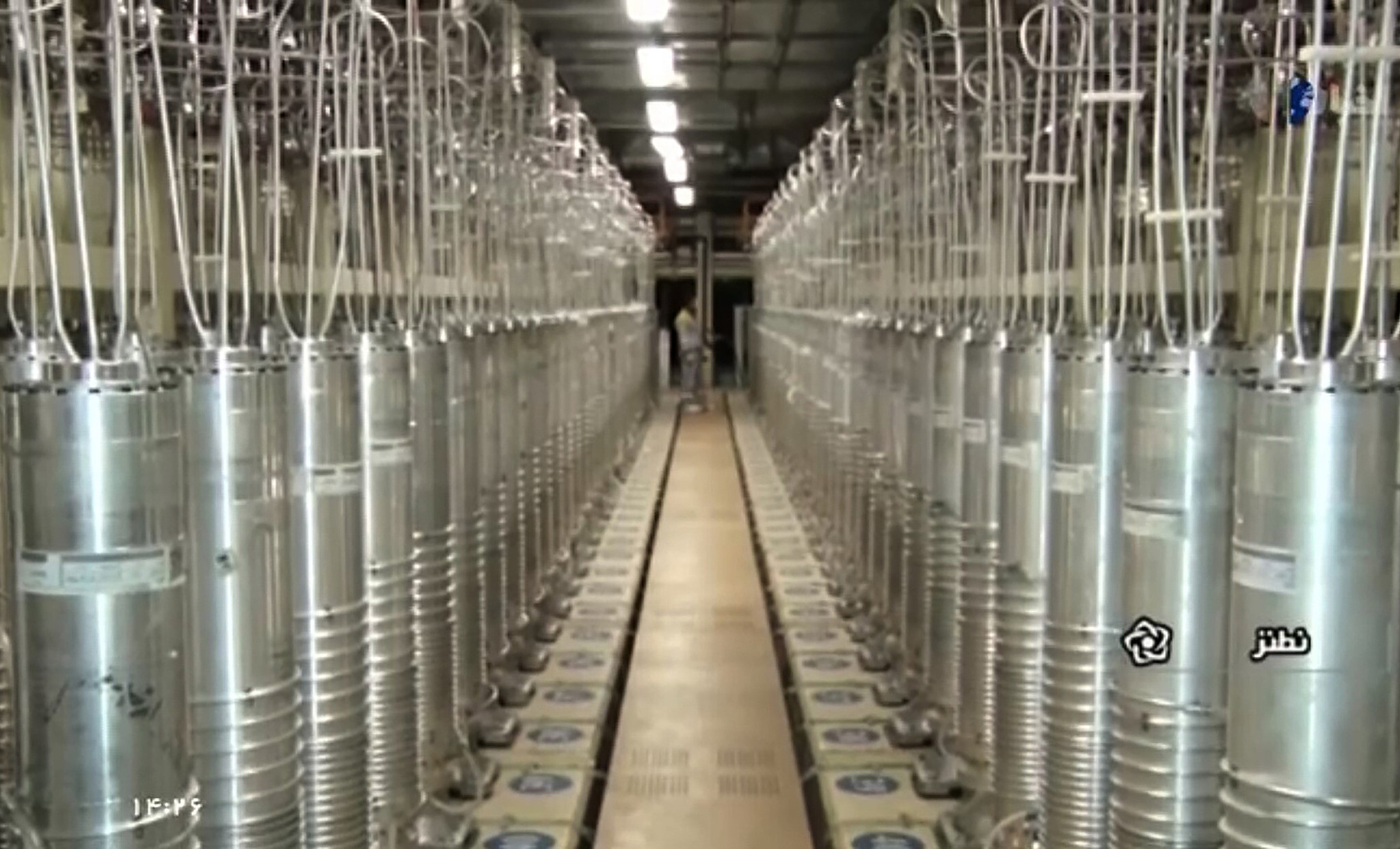
In recent months, it has started enriching uranium to unprecedented levels and has also restricted the activities of inspectors from the International Atomic Energy Agency (IAEA), the UN watchdog charged with monitoring Iran’s nuclear facilities.
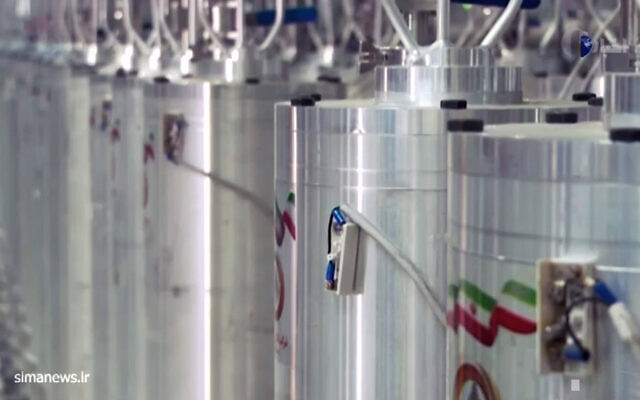
In this image made from April 17, 2021, video released by the Islamic Republic Iran Broadcasting, IRIB, state-run TV, various centrifuge machines line the hall damaged on Sunday, April 11, 2021, at the Natanz Uranium Enrichment Facility, some 200 miles (322 km) south of the capital Tehran. (IRIB via AP, File)
IAEA Director General Rafael Grossi said “no progress” was made on issues he raised during a visit to Tehran last week, which had hoped to address differences between the agency and Iran.
“Iran’s unwillingness to reach a relatively straightforward compromise with the IAEA reflects poorly on the outlook for the nuclear talks,” said Henry Rome, Iran specialist at the Eurasia Group think tank.
“Iran may calculate that its unconstrained nuclear advances… will put more pressure on the West to give ground in talks quickly,” Rome said, warning this would “likely have the opposite effect.”
“The situation regarding Iran’s nuclear advances is increasingly precarious,” Kelsey Davenport, an expert with the Arms Control Association, told journalists last week.
Covert program?
“Iran is acting like the United States is going to blink first but… pressure is a double-edged sword” that could kill any prospect of the 2015 deal being restored, Davenport added.
“If there are gaps in the IAEA’s monitoring, it will drive the speculation that Iran has engaged in illicit activity, that it has a covert program, whether there’s evidence to that or not,” Davenport said, which could in turn “undermine the prospects for sustaining the deal.”
In London, Lapid was meeting British Prime Minister Boris Johnson on Monday, and French President Emmanuel Macron in Paris on Tuesday.

Foreign Minister Yair Lapid (R) and his British counterpart Liz Truss at the UK Foreign, Commonwealth, and Development Office in London, November 29, 2021. (Stuart Mitchell)
In advance of their meeting, Lapid and his British counterpart, Liz Truss, published an article in the Daily Telegraph newspaper saying they would “work night and day to prevent the Iranian regime from ever becoming a nuclear power.”
Truss added in a statement that the UK wanted “Iran to agree to the original JCPOA” but warned that if the talks “don’t work, all options are on the table.”