US finally sets Iran-IAEA deadline⁠—sort of – analysis

Since last Thursday, the US has sent multiple loud signals to Iran that it will start exerting pressure if a nuclear compromise is not forthcoming.

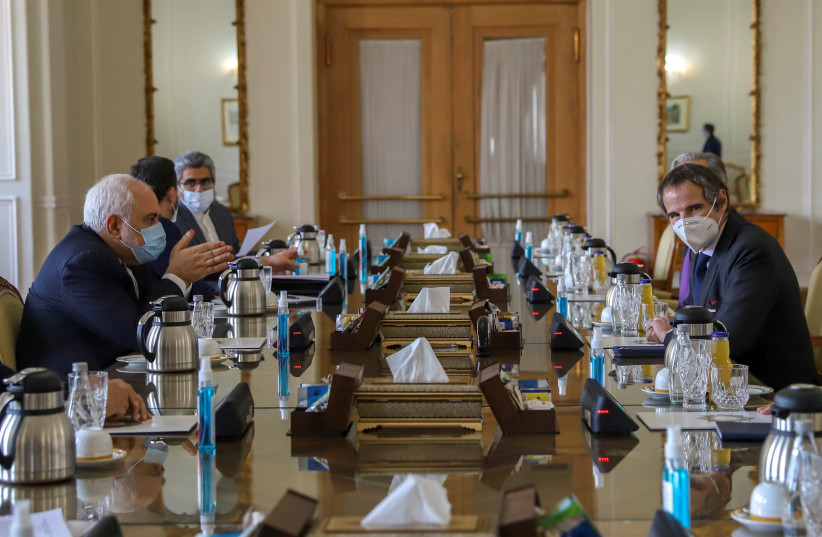
Iran's Foreign Minister Mohammad Javad Zarif meets with International Atomic Energy Agency (IAEA) Director General Rafael Grossi in Tehran (photo credit: MAJID ASGARIPOUR/WANA (WEST ASIA NEWS AGENCY) VIA REUTERS)
Iran’s Foreign Minister Mohammad Javad Zarif meets with International Atomic Energy Agency (IAEA) Director General Rafael Grossi in Tehran
(photo credit: MAJID ASGARIPOUR/WANA (WEST ASIA NEWS AGENCY) VIA REUTERS)
US President Joe Biden’s patience may finally be exhausted.
Since Thursday of last week, the US has sent multiple loud signals to Iran that it will start exerting pressure if a nuclear compromise is not forthcoming, and for the first time with some deadlines.
Late Thursday, Washington threatened to call an extraordinary ad hoc session of the International Atomic Energy Agency (IAEA) Board of Governors to condemn the Islamic Republic within 30 days if there is insufficient progress in resolving disputes with international inspectors.
“If Iran’s non-cooperation is not immediately remedied… the Board will have no choice but to reconvene in an extraordinary session before the end of this year in order to address the crisis,” a US statement to the Board of Governors said.
It said it was referring “especially” to reinstalling IAEA cameras at the Karaj workshop, which makes parts for advanced centrifuges that enrich uranium.
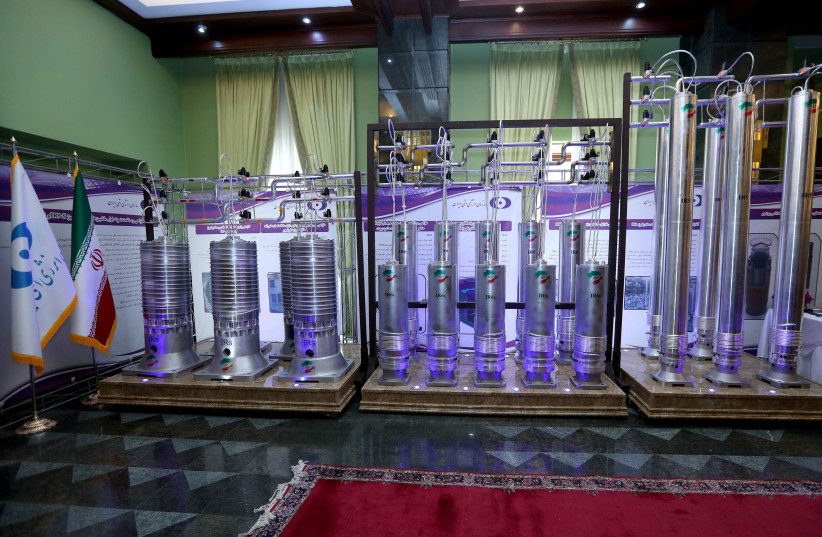
A number of new generation Iranian centrifuges are seen on display during Iran's National Nuclear Energy Day in Tehran (credit: IRANIAN PRESIDENCY OFFICE/WANA (WEST ASIA NEWS AGENCY)/HANDOUT VIA REUTERS)A number of new generation Iranian centrifuges are seen on display during Iran’s National Nuclear Energy Day in Tehran (credit: IRANIAN PRESIDENCY OFFICE/WANA (WEST ASIA NEWS AGENCY)/HANDOUT VIA REUTERS)

Karaj was struck by a drone in June, sabotage that Iran has accused the Mossad of perpetrating.
In response, Tehran not only increased various aspects of its uranium enrichment but also cut off IAEA inspectors’ access to the site.
America has tolerated nearly six months of the IAEA being blind regarding the site, but now it is giving Iran 30 days to remedy the situation.
Biden’s threat has double significance because the IAEA board just met this past week and kept its mouth shut about the lack of access and other issues so as not to undermine the start of nuclear talks in Vienna on Monday.
Early Friday, Russia quickly criticized the US threat and deadline, saying that America’s tone could undermine this week’s nuclear talks and that Iranians do not negotiate under pressure.
Moscow’s criticism seems to have been brushed off by Washington, as by Sunday, US Iran negotiator Rob Malley told BBC Sounds, “If Iran thinks it can use this time to build more leverage and then come back and say they want something better, it simply won’t work. We and our partners won’t go for it.”
In a separate piece in Politico, an anonymous US official said the Biden administration is so pessimistic about Iran’s hardline position going into the Vienna talks that it has already started moving the wheels for a “Plan B.”
All of this would seem to be more in line with what Israel wants, so why has Jerusalem been at such loggerheads with Washington over Iran during the past week?
Because the deadline is only a sort of deadline.
It seems that if Iran again grants the IAEA access to Karaj, then the Biden team will overlook all of the unanswered questions about illicit nuclear material and undeclared nuclear sites that inspectors have been trying to get answers about for years.
More importantly, there is still no deadline for the nuclear talks or point of nuclear enrichment by which the US has said it would engage its Plan B.
So if the Islamic Republic makes the minimal concession of allowing inspectors access to this one nuclear site after a six-month pause, will all be forgiven?
Even if the US moved to Plan B, it is clear that Washington does not know how far it would go with exerting pressure on Iran and what its end game would be.
The Trump administration-era sanctions are already on and China is already ignoring them, so more sanctions might have a negligible effect.
Also, Iranian President Ebrahim Raisi does not seem to care about the economic impact of the sanctions in his country at this stage, and it is unclear when he would start to feel more pressure on that issue given that he was primarily installed to be tough.
Would the US be ready to use its own cyber or covert capabilities to sabotage Natanz, Fordow or some other aspect of Iran’s nuclear program as Israel has (reportedly) in the past?
Or would it give Jerusalem the green light to do so again after a period of months where the impression was Washington has been asking the Jewish state to hold back?
Though both Israel and the US talk about all options being on the table, there is no sense among top officials that we are anywhere near the point where either country would launch a broad preemptive military airstrike.
So the US threats may be more of a tactical saving face than a strategic game-changer.
If Tehran does again grant access to Karaj, the positive would be restoring some greater monitoring of Iran’s nuclear program.
Yet, if this Iranian “concession” becomes an excuse for the Biden administration to make more strategic nuclear concessions, it could be a case of winning the battle in order to lose the war.

Iranian Brig.-Gen. urges destruction of Israel prior to nuke talks

“We will not back off from annihilation of Israel, even one millimeter.”

 Iranian Brig.-Gen. Abolfazl Shekarchi. (photo credit: Wikimedia Commons)
Iranian Brig.-Gen. Abolfazl Shekarchi.
(photo credit: Wikimedia Commons)
The spokesman for the Islamic Republic of Iran’s armed forces, Brig.-Gen. Abolfazl Shekarchi, on Saturday urged the total elimination of the Jewish state during an interview with an Iranian regime-controlled media outlet.
“We will not back off from the annihilation of Israel, even one millimeter. We want to destroy Zionism in the world,” Shekarchi told the Iranian Students News Agency.
Shekarchi’s genocidal antisemitic remarks come just days before the nuclear talks are set to restart in Vienna Monday on curbing the Islamic Republic of Iran’s illicit nuclear program. The United States and other world powers are seeking to provide Tehran with economic sanctions relief in exchange for temporary restrictions on its atomic program. Israel and other countries believe Iran’s regime seeks to build a nuclear weapons device.
The Iranian general also blasted Bahrain and the United Arab Emirates for normalizing diplomatic relations with Israel, terming the diplomacy “intolerable” for Iran’s clerical regime. “Saudi Arabia, Bahrain, UAE and other countries considered as Muslims, for us they part of the Zionist regime and this is very important,” said Shekarchi.
Shekarchi has previously lashed out at Israel, saying that Iran’s regime can  “level Haifa and Tel Aviv in the shortest possible time.”

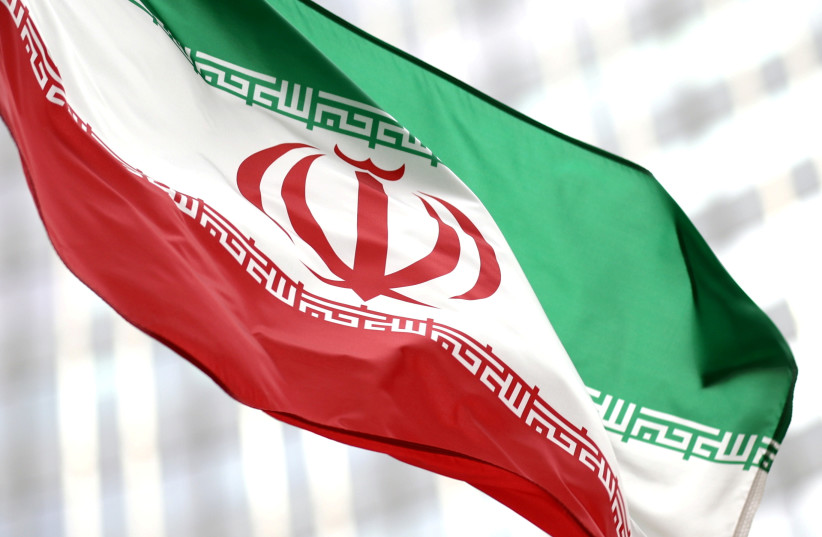
Iranian flag flies in front of the UN office building, housing IAEA headquarters, amid the coronavirus disease (COVID-19) pandemic, in Vienna, Austria, May 24, 2021. (credit: LISI NIESNER/ REUTERS)Iranian flag flies in front of the UN office building, housing IAEA headquarters, amid the coronavirus disease (COVID-19) pandemic, in Vienna, Austria, May 24, 2021. (credit: LISI NIESNER/ REUTERS)

The US under both democratic and republican administrations has classified Iran’s regime as the world’s worst state-sponsor of terrorism.
The US State Department said last year that the Islamic Republic is the top state-sponsor of antisemitism.
Sheina Vojoudi, an Iranian dissident who fled the Islamic Republic and now lives in Germany, told The Jerusalem Post that “A normal Iranian government, made by the Iranian people, would try to normalize ties with Israel. We could have great deals which can help both nations. Israeli water technology can help us to pass a serious water problem in Iran and an Iranian government would try to exchange knowledge about environmental issues especially water scarcity that we’re facing right now but the Islamic Republic instead of solving all these problems, plans for the destruction of Israel and shoots  people who ask for water.”

She added that “This regime is ruining Iran and some other countries in the Middle East and makes the region a war zone. We have domestic problems and our people never think of fighting other countries. They don’t even know why they should hate Israel. Our people will be happy to use Israeli water technology instead of planning to destroy Israel. We must save our country from this evil regime and turn the occupied Iran to a free Iran.”


Iran: Agreement can be reached if all sanctions are lifted

Iran’s Foreign Minister reiterates his country wants the lifting of all sanctions in a verifiable process.

Elad Benari, Canada , Nov 26 , 2021 10:10 PM


Hossein Amir-Abdollahian

Hossein Amir-Abdollahian

Kirill Kudryavtsev/Pool via REUTERS

Iran’s Foreign Minister, Hossein Amir-Abdollahian, made clear once again that his country wants the lifting of all sanctions in a verifiable process, Reuters reports.

The comments come ahead of the resumption on Monday of indirect talks between the United States and Iran, on a return of both countries into full compliance with the 2015 nuclear deal.

Iran has gradually scaled back its compliance with the 2015 nuclear deal it signed with world powers in response to former US President Donald Trump’s withdrawal from the agreement in May of 2018.

“If the opposing sides are prepared to return to their full obligations and the lifting of sanctions, a good and even immediate agreement can be reached,” Amir-Abdollahian said on Friday in a telephone conversation with the European Union’s foreign policy chief, Josep Borrell.

“Iran wants a good and verifiable agreement,” he added.

Iran has repeatedly demanded that the US lift sanctions imposed on Iran as part of the nuclear talks and also reassure Iran it will not abandon the deal again.

Amir-Abdollahian told Borrell on Friday that Iran would attend the Vienna talks in “good faith” despite the U.S. violation of the 2015 agreement.

US officials have said that while they prefer the diplomatic route to reach an agreement with Iran, there are other options on the table should that fail.

US negotiator Rob Malley said this week that Washington will not “sit idly” on Iran if it drags its feet on returning to the nuclear deal.

Meanwhile, General Kenneth McKenzie, the top US commander in the Middle East, said that Iran is “very close” to a nuclear bomb and his forces stand ready with a potential military option should talks with the Islamic Republic fail.


(Arutz Sheva’s North American desk is keeping you updated until the start of Shabbat in New York. The time posted automatically on all Arutz Sheva articles, however, is Israeli time.)