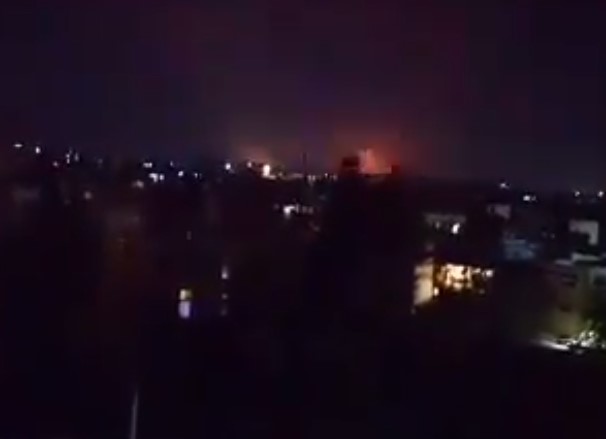
Syria sent drones to strike at an American military Syria outpost in Tanf. However, the strikes were not just targeting the US.
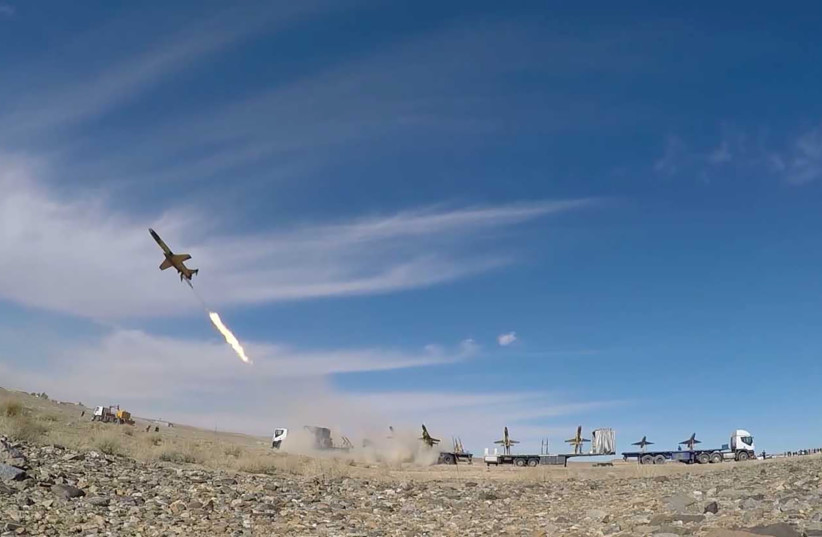
 A drone is launched during a large-scale drone combat exercise of Army of the Islamic Republic of Iran, in Semnan, Iran January 6, 2021.  (photo credit: IRANIAN ARMY/WANA (WEST ASIA NEWS AGENCY) VIA REUTERS)
A drone is launched during a large-scale drone combat exercise of Army of the Islamic Republic of Iran, in Semnan, Iran January 6, 2021.
(photo credit: IRANIAN ARMY/WANA (WEST ASIA NEWS AGENCY) VIA REUTERS)
Iran conducted a complex and coordinated attack on US forces in Syria last week. It used up to five armed drones to strike at the Tanf garrison, a lonely US outpost in Syria near the Jordanian and Iraqi border.
The assessment by the US is that Iran was behind this attack. It is the latest of numerous drone attacks on US forces in the region this year. Iranian-backed groups in Iraq have used drones to target US forces at Erbil airport and other locations. The attacks also are part of the rising Iranian drone threat across the region. This means the attack on Tanf is a message not just for the US, but also for Israel, Saudi Arabia and other countries facing Iran’s drones.
Pentagon spokesman John Kirby said the Tanf attack was “complex, coordinated and deliberate attack.” But the US didn’t go into more specifics, reports said. US knowledge about the planning of the attack appears to be more than is being reported in media. This is because reports say that the US was “tipped off” to the attack and that around 200 troops were evacuated on a C-130 transport, according to Fox News.
It is not the first time the US had some knowledge an attack was coming and prepared for it. In January 2020 after the US killed Iranian IRGC Quds Force leader Qasem Soleimani the US received hours of warning about an Iranian ballistic missile attack on Al-Asad base in Iraq. Troops were sent to bunkers and sensitive equipment was moved away.
Reuters says that on the night of January 7 “not a single fighter jet or helicopter remained out in the open.” The attack came after midnight. The US similarly avoided casualties at Tanf. But the advanced knowledge raises questions about why the US didn’t try to pre-empt the attack or interdict it before it happened. It also raises questions about lack of air defenses for US facilities. Reports indicate US forces tried out counter-UAS technology called Smart Shooter in June 2020, a technology used for countering small drones. For larger drones one needs a system more like Israel’s Iron Dome, which can counter drones. The US has two Iron Dome batteries, but they are based in Guam according to reports.
What this tells us is that the US had some prior knowledge about Iranian threats to Tanf. It’s not the first time Tanf has been threatened. An Iranian drone also threatened the area in 2017 and the US shot the drone down. Tanf has a 55km “de-confliction” zone around it, meaning the US reserves the right to defend the area up to 55km. That’s a big radius and keeps any prying eyes away. But Iran and its militias want the Americans to feel vulnerable. Iran has been testing US defenses in Iraq and Syria.
Iran has also used Syria to base drones for attacks on Israel. In February 2018 an Iranian drone from the T-4 base near Palmyra flew into Israeli airspace. Israel shot it down. In May 2021 another Iranian drone, perhaps brought from Iraq, flew into Israeli airspace and was downed. In August 2019 Israel struck a Hezbollah “killer drone” team that was operating near the Golan border. That means that Iran’s drone threats to the US in Iraq and Syria come in the context of Iran’s drone threats across the region and also its attempts to target Israel.
The Iranian drones being used in Iraq and Syria may also be of a similar type to those used by the Iranian-backed Houthis in Yemen. These are basically large flying tubes with wings and the tube can be backed with explosives so the drone is a kind of kamikaze device, not so different than a German V-1 in the Second World War.
Some of these drones are called Samad type drones, and they come in several types, Samad-1, Samad-2 and Samad-3. In a July analysis of the Iran-backed drone threat in Iraq Farzin Nadimi, an associate fellow with The Washington Institute and Michael Knights, the Boston-based Jill and Jay Bernstein Fellow of The Washington Institute, noted the similarities in the drones.
The Iraqi PMU, which is also called Hashd al-Shaabi and consists of Iranian-backed militias, had paraded drones in Iraq.  One type was called Sahab. “Like the Samad, Sahab is equipped with long-range transceiver antennas for precision GPS navigation. According to the UN Panel of Experts on Yemen, which examined numerous crashed examples of Samad, its extended-range version (Samad-3) can fly over 1,000 km. Six Sahab drones were shown at the parade,” the authors note. The Houthi-style Samad, which is based on Iranian technology and backing, was already present in Iraq in May 2020 Nick Water, Digital Investigation expert at Bellingcat made note of this at the time.
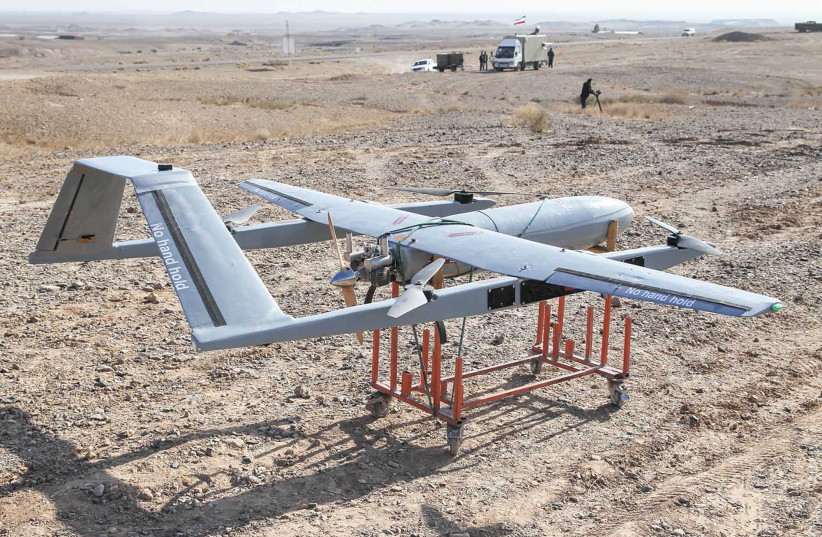
A drone is pictured during a large-scale drone combat exercise of Army of the Islamic Republic of Iran, in Semnan, Iran January 4, 2021. Picture taken January 4, 2021 (credit: IRANIAN ARMY/WANA/REUTERS)A drone is pictured during a large-scale drone combat exercise of Army of the Islamic Republic of Iran, in Semnan, Iran January 4, 2021. Picture taken January 4, 2021 (credit: IRANIAN ARMY/WANA/REUTERS)

Nadimi and Knights also noted how brazen the parade of Iranian-style drones was. “The admission of Sahab/Samad fixed-wing drones is also interesting considering their closeness to the KAS-04 (Samad-type) systems used in at least five drone attacks on U.S. facilities since April 2021.” Basically, Iran was showing its cards in Iraq. Iranian-backed Houthis also show off their drones. Many of these have been used against Saudi Arabia and run the gamut from the Samad types to the Qasef and Qasef 2K and other drones. There’s no secret here. The drones are often on display, like birds at a zoo.
An April INSS article by Ari Heistein and Elisha Stoin noted that “The Houthis have an extensive arsenal of UAVs, including long-range Samad[24] models. The group used Samad UAVs for long-range attacks in 2018 (Abu Dhabi) and then again in 2019 (Riyadh). However, the Samad-3, which claims an operational range of 1,800 km – theoretically enough to conduct attack on Israel – will have limited ability to inflict damage on Israeli infrastructure, given its 45 kg warhead.”
The Houthis also have a delta-wing drone called Waid. Knights described this drone as well: “The use of delta-wing attack drones and Quds-2 cruise missiles. Also shown at the March exhibition, Waid is the Houthi name for the loitering munition that Iran used to attack Saudi pipelines and the Abqaiq oil facility in May and September 2019, respectively.”
The Waid drone supposedly can fly 2,500km and reach Israel. In January Newsweek wrote that “imagery seen by Newsweek and confirmed by an expert who follows Iranian activities in the region indicate the presence of Iranian Shahed-136 loitering munitions, also called ‘suicide drones,’ deployed to the northern Yemeni province of Al-Jawf, an area of the country controlled by the Ansar Allah, or Houthi, Zaidi Shiite Muslim rebel movement.” It was unclear if the Shahed 136, which had not previously been known, is similar or the same as the Waid.
Closer to Israel, Hamas also has the Shehab drone, unveiled in the May war in Gaza. Drone expert Joseph Trevithick wrote at The Drive in May that “while Hamas’ claims it is entirely indigenous development, this drone’s general configuration, at least externally, is similar in some respects to the Houthis’ Qasef-series, as well as the Iranian Ababil-T, from which the former is at least derived.”
The October 20 attack on Tanf then is part of the wider context of drone attacks by Iran or its proxies across the region. The importance of defending against these kinds of threats and dominating the air is clear for every country these days in the Middle East. Israel is hosting the Blue Flag exercise alongside air forces from the US, Germany, France, Greece, India, Italy, and the UK. The UAE’s Air Force head was in Israel this week.
The overall context of the Tanf attack is that its complexity is a warning to Israel. Like the Abqaiq attack by Iran using drones and cruise missiles in September 2019, another complex drone attack has taken place in the region. Iran is using the Houthis and militias in Iraq, as well as Hamas to test out its drone technology. Iran also used drones to target a tanker in the Gulf of Oman in July. The US, UK and Israel blamed Iran for that attack which killed two crew members of the civilian ship. In that case, an Iranian drone flew into the bridge of the ship, likely a targeted purposeful attempt to kill the crew. Questions about how Iran had the coordinates of the ship and was able to guide the drone into that precise location remain to be answered. It shows Iran’s deadly technology is increasing across the region.

Iran sending advanced anti-aircraft batteries to challenge Israel

Israel carries out strikes in Syria in an attempt to thwart Iranian entrenchment and the smuggling of advanced weapons to Hezbollah in Syria and Lebanon.

 Iranian flag flies in front of the UN office building in Vienna (photo credit: REUTERS/LISI NIESNER/FILE PHOTO)
Iranian flag flies in front of the UN office building in Vienna
(photo credit: REUTERS/LISI NIESNER/FILE PHOTO)
Iran has begun deploying advanced anti-aircraft missile batteries to the region, including in Syria where Israeli jets routinely carry out airstrikes, in an attempt to challenge Israel Air Force jets.
Israel has carried out hundreds of strikes in Syria in an attempt to thwart Iranian entrenchment and the smuggling of advanced weapons to Hezbollah in Syria and Lebanon, according to foreign reports, and in countries like Iraq and even further as part of its war-between-wars campaign against Iran.
Over the past year, while Israeli strikes have intensified in Syria, the response time by Syrian air-defense batteries has become quicker. This has lead to the IAF changing how it acts during such operations, including by having larger formation during operations so that more targets can be struck at once instead of having jets return to the same target.
In 2018, an F-16 crashed in northern Israel after it was struck by an S-200 missile fired by Syrian forces during an Israeli operation. Syrian missiles have also landed in Israel in recent years, including this year when shrapnel from one missile hit northern Tel Aviv, and when another errant interceptor missile landed close to the Dimona nuclear site in the Negev Desert.
Iran is a top priority for Israel’s military, and Chief of Staff Lt.-Gen. Aviv Kohavi has set aside an additional defense budget for war readiness and military exercises. The IAF has also resumed intensive training for scenarios in which Iran’s nuclear facilities are targeted.

 Israeli soldiers from the Armored Corps seen near the Syrian border in the northern Golan Heights, October 17, 2021. (credit: MICHAEL GILADI/FLASH90)Israeli soldiers from the Armored Corps seen near the Syrian border in the northern Golan Heights, October 17, 2021. (credit: MICHAEL GILADI/FLASH90)

In an attempt to challenge Israeli jets, Iran has changed the deployment of its anti-aircraft missile batteries, separating their radars from the missile launchers. Such a move forces more Israeli jets to take part in any possible operation against the country’s nuclear program.
The Israel Air Force understands that the Islamic Republic’s defense industry is robust. While it might not have an air force, its drone capabilities are worrisome and pose a major threat to Israel and other regional countries, as seen by the 2019 Aramco attack and the recent deadly Mercer Street attack earlier this year.
Defense officials have identified an increased amount of Iranian drones in the hands of Hezbollah, Hamas, and other terrorist groups.
Hamas, Palestinian Islamic Jihad and Hezbollah have all used weaponized drones to carry out attacks after they invested in drone capabilities.
Drones have breached Israeli airspace in recent years, leading the IDF to scramble jets or fire missiles. Hamas used Iranian drones during the last war in May, and several Iranian drones tried to breach Israeli airspace in the North of the country.
Following the Mercer Street attack, Defense Minister Benny Gantz warned that Iran has used its drones in several attacks, and that is “exactly why we must act now against Iran. Iran not only strives to gain nuclear capabilities, but it is also sparking a dangerous arms race and sowing instability in the Middle East via terrorist militias armed with hundreds of UAVs, in Iran, Yemen, Iraq and other countries.”
Warning that the threat posed by Iran is “not a future threat but a tangible and immediate one,” Gantz vowed that Israel will work to remove any threat against Israeli citizens and interests.


Some parts of attack plans for Tehran’s nuclear sites will be viable shortly, others could take over a year, ToI learns; raids on Iranian proxies in Syria getting more difficult


Israeli F-35 fighter jets fly in formation during the military's Blue Flag exercise in October 2021. (Israel Defense Forces)

Israeli F-35 fighter jets fly in formation during the military’s Blue Flag exercise in October 2021. (Israel Defense Forces)

The Israeli Air Force will begin practicing for a strike on Iran’s nuclear program beginning next year, having set aside funding and updated its training schedule for the mission, The Times of Israel has learned.

In light of growing uncertainty regarding a return by Iran to the 2015 nuclear deal, known as the Joint Comprehensive Plan of Action, amid long-stalled negotiations with the United States, the Israel Defense Forces in recent months has ramped up its efforts to prepare a credible military threat against Tehran’s nuclear facilities.

Following the signing of the JCPOA in 2015, Israel put the issue of a military strike on the Iranian nuclear program on the back burner, allowing the IDF to invest its resources into other areas. But following the US abrogation of the nuclear deal in 2018 and Iran’s subsequent violations of the agreement since then — which picked up considerably ahead of and during the stalled talks — the matter has taken on renewed importance to Israel, which sees an Iranian nuclear bomb as a near existential threat.

In the beginning of this year, IDF Chief of Staff Aviv Kohavi announced he had instructed the military to begin drawing up fresh attack plans, and last week the government reportedly allocated billions of shekels toward making those plans viable.

In his speech to the United Nations General Assembly last month, Prime Minister Naftali Bennett declared that “Iran’s nuclear program has hit a watershed moment, and so has our tolerance. Words do not stop centrifuges from spinning… We will not allow Iran to acquire a nuclear weapon.”

The Times of Israel has learned that some aspects of the IAF’s strike plan, which is still in the “draft” stage, could be ready within a short period of time, while others would take more than a year to be fully actionable.

This Nov. 4, 2020, satellite photo by Maxar Technologies shows Iran’s Fordo nuclear site (Maxar Technologies via AP)

Preparing for such a strike has become a top priority for the Israeli Air Force and making the necessary preparations has required changes to its training schedule.

In addition to having to find ways to strike Iranian facilities that are buried deep underground, requiring specialized munitions and tactics, the Israeli Air Force will have to deal with increasingly sophisticated Iranian air defenses in order to conduct such a strike. The air force will also have to prepare for an expected retaliation against Israel by Iran and its allies throughout the region.

Syria strikes getting more complicated

While preparing for a possible strike on Iran, the IAF has continued to conduct airstrikes in Syria against Iran and its proxies there, an effort known in the military as the “campaign between campaigns,” often referred to by its Hebrew acronym Mabam. Most recently, Israel reportedly attacked three sites on Monday morning that were linked to Hezbollah’s efforts to establish a permanent base of operation on the Syrian Golan, close to the Israeli border.

Israel has conducted hundreds of airstrikes on Iranian-linked targets in Syria over the years, but in recent months carrying out such operations has gotten more complicated, the IAF believes, as Syria has improved its air defense capabilities, in part due to upgraded Iranian-made components, allowing it to respond more quickly than in the past to Israeli strikes. In at least one case, an Iranian-improved Syrian air defense battery fired at Israeli jets, but it missed its mark.

While Israel has not lost a fighter jet to these countermeasures since 2018, when an F-16 was shot down by a Syrian S-200 missile, these remain a threat to both the Israeli aircraft conducting the strike and to people on the ground, as could be seen by the shrapnel that rained down on Tel Aviv from a failed interception attempt by Syria last month.

Also making these operations more difficult, Iran has recently begun deploying its domestically produced advanced air defense systems in Syria, Iraq, Yemen and Lebanon to protect its forces and proxies in those countries from IDF strikes, The Times of Israel has learned.

Though these anti-aircraft systems have never hit the Israeli jets — the Israel Defense Forces on Monday said they had yet to actually be fired at Israeli aircraft — the Israeli Air Force sees them as a new and serious threat to its campaign against Iranian entrenchment in the region. They have proven difficult to counter as the various components of the air defense batteries — the radars, missile launchers and command centers — can be spread out across large geographic areas, making it nearly impossible to destroy them entirely in one counterattack.

Explosions seen near the northern Syrian city of Aleppo on July 19, 2021 following a reported Israeli airstrike (Screencapture/Twitter)

In light of these improved Syrian and newly employed Iranian defensive capabilities, the IAF in recent months has updated its methods, using larger formations with more aircraft to conduct strikes on more targets at one time, instead of carrying out more strikes using smaller formations, The Times of Israel has learned.

With two months to go in 2021, the IAF believes it is on track to conduct as many strikes in Syria this year as last. (Last December, the military said it had struck some 50 targets in Syria during 2020.)

Despite rumblings from Russian officials in recent weeks over alleged Israeli strikes in Syria, the IAF does not believe that Moscow has changed its policies on the matter or plans to interfere with Israeli efforts against Iran’s presence in Syria. Russian dictator Vladimir Putin agreed to maintain Moscow’s tacit acceptance of these strikes during his meeting with Prime Minister Naftali Bennett in Sochi, according to Israeli officials.