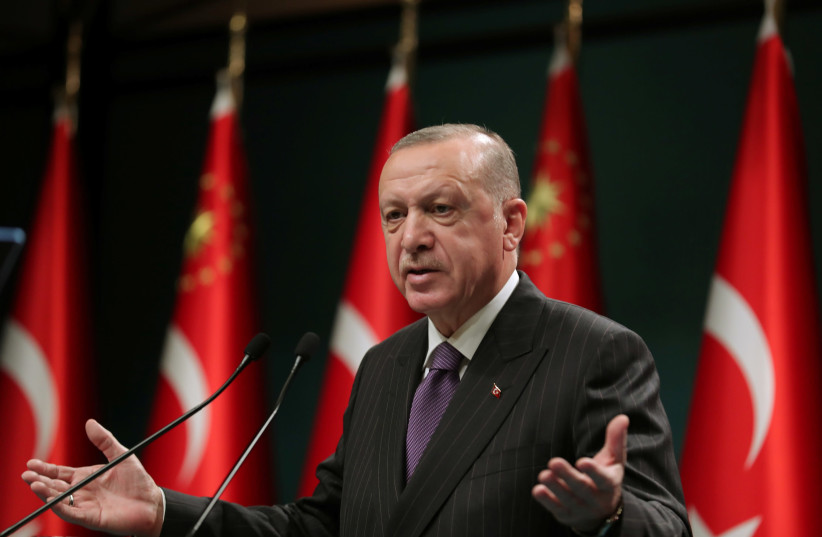
Turkey’s leader
Recep Tayyip Erdogan ordered ambassadors from 10 leading democracies to be declared “persona non grata,” cementing Ankara’s shift toward authoritarianism and alliance with countries that oppose the US and the West.
The attack was made by Ankara after the US and other countries had critiqued Turkey for continuing to imprison philanthropist
Osman Kavala.
Kavala is one of tens of thousands of Turkish people who have been imprisoned on false charges by Ankara as part of a purge led by the ruling AKP party that targets liberals, college students, LGBT activists, Kurds, opposition members of the HDP, women, media and critics of all stripes.
Recently Ankara’s government has gone back to 2013 and 2014 to find activists involved in any protests against the AKP and imprison them. Turkey is the world’s larger jailor of journalists. Despite being a member of NATO, Turkey has routinely crushed the media, bulldozed Turkish neighborhoods in cities as part of claims it is fighting “terrorism” and has launched invasions of Syria, ethnically cleansing Kurds, Yazidis and other minorities.
The envoys from a number of key democracies have put a spotlight on the Kavala case as an egregious miscarriage of justice. Turkey has now threatened to expel ambassadors from the US, Germany, France, the Netherlands, Canada, Denmark, Sweden, Finland, Norway and New Zealand.
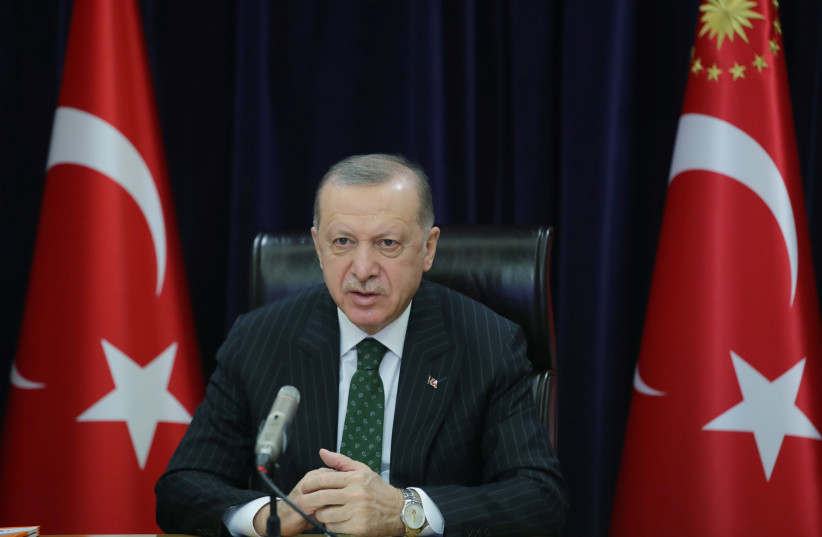 Turkish President Tayyip Erdogan attends a meeting of his ruling AK Party via video link in Ankara, Turkey March 4, 2021. (credit: PRESIDENTIAL PRESS OFFICE/HANDOUT VIA REUTERS)
Erdogan said that foreign ambassadors “cannot dare to come to the Turkish foreign ministry and give orders… I gave the necessary order to our foreign minister and said what must be done: these 10 ambassadors must be declared persona non grata at once.” He also was quoted as saying “they will know and understand Turkey. The day they do not know and understand Turkey, they will leave.”
This is part of Ankara’s growing extremism. Already a repressive authoritarian state, Ankara has become increasingly hostile to NATO and western countries. It often threatens Greece and has threatened France. In October 2020, last year, Ankara’s incitement against France likely radicalized a terrorist that caused an attack in Nice. The incident came after Ankara’s leaders began to invent new claims of being offended by France’s Charlie Hebdo magazine.
Turkey’s leadership, which backs the Muslim Brotherhood, has tended to use religion as a unifier and as a weapon. It has sought to encourage Turkish society to become more Islamist and see “Islamic” causes as their own, whether that means Ankara meddling in Kashmir, or trying to pretend it supports the Palestinians. Turkey has hosted Hamas officials several times, leading to condemnation from the US, and reports two years said that Hamas had planned attacks from Turkey. Turkey also hosted the Taliban and extremist groups from Syria.
The support for extremists is part of Ankara’s shift toward authoritarianism. In Syria, Turkey not only ethnically cleansed Afrin in 2018, expelling 150,000 Kurds and Yazidis, in October 2019, it threatened the US in Syria and invaded an area where the US-backed Syrian Democratic Forces were present.
Turkish-backed extremists from Ahrar al-Sharqiya, who have now been sanctioned by Washington, murdered democracy activist Hevrin Khalaf, an unarmed young woman. Turkish media called her a “terrorist” and said she was “neutralized.” Turkey has also incited against US official Brett McGurk and accused the US of training “terrorists” in Syria. In recent months Turkey has increased its drone strikes, targeting SDF and other people in northern Syria and also in the Yazidi region of Sinjar in Iraq.
Turkey also provides weapons to Syrian groups it backs in northern Syria and encourages them to shell Tel Tamr, an area held by the SDF and also an area with a Christian community. As such Turkey destabilized minority groups throughout northern Syria in areas once threatened by ISIS, now threatened by Ankara.
In the meantime, Ankara has grown closer to Russia, China and Iran. It seeks more arms sales with Russia and wants an alliance of more authoritarian countries such as Malaysia, Pakistan, the Taliban in Afghanistan and Qatar.
Turkey has dialed back some of its more extreme incitement against Israel since 2020. This is largely because Trump, a key ally of Erdogan, left office. When Trump left several US diplomats who were pro-Turkey’s AKP also left. This meant Turkey needed to work toward reconciliation after several years of having a blank check for authoritarianism when Erdogan worked closely with the Trump White House. Turkey sought outreach to Egypt and the Gulf states, sensing that Egypt, the Gulf and Greece were growing closer with Israel and all of these countries had tired of Turkey’s aggressive behavior and threats. For instance, during the Abraham Accords, it was Turkey that threatened to cut relations with Israel.
In recent days the incitement against Israel has returned as Ankara claimed it had detained “Mossad” members. This comes more than a year after Ankara had claimed it would “liberate Al-Aqsa,” a reference to the Islamic mosque in Jerusalem. Pro-AKP media in Turkey have claimed that Ankara is now expelling foreign ambassadors to stop them meddling in Turkey.
It should be noted that while Ankara has sought to expel and harass ambassadors from leading democracies, Israel is hosting many of those countries this week as part of the Blue Flag air force drill. Air forces from the US, Germany, Italy, the UK, France, India and Greece are in Israel. The US, Germany and France are among the countries Turkey is threatening now. Sweden also had a high level visit to Israel recently. Germany’s outgoing leader Angela Merkel was in Turkey recently, an exception in Europe in relations with Erdogan she has appeared to support Turkey’s authoritarian ruler. But she is leaving office and Germany is one of the countries Turkey has slammed despite her recent trip.
Ankara’s overall posture puts it increasingly at odds with democracy and Europe. It tends to use its far-right media and speeches of its ruling party to bash Europe. Europe and the US is seen as the enemy in Turkey, while Russia, Qatar, China, Iran, Pakistan, Malaysia, Azerbaijan and other states are seen as allies and friends. Groups like the Taliban and Hamas get a welcome in Ankara that is never afforded to western democracies. This is symbolic of Ankara’s shift toward extremism. The country increasingly employs poor Syrian refugees as mercenaries.
Although some argue that this is just another rant by Erdogan and is a threat designed to get some concessions, the affect is that Turkey’s currency is once again weakening and that will harm the middle class and especially those more open-minded Turkish voters who are linked to Europe, while increasing poverty and dependence on the government. The ruling party is wagering that this helps cement it in power.
Turkey has also threatened a new conflict in Syria if this doesn’t do enough to increase populism. Increasingly Ankara’s ruling party increases tensions with NATO, the West and the US every time it wants votes, positioning itself as one of the leading anti-western countries.
Even Iran, Russia and China don’t have the same levels of extreme rhetoric. Oddly, Turkey remains a NATO member despite these incidents.