IDF mum on alleged strikes on observation posts; no casualties reported; apparent attack comes after Putin said to tell Bennett Russia won’t hamper Israeli action

Israeli helicopters hit three targets in Syria near the border in the early hours of Monday, Syrian media reported.
According to the reports, the missiles struck targets connected to the Hezbollah terror group on the outskirts of the town of al-Baath as well as other locations in southern Syria.
The three sites were all reportedly connected to Hezbollah’s so-called Golan File, its efforts to establish a front along the Golan border from which it can carry out attacks against Israel.
According to Syrian media, two of the sites were observation posts used by the Lebanese terror group, while the third target was a site just next to a Syrian military facility that Israel has long claimed was working with Hezbollah.
The Syrian Observatory for Human Rights, a pro-Syrian opposition organization of unclear funding, said the strikes caused “material damage,” but there was no immediate word on casualties.
There was no comment from the Israel Defense Forces, in line with its policy of only publicly acknowledging strikes that are in response to attacks from Syria.
Israel has carried out hundreds of airstrikes inside Syria over the course of the country’s civil war, targeting what it says are suspected arms shipments believed to be bound for Lebanon’s Iran-backed Hezbollah terror group, which is fighting alongside Syrian government forces.
Israel has also reportedly carried out several strikes along the border targeting Hezbollah and Iranian efforts to entrench themselves in the country, most recently an alleged sniper attack last week that targeted a Syrian intelligence agent.
Midhat as-Saleh, a well-known figure in Syria, was fatally shot in Ain Eltinah, a village along the Israeli border in the Golan Heights where he ran a Syrian government office. Syria said he was killed by Israeli sniper fire, but the Israeli military and other officials declined to comment on the charge.
Hebrew media reports claimed as-Saleh had been assisting the Iranian military presence near the border. If the claims are confirmed, it would mark the first time that Israeli snipers are known to have killed someone identified as an Iranian-linked target across the border.
The alleged attack in al-Baath comes days after Israel said it received a green light from Russian President Vladimir Putin to keep up its airstrikes in Syria.
Prime Minister Naftali Bennett and Putin agreed during a meeting in Sochi on Friday that the two nations would continue to implement the so-called deconfliction mechanism that works to prevent Israeli and Russian forces from clashing in Syria, a senior Israeli official said.
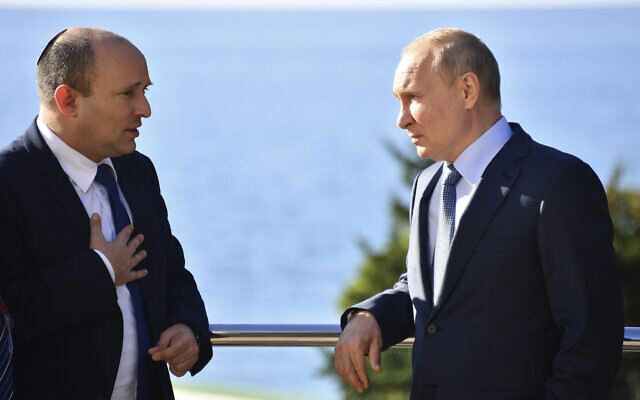
“The prime minister presented his world view on ways to stop Iran’s nuclear drive and Iran’s entrenchment in Syria,” he said in a statement. “It was decided to keep policies vis-à-vis Russia in place (regarding airstrikes in Syrian territory,)” said Housing Minister Ze’ev Elkin, who accompanied Bennett to act as a translator and adviser.
Russia is a close ally of Syria’s Bashar Assad, has forces based and operating in Syria, and also provides Syria with its air defenses that try and shoot down Israeli jets and missiles.